
Ever wondered how scientists figure out how the world works?...
 Science3 görüntüleme·Güncellendi Jun 6, 2026·7 sayfa
Exploring the Scientific Method: Steps and Applications

1 / 7
1
of 7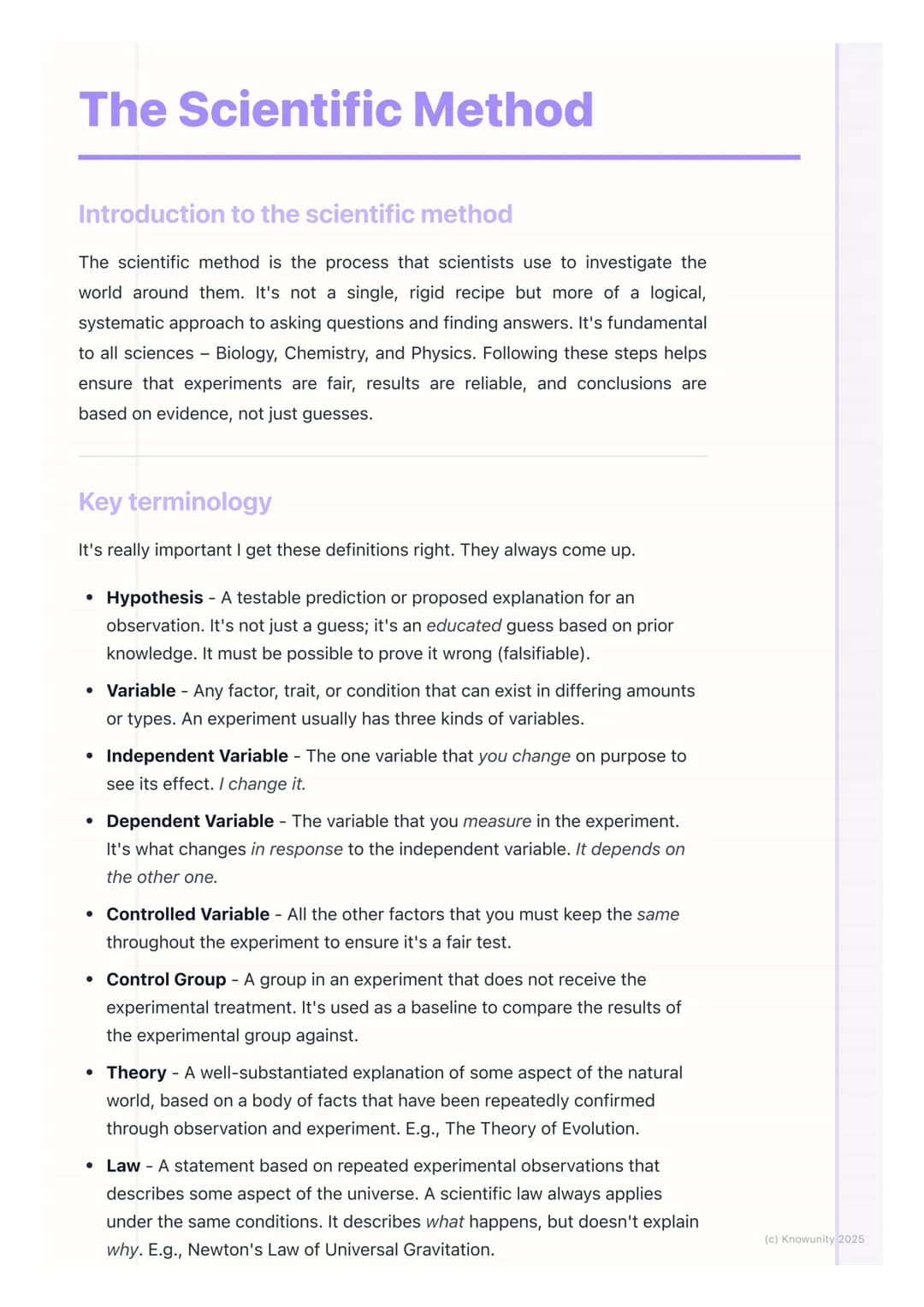
The Scientific Method Basics
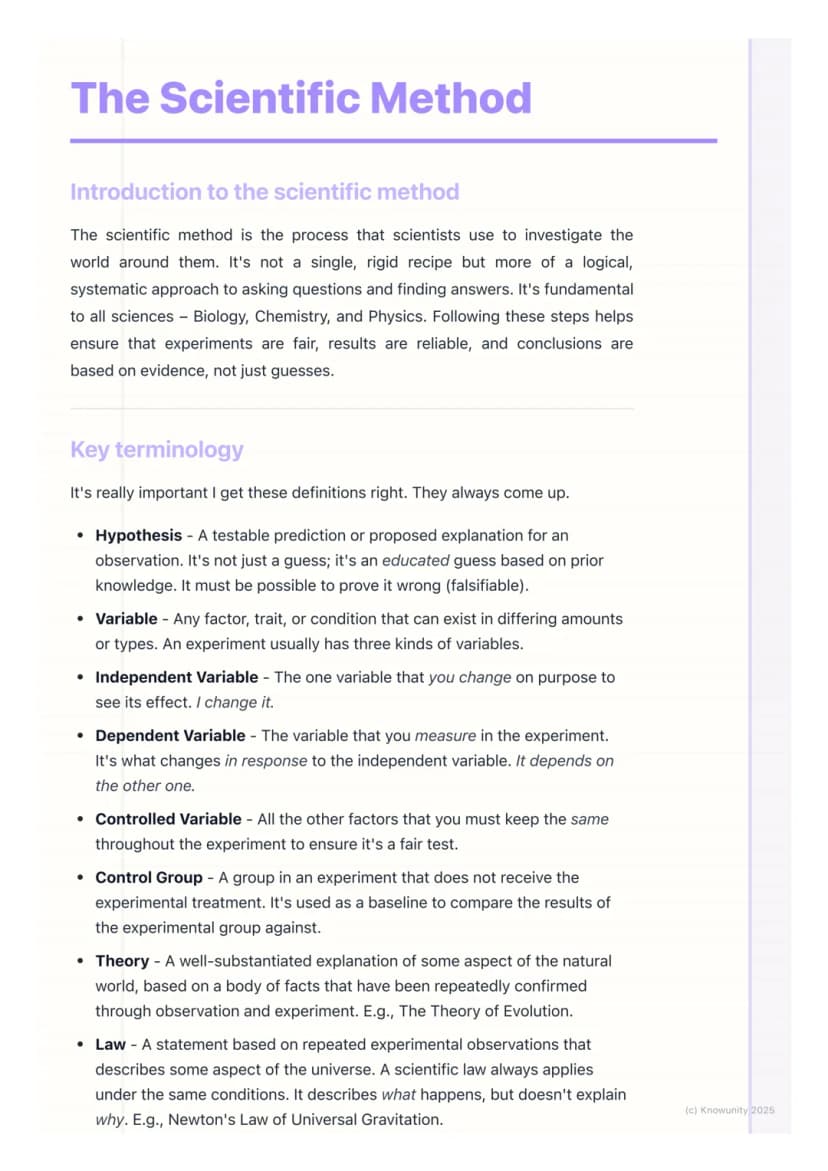
The scientific method isn't some rigid set of rules - it's more like a logical way of asking questions and finding reliable answers. Scientists use this approach in Biology, Chemistry, and Physics to make sure their experiments are fair and their results actually mean something.
Think of it as detective work for science. Instead of just guessing why something happens, scientists follow specific steps to gather evidence and draw conclusions. This systematic approach helps separate facts from opinions and ensures that scientific discoveries are based on solid proof, not just hunches.
Key Point: The scientific method helps ensure experiments are fair, results are reliable, and conclusions are based on evidence rather than guesses.
2
of 7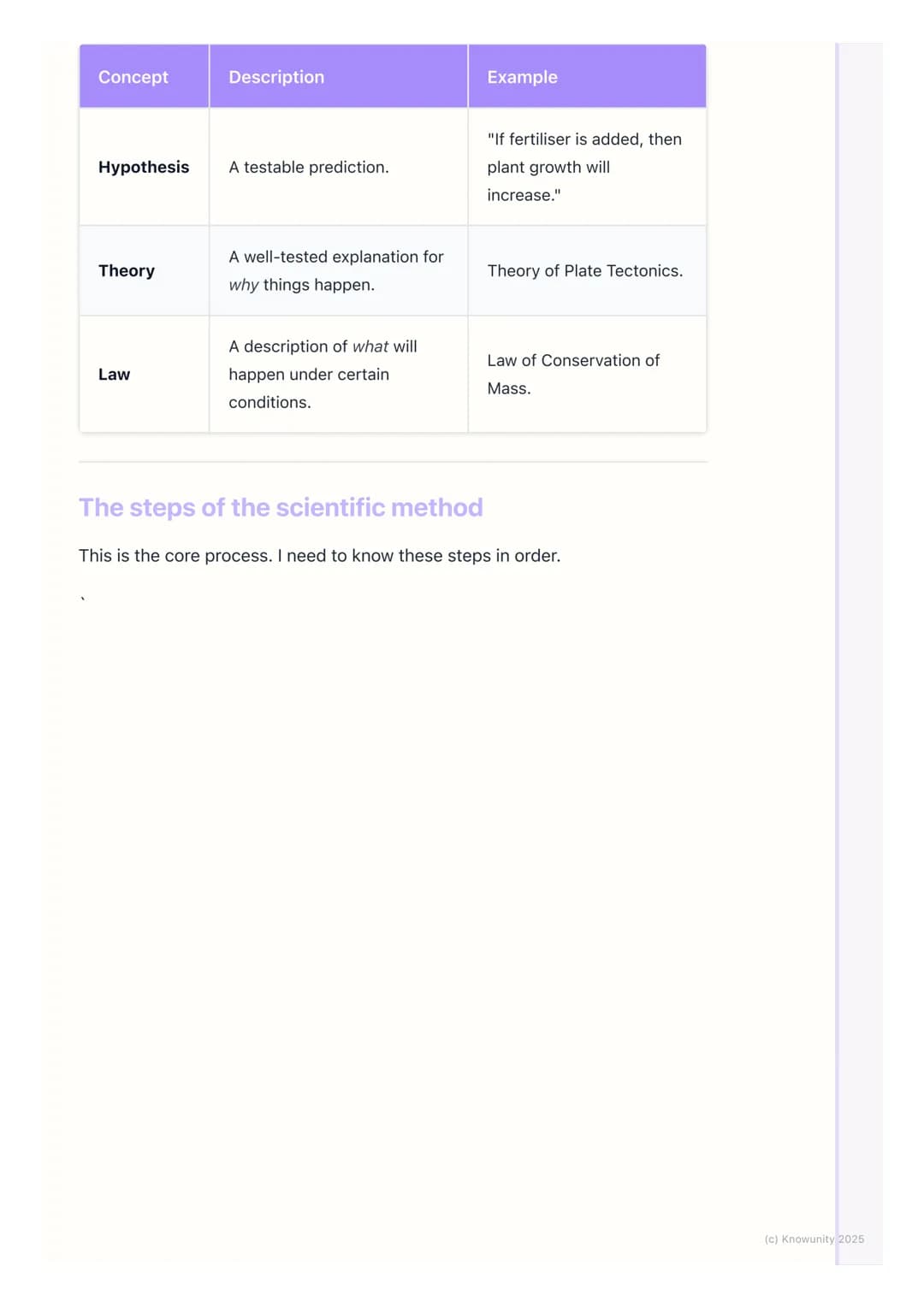
Essential Scientific Terms You Need to Know
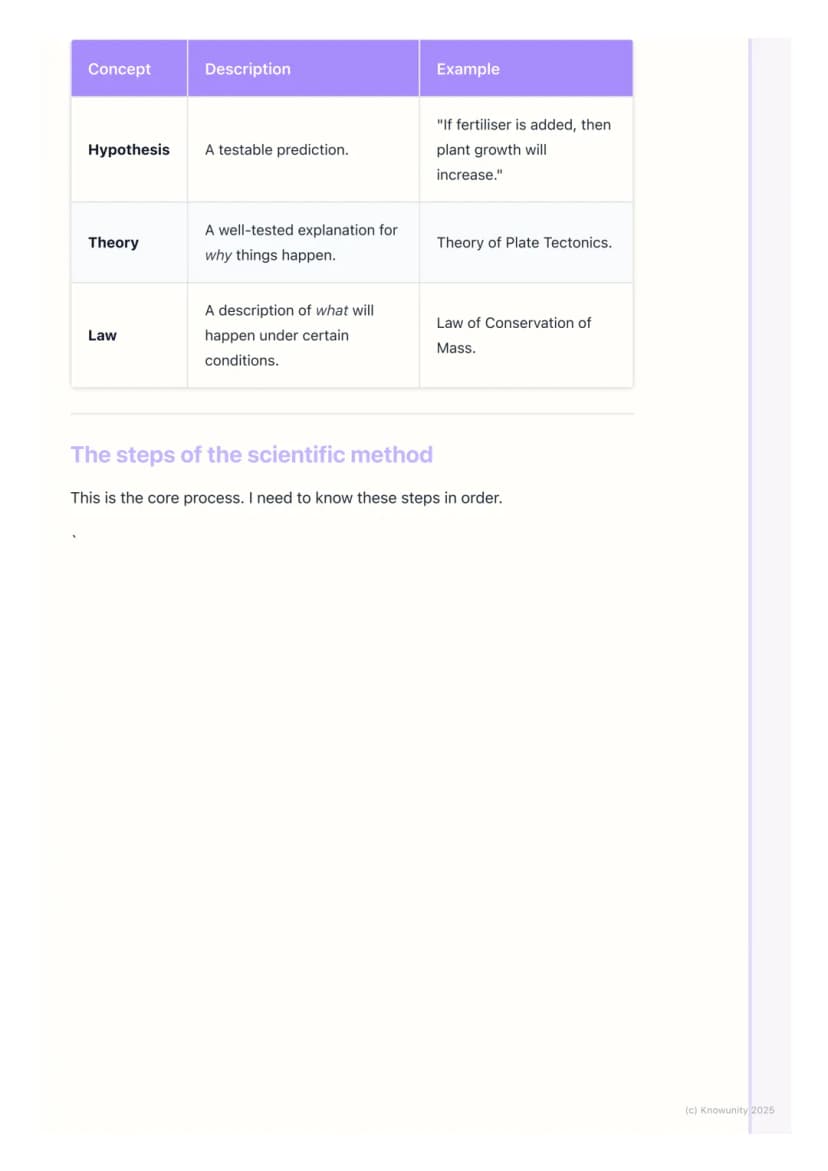
Let's sort out the key vocabulary that always pops up in exams. A hypothesis is your educated guess about what might happen - but it has to be testable. Think "If I do X, then Y will happen."
Variables are the different factors in your experiment. The independent variable is what you deliberately change (like adding fertiliser), the dependent variable is what you measure as a result (like plant height), and controlled variables are everything else you keep exactly the same to make it fair.
Here's where students often get confused: a theory (like Evolution) is a well-tested explanation backed by loads of evidence, whilst a law (like gravity) simply describes what happens without explaining why. A control group gets no treatment - it's your baseline for comparison.
Remember: A hypothesis must be falsifiable - there must be a way to prove it wrong through experimentation.
3
of 7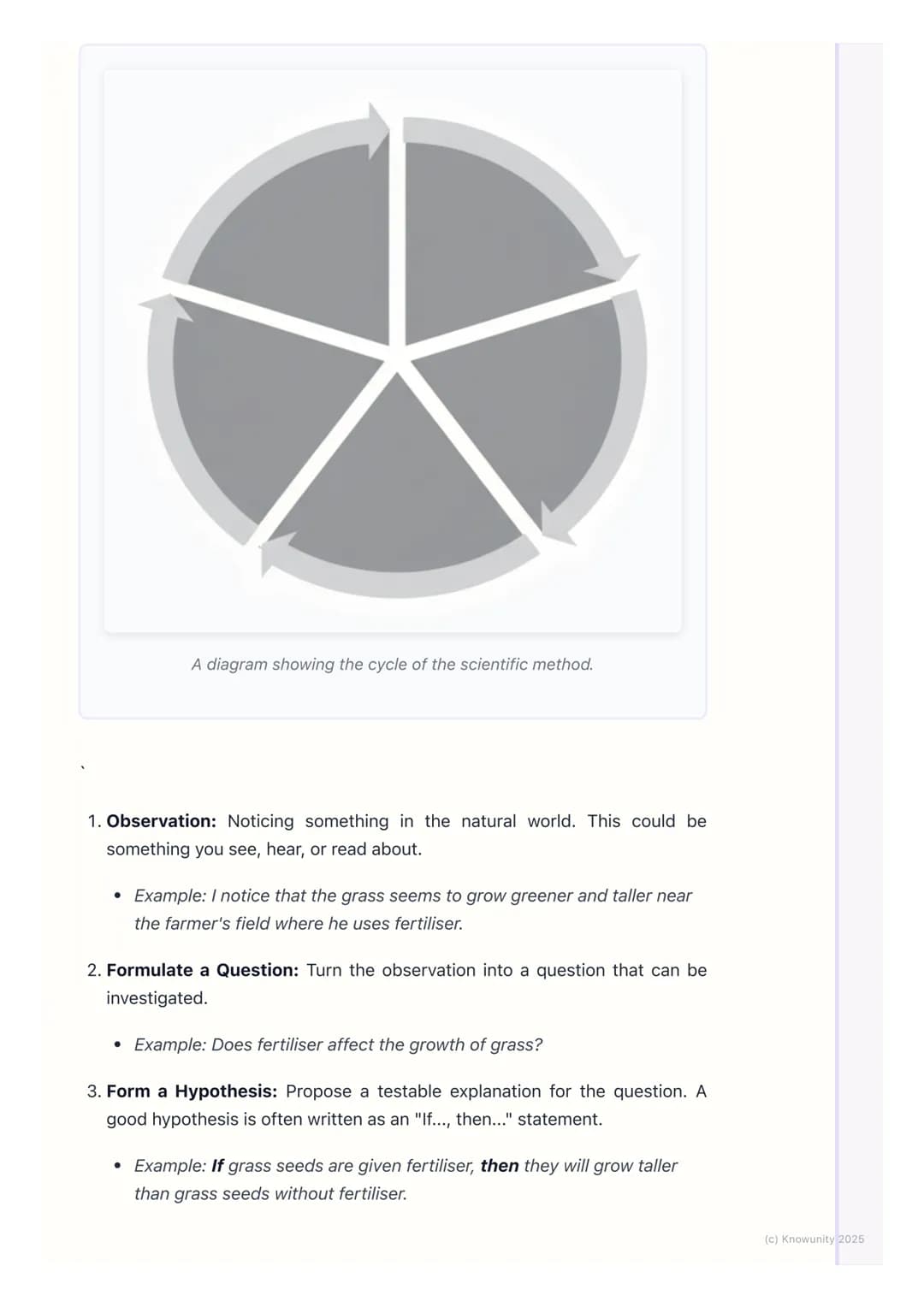
The Seven Steps in Action
The scientific method follows a logical sequence that starts with simple observation. You notice something interesting in the world around you - maybe grass grows better near a farmer's field.
Next, you formulate a question that can actually be investigated: "Does fertiliser affect grass growth?" Then comes your hypothesis - your testable prediction written as an "If... then..." statement: "If grass gets fertiliser, then it will grow taller than grass without fertiliser."
This systematic approach ensures you're not just randomly experimenting but following a logical path from curiosity to evidence-based conclusions.
Pro Tip: Good hypotheses are specific, measurable, and written in "If... then..." format to make testing straightforward.
4
of 7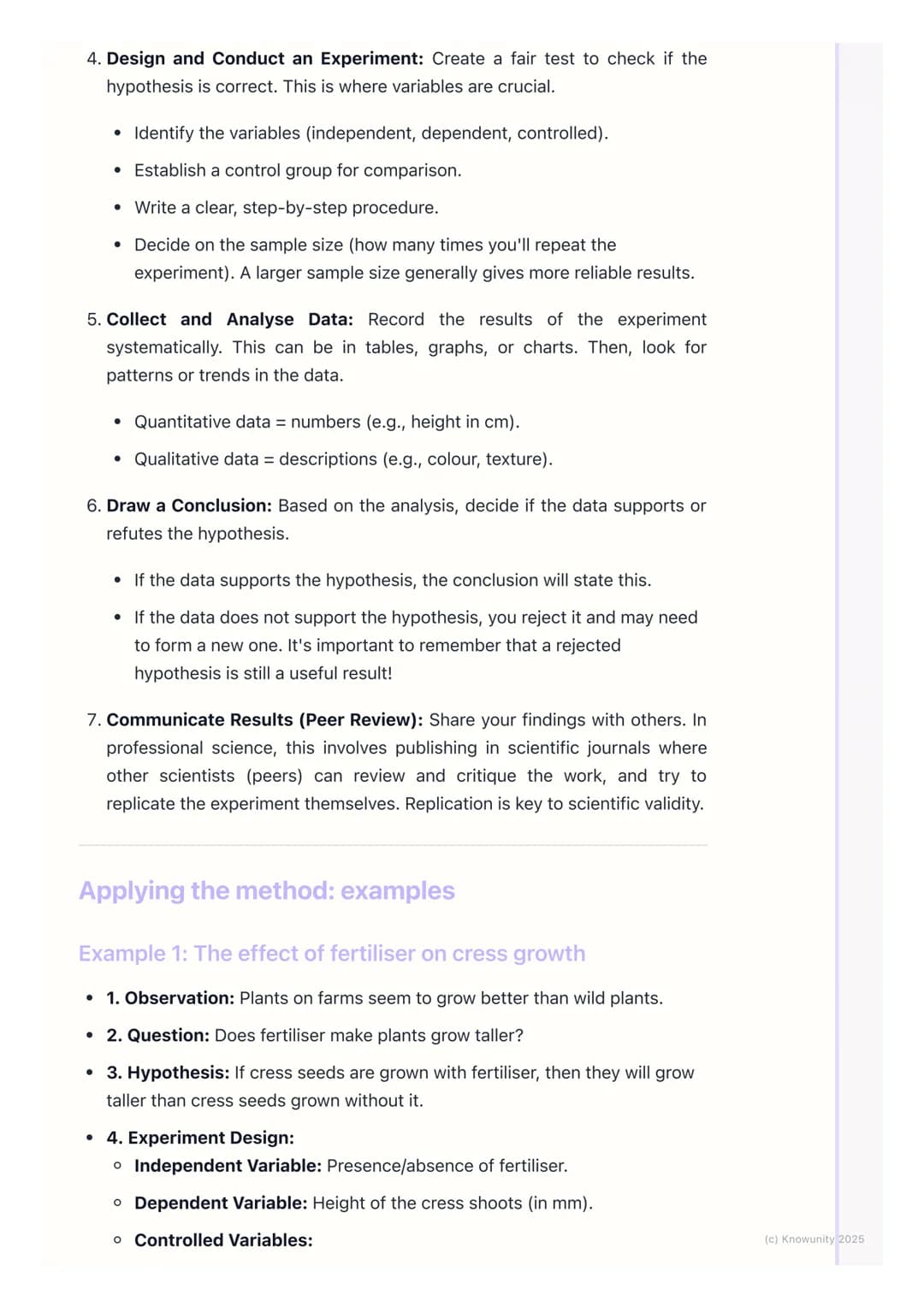
Designing and Conducting Fair Experiments
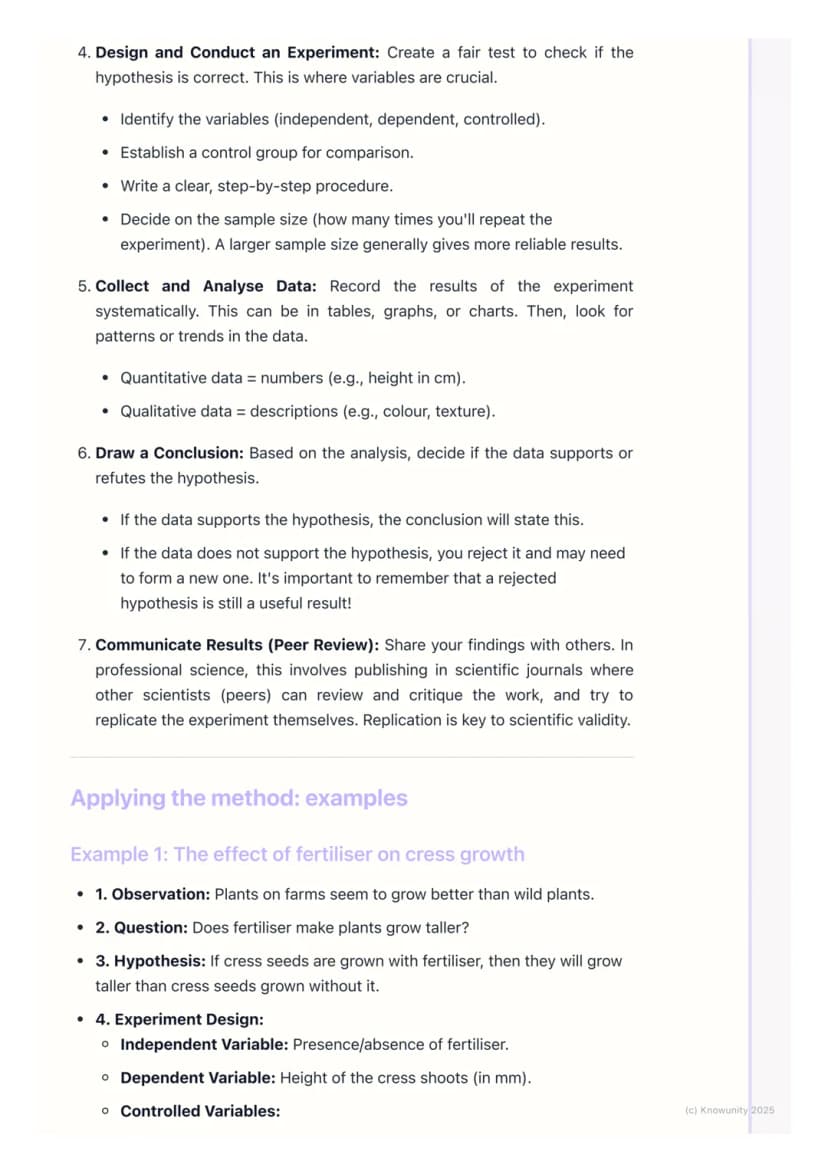
Now for the practical bit - designing your experiment. You need to identify your variables clearly, set up a control group for comparison, and write a step-by-step procedure that someone else could follow exactly.
Sample size matters here - testing one plant won't give reliable results, but testing 50 plants and averaging the results will. The bigger your sample, the more trustworthy your conclusions become.
When you collect and analyse data, you're looking for patterns. Quantitative data gives you numbers (height in cm), whilst qualitative data gives you descriptions (colour changes). Both types can be valuable depending on what you're investigating.
Fair Test Rule: Only change ONE variable at a time - if you change light AND fertiliser, you won't know which one caused the effect!
5
of 7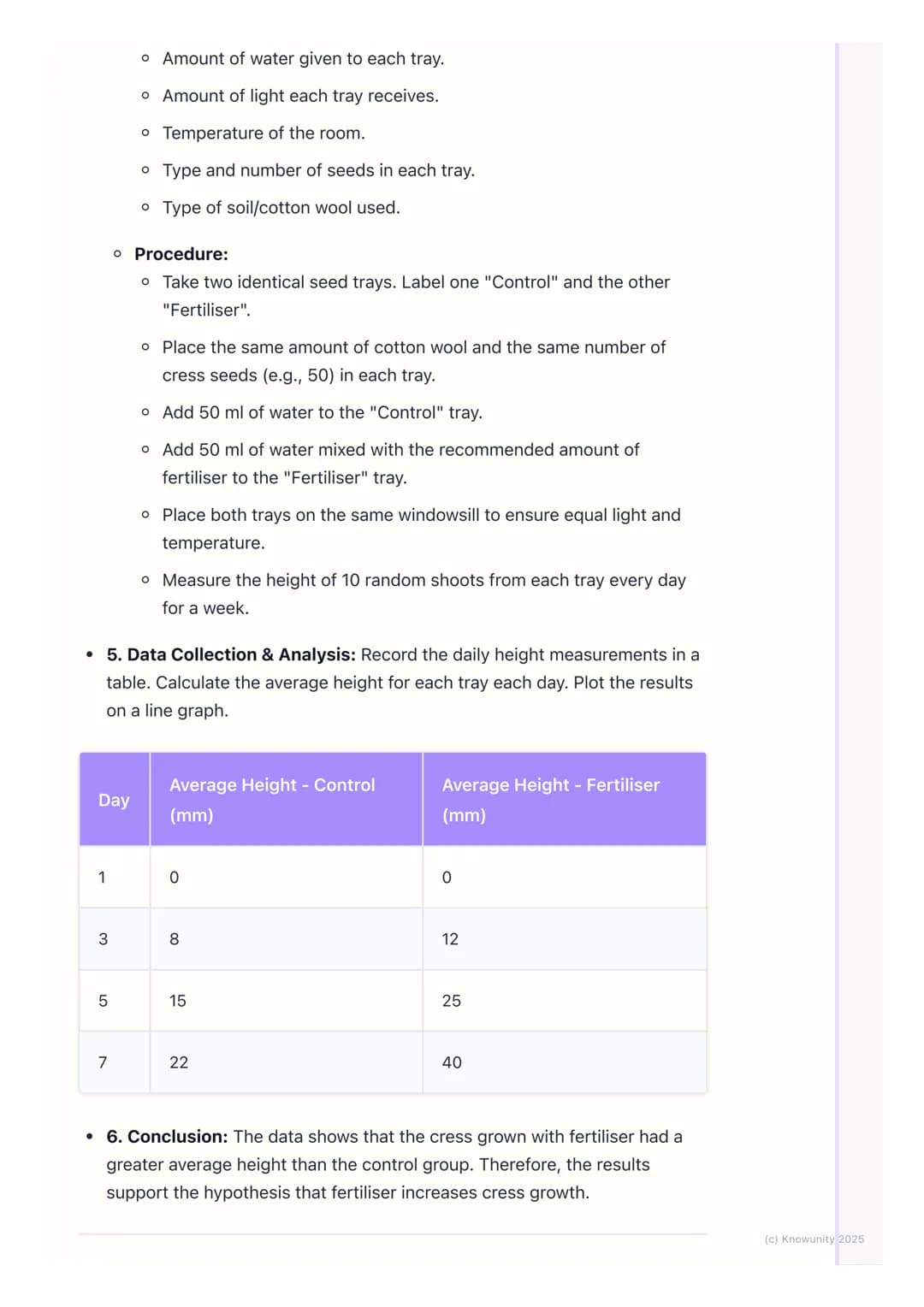
Drawing Conclusions and Real Examples
After analysing your data, it's time to draw conclusions. If your results support your hypothesis, brilliant! If they don't, that's still valuable - you've learned something important and can form a new hypothesis.
The final step is communicating your results through peer review, where other scientists can check your work and try to replicate your experiment. Replication is crucial in science.
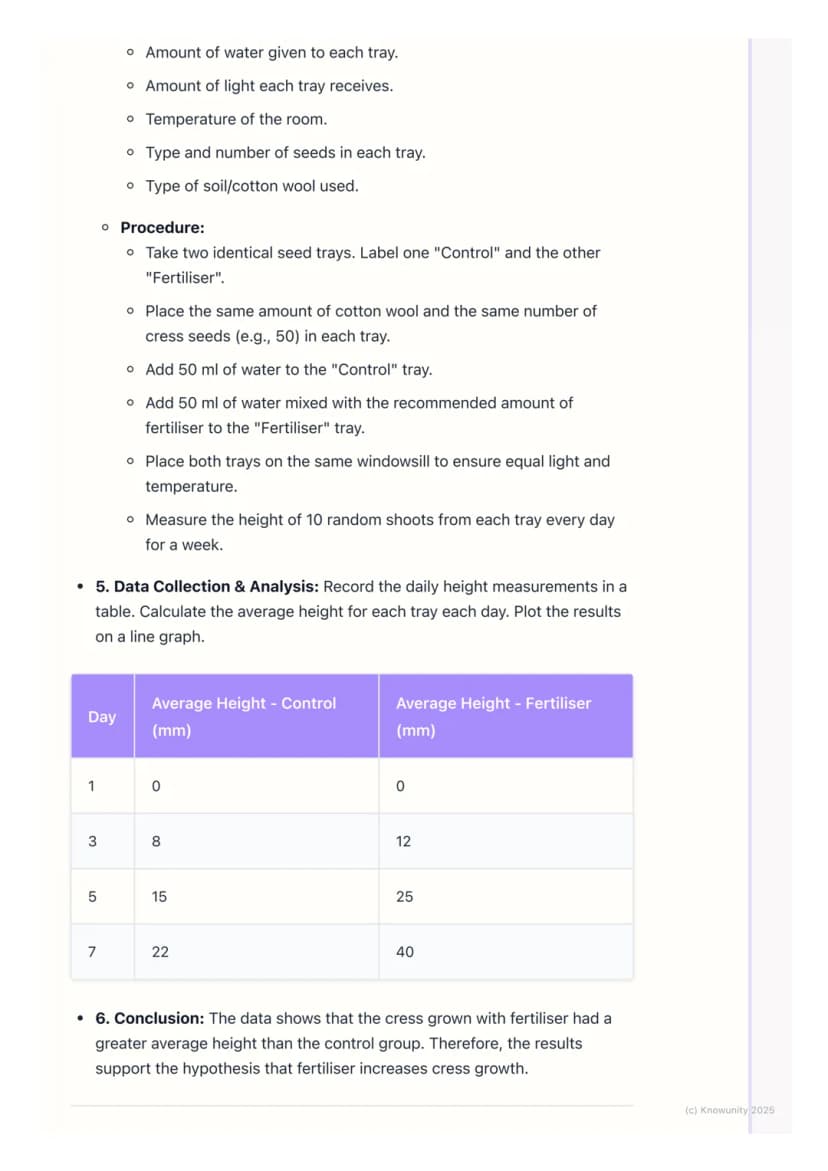
Here's a practical example: testing fertiliser on cress. You'd have two identical trays - one control (water only) and one experimental . Keep everything else the same: same light, temperature, soil, and number of seeds. Measure growth daily and compare the averages.
Key Insight: A rejected hypothesis is still a useful result - it eliminates one possibility and guides future investigations.
6
of 7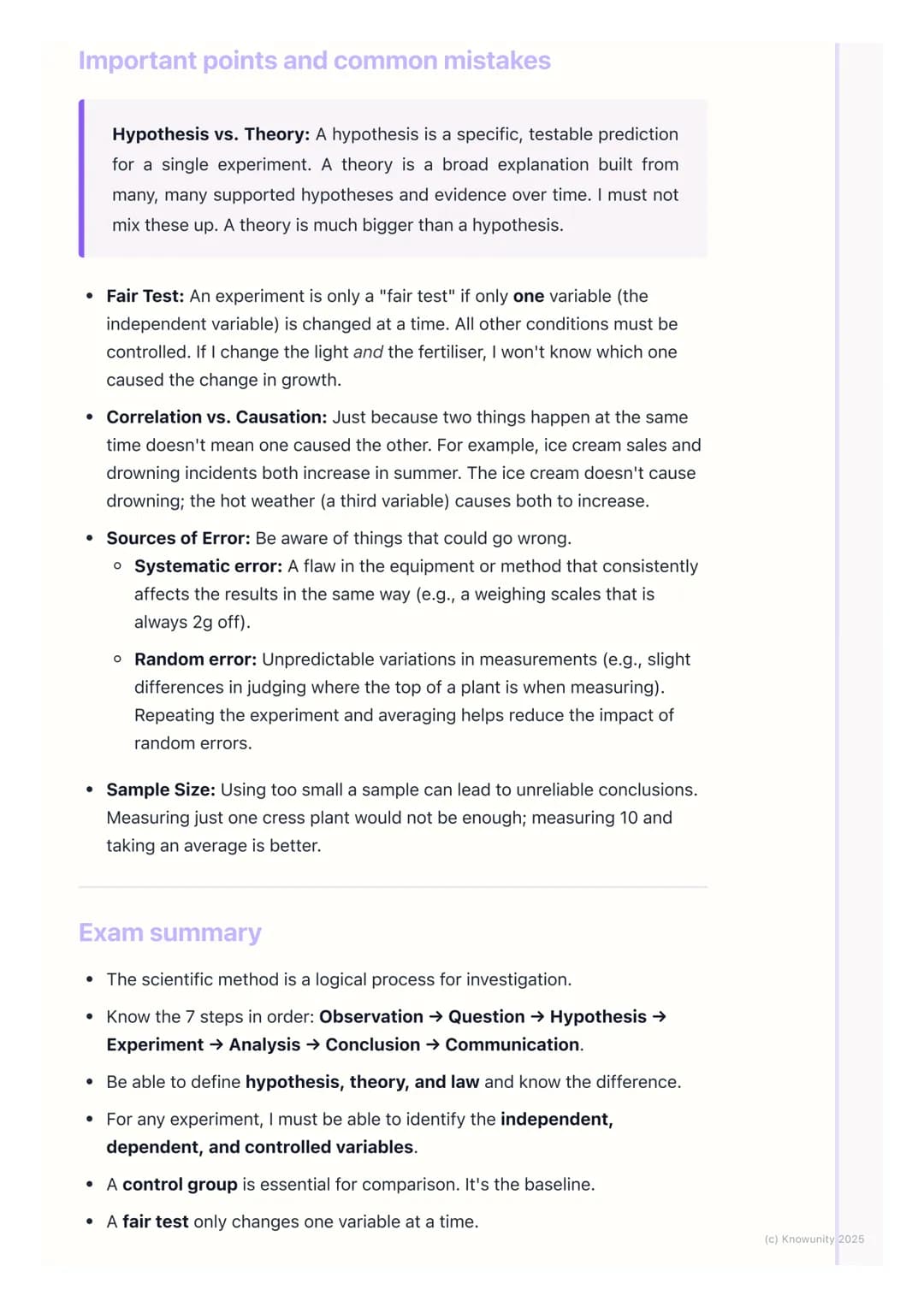
Common Mistakes and Important Distinctions
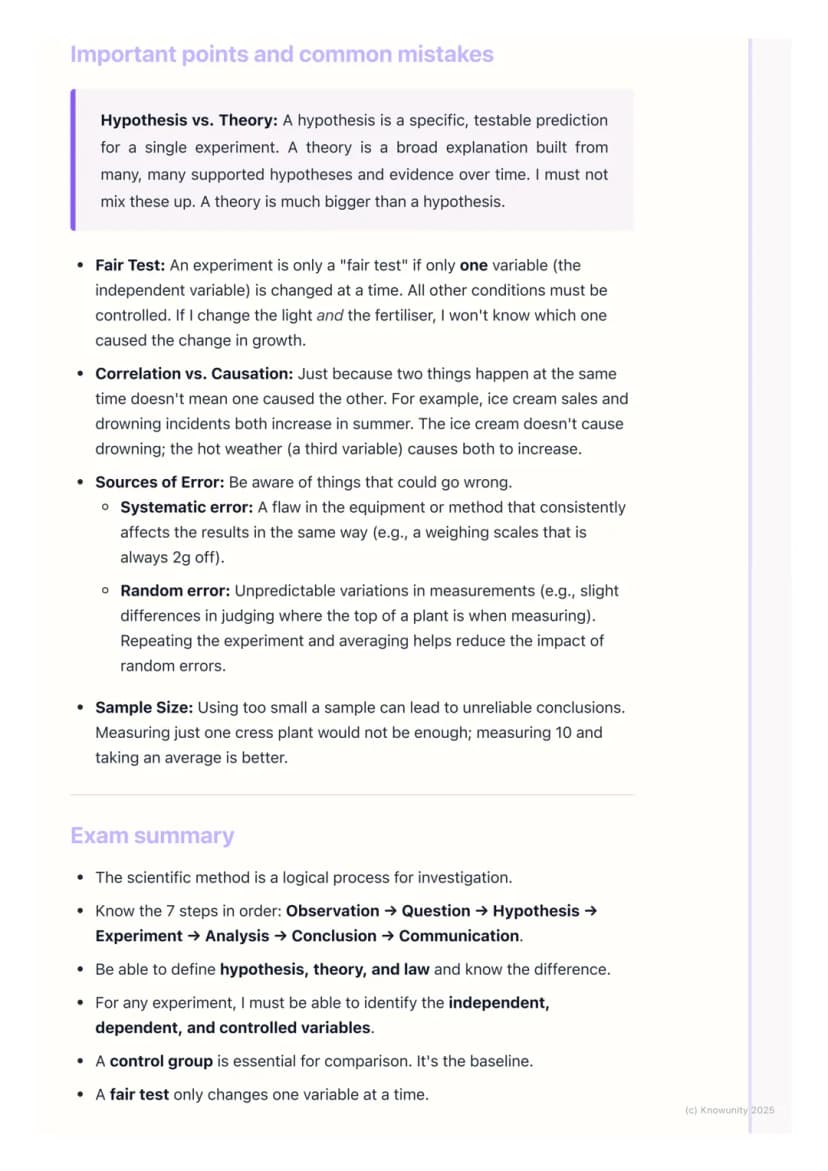
Don't mix up correlation and causation - just because ice cream sales and drowning both increase in summer doesn't mean ice cream causes drowning! Hot weather causes both increases.
Systematic errors happen when your equipment is consistently wrong (like scales that are always 2g off), whilst random errors are unpredictable variations. Repeating experiments and averaging results helps reduce random errors.
Remember the hierarchy: hypothesis → theory → law. A hypothesis is a single testable prediction, a theory is a broad explanation built from many supported hypotheses over time, and a law describes what happens without explaining why.
Exam Success: Always identify independent, dependent, and controlled variables in any experiment question - this is guaranteed to come up!
7
of 7
Exam Summary Points
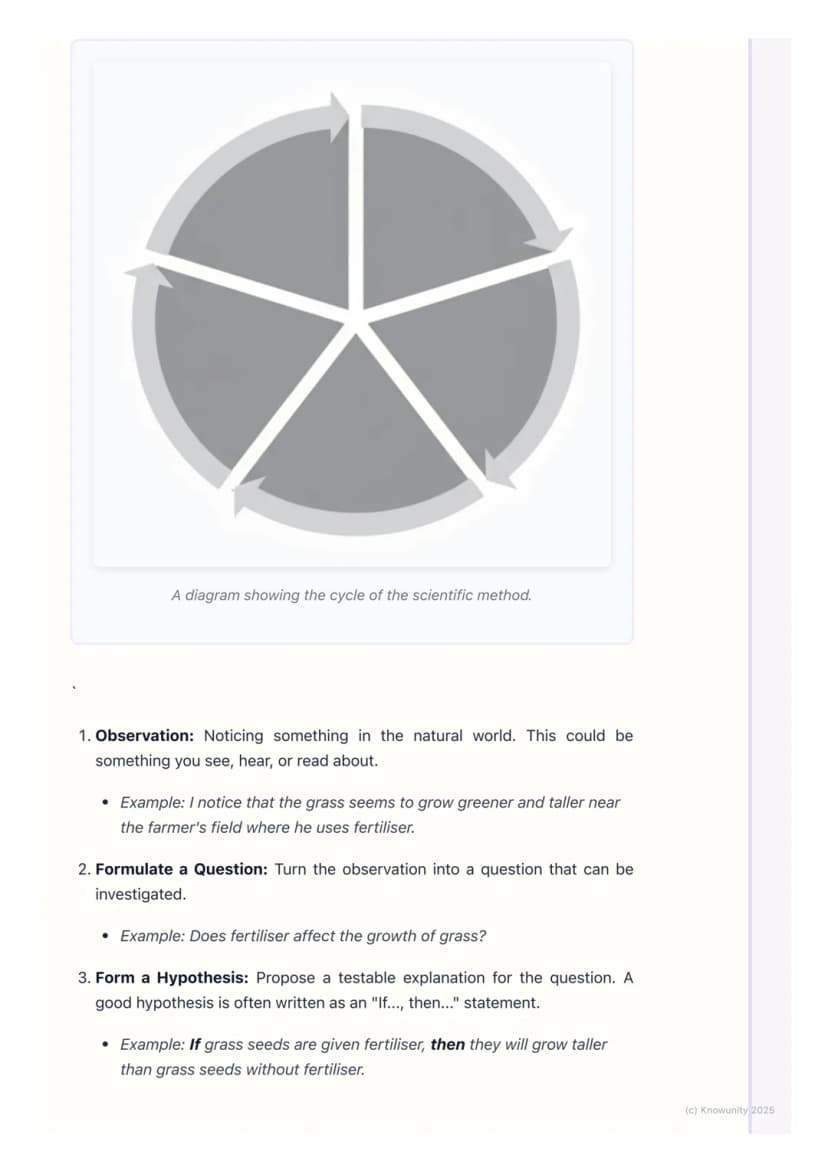
For your exams, nail down these essentials: know the seven steps in order (Observation → Question → Hypothesis → Experiment → Analysis → Conclusion → Communication), and be able to spot variables in any experimental setup.
Remember that control groups are your baseline for comparison, fair tests only change one variable at a time, and conclusions must stick strictly to the evidence you've collected. Replication by other scientists is what makes results trustworthy in the scientific community.
The scientific method isn't just academic theory - it's the foundation of how we understand everything from medicine to climate change. Master these concepts and you'll have the tools to think like a scientist.
Final Tip: Practice identifying variables in different scenarios - this skill transfers across all science subjects and exam questions.
Hiç sormayacaksın sanmıştık...
Knowunity yapay zeka arkadaşı nedir?
Yapay zeka arkadaşımız öğrencilerin ihtiyaçlarına göre özel olarak tasarlanmıştır. Platformda bulunan milyonlarca içeriğe dayanarak öğrencilere gerçekten anlamlı ve ilgili yanıtlar verebiliyoruz. Ancak mesele sadece cevaplar değil, refakatçi aynı zamanda kişiselleştirilmiş öğrenme planları, sınavlar veya sohbet içerikleri ve öğrencilerin becerilerine ve gelişimlerine dayalı %100 kişiselleştirme ile öğrencilere günlük öğrenme zorluklarında rehberlik ediyor.
Knowunity uygulamasını nereden indirebilirim?
Uygulamayı Google Play Store ve Apple App Store'dan indirebilirsiniz.
Knowunity ücretsiz mi?
Knowunity uygulaması ücretsiz! Uygulamamız çok yakında indirmeye hazır olacak, bekle bizi. 💙
Science dersinin en popüler içerikleri
7ScienceScience/Physics notes - Speed, density, work
Speed density work formulas
3rd Year81
ScienceAtomic Structure and the Periodic Table
Students will learn about the structure of atoms, including protons, neutrons, and electrons, and how elements are organised and classified in the Periodic Table based on their electronic configuration and chemical properties.
5th Year41
ScienceHuman Body Systems
An introduction to major human body systems such as the digestive, circulatory, respiratory, and nervous systems, understanding their basic functions.
2nd Year131
ScienceJunior Cert Science Notes: The Cell
Notes on the Cell
3rd Year261
ScienceCells
Junior cert science cells summary
1st Year611
ScienceHuman Reproductive System
A basic overview of the male and female reproductive systems, including their main structures and functions.
TY191
ScienceLight and Optics
Exploring the properties of light, including how it travels, reflects, and refracts, and how we perceive colours.
2nd Year50
En popüler içerikler
9 Irish
IrishIrish oral questions and answers
Questions and answers for the leaving cert oral
5th Year4264
 English
Key Quotes : Sive
Key Quotes and explanations: Sive
6th Year2842
IrishIrish oral questions
Outline of oral questions
5th Year2055
IrishIníon- le hÁine Durkin
Aine Durkin’s poem, Iníon: Themes & summary
5th Year890
IrishIrish poetry 2027
Iníon + Dínit an Bhróin
5th Year1153
IrishLC HL notes- Iníon (poem)
Includes poem in English and Irish, theme, key words & phrases
5th Year2304
EnglishCultural Context : Shawshank Redemption : Sive : Small Things Like These
Comparative Study : Cultural Context : Shawshank Redemption, Sive and Small Things Like These
6th Year1430
IrishMo Ghrá-sa (Idir Lúibíní)
Notes on mo ghrá-sa
5th Year380
IrishAn Gaeilge Aiste
Irish Language essay
6th Year1320
Aradığını bulamıyor musun? Diğer derslere göz at.
Kullanıcılarımızdan yorumlar. Onlar her şeyi çok beğendi — sen de beğeneceksin.
4.6/5App Store
4.7/5Google Play
Uygulama çok kolay kullanılıyor ve güzel tasarlanmış. Şu ana kadar aradığım her şeyi buldum ve sunumlardan çok şey öğrendim! Kesinlikle ödevlerim için hep kullanacağım!
A.S.iOS kullanıcısı
Uygulama çok iyi. Çok fazla ders notu ve yardımlaşma var. Örneğin benim problem yaşadığım bir ders Geometriydi ve ANINDA yardım ettiler beraber hem sorularımı çözdük hem konu anlatımı buldum. Herkese tavsiye ederim.
S.L.Android kullanıcısı
BEN ŞOK. Reklamını sık sık gördüğüm için uygulamayı denedim ve gerçekten hayran kaldım. Bu uygulama okul için tam ihtiyacım olan şey. Anında ödev yardımı, konu anlatımı, örnek sınavlar, flaşkartlar hepsi hepsi var, şiddetle tavsiye ederim ✅
A.iOS kullanıcısı
Science3 görüntüleme·Güncellendi Jun 6, 2026·7 sayfaExploring the Scientific Method: Steps and Applications
Ever wondered how scientists figure out how the world works? The scientific method is basically a step-by-step recipe that scientists use to investigate everything around us - and it's not as complicated as you might think!
1
of 7
Ders notlarını görmek için kaydol. Ücretsiz!
- Tüm belgeleri görebilirsin
- Notlarını Yükselt
- Milyonlarca öğrenciye katıl
The Scientific Method Basics
The scientific method isn't some rigid set of rules - it's more like a logical way of asking questions and finding reliable answers. Scientists use this approach in Biology, Chemistry, and Physics to make sure their experiments are fair and their results actually mean something.
Think of it as detective work for science. Instead of just guessing why something happens, scientists follow specific steps to gather evidence and draw conclusions. This systematic approach helps separate facts from opinions and ensures that scientific discoveries are based on solid proof, not just hunches.
Key Point: The scientific method helps ensure experiments are fair, results are reliable, and conclusions are based on evidence rather than guesses.
2
of 7Ders notlarını görmek için kaydol. Ücretsiz!
- Tüm belgeleri görebilirsin
- Notlarını Yükselt
- Milyonlarca öğrenciye katıl
Essential Scientific Terms You Need to Know
Let's sort out the key vocabulary that always pops up in exams. A hypothesis is your educated guess about what might happen - but it has to be testable. Think "If I do X, then Y will happen."
Variables are the different factors in your experiment. The independent variable is what you deliberately change (like adding fertiliser), the dependent variable is what you measure as a result (like plant height), and controlled variables are everything else you keep exactly the same to make it fair.
Here's where students often get confused: a theory (like Evolution) is a well-tested explanation backed by loads of evidence, whilst a law (like gravity) simply describes what happens without explaining why. A control group gets no treatment - it's your baseline for comparison.
Remember: A hypothesis must be falsifiable - there must be a way to prove it wrong through experimentation.
3
of 7Ders notlarını görmek için kaydol. Ücretsiz!
- Tüm belgeleri görebilirsin
- Notlarını Yükselt
- Milyonlarca öğrenciye katıl
The Seven Steps in Action
The scientific method follows a logical sequence that starts with simple observation. You notice something interesting in the world around you - maybe grass grows better near a farmer's field.
Next, you formulate a question that can actually be investigated: "Does fertiliser affect grass growth?" Then comes your hypothesis - your testable prediction written as an "If... then..." statement: "If grass gets fertiliser, then it will grow taller than grass without fertiliser."
This systematic approach ensures you're not just randomly experimenting but following a logical path from curiosity to evidence-based conclusions.
Pro Tip: Good hypotheses are specific, measurable, and written in "If... then..." format to make testing straightforward.
4
of 7Ders notlarını görmek için kaydol. Ücretsiz!
- Tüm belgeleri görebilirsin
- Notlarını Yükselt
- Milyonlarca öğrenciye katıl
Designing and Conducting Fair Experiments
Now for the practical bit - designing your experiment. You need to identify your variables clearly, set up a control group for comparison, and write a step-by-step procedure that someone else could follow exactly.
Sample size matters here - testing one plant won't give reliable results, but testing 50 plants and averaging the results will. The bigger your sample, the more trustworthy your conclusions become.
When you collect and analyse data, you're looking for patterns. Quantitative data gives you numbers (height in cm), whilst qualitative data gives you descriptions (colour changes). Both types can be valuable depending on what you're investigating.
Fair Test Rule: Only change ONE variable at a time - if you change light AND fertiliser, you won't know which one caused the effect!
5
of 7Ders notlarını görmek için kaydol. Ücretsiz!
- Tüm belgeleri görebilirsin
- Notlarını Yükselt
- Milyonlarca öğrenciye katıl
Drawing Conclusions and Real Examples
After analysing your data, it's time to draw conclusions. If your results support your hypothesis, brilliant! If they don't, that's still valuable - you've learned something important and can form a new hypothesis.
The final step is communicating your results through peer review, where other scientists can check your work and try to replicate your experiment. Replication is crucial in science.
Here's a practical example: testing fertiliser on cress. You'd have two identical trays - one control (water only) and one experimental . Keep everything else the same: same light, temperature, soil, and number of seeds. Measure growth daily and compare the averages.
Key Insight: A rejected hypothesis is still a useful result - it eliminates one possibility and guides future investigations.
6
of 7Ders notlarını görmek için kaydol. Ücretsiz!
- Tüm belgeleri görebilirsin
- Notlarını Yükselt
- Milyonlarca öğrenciye katıl
Common Mistakes and Important Distinctions
Don't mix up correlation and causation - just because ice cream sales and drowning both increase in summer doesn't mean ice cream causes drowning! Hot weather causes both increases.
Systematic errors happen when your equipment is consistently wrong (like scales that are always 2g off), whilst random errors are unpredictable variations. Repeating experiments and averaging results helps reduce random errors.
Remember the hierarchy: hypothesis → theory → law. A hypothesis is a single testable prediction, a theory is a broad explanation built from many supported hypotheses over time, and a law describes what happens without explaining why.
Exam Success: Always identify independent, dependent, and controlled variables in any experiment question - this is guaranteed to come up!
7
of 7Ders notlarını görmek için kaydol. Ücretsiz!
- Tüm belgeleri görebilirsin
- Notlarını Yükselt
- Milyonlarca öğrenciye katıl
Exam Summary Points
For your exams, nail down these essentials: know the seven steps in order (Observation → Question → Hypothesis → Experiment → Analysis → Conclusion → Communication), and be able to spot variables in any experimental setup.
Remember that control groups are your baseline for comparison, fair tests only change one variable at a time, and conclusions must stick strictly to the evidence you've collected. Replication by other scientists is what makes results trustworthy in the scientific community.
The scientific method isn't just academic theory - it's the foundation of how we understand everything from medicine to climate change. Master these concepts and you'll have the tools to think like a scientist.
Final Tip: Practice identifying variables in different scenarios - this skill transfers across all science subjects and exam questions.
Hiç sormayacaksın sanmıştık...
Knowunity yapay zeka arkadaşı nedir?
Yapay zeka arkadaşımız öğrencilerin ihtiyaçlarına göre özel olarak tasarlanmıştır. Platformda bulunan milyonlarca içeriğe dayanarak öğrencilere gerçekten anlamlı ve ilgili yanıtlar verebiliyoruz. Ancak mesele sadece cevaplar değil, refakatçi aynı zamanda kişiselleştirilmiş öğrenme planları, sınavlar veya sohbet içerikleri ve öğrencilerin becerilerine ve gelişimlerine dayalı %100 kişiselleştirme ile öğrencilere günlük öğrenme zorluklarında rehberlik ediyor.
Knowunity uygulamasını nereden indirebilirim?
Uygulamayı Google Play Store ve Apple App Store'dan indirebilirsiniz.
Knowunity ücretsiz mi?
Knowunity uygulaması ücretsiz! Uygulamamız çok yakında indirmeye hazır olacak, bekle bizi. 💙
Science dersinin en popüler içerikleri
7ScienceScience/Physics notes - Speed, density, work
Speed density work formulas
3rd Year81
ScienceAtomic Structure and the Periodic Table
Students will learn about the structure of atoms, including protons, neutrons, and electrons, and how elements are organised and classified in the Periodic Table based on their electronic configuration and chemical properties.
5th Year41
ScienceHuman Body Systems
An introduction to major human body systems such as the digestive, circulatory, respiratory, and nervous systems, understanding their basic functions.
2nd Year131
ScienceJunior Cert Science Notes: The Cell
Notes on the Cell
3rd Year261
ScienceCells
Junior cert science cells summary
1st Year611
ScienceHuman Reproductive System
A basic overview of the male and female reproductive systems, including their main structures and functions.
TY191
ScienceLight and Optics
Exploring the properties of light, including how it travels, reflects, and refracts, and how we perceive colours.
2nd Year50
En popüler içerikler
9IrishIrish oral questions and answers
Questions and answers for the leaving cert oral
5th Year4264
EnglishKey Quotes : Sive
Key Quotes and explanations: Sive
6th Year2842
IrishIrish oral questions
Outline of oral questions
5th Year2055
IrishIníon- le hÁine Durkin
Aine Durkin’s poem, Iníon: Themes & summary
5th Year890
IrishIrish poetry 2027
Iníon + Dínit an Bhróin
5th Year1153
IrishLC HL notes- Iníon (poem)
Includes poem in English and Irish, theme, key words & phrases
5th Year2304
EnglishCultural Context : Shawshank Redemption : Sive : Small Things Like These
Comparative Study : Cultural Context : Shawshank Redemption, Sive and Small Things Like These
6th Year1430
IrishMo Ghrá-sa (Idir Lúibíní)
Notes on mo ghrá-sa
5th Year380
IrishAn Gaeilge Aiste
Irish Language essay
6th Year1320
Aradığını bulamıyor musun? Diğer derslere göz at.
Kullanıcılarımızdan yorumlar. Onlar her şeyi çok beğendi — sen de beğeneceksin.
4.6/5App Store
4.7/5Google Play
Uygulama çok kolay kullanılıyor ve güzel tasarlanmış. Şu ana kadar aradığım her şeyi buldum ve sunumlardan çok şey öğrendim! Kesinlikle ödevlerim için hep kullanacağım!
A.S.iOS kullanıcısı
Uygulama çok iyi. Çok fazla ders notu ve yardımlaşma var. Örneğin benim problem yaşadığım bir ders Geometriydi ve ANINDA yardım ettiler beraber hem sorularımı çözdük hem konu anlatımı buldum. Herkese tavsiye ederim.
S.L.Android kullanıcısı
BEN ŞOK. Reklamını sık sık gördüğüm için uygulamayı denedim ve gerçekten hayran kaldım. Bu uygulama okul için tam ihtiyacım olan şey. Anında ödev yardımı, konu anlatımı, örnek sınavlar, flaşkartlar hepsi hepsi var, şiddetle tavsiye ederim ✅
A.iOS kullanıcısı