
Lenses are everywhere - in your phone camera, glasses, and... Daha fazla göster
 Physics5 görüntüleme·Güncellendi May 28, 2026·10 sayfa
Understanding Lenses: Convex and Concave Explained

1 / 10
1
of 10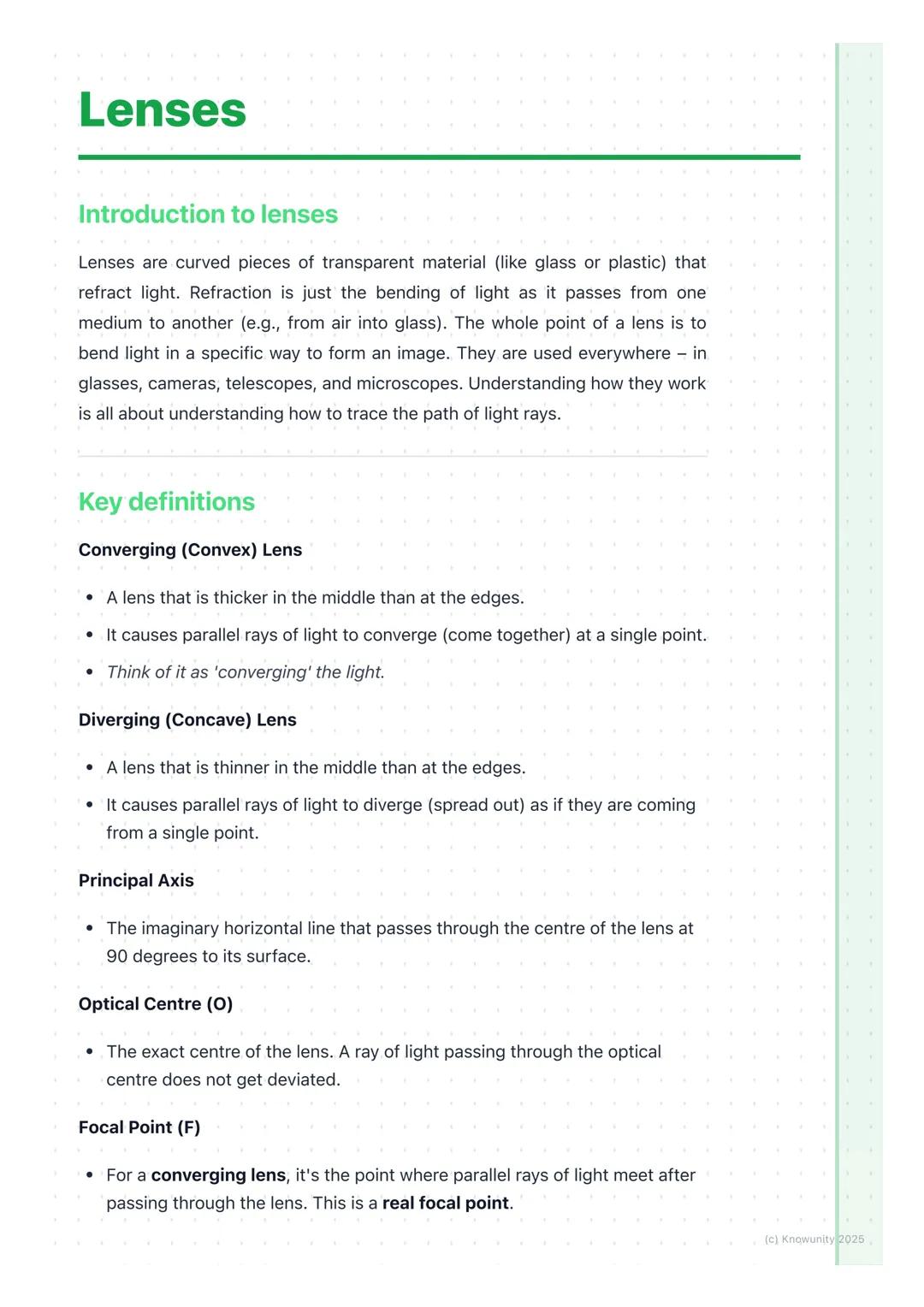
Introduction to Lenses
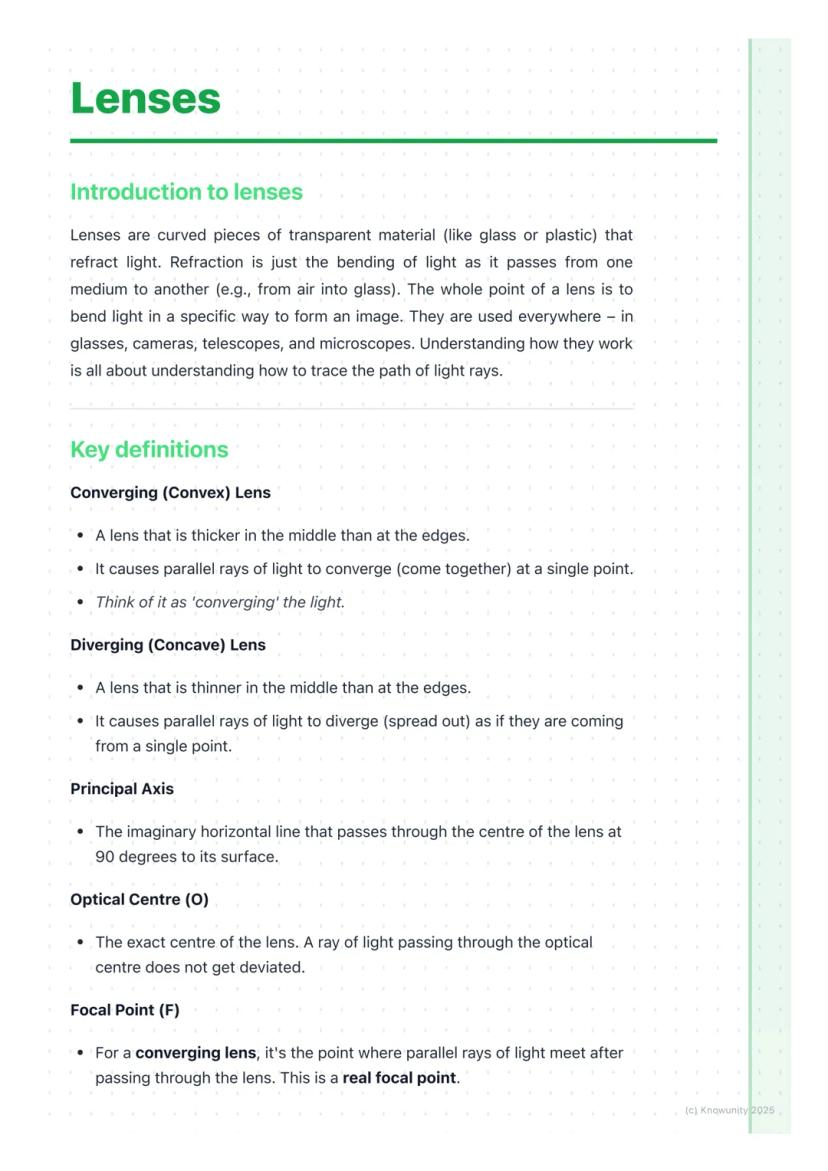
Ever wondered how your camera focuses or how glasses help you see clearly? It's all about refraction - the bending of light as it passes through different materials.
Converging (convex) lenses are thicker in the middle and bring light rays together at a focal point. Think of a magnifying glass - that's a converging lens. Diverging (concave) lenses are thinner in the middle and spread light rays apart.
The optical centre (O) is the middle of the lens where light passes straight through. The focal point (F) is where parallel light rays meet (or appear to come from), and the focal length (f) is the distance from the centre to this point.
Quick Tip: Remember "thick middle = converging, thin middle = diverging" to never mix them up!
2
of 10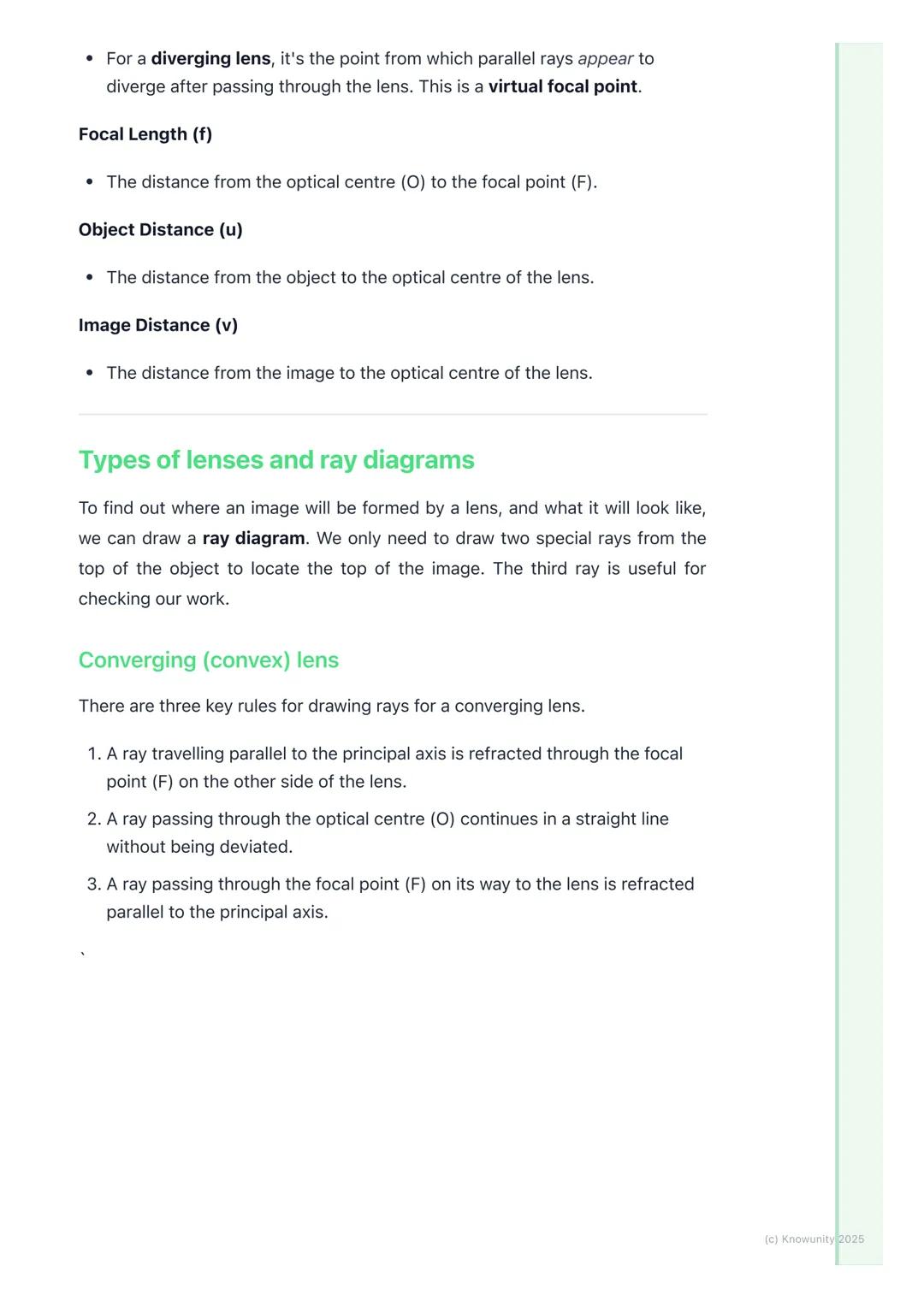
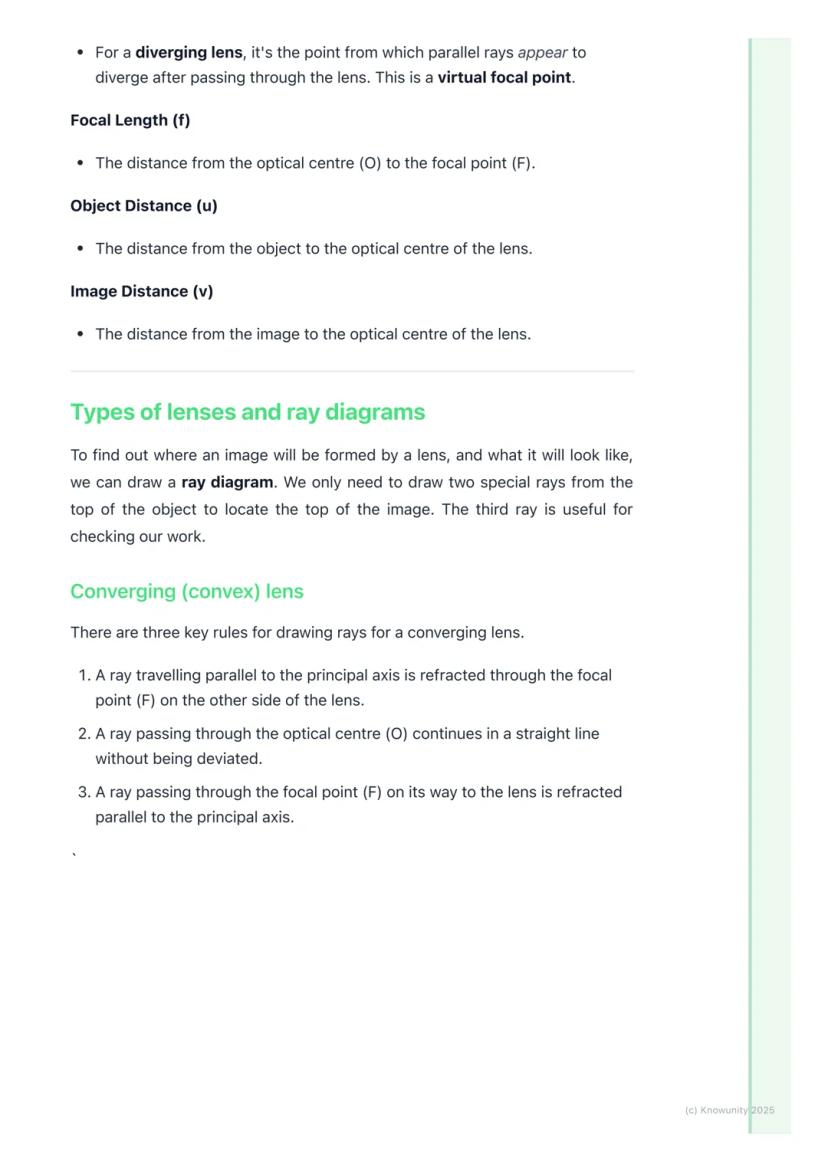
Ray Diagrams for Converging Lenses
Drawing ray diagrams is like creating a map for light! You only need two special rays to find where an image forms.
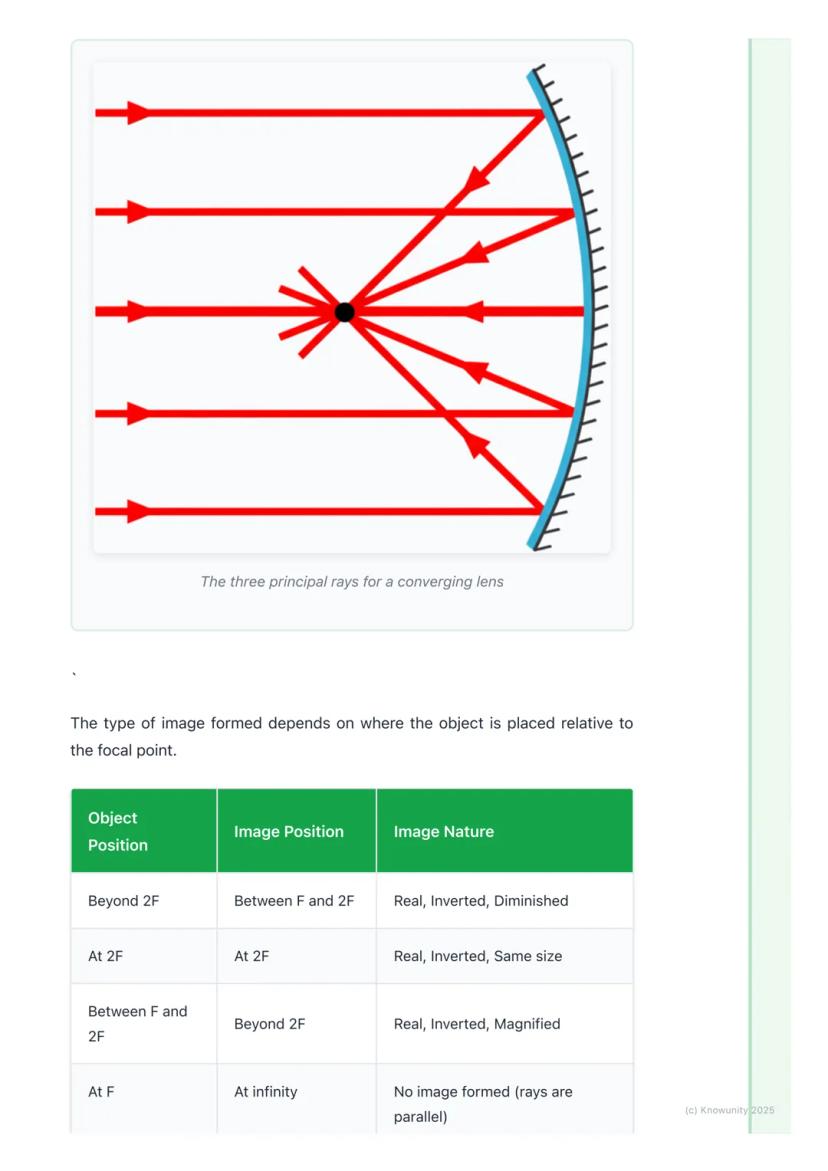
For converging lenses, follow these three rules: 1) A ray parallel to the axis bends through the focal point, 2) A ray through the optical centre goes straight, and 3) A ray through the focal point becomes parallel to the axis.
The image you get depends entirely on where you place the object. If it's beyond 2F, you get a real, inverted, smaller image. Between F and 2F? Real, inverted, but magnified. Place it inside the focal length and boom - you've got a magnifying glass with a virtual, upright, enlarged image!
Exam Success: Learn the object position table by heart - it's a guaranteed marks winner!
3
of 10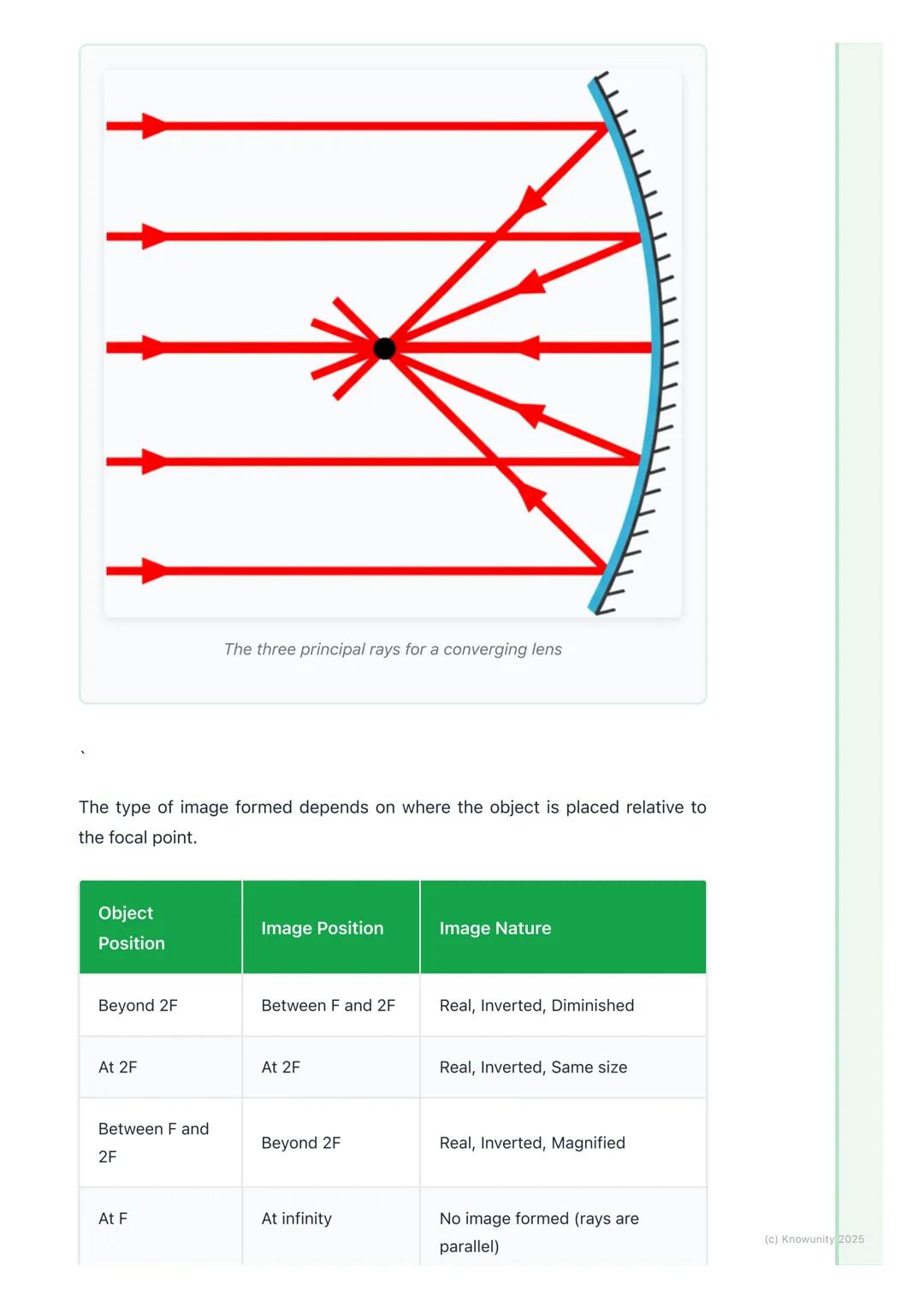
Object Position and Image Types
Here's where converging lenses get interesting - the image changes dramatically based on object placement!
When your object sits beyond 2F, you get a real, inverted, diminished image between F and 2F. This is exactly how camera lenses work. At exactly 2F, the image appears at 2F on the other side, same size but upside down.
Place the object between F and 2F, and suddenly your image jumps beyond 2F, becoming real, inverted, but magnified. Put it right at F and no image forms - the rays become parallel. The magic happens inside F where you get a virtual, upright, magnified image.
Memory Trick: "Real images flip, virtual images don't" - real images are always inverted, virtual ones stay upright!
4
of 10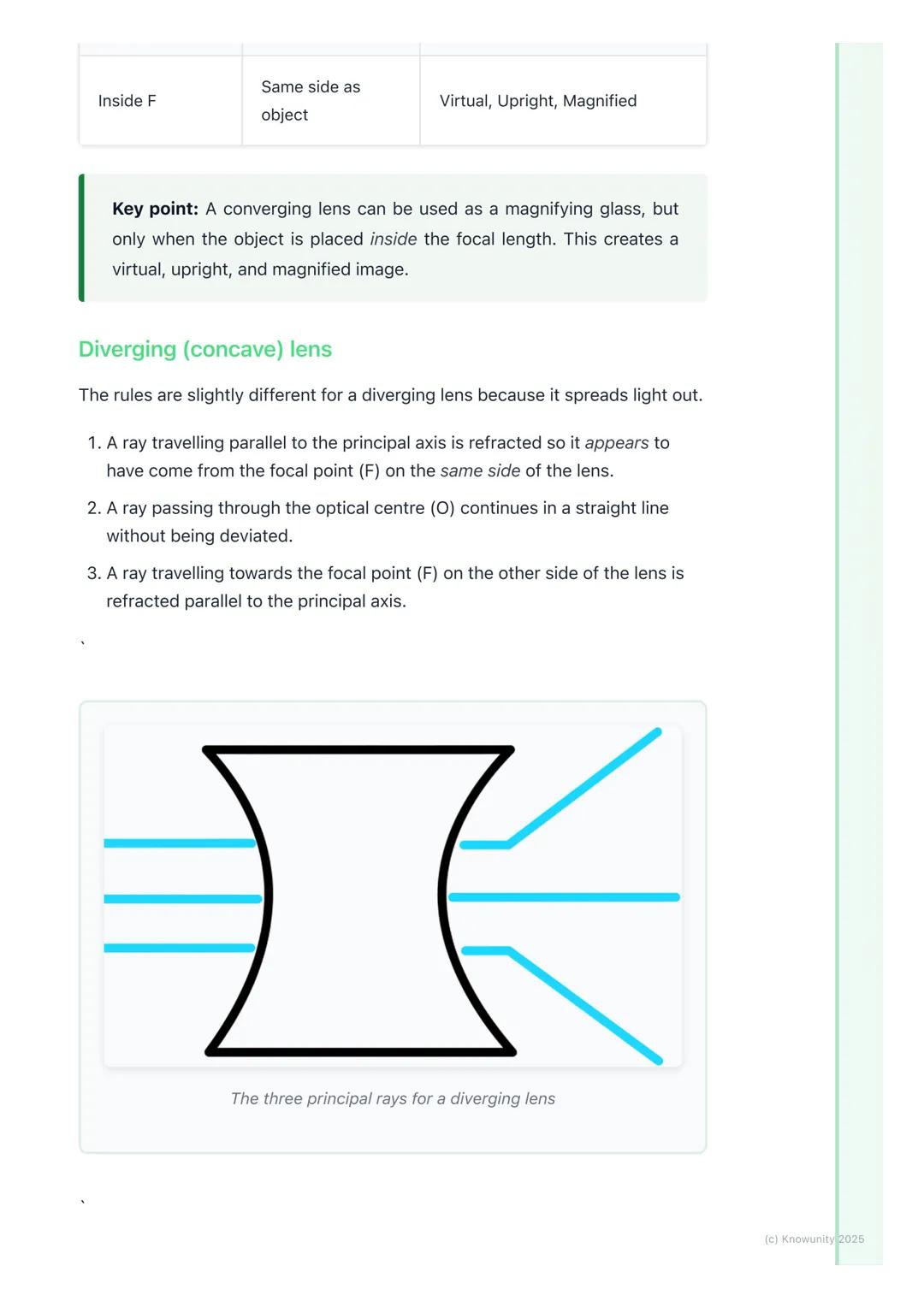
Diverging Lenses and Their Properties
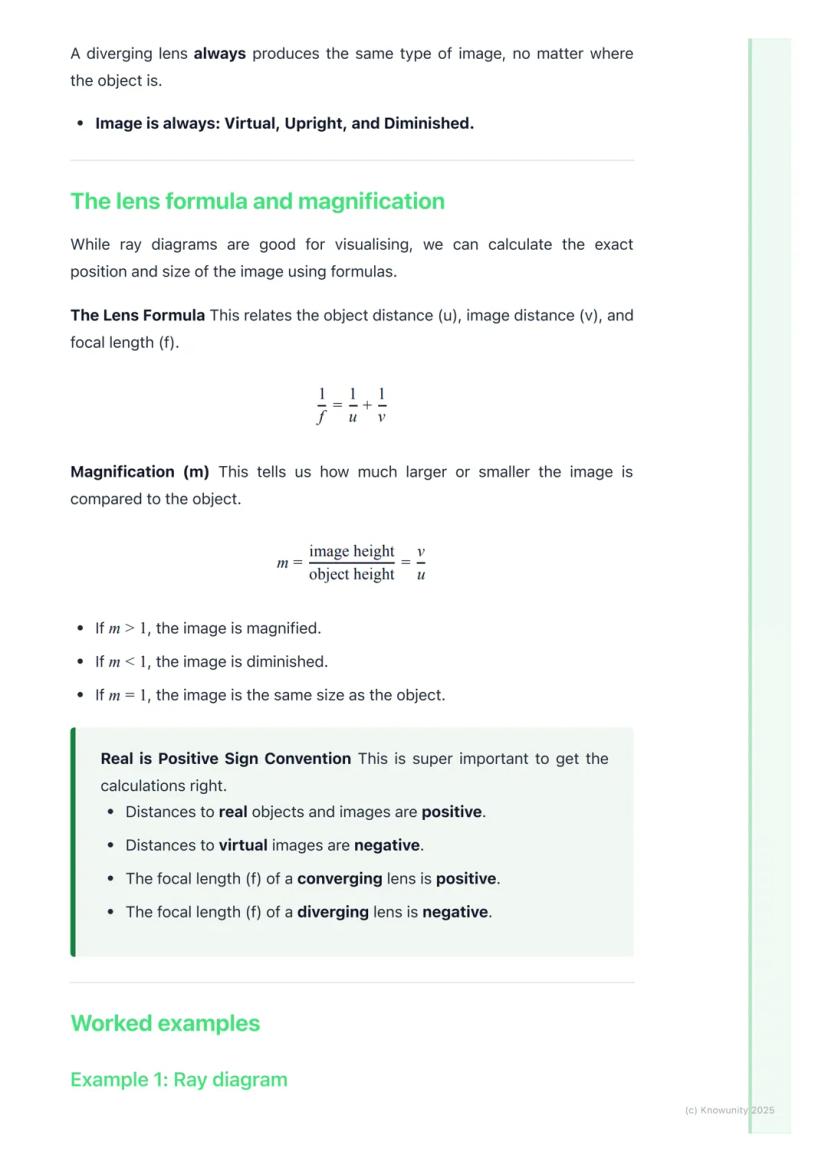
Diverging lenses are the reliable ones - they always produce the same type of image, no matter where you put the object!
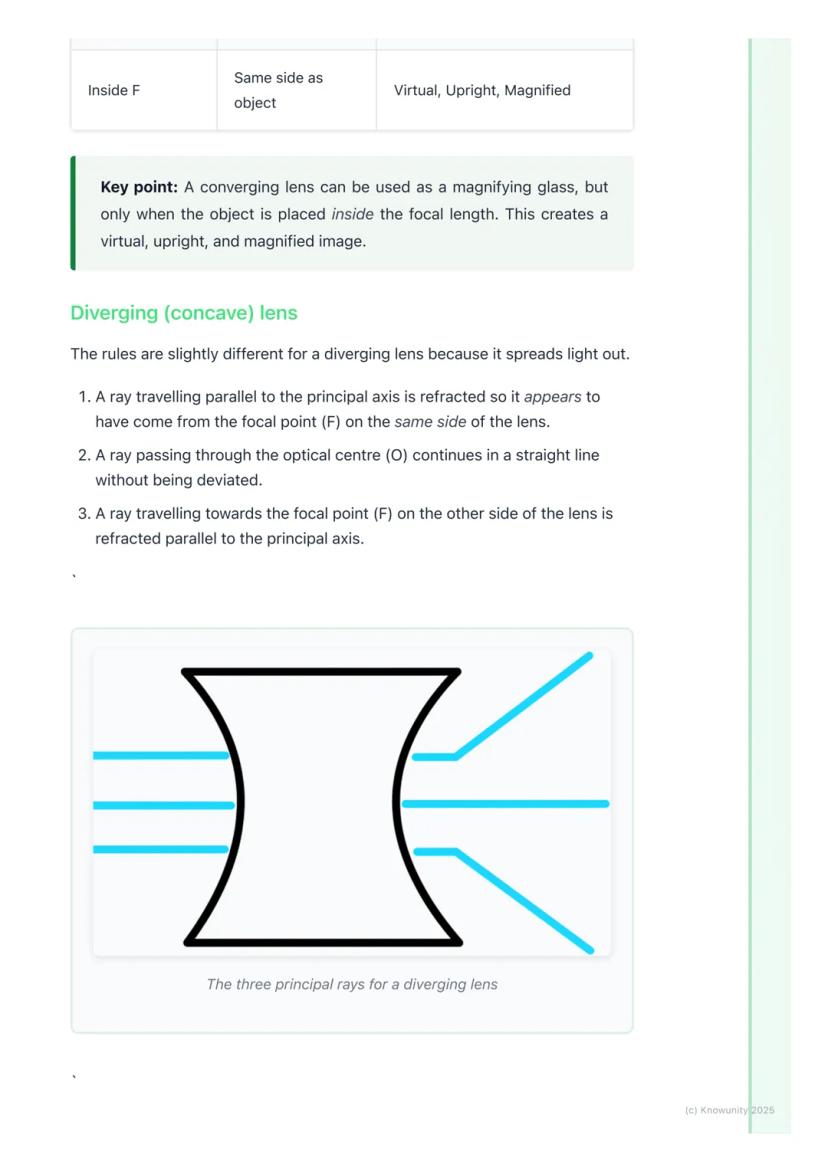
The ray rules are similar but with a twist: parallel rays appear to come from the focal point on the same side as the object. A ray towards the far focal point gets bent parallel to the axis.
No matter what you do with a diverging lens, you'll always get a virtual, upright, diminished image. Always. This makes them perfect for things like peepholes in doors or certain types of glasses for short-sightedness.
Study Smart: Since diverging lenses are predictable, focus your revision time on the trickier converging lens scenarios!
5
of 10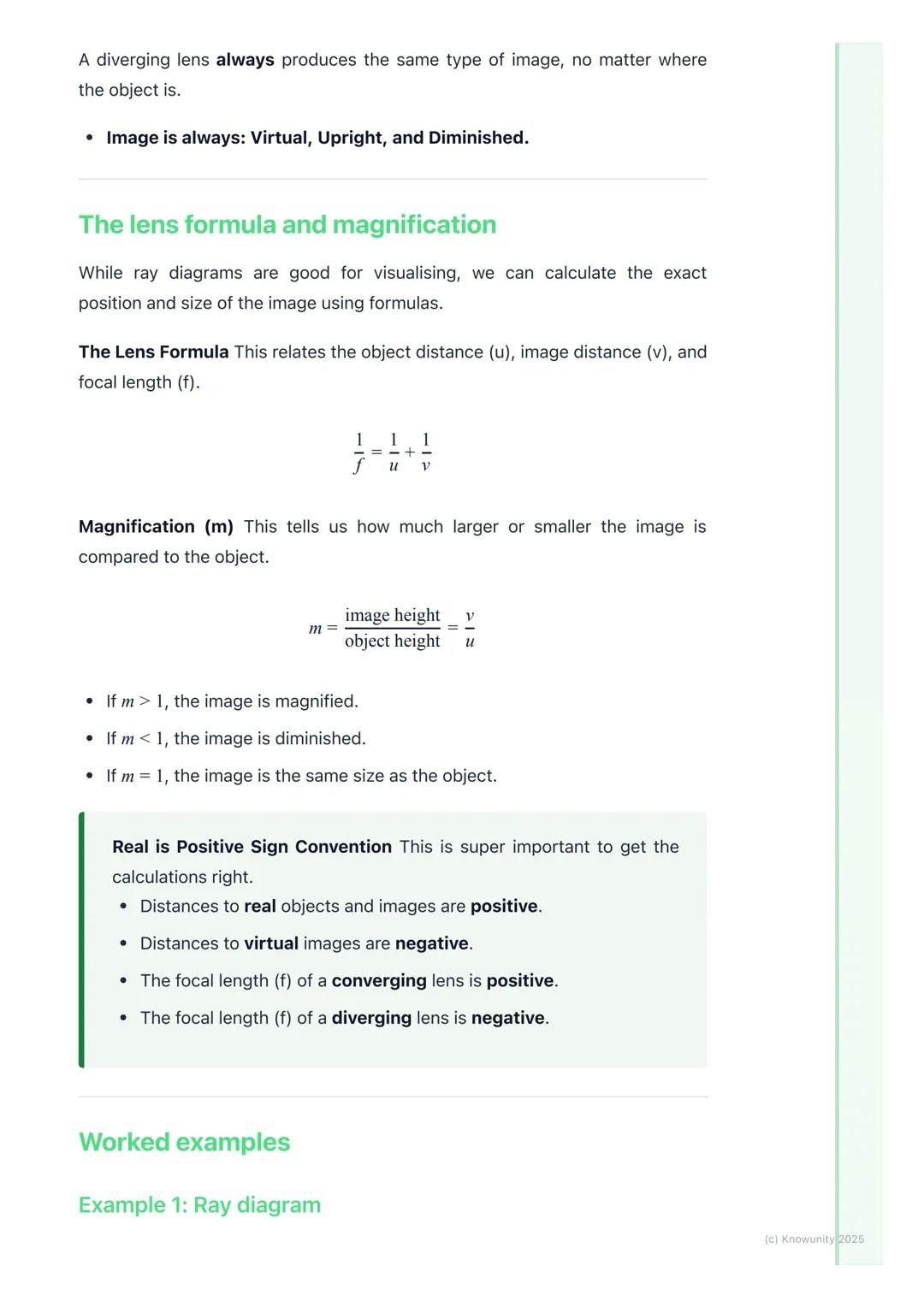
Lens Formula and Magnification Calculations
Time to put numbers to your diagrams! The lens formula connects everything: 1/f = 1/u + 1/v, where f is focal length, u is object distance, and v is image distance.
Magnification tells you how much bigger or smaller your image is: m = v/u. If m > 1, your image is magnified. If m < 1, it's diminished. Simple!
The sign convention is crucial: "Real is Positive" means real objects and images get positive distances, virtual images get negative distances. Converging lenses have positive focal lengths, diverging ones negative.
Calculation Confidence: Practice the sign convention until it's automatic - getting signs wrong will mess up your entire answer!
6
of 10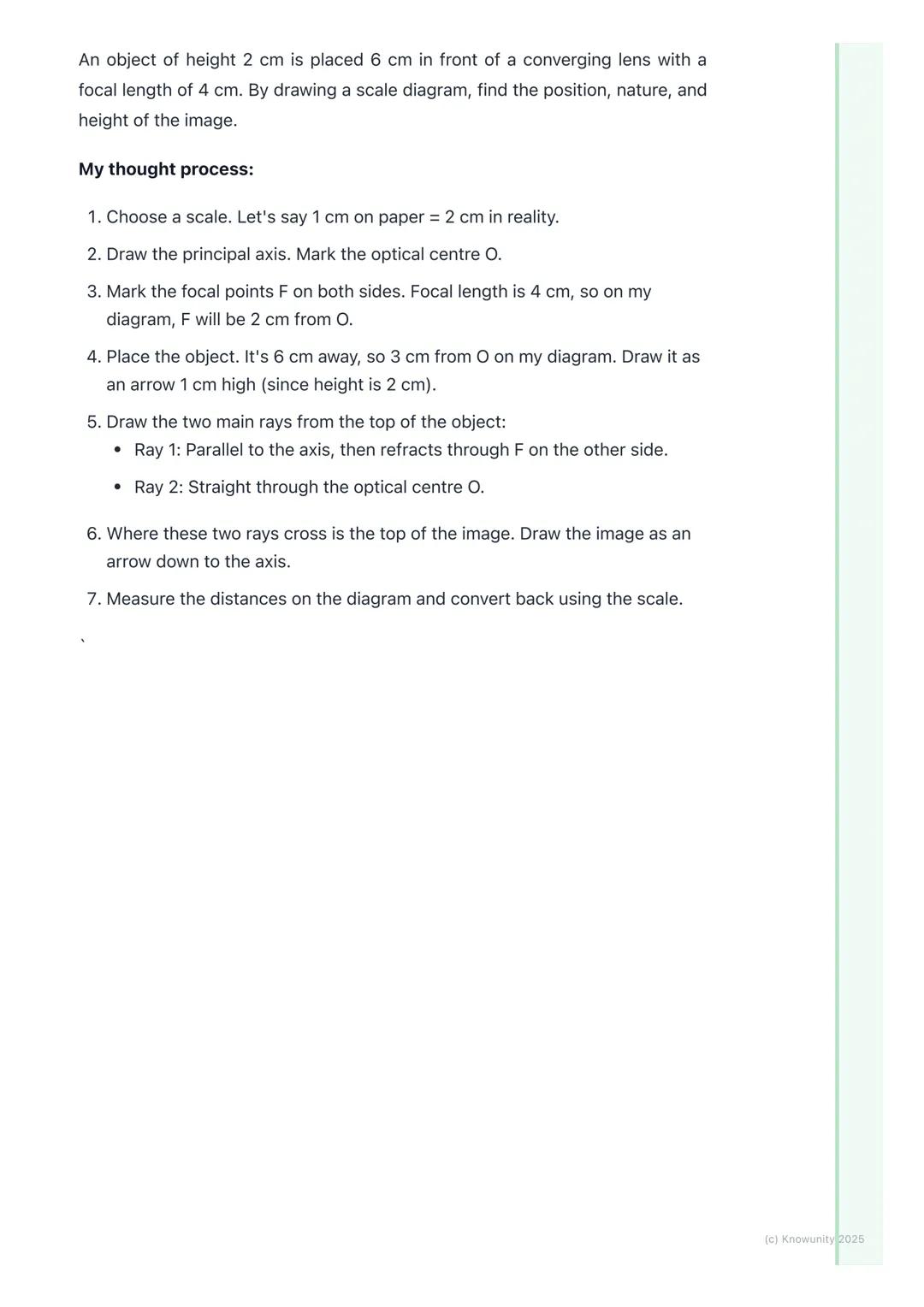
Worked Example: Ray Diagram Method
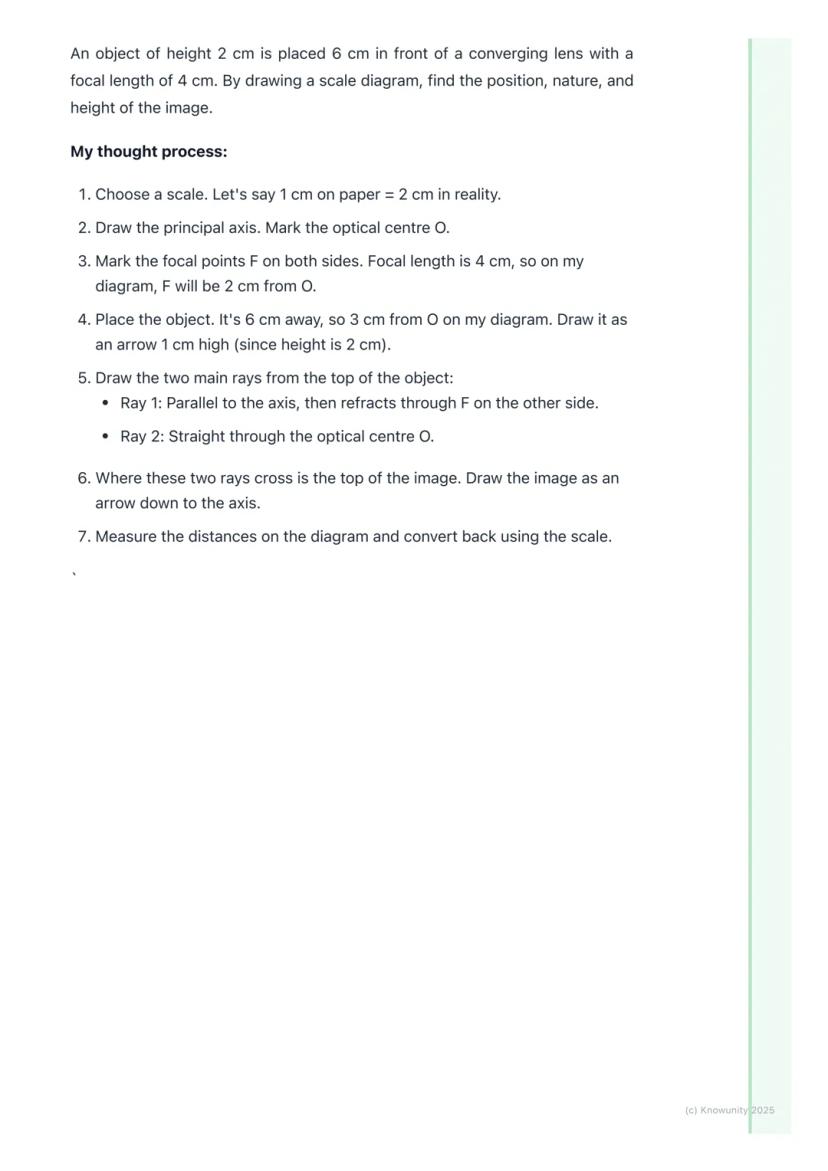
Let's solve a real problem! An object (2 cm tall) sits 6 cm from a converging lens with focal length 4 cm.
First, choose your scale - say 1 cm on paper = 2 cm reality. Draw your axis, mark the optical centre O, then place focal points F at 2 cm from O on your diagram.
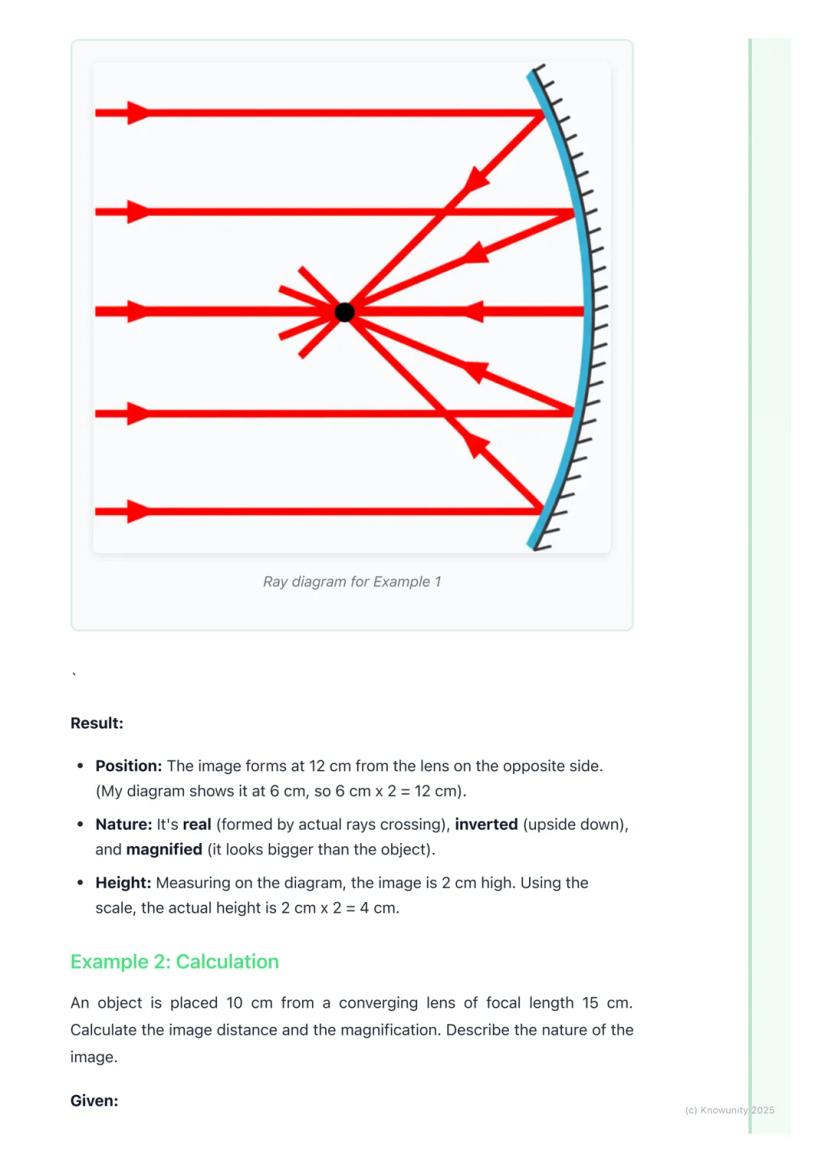
Place your object 3 cm from O (representing 6 cm) and draw it 1 cm tall. Now trace your two main rays: one parallel to the axis (bends through F), another straight through O. Where they cross is your image!
Measuring gives us an image 6 cm from O on the diagram (12 cm in reality), 2 cm tall on diagram (4 cm reality). It's real, inverted, and magnified.
Diagram Success: Always use a ruler and draw large, clear diagrams - messy drawings lead to wrong answers!
7
of 10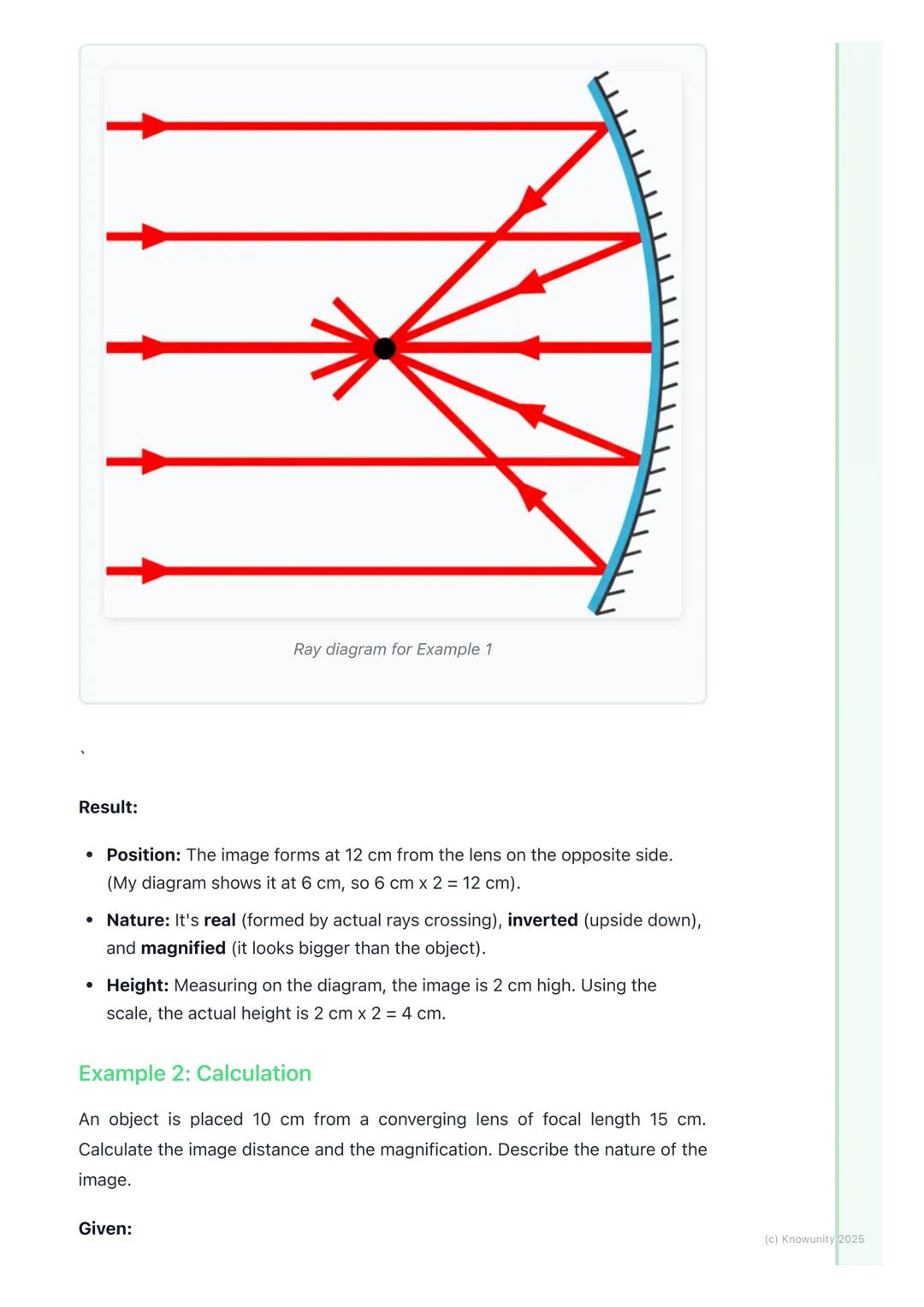
Worked Example: Mathematical Method
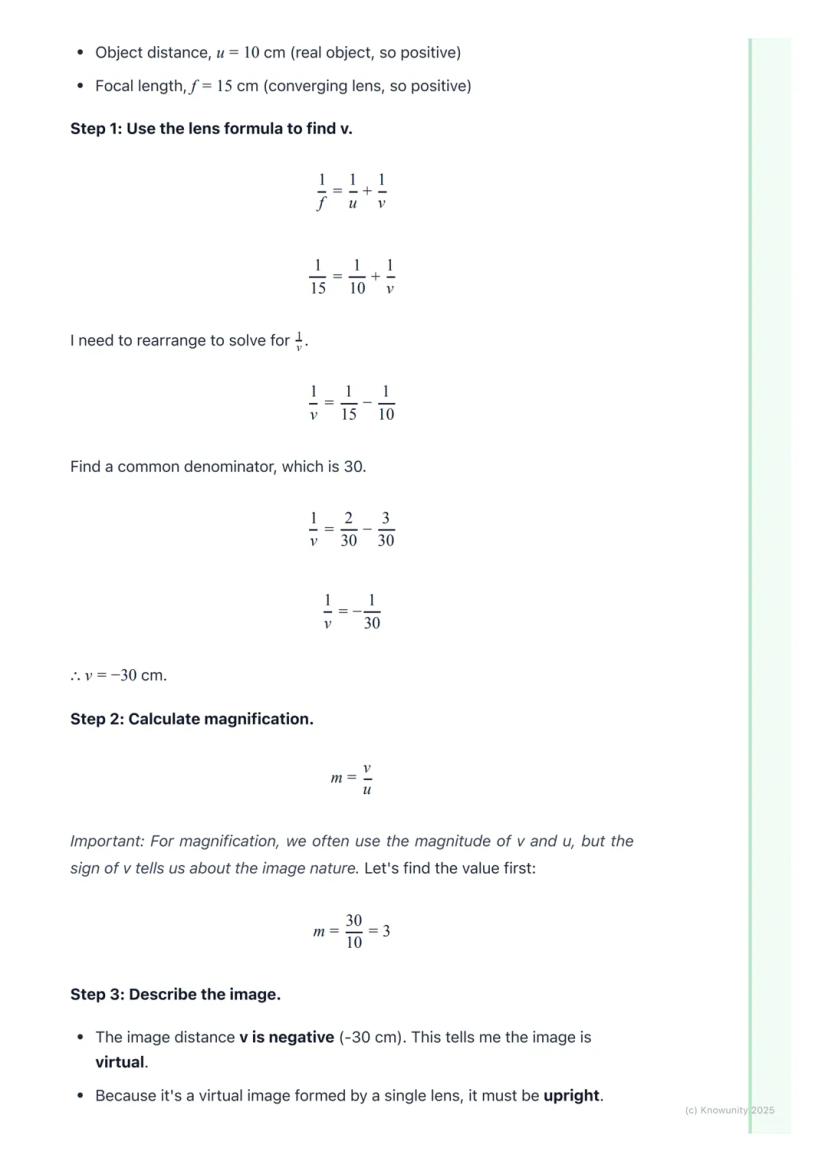
Now let's use pure maths! Object at 10 cm from a converging lens with focal length 15 cm.
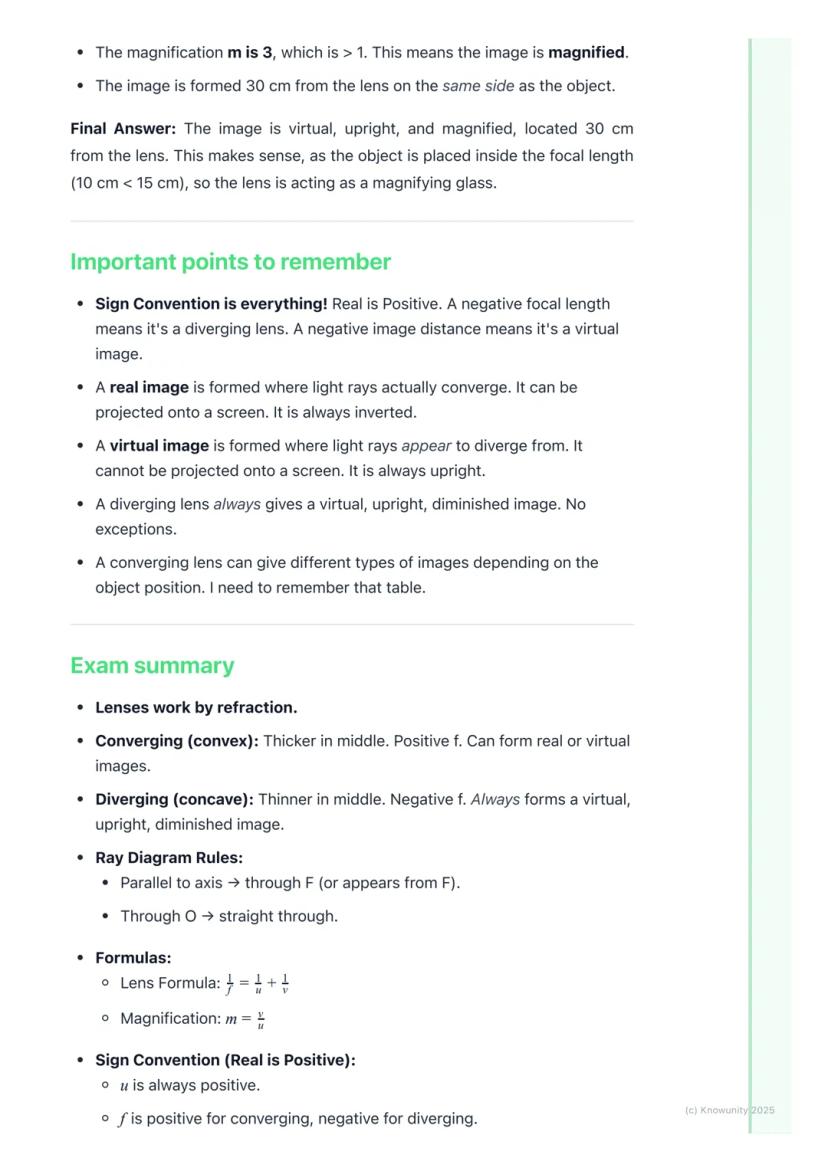
Using 1/f = 1/u + 1/v: 1/15 = 1/10 + 1/v. Rearranging: 1/v = 1/15 - 1/10 = 2/30 - 3/30 = -1/30. Therefore v = -30 cm.
The negative v means a virtual image! Magnification m = v/u = 30/10 = 3, so it's magnified threefold.
Since the object is inside the focal length (10 < 15), this makes perfect sense - the lens acts as a magnifying glass, creating a virtual, upright, magnified image 30 cm from the lens.
Check Your Logic: Always verify your mathematical answer makes physical sense - it prevents silly mistakes!
8
of 10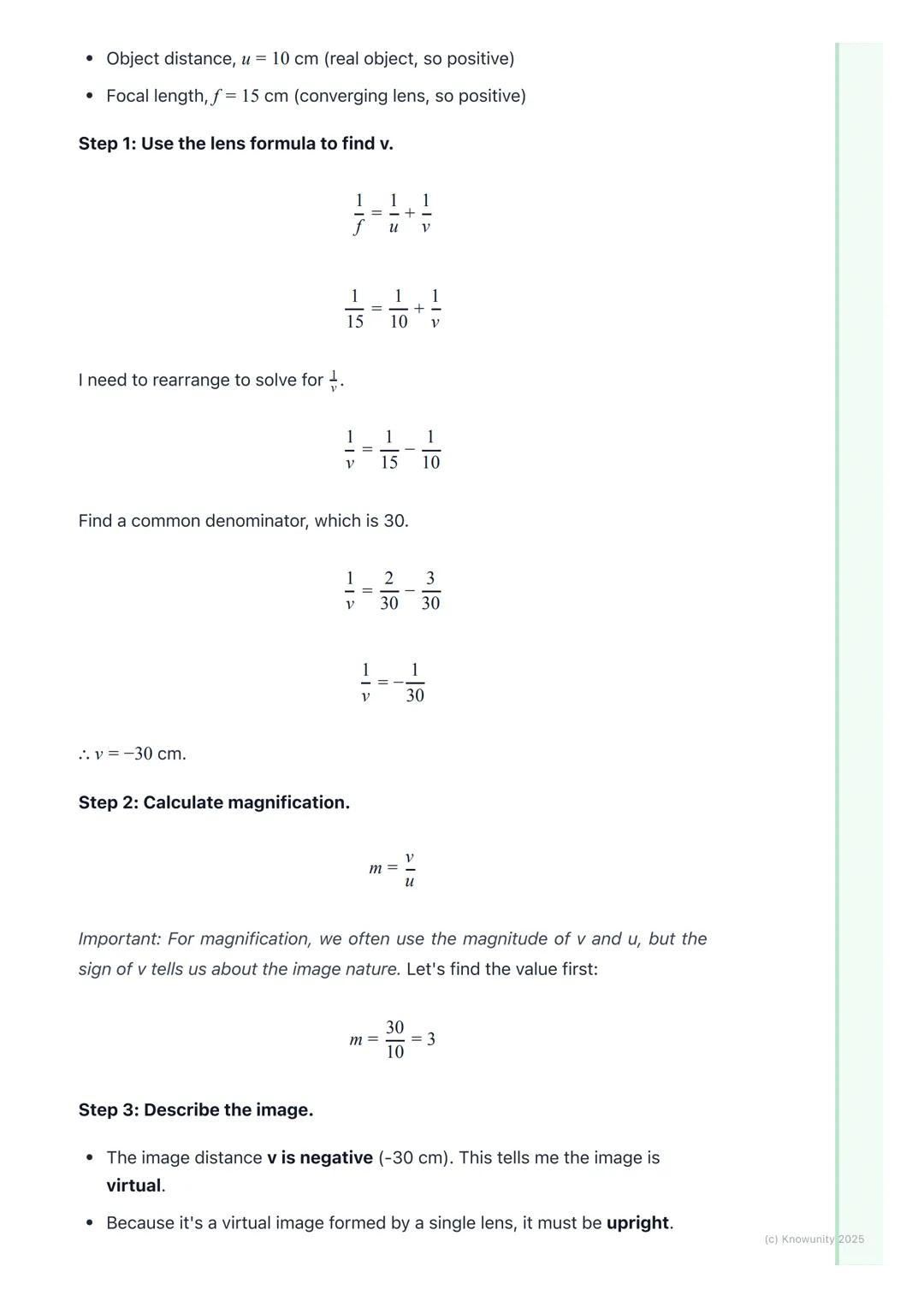
Sign Convention Deep Dive
Getting signs right separates the top students from the rest! The golden rule is "Real is Positive".
Object distance u is always positive (real objects). Focal length f is positive for converging lenses, negative for diverging ones. Image distance v is positive for real images, negative for virtual images.
When calculating magnification, use m = v/u with the actual values (including signs). The sign of v tells you if the image is real (positive) or virtual (negative).
A negative image distance always means virtual, upright image. A positive image distance means real, inverted image. Master this and you'll never get confused again!
Sign Mastery: Write "Real = +" at the top of every lens problem - it's your safety net!
9
of 10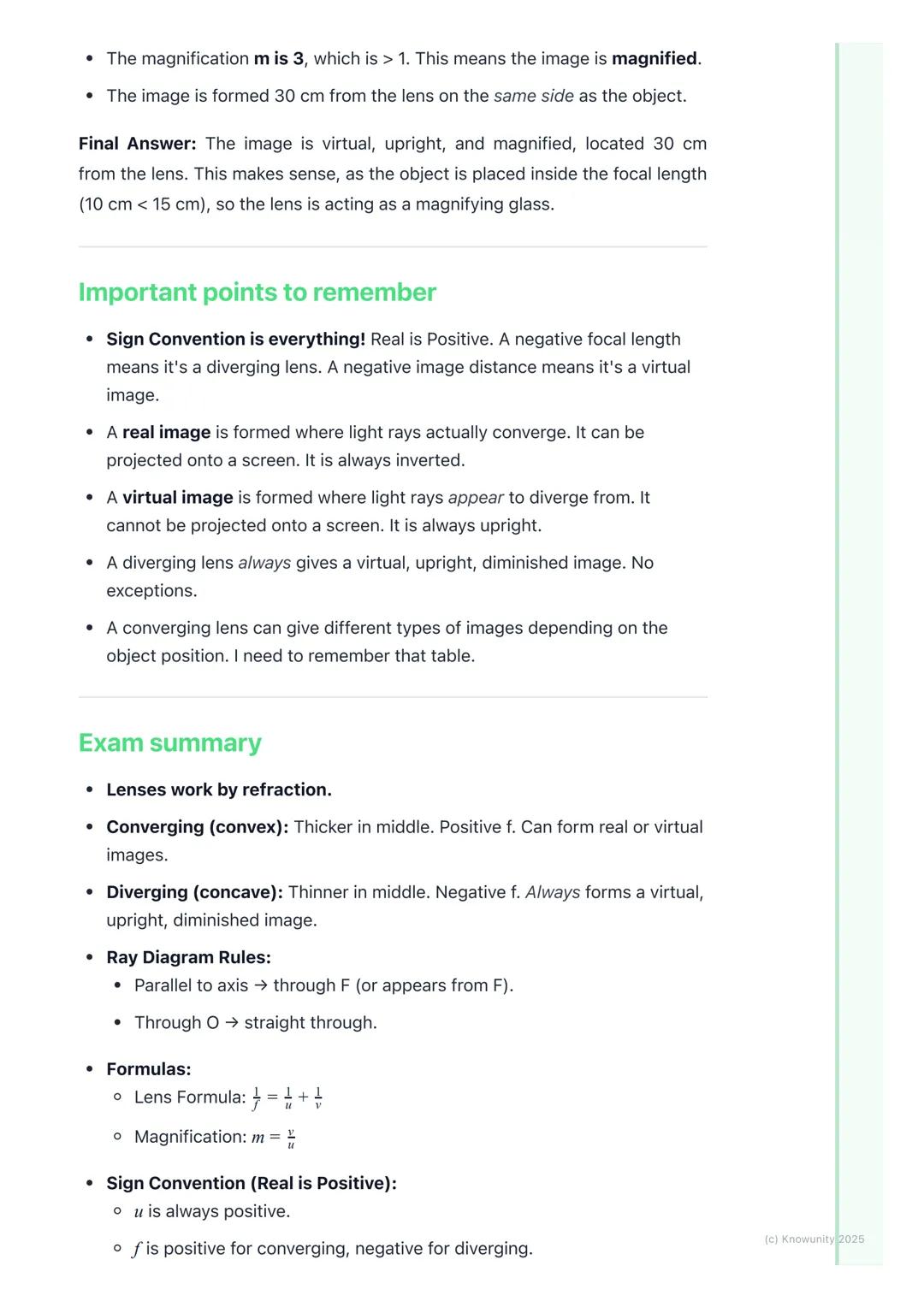
Key Exam Points and Summary
Here's what you absolutely must remember for exams: lenses work by refraction, converging lenses have positive focal lengths and can form various image types, while diverging lenses have negative focal lengths and always form virtual, upright, diminished images.
For ray diagrams, know your three rules inside out. For calculations, master the lens formula and magnification .
The sign convention is your best friend - real is positive, virtual images have negative distances. A real image can be projected on a screen and is always inverted. A virtual image cannot be projected and is always upright.
Exam Strategy: Practice both ray diagrams and calculations for the same scenario - understanding both methods deeply will boost your confidence massively!
10
of 10
Hiç sormayacaksın sanmıştık...
Knowunity yapay zeka arkadaşı nedir?
Yapay zeka arkadaşımız öğrencilerin ihtiyaçlarına göre özel olarak tasarlanmıştır. Platformda bulunan milyonlarca içeriğe dayanarak öğrencilere gerçekten anlamlı ve ilgili yanıtlar verebiliyoruz. Ancak mesele sadece cevaplar değil, refakatçi aynı zamanda kişiselleştirilmiş öğrenme planları, sınavlar veya sohbet içerikleri ve öğrencilerin becerilerine ve gelişimlerine dayalı %100 kişiselleştirme ile öğrencilere günlük öğrenme zorluklarında rehberlik ediyor.
Knowunity uygulamasını nereden indirebilirim?
Uygulamayı Google Play Store ve Apple App Store'dan indirebilirsiniz.
Knowunity ücretsiz mi?
Knowunity uygulaması ücretsiz! Uygulamamız çok yakında indirmeye hazır olacak, bekle bizi. 💙
Physics dersinin en popüler içerikleri
3En popüler içerikler
9Aradığını bulamıyor musun? Diğer derslere göz at.
Kullanıcılarımızdan yorumlar. Onlar her şeyi çok beğendi — sen de beğeneceksin.
4.6/5App Store
4.7/5Google Play
Uygulama çok kolay kullanılıyor ve güzel tasarlanmış. Şu ana kadar aradığım her şeyi buldum ve sunumlardan çok şey öğrendim! Kesinlikle ödevlerim için hep kullanacağım!
A.S.iOS kullanıcısı
Uygulama çok iyi. Çok fazla ders notu ve yardımlaşma var. Örneğin benim problem yaşadığım bir ders Geometriydi ve ANINDA yardım ettiler beraber hem sorularımı çözdük hem konu anlatımı buldum. Herkese tavsiye ederim.
S.L.Android kullanıcısı
BEN ŞOK. Reklamını sık sık gördüğüm için uygulamayı denedim ve gerçekten hayran kaldım. Bu uygulama okul için tam ihtiyacım olan şey. Anında ödev yardımı, konu anlatımı, örnek sınavlar, flaşkartlar hepsi hepsi var, şiddetle tavsiye ederim ✅
A.iOS kullanıcısı
Physics5 görüntüleme·Güncellendi May 28, 2026·10 sayfaUnderstanding Lenses: Convex and Concave Explained
Lenses are everywhere - in your phone camera, glasses, and even your eyes! They're simply curved pieces of glass or plastic that bend light to create images. Understanding how they work is all about tracking light rays and knowing a... Daha fazla göster
1
of 10Ders notlarını görmek için kaydol. Ücretsiz!
- Tüm belgeleri görebilirsin
- Notlarını Yükselt
- Milyonlarca öğrenciye katıl
Introduction to Lenses
Ever wondered how your camera focuses or how glasses help you see clearly? It's all about refraction - the bending of light as it passes through different materials.
Converging (convex) lenses are thicker in the middle and bring light rays together at a focal point. Think of a magnifying glass - that's a converging lens. Diverging (concave) lenses are thinner in the middle and spread light rays apart.
The optical centre (O) is the middle of the lens where light passes straight through. The focal point (F) is where parallel light rays meet (or appear to come from), and the focal length (f) is the distance from the centre to this point.
Quick Tip: Remember "thick middle = converging, thin middle = diverging" to never mix them up!
2
of 10Ders notlarını görmek için kaydol. Ücretsiz!
- Tüm belgeleri görebilirsin
- Notlarını Yükselt
- Milyonlarca öğrenciye katıl
Ray Diagrams for Converging Lenses
Drawing ray diagrams is like creating a map for light! You only need two special rays to find where an image forms.
For converging lenses, follow these three rules: 1) A ray parallel to the axis bends through the focal point, 2) A ray through the optical centre goes straight, and 3) A ray through the focal point becomes parallel to the axis.
The image you get depends entirely on where you place the object. If it's beyond 2F, you get a real, inverted, smaller image. Between F and 2F? Real, inverted, but magnified. Place it inside the focal length and boom - you've got a magnifying glass with a virtual, upright, enlarged image!
Exam Success: Learn the object position table by heart - it's a guaranteed marks winner!
3
of 10Ders notlarını görmek için kaydol. Ücretsiz!
- Tüm belgeleri görebilirsin
- Notlarını Yükselt
- Milyonlarca öğrenciye katıl
Object Position and Image Types
Here's where converging lenses get interesting - the image changes dramatically based on object placement!
When your object sits beyond 2F, you get a real, inverted, diminished image between F and 2F. This is exactly how camera lenses work. At exactly 2F, the image appears at 2F on the other side, same size but upside down.
Place the object between F and 2F, and suddenly your image jumps beyond 2F, becoming real, inverted, but magnified. Put it right at F and no image forms - the rays become parallel. The magic happens inside F where you get a virtual, upright, magnified image.
Memory Trick: "Real images flip, virtual images don't" - real images are always inverted, virtual ones stay upright!
4
of 10Ders notlarını görmek için kaydol. Ücretsiz!
- Tüm belgeleri görebilirsin
- Notlarını Yükselt
- Milyonlarca öğrenciye katıl
Diverging Lenses and Their Properties
Diverging lenses are the reliable ones - they always produce the same type of image, no matter where you put the object!
The ray rules are similar but with a twist: parallel rays appear to come from the focal point on the same side as the object. A ray towards the far focal point gets bent parallel to the axis.
No matter what you do with a diverging lens, you'll always get a virtual, upright, diminished image. Always. This makes them perfect for things like peepholes in doors or certain types of glasses for short-sightedness.
Study Smart: Since diverging lenses are predictable, focus your revision time on the trickier converging lens scenarios!
5
of 10Ders notlarını görmek için kaydol. Ücretsiz!
- Tüm belgeleri görebilirsin
- Notlarını Yükselt
- Milyonlarca öğrenciye katıl
Lens Formula and Magnification Calculations
Time to put numbers to your diagrams! The lens formula connects everything: 1/f = 1/u + 1/v, where f is focal length, u is object distance, and v is image distance.
Magnification tells you how much bigger or smaller your image is: m = v/u. If m > 1, your image is magnified. If m < 1, it's diminished. Simple!
The sign convention is crucial: "Real is Positive" means real objects and images get positive distances, virtual images get negative distances. Converging lenses have positive focal lengths, diverging ones negative.
Calculation Confidence: Practice the sign convention until it's automatic - getting signs wrong will mess up your entire answer!
6
of 10Ders notlarını görmek için kaydol. Ücretsiz!
- Tüm belgeleri görebilirsin
- Notlarını Yükselt
- Milyonlarca öğrenciye katıl
Worked Example: Ray Diagram Method
Let's solve a real problem! An object (2 cm tall) sits 6 cm from a converging lens with focal length 4 cm.
First, choose your scale - say 1 cm on paper = 2 cm reality. Draw your axis, mark the optical centre O, then place focal points F at 2 cm from O on your diagram.
Place your object 3 cm from O (representing 6 cm) and draw it 1 cm tall. Now trace your two main rays: one parallel to the axis (bends through F), another straight through O. Where they cross is your image!
Measuring gives us an image 6 cm from O on the diagram (12 cm in reality), 2 cm tall on diagram (4 cm reality). It's real, inverted, and magnified.
Diagram Success: Always use a ruler and draw large, clear diagrams - messy drawings lead to wrong answers!
7
of 10Ders notlarını görmek için kaydol. Ücretsiz!
- Tüm belgeleri görebilirsin
- Notlarını Yükselt
- Milyonlarca öğrenciye katıl
Worked Example: Mathematical Method
Now let's use pure maths! Object at 10 cm from a converging lens with focal length 15 cm.
Using 1/f = 1/u + 1/v: 1/15 = 1/10 + 1/v. Rearranging: 1/v = 1/15 - 1/10 = 2/30 - 3/30 = -1/30. Therefore v = -30 cm.
The negative v means a virtual image! Magnification m = v/u = 30/10 = 3, so it's magnified threefold.
Since the object is inside the focal length (10 < 15), this makes perfect sense - the lens acts as a magnifying glass, creating a virtual, upright, magnified image 30 cm from the lens.
Check Your Logic: Always verify your mathematical answer makes physical sense - it prevents silly mistakes!
8
of 10Ders notlarını görmek için kaydol. Ücretsiz!
- Tüm belgeleri görebilirsin
- Notlarını Yükselt
- Milyonlarca öğrenciye katıl
Sign Convention Deep Dive
Getting signs right separates the top students from the rest! The golden rule is "Real is Positive".
Object distance u is always positive (real objects). Focal length f is positive for converging lenses, negative for diverging ones. Image distance v is positive for real images, negative for virtual images.
When calculating magnification, use m = v/u with the actual values (including signs). The sign of v tells you if the image is real (positive) or virtual (negative).
A negative image distance always means virtual, upright image. A positive image distance means real, inverted image. Master this and you'll never get confused again!
Sign Mastery: Write "Real = +" at the top of every lens problem - it's your safety net!
9
of 10Ders notlarını görmek için kaydol. Ücretsiz!
- Tüm belgeleri görebilirsin
- Notlarını Yükselt
- Milyonlarca öğrenciye katıl
Key Exam Points and Summary
Here's what you absolutely must remember for exams: lenses work by refraction, converging lenses have positive focal lengths and can form various image types, while diverging lenses have negative focal lengths and always form virtual, upright, diminished images.
For ray diagrams, know your three rules inside out. For calculations, master the lens formula and magnification .
The sign convention is your best friend - real is positive, virtual images have negative distances. A real image can be projected on a screen and is always inverted. A virtual image cannot be projected and is always upright.
Exam Strategy: Practice both ray diagrams and calculations for the same scenario - understanding both methods deeply will boost your confidence massively!
10
of 10Ders notlarını görmek için kaydol. Ücretsiz!
- Tüm belgeleri görebilirsin
- Notlarını Yükselt
- Milyonlarca öğrenciye katıl
Hiç sormayacaksın sanmıştık...
Knowunity yapay zeka arkadaşı nedir?
Yapay zeka arkadaşımız öğrencilerin ihtiyaçlarına göre özel olarak tasarlanmıştır. Platformda bulunan milyonlarca içeriğe dayanarak öğrencilere gerçekten anlamlı ve ilgili yanıtlar verebiliyoruz. Ancak mesele sadece cevaplar değil, refakatçi aynı zamanda kişiselleştirilmiş öğrenme planları, sınavlar veya sohbet içerikleri ve öğrencilerin becerilerine ve gelişimlerine dayalı %100 kişiselleştirme ile öğrencilere günlük öğrenme zorluklarında rehberlik ediyor.
Knowunity uygulamasını nereden indirebilirim?
Uygulamayı Google Play Store ve Apple App Store'dan indirebilirsiniz.
Knowunity ücretsiz mi?
Knowunity uygulaması ücretsiz! Uygulamamız çok yakında indirmeye hazır olacak, bekle bizi. 💙
Physics dersinin en popüler içerikleri
3En popüler içerikler
9Aradığını bulamıyor musun? Diğer derslere göz at.
Kullanıcılarımızdan yorumlar. Onlar her şeyi çok beğendi — sen de beğeneceksin.
4.6/5App Store
4.7/5Google Play
Uygulama çok kolay kullanılıyor ve güzel tasarlanmış. Şu ana kadar aradığım her şeyi buldum ve sunumlardan çok şey öğrendim! Kesinlikle ödevlerim için hep kullanacağım!
A.S.iOS kullanıcısı
Uygulama çok iyi. Çok fazla ders notu ve yardımlaşma var. Örneğin benim problem yaşadığım bir ders Geometriydi ve ANINDA yardım ettiler beraber hem sorularımı çözdük hem konu anlatımı buldum. Herkese tavsiye ederim.
S.L.Android kullanıcısı
BEN ŞOK. Reklamını sık sık gördüğüm için uygulamayı denedim ve gerçekten hayran kaldım. Bu uygulama okul için tam ihtiyacım olan şey. Anında ödev yardımı, konu anlatımı, örnek sınavlar, flaşkartlar hepsi hepsi var, şiddetle tavsiye ederim ✅
A.iOS kullanıcısı