
Ever wondered why oil floats on water or why a... Daha fazla göster
 Physics4 görüntüleme·Güncellendi May 26, 2026·6 sayfa
Understanding Density: Definition and Calculation

1 / 6
1
of 6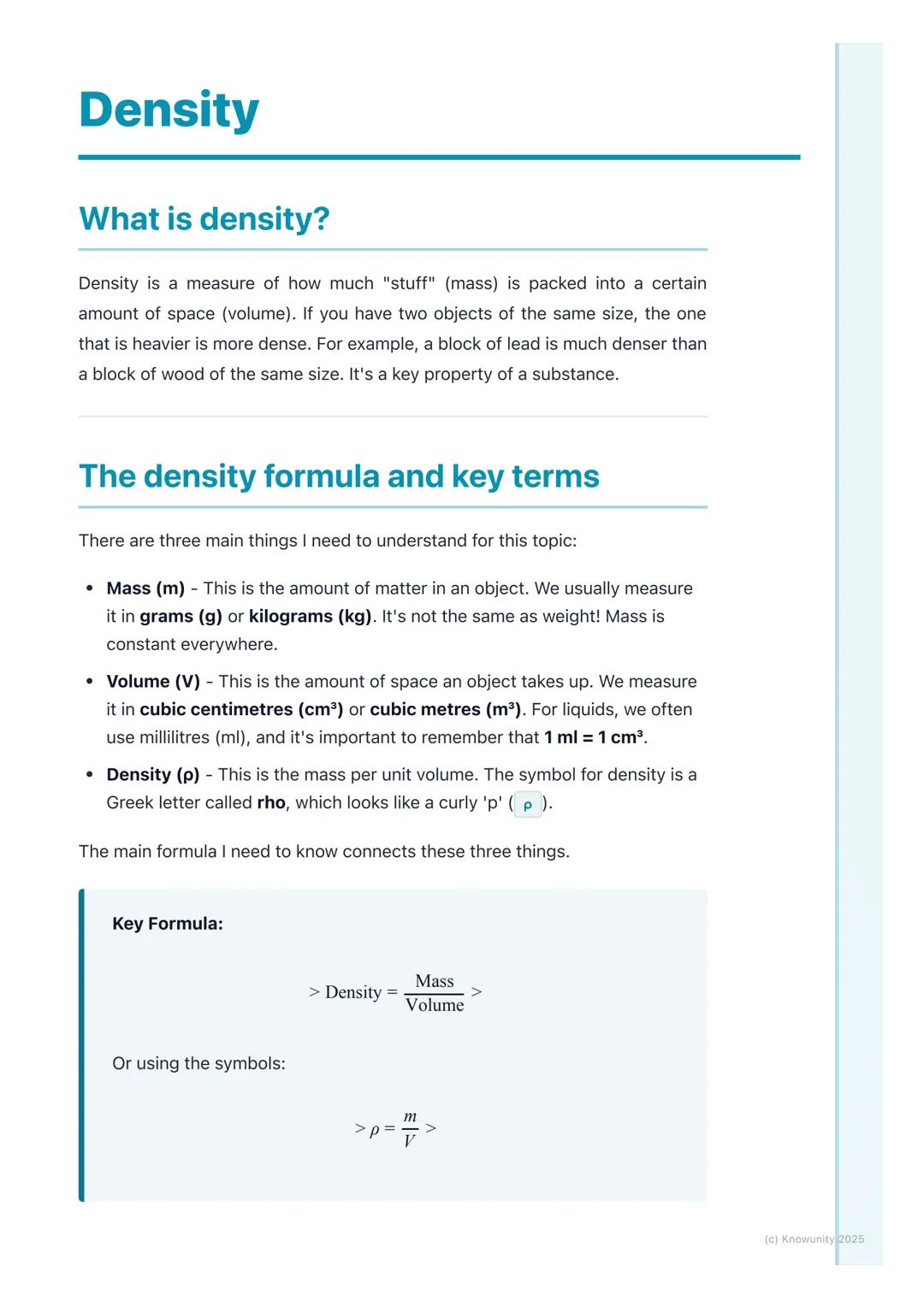
What is Density?
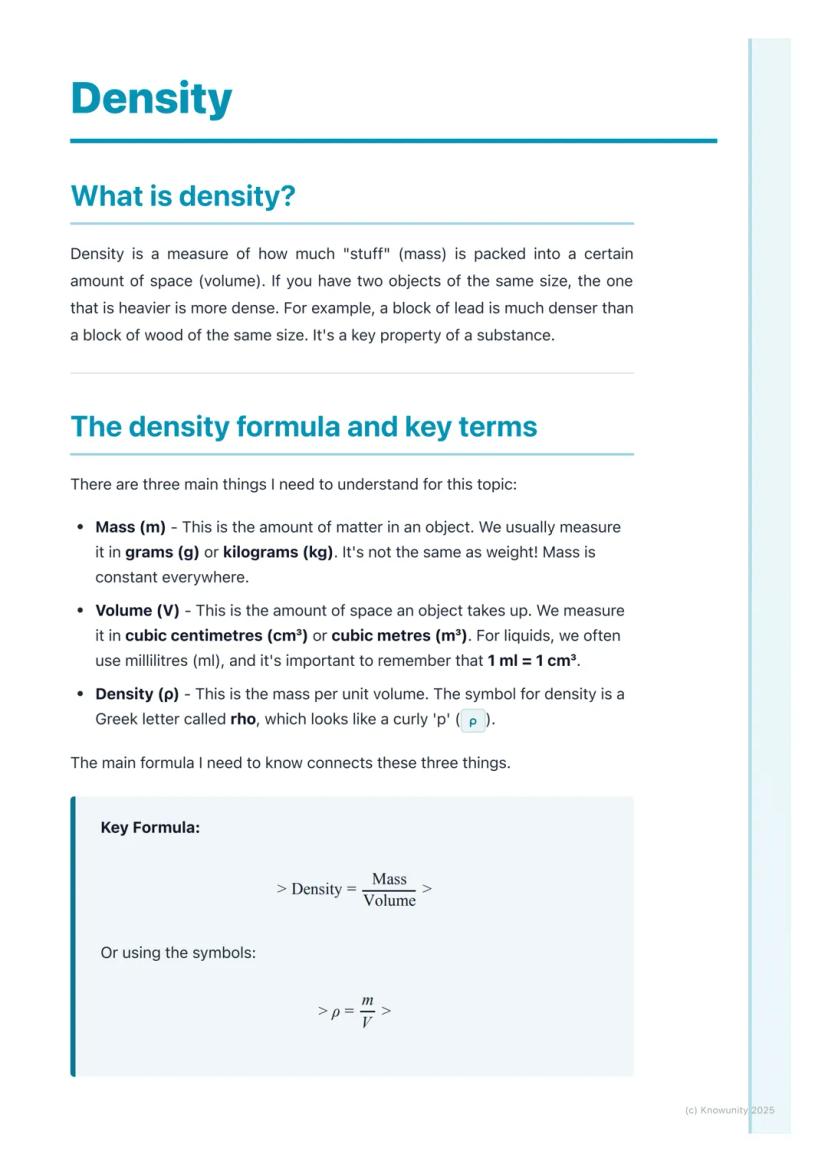
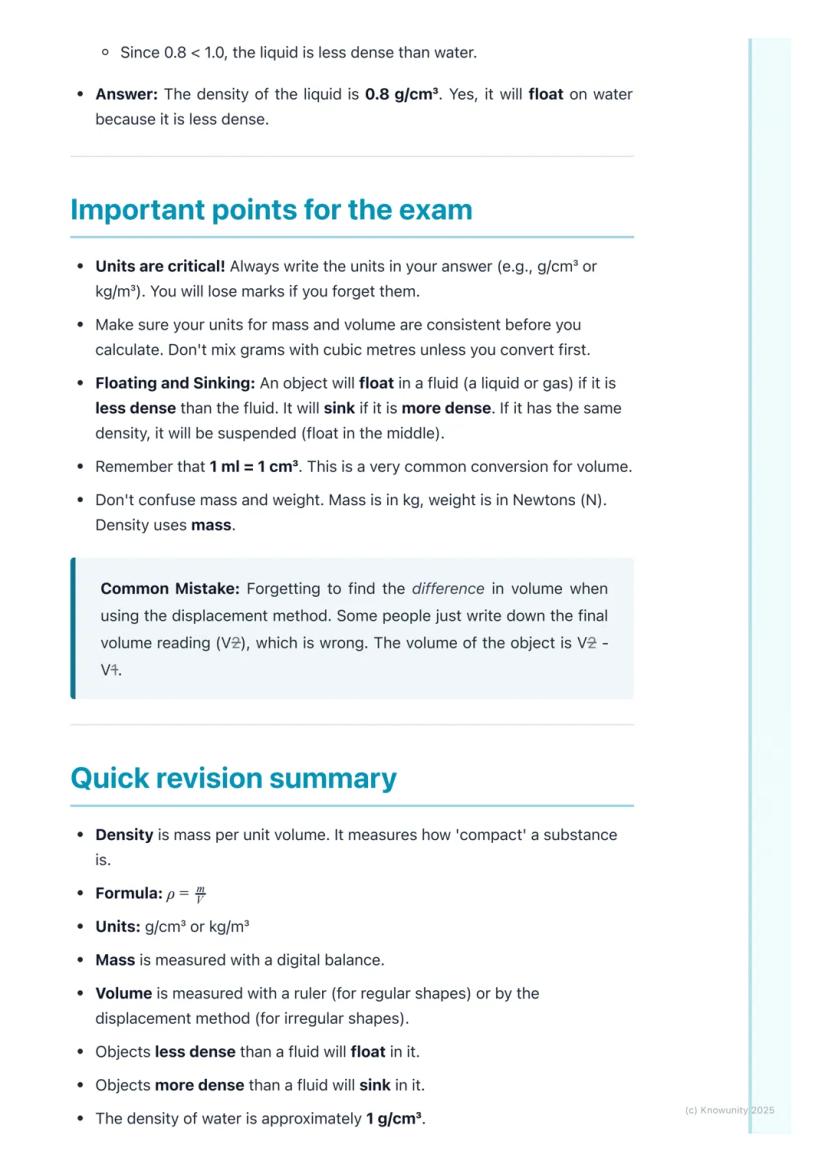
Think of density as how tightly packed the "stuff" is in any object. If you've got two blocks the same size, the heavier one is more dense. A lead block feels much heavier than a wooden block of the same size because lead packs way more matter into the same space.
Density is basically mass per unit volume - it tells you how much matter is crammed into a given space. The symbol for density is ρ (rho), which looks like a curvy 'p'.
The key formula you need to master is: ρ = m/V . This simple equation is your ticket to solving loads of physics problems.
Quick Tip: Remember that mass (measured in grams or kilograms) isn't the same as weight. Mass stays constant wherever you go, even on the moon!
2
of 6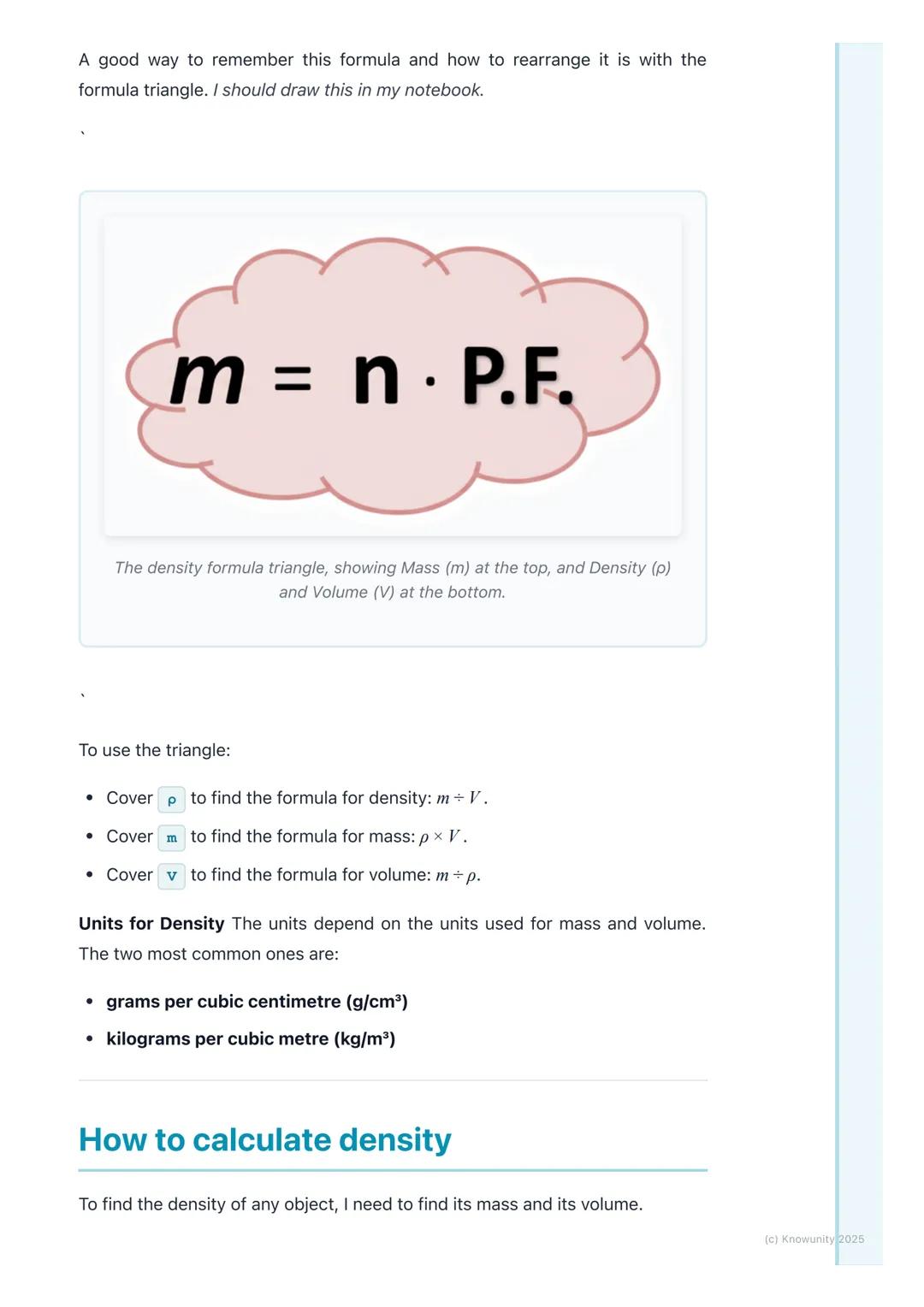
The Formula Triangle and Units
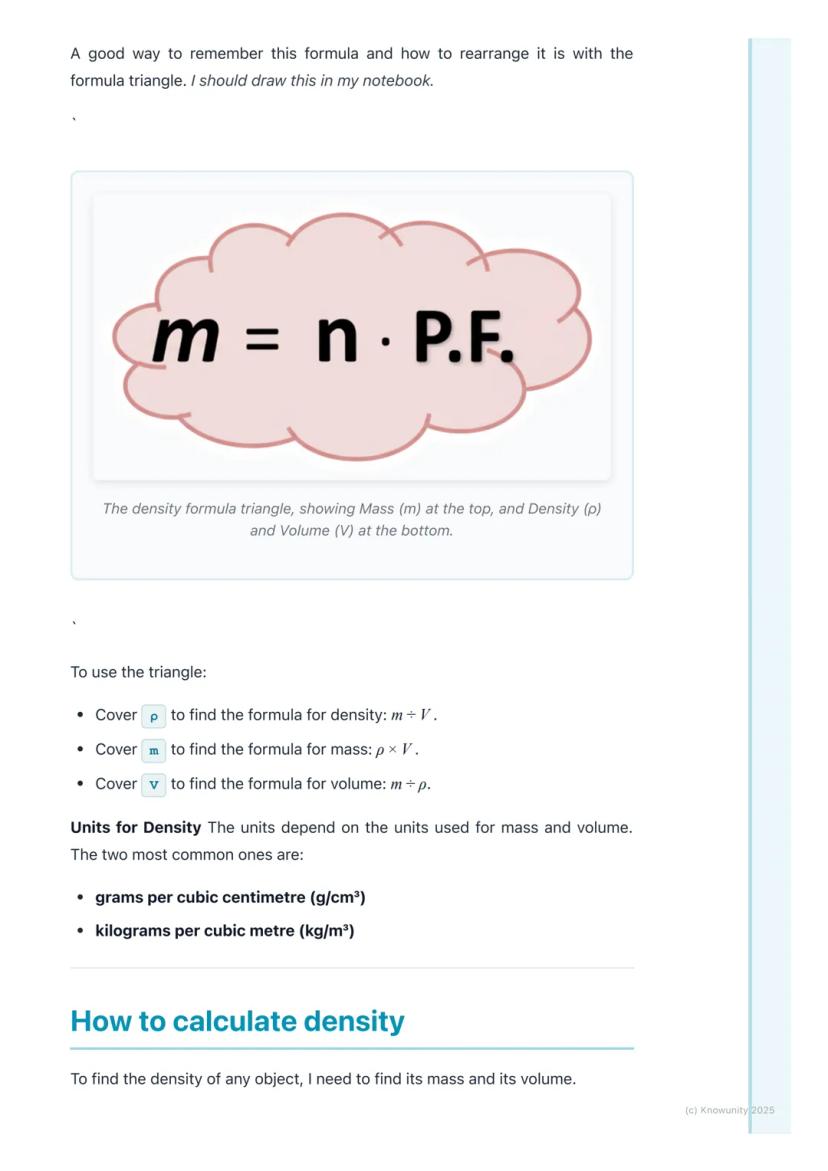
Here's a brilliant trick to remember the density formula and rearrange it easily. Draw a triangle with mass (m) at the top, and density (ρ) and volume (V) at the bottom.
To use it, just cover what you want to find. Cover ρ to get density: m ÷ V. Cover m to get mass: ρ × V. Cover V to get volume: m ÷ ρ.
Units for density depend on what you use for mass and volume. The two most common are grams per cubic centimetre and kilograms per cubic metre . Always check your units match before calculating!
Remember: 1 millilitre equals 1 cubic centimetre . This conversion pops up constantly in exams.
3
of 6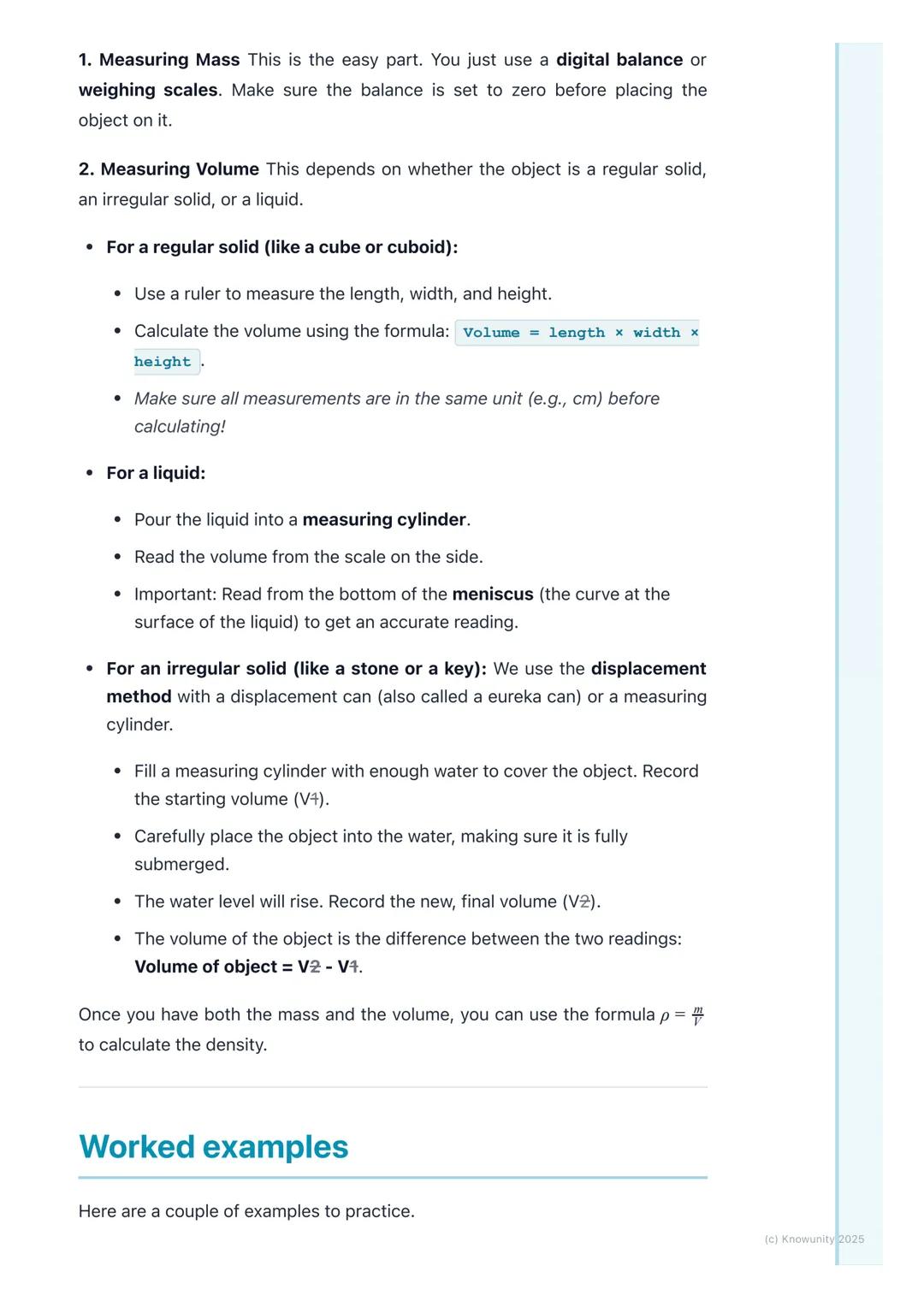
Measuring Mass and Volume
Measuring mass is straightforward - just use digital scales or a balance. Always zero the balance first for accurate readings.
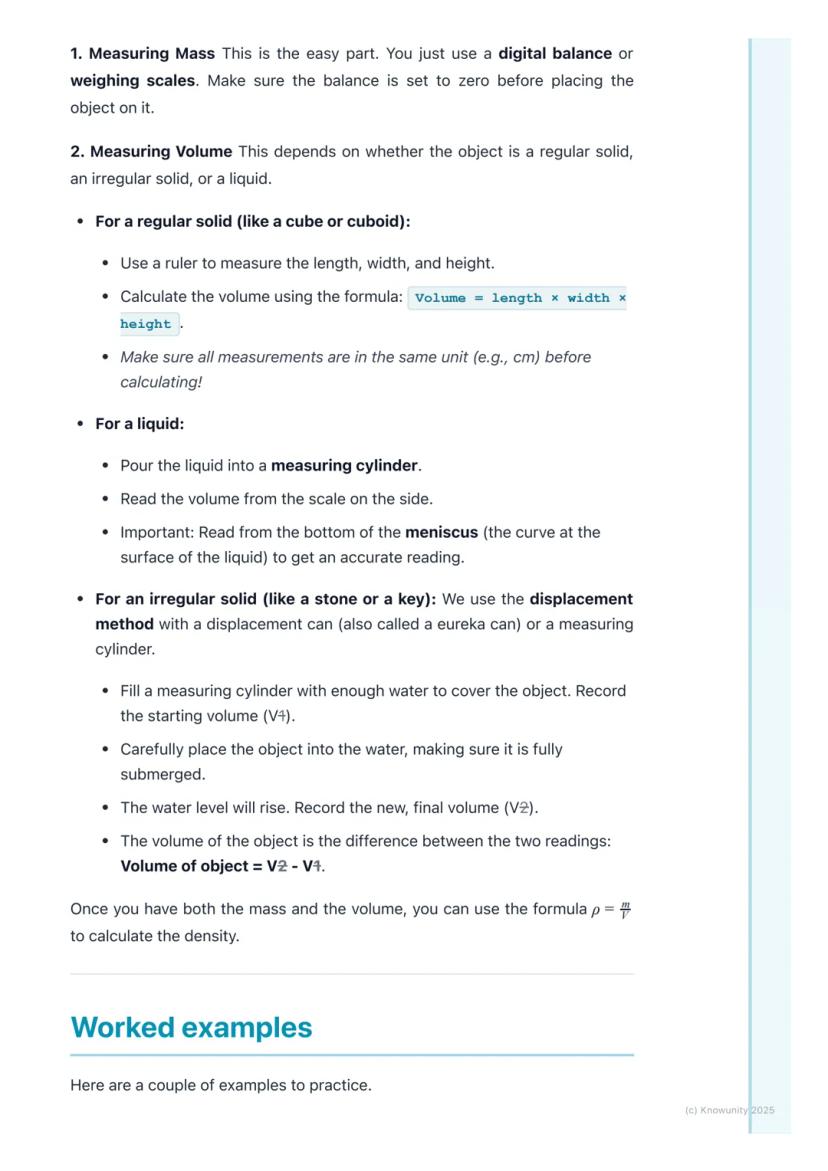
Volume measurement depends on your object's shape. For regular solids like cubes, measure length, width, and height with a ruler, then multiply them together. Make sure all measurements use the same units!
For liquids, pour into a measuring cylinder and read from the bottom of the meniscus (that curved surface). For irregular solids like stones, use the displacement method. Fill a measuring cylinder with water, record the starting volume (V₁), add your object, then record the new volume (V₂). The object's volume is V₂ - V₁.
Common Mistake: Don't just write down the final water level - you need the difference between final and initial volumes!
4
of 6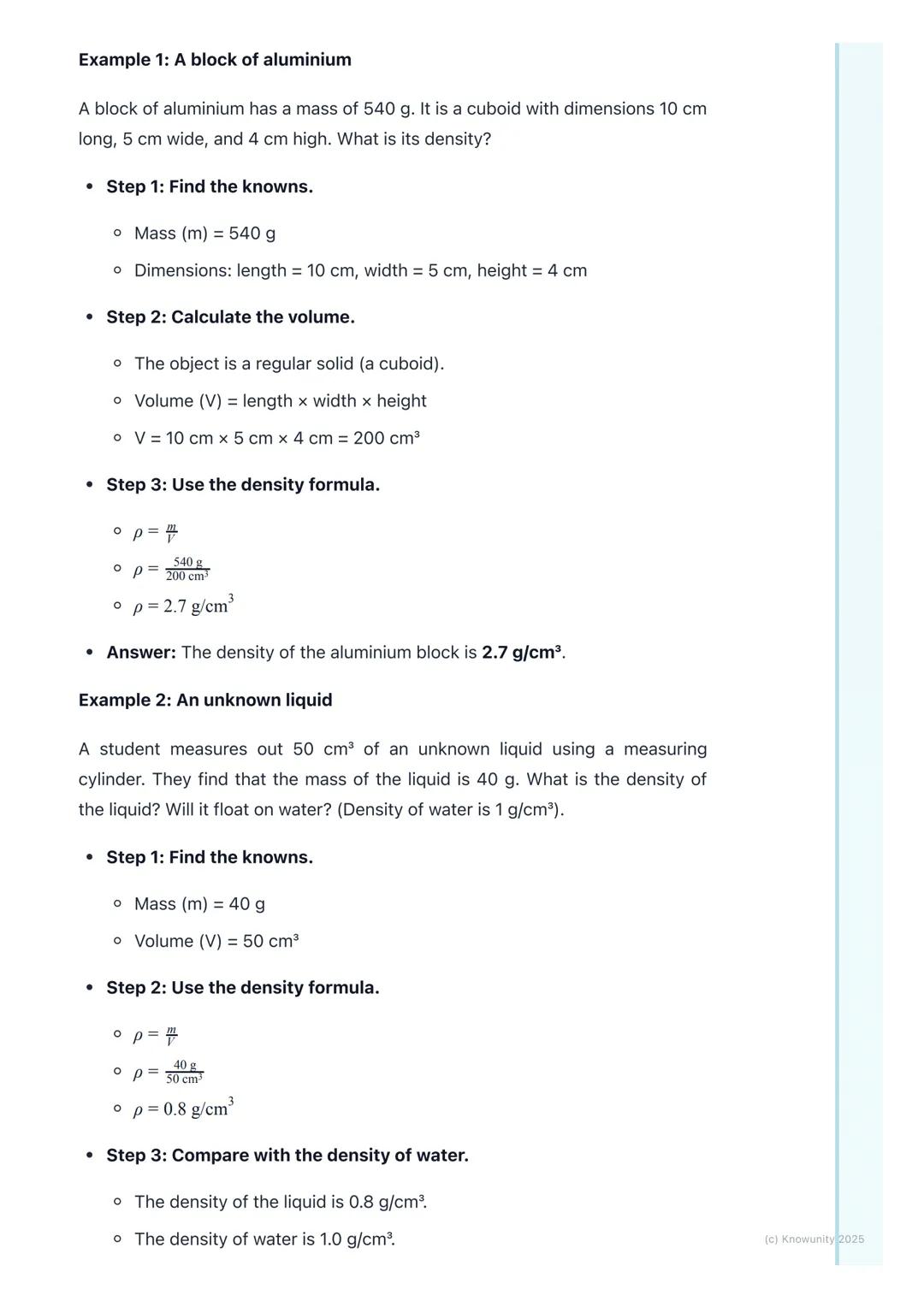
Worked Examples
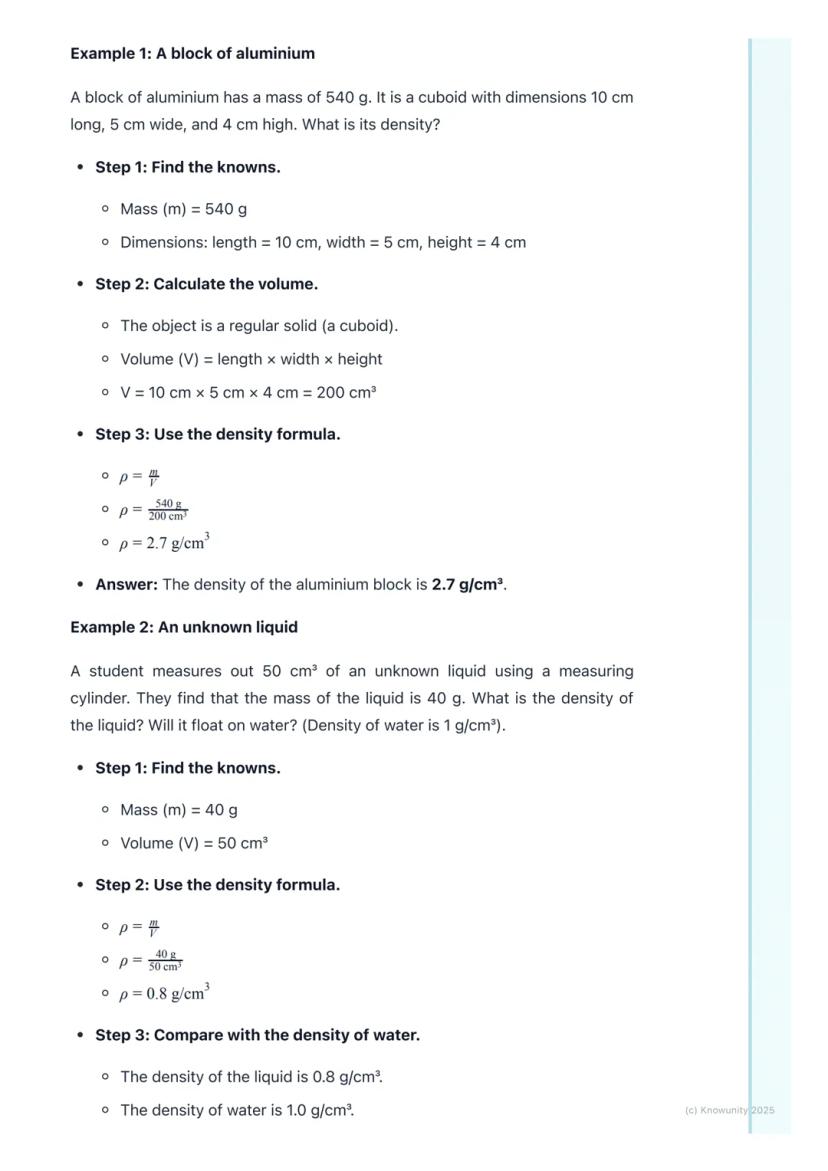
Let's tackle a density calculation with an aluminium block. It has a mass of 540g and measures 10cm × 5cm × 4cm.
First, calculate the volume: 10 × 5 × 4 = 200 cm³. Then use the formula: ρ = 540g ÷ 200cm³ = 2.7 g/cm³.
Here's another example: 50 cm³ of unknown liquid has a mass of 40g. Using ρ = m/V: 40g ÷ 50cm³ = 0.8 g/cm³. Since water has a density of 1 g/cm³, this liquid is less dense than water and will float.
The key to success is working systematically - identify what you know, calculate what you need, then apply the formula carefully.
Exam Tip: Always include units in your final answer. You'll lose marks without them, even if your calculation is perfect!
5
of 6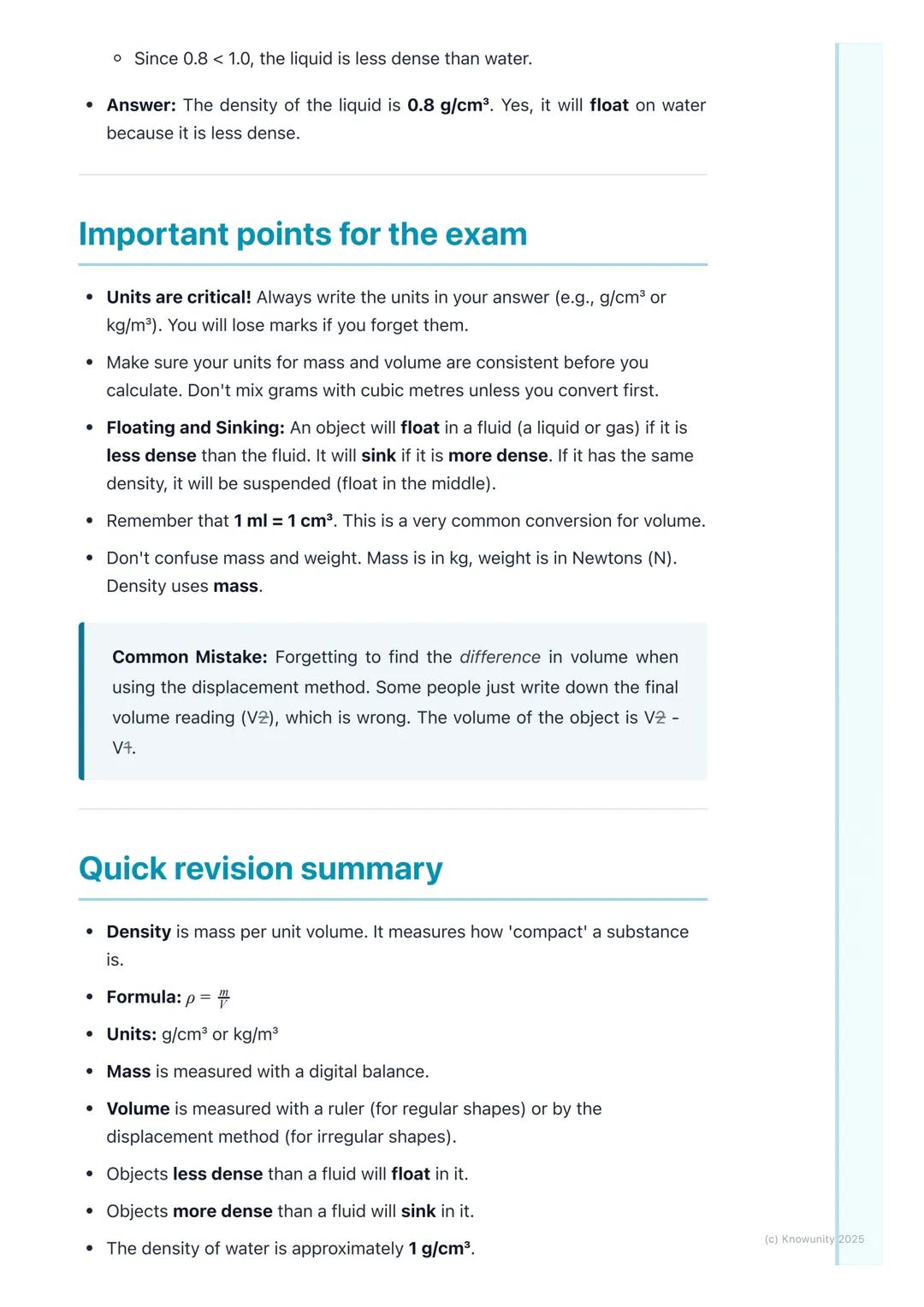
Floating, Sinking, and Exam Success
Understanding density helps predict floating and sinking. Objects less dense than a fluid will float; denser objects will sink. If densities match exactly, the object hovers suspended in the middle.
For exam success, remember these crucial points: units are absolutely essential, keep mass and volume units consistent, and don't confuse mass (kg) with weight (N). Density always uses mass, not weight.
Water's density is approximately 1 g/cm³ - memorise this because it's your reference point for comparing other substances. Oil floats on water because it's less dense, while rocks sink because they're denser.
Quick Check: If you're using the displacement method, always subtract the initial water volume from the final volume. This catches out loads of students!
6
of 6
Hiç sormayacaksın sanmıştık...
Knowunity yapay zeka arkadaşı nedir?
Yapay zeka arkadaşımız öğrencilerin ihtiyaçlarına göre özel olarak tasarlanmıştır. Platformda bulunan milyonlarca içeriğe dayanarak öğrencilere gerçekten anlamlı ve ilgili yanıtlar verebiliyoruz. Ancak mesele sadece cevaplar değil, refakatçi aynı zamanda kişiselleştirilmiş öğrenme planları, sınavlar veya sohbet içerikleri ve öğrencilerin becerilerine ve gelişimlerine dayalı %100 kişiselleştirme ile öğrencilere günlük öğrenme zorluklarında rehberlik ediyor.
Knowunity uygulamasını nereden indirebilirim?
Uygulamayı Google Play Store ve Apple App Store'dan indirebilirsiniz.
Knowunity ücretsiz mi?
Knowunity uygulaması ücretsiz! Uygulamamız çok yakında indirmeye hazır olacak, bekle bizi. 💙
Physics dersinin en popüler içerikleri
3PhysicsBalanced and Unbalanced Forces
Students will explore how balanced forces result in no change in motion, while unbalanced forces cause an object to accelerate or change direction.
2nd Year421
PhysicsTypes of Forces
Students will identify common forces such as gravity (pulling objects down), friction (opposing motion), and air resistance (slowing objects in the air).
2nd Year460
PhysicsSpeed, Distance, and Time
Students will learn the basic concepts of speed, distance, and time, and how they relate to each other in describing motion.
2nd Year100
En popüler içerikler
9 Irish
IrishIrish oral questions and answers
Questions and answers for the leaving cert oral
5th Year4254
IrishIrish oral questions
Outline of oral questions
5th Year2055
 English
Key Quotes : Sive
Key Quotes and explanations: Sive
6th Year2822
IrishIníon- le hÁine Durkin
Aine Durkin’s poem, Iníon: Themes & summary
5th Year850
IrishIrish poetry 2027
Iníon + Dínit an Bhróin
5th Year1133
IrishLC HL notes- Iníon (poem)
Includes poem in English and Irish, theme, key words & phrases
5th Year2284
IrishGaeilge Grammar Office
All the basics you need to know on Irish grammar.
6th Year1013
EnglishCultural Context : Shawshank Redemption : Sive : Small Things Like These
Comparative Study : Cultural Context : Shawshank Redemption, Sive and Small Things Like These
6th Year1420
IrishAn Gaeilge Aiste
Irish Language essay
6th Year1310
Aradığını bulamıyor musun? Diğer derslere göz at.
Kullanıcılarımızdan yorumlar. Onlar her şeyi çok beğendi — sen de beğeneceksin.
4.6/5App Store
4.7/5Google Play
Uygulama çok kolay kullanılıyor ve güzel tasarlanmış. Şu ana kadar aradığım her şeyi buldum ve sunumlardan çok şey öğrendim! Kesinlikle ödevlerim için hep kullanacağım!
A.S.iOS kullanıcısı
Uygulama çok iyi. Çok fazla ders notu ve yardımlaşma var. Örneğin benim problem yaşadığım bir ders Geometriydi ve ANINDA yardım ettiler beraber hem sorularımı çözdük hem konu anlatımı buldum. Herkese tavsiye ederim.
S.L.Android kullanıcısı
BEN ŞOK. Reklamını sık sık gördüğüm için uygulamayı denedim ve gerçekten hayran kaldım. Bu uygulama okul için tam ihtiyacım olan şey. Anında ödev yardımı, konu anlatımı, örnek sınavlar, flaşkartlar hepsi hepsi var, şiddetle tavsiye ederim ✅
A.iOS kullanıcısı
Physics4 görüntüleme·Güncellendi May 26, 2026·6 sayfaUnderstanding Density: Definition and Calculation
Ever wondered why oil floats on water or why a tiny piece of gold feels so heavy? It's all about density - one of the most practical physics concepts you'll use. Understanding density helps explain everything from why ships float... Daha fazla göster
1
of 6Ders notlarını görmek için kaydol. Ücretsiz!
- Tüm belgeleri görebilirsin
- Notlarını Yükselt
- Milyonlarca öğrenciye katıl
What is Density?
Think of density as how tightly packed the "stuff" is in any object. If you've got two blocks the same size, the heavier one is more dense. A lead block feels much heavier than a wooden block of the same size because lead packs way more matter into the same space.
Density is basically mass per unit volume - it tells you how much matter is crammed into a given space. The symbol for density is ρ (rho), which looks like a curvy 'p'.
The key formula you need to master is: ρ = m/V . This simple equation is your ticket to solving loads of physics problems.
Quick Tip: Remember that mass (measured in grams or kilograms) isn't the same as weight. Mass stays constant wherever you go, even on the moon!
2
of 6Ders notlarını görmek için kaydol. Ücretsiz!
- Tüm belgeleri görebilirsin
- Notlarını Yükselt
- Milyonlarca öğrenciye katıl
The Formula Triangle and Units
Here's a brilliant trick to remember the density formula and rearrange it easily. Draw a triangle with mass (m) at the top, and density (ρ) and volume (V) at the bottom.
To use it, just cover what you want to find. Cover ρ to get density: m ÷ V. Cover m to get mass: ρ × V. Cover V to get volume: m ÷ ρ.
Units for density depend on what you use for mass and volume. The two most common are grams per cubic centimetre and kilograms per cubic metre . Always check your units match before calculating!
Remember: 1 millilitre equals 1 cubic centimetre . This conversion pops up constantly in exams.
3
of 6Ders notlarını görmek için kaydol. Ücretsiz!
- Tüm belgeleri görebilirsin
- Notlarını Yükselt
- Milyonlarca öğrenciye katıl
Measuring Mass and Volume
Measuring mass is straightforward - just use digital scales or a balance. Always zero the balance first for accurate readings.
Volume measurement depends on your object's shape. For regular solids like cubes, measure length, width, and height with a ruler, then multiply them together. Make sure all measurements use the same units!
For liquids, pour into a measuring cylinder and read from the bottom of the meniscus (that curved surface). For irregular solids like stones, use the displacement method. Fill a measuring cylinder with water, record the starting volume (V₁), add your object, then record the new volume (V₂). The object's volume is V₂ - V₁.
Common Mistake: Don't just write down the final water level - you need the difference between final and initial volumes!
4
of 6Ders notlarını görmek için kaydol. Ücretsiz!
- Tüm belgeleri görebilirsin
- Notlarını Yükselt
- Milyonlarca öğrenciye katıl
Worked Examples
Let's tackle a density calculation with an aluminium block. It has a mass of 540g and measures 10cm × 5cm × 4cm.
First, calculate the volume: 10 × 5 × 4 = 200 cm³. Then use the formula: ρ = 540g ÷ 200cm³ = 2.7 g/cm³.
Here's another example: 50 cm³ of unknown liquid has a mass of 40g. Using ρ = m/V: 40g ÷ 50cm³ = 0.8 g/cm³. Since water has a density of 1 g/cm³, this liquid is less dense than water and will float.
The key to success is working systematically - identify what you know, calculate what you need, then apply the formula carefully.
Exam Tip: Always include units in your final answer. You'll lose marks without them, even if your calculation is perfect!
5
of 6Ders notlarını görmek için kaydol. Ücretsiz!
- Tüm belgeleri görebilirsin
- Notlarını Yükselt
- Milyonlarca öğrenciye katıl
Floating, Sinking, and Exam Success
Understanding density helps predict floating and sinking. Objects less dense than a fluid will float; denser objects will sink. If densities match exactly, the object hovers suspended in the middle.
For exam success, remember these crucial points: units are absolutely essential, keep mass and volume units consistent, and don't confuse mass (kg) with weight (N). Density always uses mass, not weight.
Water's density is approximately 1 g/cm³ - memorise this because it's your reference point for comparing other substances. Oil floats on water because it's less dense, while rocks sink because they're denser.
Quick Check: If you're using the displacement method, always subtract the initial water volume from the final volume. This catches out loads of students!
6
of 6Ders notlarını görmek için kaydol. Ücretsiz!
- Tüm belgeleri görebilirsin
- Notlarını Yükselt
- Milyonlarca öğrenciye katıl
Hiç sormayacaksın sanmıştık...
Knowunity yapay zeka arkadaşı nedir?
Yapay zeka arkadaşımız öğrencilerin ihtiyaçlarına göre özel olarak tasarlanmıştır. Platformda bulunan milyonlarca içeriğe dayanarak öğrencilere gerçekten anlamlı ve ilgili yanıtlar verebiliyoruz. Ancak mesele sadece cevaplar değil, refakatçi aynı zamanda kişiselleştirilmiş öğrenme planları, sınavlar veya sohbet içerikleri ve öğrencilerin becerilerine ve gelişimlerine dayalı %100 kişiselleştirme ile öğrencilere günlük öğrenme zorluklarında rehberlik ediyor.
Knowunity uygulamasını nereden indirebilirim?
Uygulamayı Google Play Store ve Apple App Store'dan indirebilirsiniz.
Knowunity ücretsiz mi?
Knowunity uygulaması ücretsiz! Uygulamamız çok yakında indirmeye hazır olacak, bekle bizi. 💙
Physics dersinin en popüler içerikleri
3PhysicsBalanced and Unbalanced Forces
Students will explore how balanced forces result in no change in motion, while unbalanced forces cause an object to accelerate or change direction.
2nd Year421
PhysicsTypes of Forces
Students will identify common forces such as gravity (pulling objects down), friction (opposing motion), and air resistance (slowing objects in the air).
2nd Year460
PhysicsSpeed, Distance, and Time
Students will learn the basic concepts of speed, distance, and time, and how they relate to each other in describing motion.
2nd Year100
En popüler içerikler
9IrishIrish oral questions and answers
Questions and answers for the leaving cert oral
5th Year4254
IrishIrish oral questions
Outline of oral questions
5th Year2055
EnglishKey Quotes : Sive
Key Quotes and explanations: Sive
6th Year2822
IrishIníon- le hÁine Durkin
Aine Durkin’s poem, Iníon: Themes & summary
5th Year850
IrishIrish poetry 2027
Iníon + Dínit an Bhróin
5th Year1133
IrishLC HL notes- Iníon (poem)
Includes poem in English and Irish, theme, key words & phrases
5th Year2284
IrishGaeilge Grammar Office
All the basics you need to know on Irish grammar.
6th Year1013
EnglishCultural Context : Shawshank Redemption : Sive : Small Things Like These
Comparative Study : Cultural Context : Shawshank Redemption, Sive and Small Things Like These
6th Year1420
IrishAn Gaeilge Aiste
Irish Language essay
6th Year1310
Aradığını bulamıyor musun? Diğer derslere göz at.
Kullanıcılarımızdan yorumlar. Onlar her şeyi çok beğendi — sen de beğeneceksin.
4.6/5App Store
4.7/5Google Play
Uygulama çok kolay kullanılıyor ve güzel tasarlanmış. Şu ana kadar aradığım her şeyi buldum ve sunumlardan çok şey öğrendim! Kesinlikle ödevlerim için hep kullanacağım!
A.S.iOS kullanıcısı
Uygulama çok iyi. Çok fazla ders notu ve yardımlaşma var. Örneğin benim problem yaşadığım bir ders Geometriydi ve ANINDA yardım ettiler beraber hem sorularımı çözdük hem konu anlatımı buldum. Herkese tavsiye ederim.
S.L.Android kullanıcısı
BEN ŞOK. Reklamını sık sık gördüğüm için uygulamayı denedim ve gerçekten hayran kaldım. Bu uygulama okul için tam ihtiyacım olan şey. Anında ödev yardımı, konu anlatımı, örnek sınavlar, flaşkartlar hepsi hepsi var, şiddetle tavsiye ederim ✅
A.iOS kullanıcısı