
Ever wondered how musicians can look at squiggly lines and... Daha fazla göster
 Music3 görüntüleme·Güncellendi Jun 6, 2026·6 sayfa
Understanding the Staff, Lines, and Clefs
1 / 6
1
of 6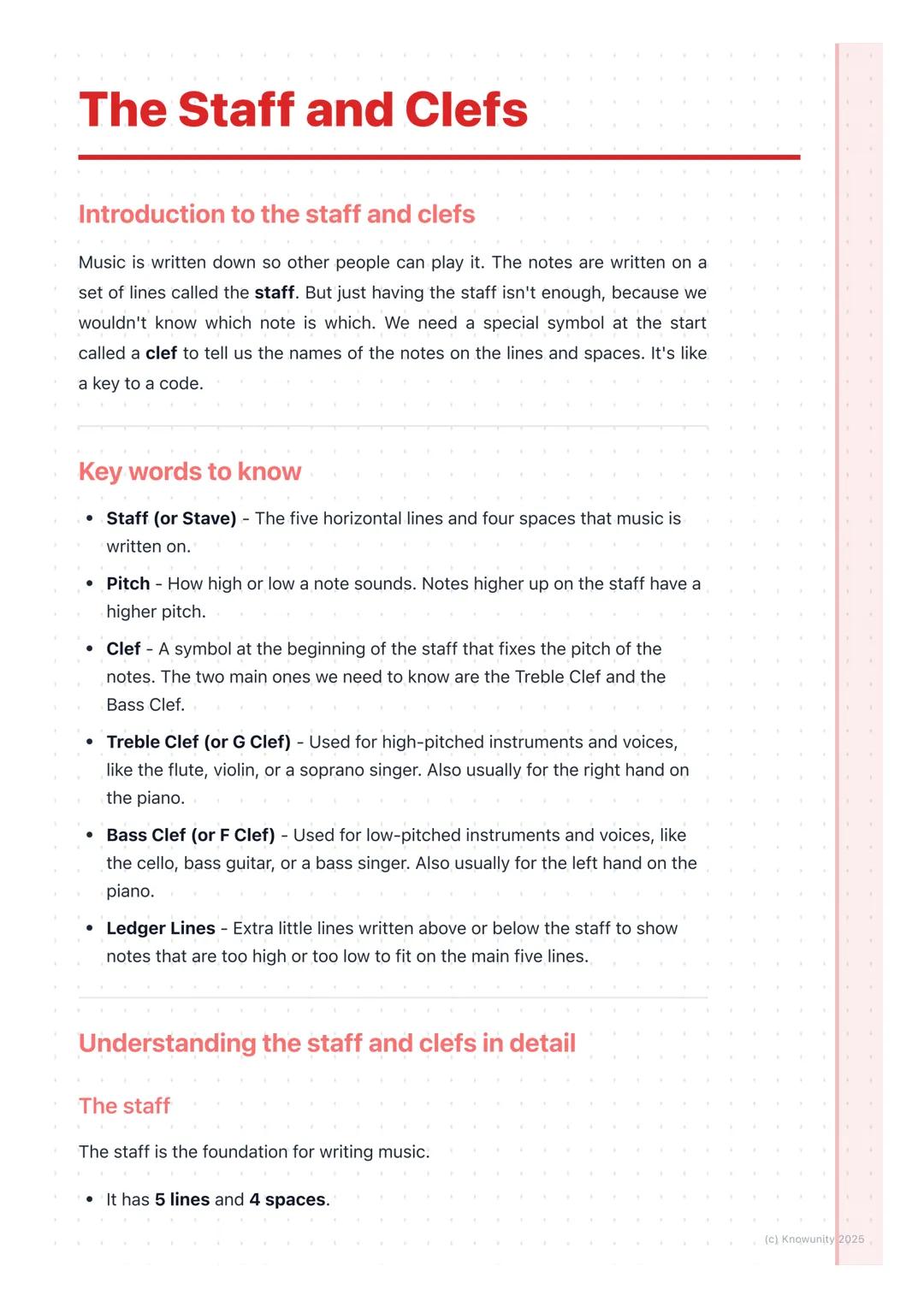
The Staff and Clefs Basics
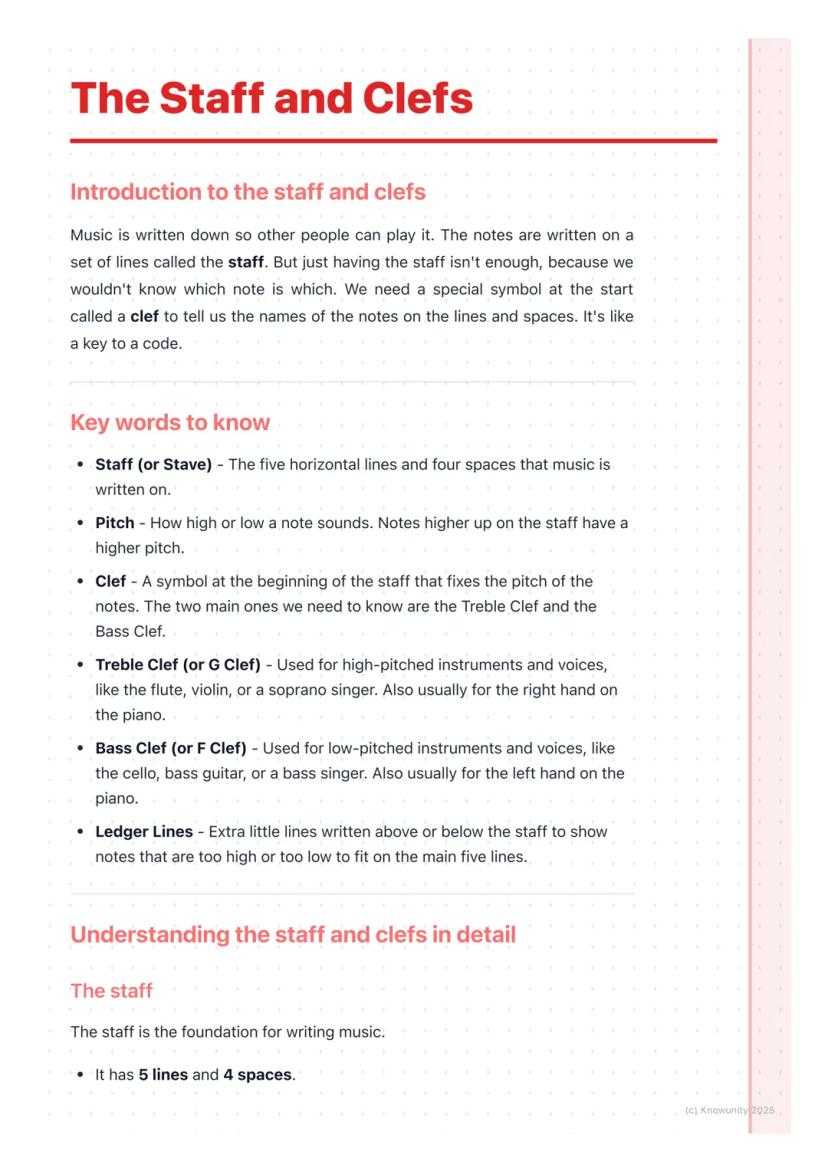
Think of the staff as music's address system - without it, notes would be homeless! The staff is made up of 5 horizontal lines and 4 spaces where all musical notes live. But here's the thing: those lines and spaces mean nothing without a special symbol at the beginning called a clef.
A clef is like a musical GPS - it tells you exactly which note is which. The pitch (how high or low a note sounds) depends on where it sits on the staff and which clef you're using. Notes higher up on the staff have a higher pitch than notes lower down.
There are two main clefs you need to master: the treble clef (for high sounds like flutes and sopranos) and the bass clef (for low sounds like cellos and bass guitars). Most piano music uses both - treble for the right hand, bass for the left.
Quick Tip: Always count lines and spaces from bottom to top - line 1 is at the bottom, line 5 is at the top!
2
of 6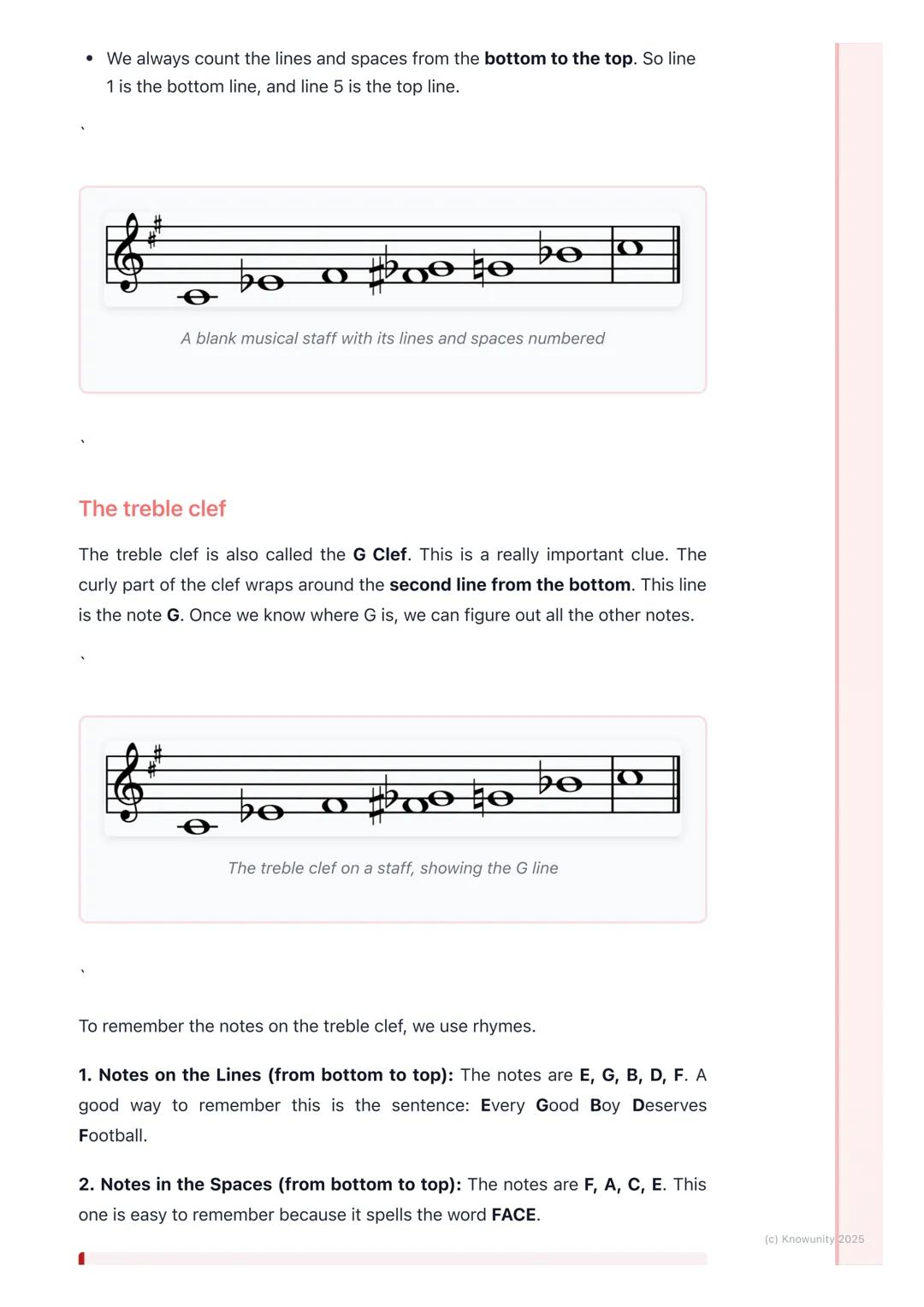
The Treble Clef (G Clef)
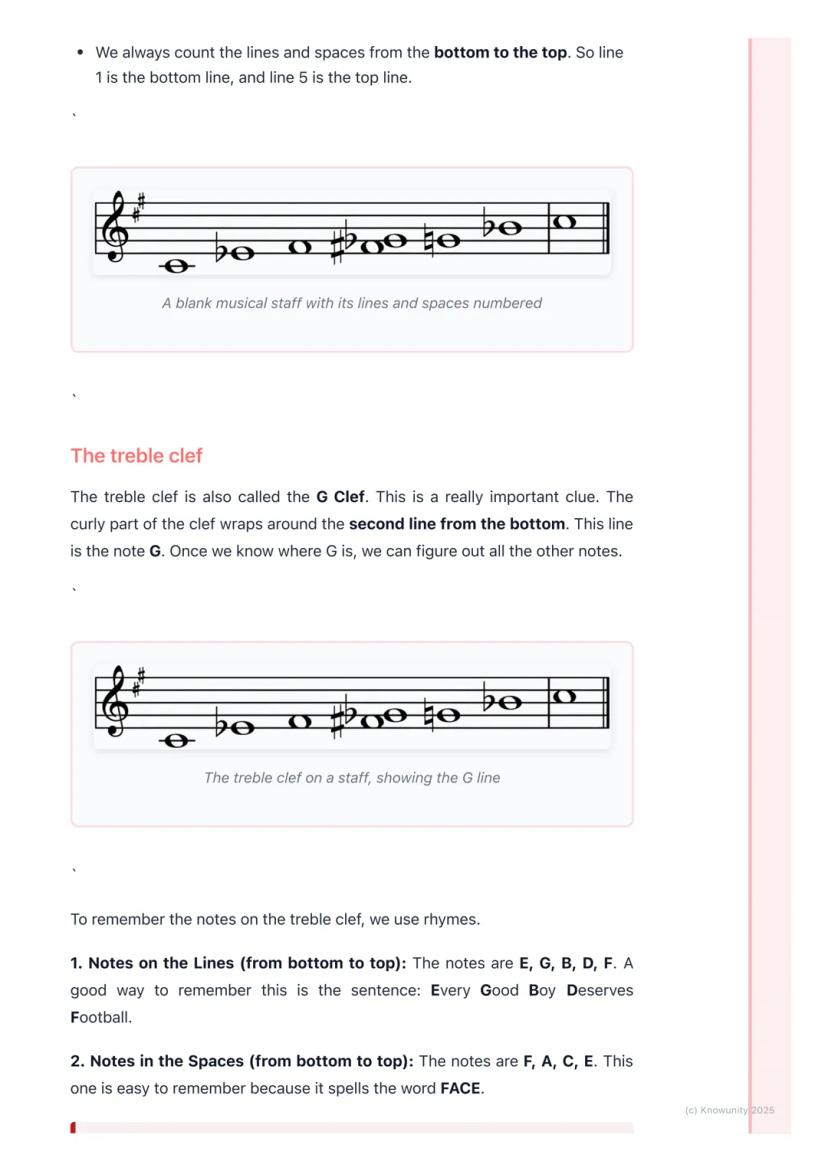
The treble clef is your best mate for reading high-pitched music. Here's a clever trick: it's also called the G clef because that curly bit wraps around the second line, marking where G lives. Once you know where G is, you can work out everything else!
For the lines (from bottom to top), the notes are E, G, B, D, F. Remember this with: "Every Good Boy Deserves Football". For the spaces (from bottom to top), you get F, A, C, E - which simply spells "FACE"!
The beauty of music is that notes follow alphabetical order: A, B, C, D, E, F, G, then back to A again. So if you know one note, just count up or down the alphabet to find the next one.
Memory Hack: FACE is super easy because it's actually a word - no complicated sentences to remember!
3
of 6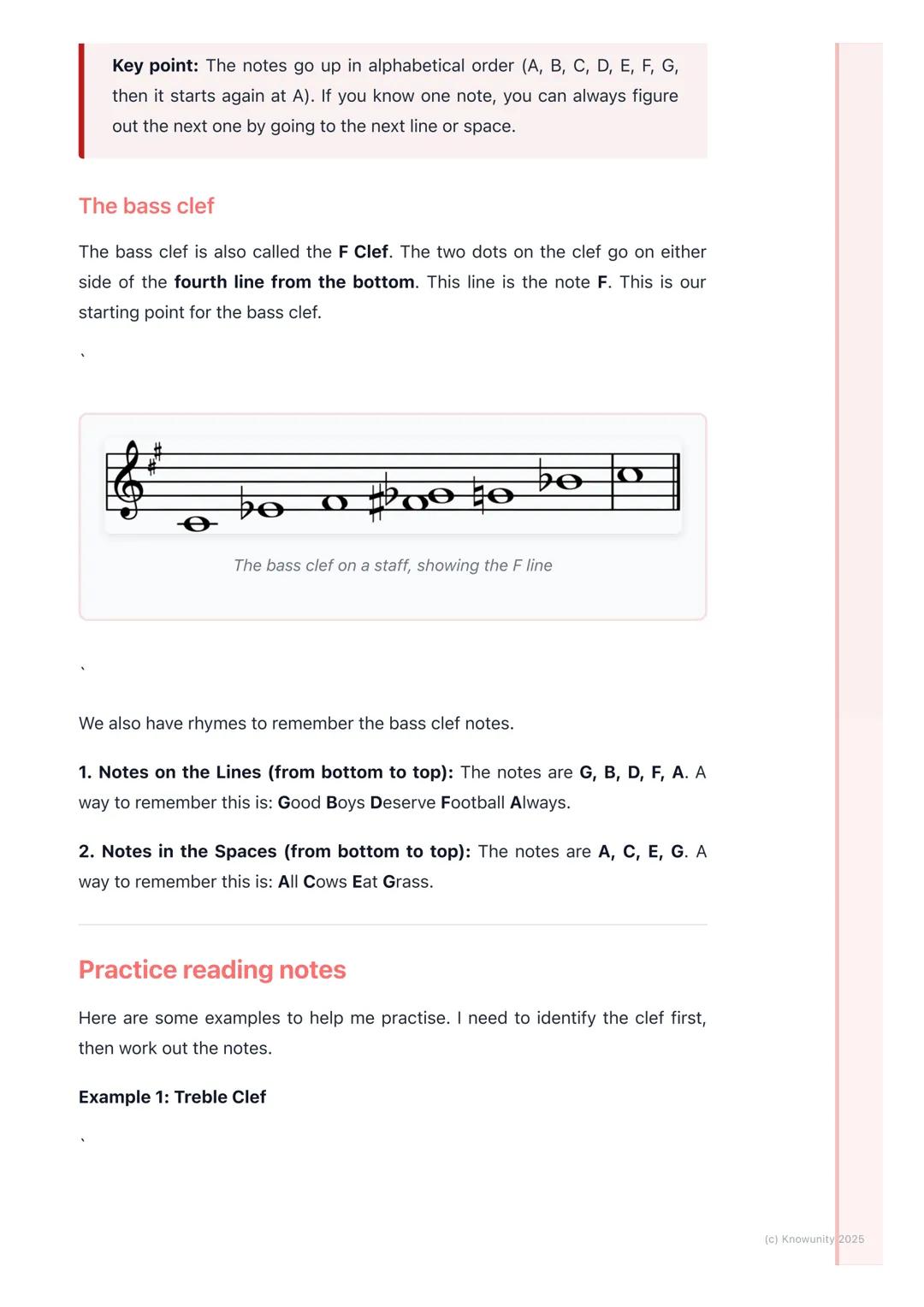
The Bass Clef (F Clef)
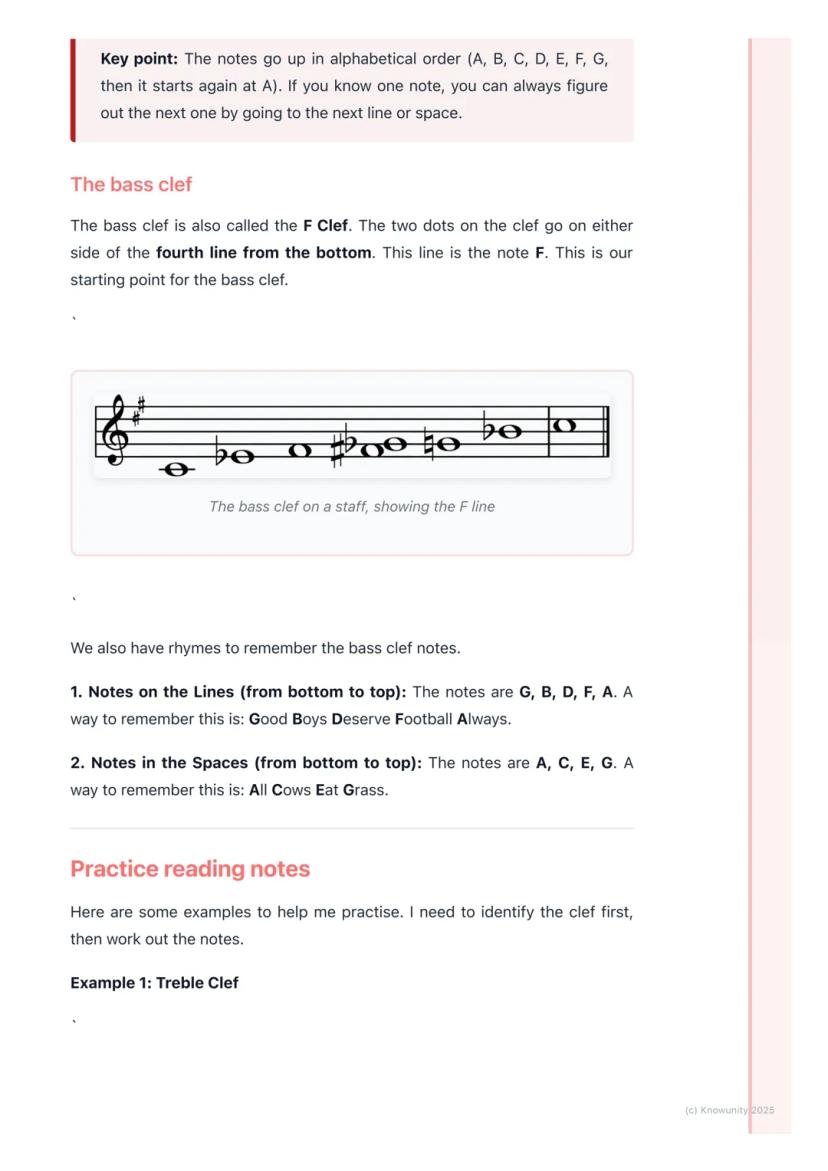
Now let's tackle the bass clef, also known as the F clef. Those two little dots sit on either side of the fourth line, marking where F lives. This is your starting point for reading bass clef notes.
For the lines in bass clef (bottom to top), you get G, B, D, F, A. Remember this with: "Good Boys Deserve Football Always". For the spaces, it's A, C, E, G - try "All Cows Eat Grass" to remember this one!
Notice how the bass clef rhymes are similar to treble clef but slightly different? That's because bass clef notes are positioned differently on the staff. The same line that's a B in treble clef is actually a D in bass clef!
Warning: Always check your clef first! This is the most common mistake students make - reading a note in the wrong clef.
4
of 6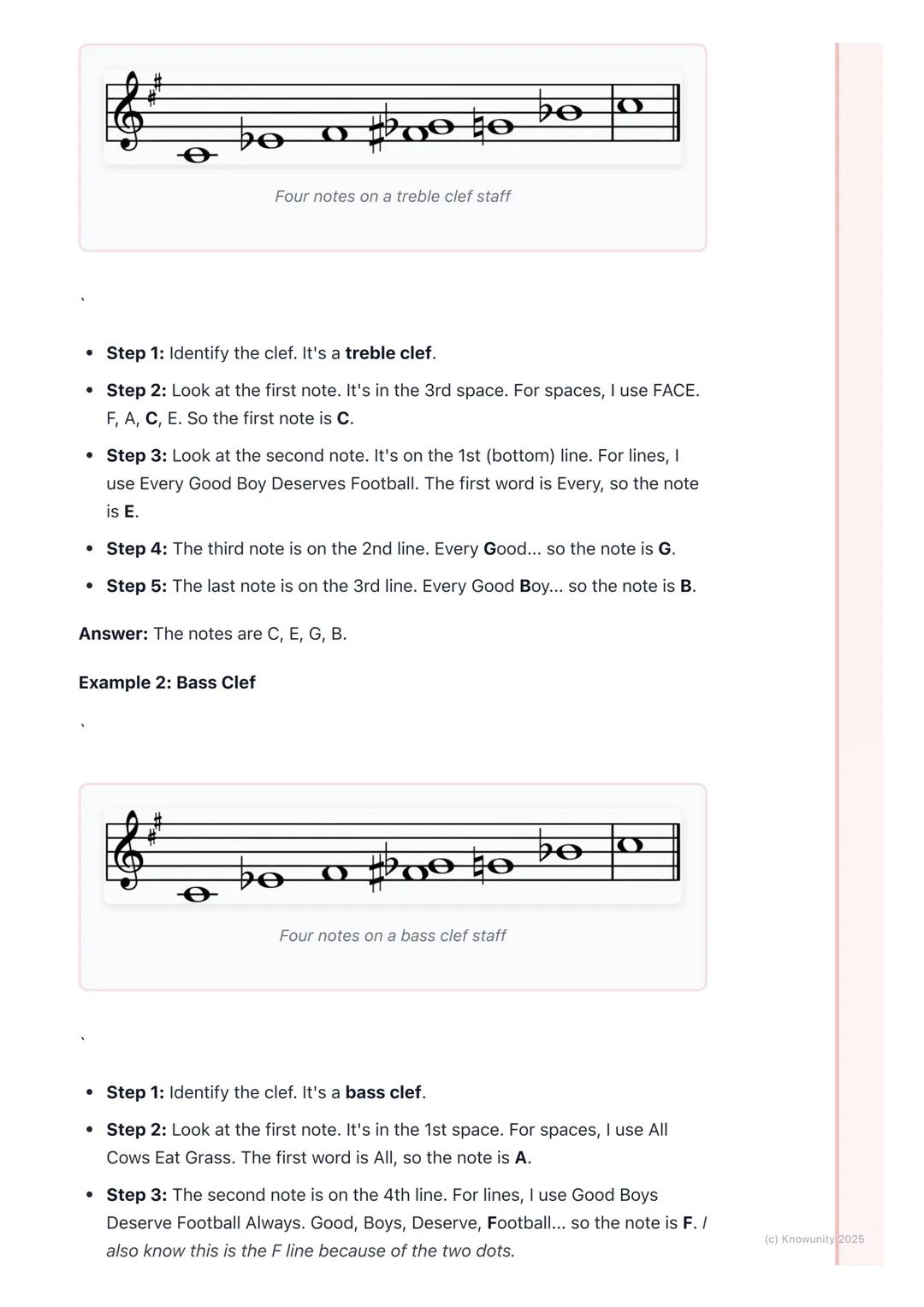
Reading Notes Step by Step
Let's put this into practice! When you see notes on a staff, follow these simple steps: identify the clef first, then use your rhymes to work out each note.
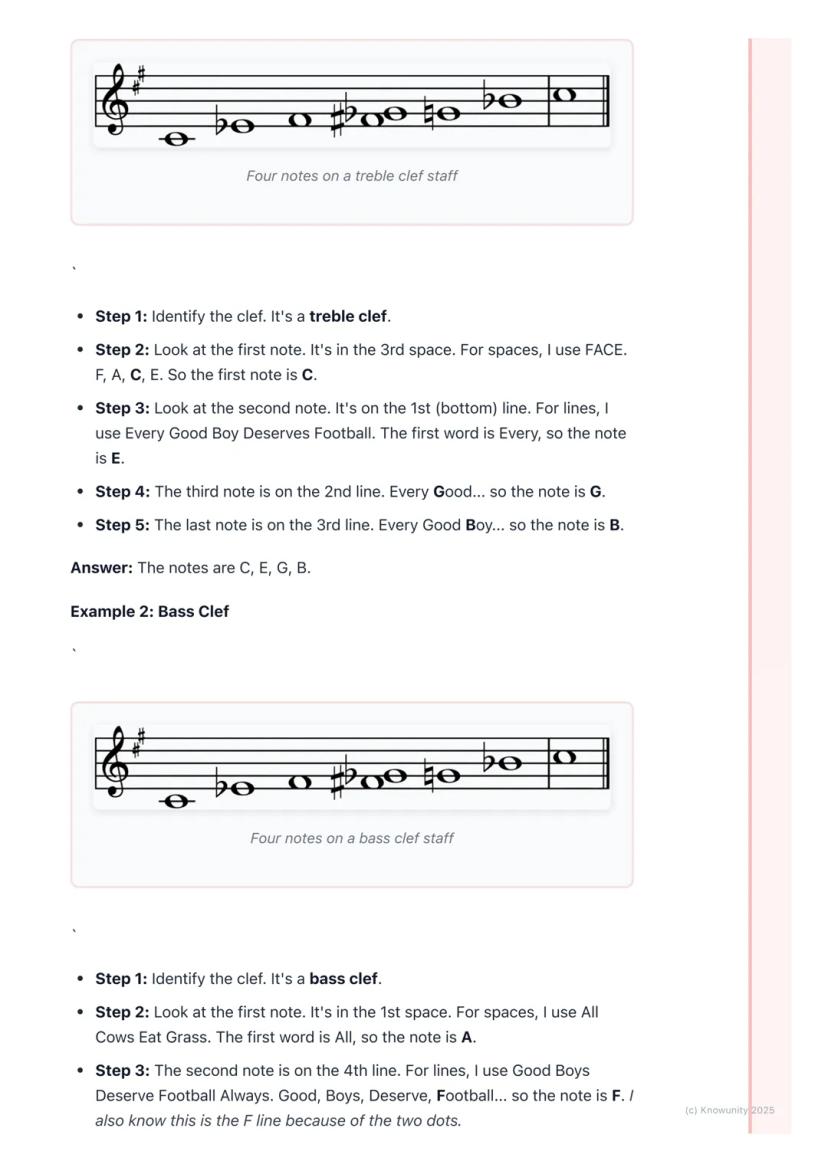
For treble clef example: If you see a note in the third space, think "FACE" - F, A, C... so it's C. If there's a note on the bottom line, think "Every Good Boy..." - the first word is Every, so it's E.
For bass clef example: A note in the first space means "All Cows Eat Grass" - All comes first, so it's A. A note on the fourth line (where the dots are) is always F in bass clef.
Pro Tip: The rhymes work like counting - use them in order from bottom to top, just like counting from 1 to 5!
5
of 6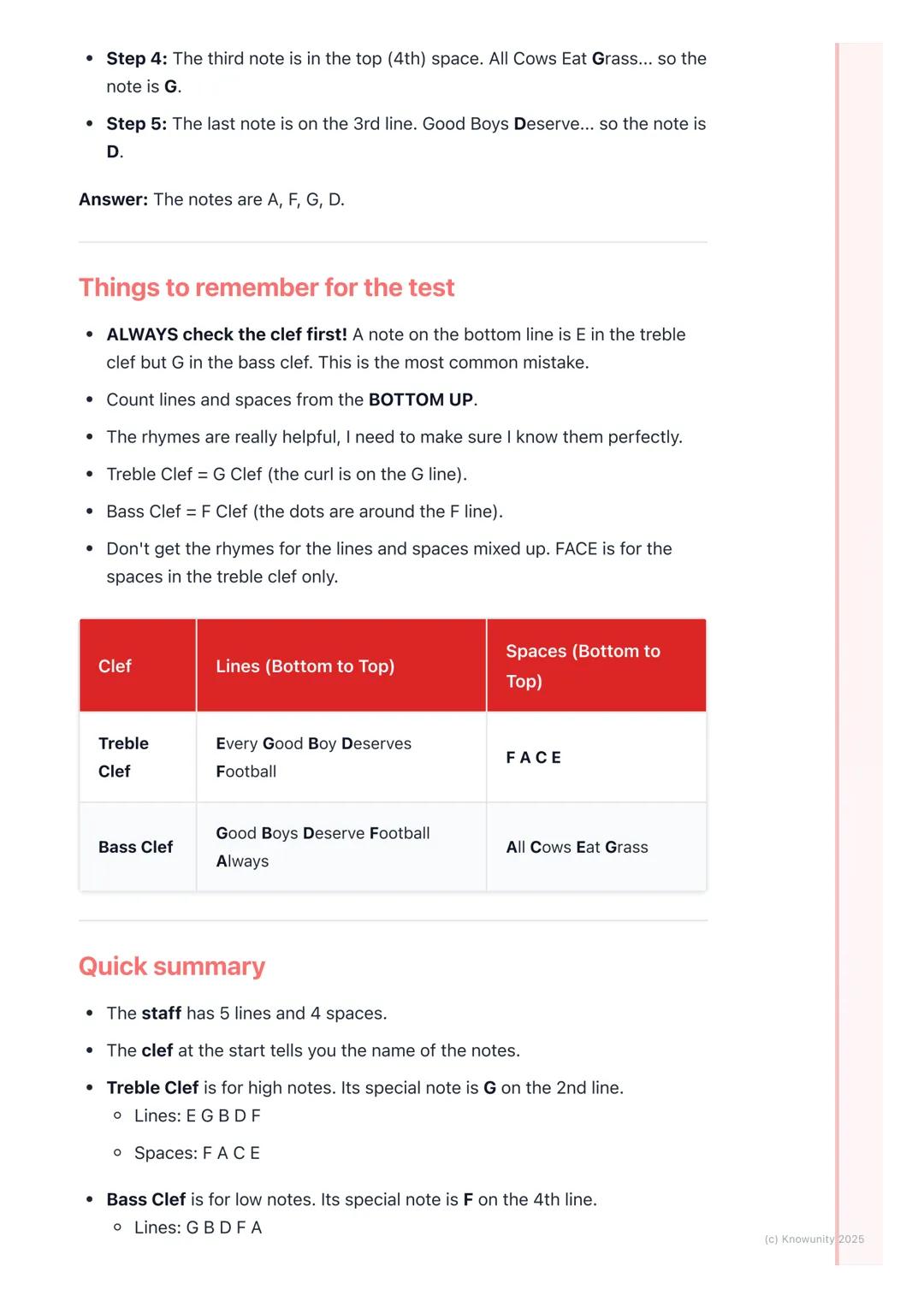
Test Preparation Essentials
Here's what you absolutely must remember for your test: always identify the clef before reading any notes! The same line can be completely different notes depending on the clef - E in treble becomes G in bass.
Your treble clef memory tools: Lines = "Every Good Boy Deserves Football" (EGBDF), Spaces = "FACE". Your bass clef memory tools: Lines = "Good Boys Deserve Football Always" (GBDFA), Spaces = "All Cows Eat Grass" (ACEG).
Remember that treble clef = G clef (the curl marks the G line) and bass clef = F clef (the dots mark the F line). Don't mix up the rhymes between clefs - FACE only works for treble clef spaces!
Exam Success: Practice identifying the clef first, then count from bottom to top using your rhymes - this method never fails!
6
of 6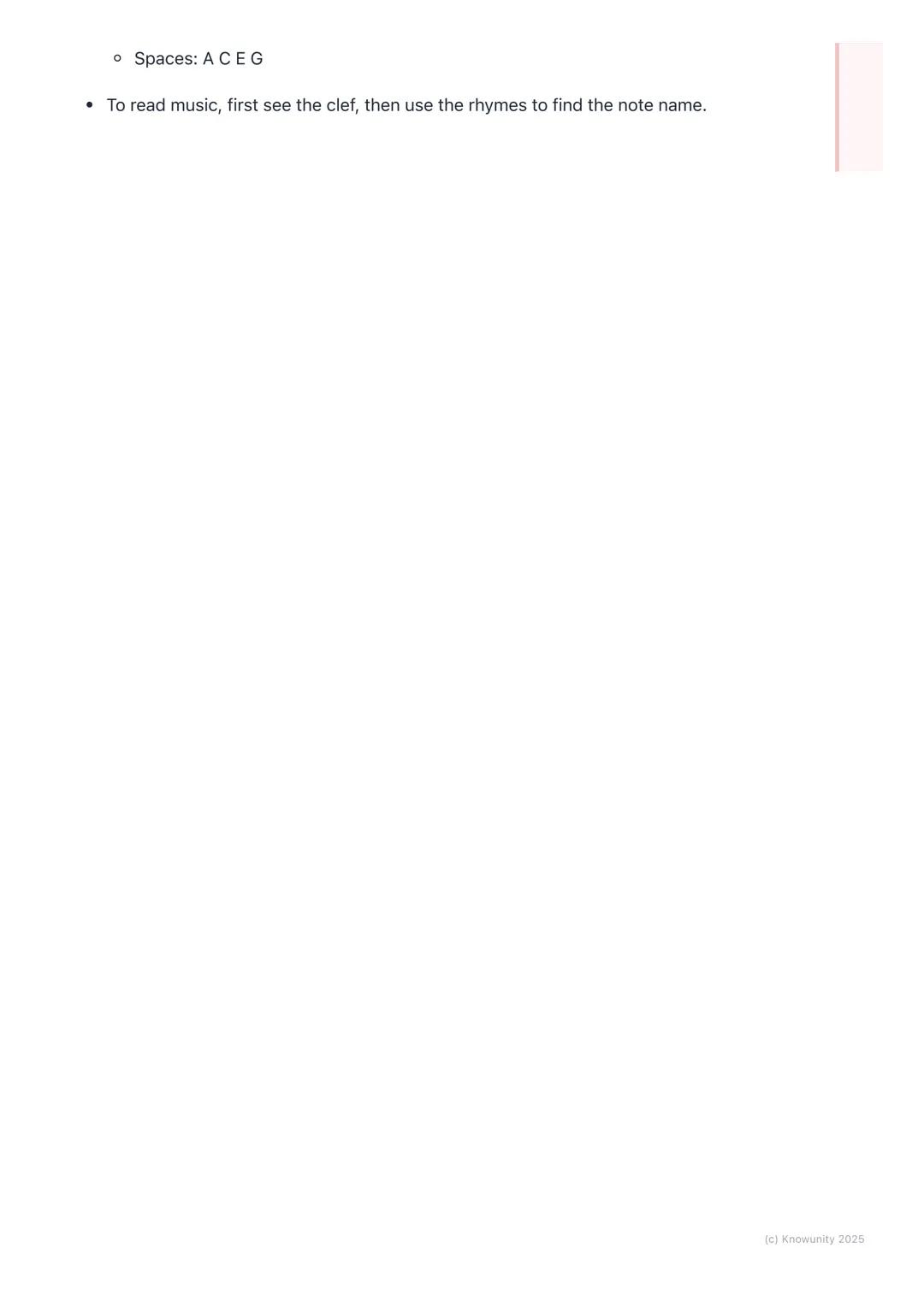
Quick Reference Summary
You've now got all the tools to read basic music notation! The staff gives notes their home, the clef tells you their names, and your rhymes help you remember everything.
Treble clef handles the high stuff (think violins and sopranos) with EGBDF for lines and FACE for spaces. Bass clef covers the low end (think cellos and bass guitars) with GBDFA for lines and ACEG for spaces. When in doubt, always check that clef symbol first - it's your musical compass that points you in the right direction every time!
Final Reminder: Master these rhymes and you'll never struggle with note reading again - it's like having a cheat code for music!
Hiç sormayacaksın sanmıştık...
Knowunity yapay zeka arkadaşı nedir?
Yapay zeka arkadaşımız öğrencilerin ihtiyaçlarına göre özel olarak tasarlanmıştır. Platformda bulunan milyonlarca içeriğe dayanarak öğrencilere gerçekten anlamlı ve ilgili yanıtlar verebiliyoruz. Ancak mesele sadece cevaplar değil, refakatçi aynı zamanda kişiselleştirilmiş öğrenme planları, sınavlar veya sohbet içerikleri ve öğrencilerin becerilerine ve gelişimlerine dayalı %100 kişiselleştirme ile öğrencilere günlük öğrenme zorluklarında rehberlik ediyor.
Knowunity uygulamasını nereden indirebilirim?
Uygulamayı Google Play Store ve Apple App Store'dan indirebilirsiniz.
Knowunity ücretsiz mi?
Knowunity uygulaması ücretsiz! Uygulamamız çok yakında indirmeye hazır olacak, bekle bizi. 💙
Music dersinin en popüler içerikleri
2En popüler içerikler
9Aradığını bulamıyor musun? Diğer derslere göz at.
Kullanıcılarımızdan yorumlar. Onlar her şeyi çok beğendi — sen de beğeneceksin.
4.6/5App Store
4.7/5Google Play
Uygulama çok kolay kullanılıyor ve güzel tasarlanmış. Şu ana kadar aradığım her şeyi buldum ve sunumlardan çok şey öğrendim! Kesinlikle ödevlerim için hep kullanacağım!
A.S.iOS kullanıcısı
Uygulama çok iyi. Çok fazla ders notu ve yardımlaşma var. Örneğin benim problem yaşadığım bir ders Geometriydi ve ANINDA yardım ettiler beraber hem sorularımı çözdük hem konu anlatımı buldum. Herkese tavsiye ederim.
S.L.Android kullanıcısı
BEN ŞOK. Reklamını sık sık gördüğüm için uygulamayı denedim ve gerçekten hayran kaldım. Bu uygulama okul için tam ihtiyacım olan şey. Anında ödev yardımı, konu anlatımı, örnek sınavlar, flaşkartlar hepsi hepsi var, şiddetle tavsiye ederim ✅
A.iOS kullanıcısı
Music3 görüntüleme·Güncellendi Jun 6, 2026·6 sayfaUnderstanding the Staff, Lines, and Clefs
Ever wondered how musicians can look at squiggly lines and turn them into beautiful music? It all starts with understanding the staff and clefs- the basic code that makes reading music possible. Once you crack this code, you'll be... Daha fazla göster
1
of 6Ders notlarını görmek için kaydol. Ücretsiz!
- Tüm belgeleri görebilirsin
- Notlarını Yükselt
- Milyonlarca öğrenciye katıl
The Staff and Clefs Basics
Think of the staff as music's address system - without it, notes would be homeless! The staff is made up of 5 horizontal lines and 4 spaces where all musical notes live. But here's the thing: those lines and spaces mean nothing without a special symbol at the beginning called a clef.
A clef is like a musical GPS - it tells you exactly which note is which. The pitch (how high or low a note sounds) depends on where it sits on the staff and which clef you're using. Notes higher up on the staff have a higher pitch than notes lower down.
There are two main clefs you need to master: the treble clef (for high sounds like flutes and sopranos) and the bass clef (for low sounds like cellos and bass guitars). Most piano music uses both - treble for the right hand, bass for the left.
Quick Tip: Always count lines and spaces from bottom to top - line 1 is at the bottom, line 5 is at the top!
2
of 6Ders notlarını görmek için kaydol. Ücretsiz!
- Tüm belgeleri görebilirsin
- Notlarını Yükselt
- Milyonlarca öğrenciye katıl
The Treble Clef (G Clef)
The treble clef is your best mate for reading high-pitched music. Here's a clever trick: it's also called the G clef because that curly bit wraps around the second line, marking where G lives. Once you know where G is, you can work out everything else!
For the lines (from bottom to top), the notes are E, G, B, D, F. Remember this with: "Every Good Boy Deserves Football". For the spaces (from bottom to top), you get F, A, C, E - which simply spells "FACE"!
The beauty of music is that notes follow alphabetical order: A, B, C, D, E, F, G, then back to A again. So if you know one note, just count up or down the alphabet to find the next one.
Memory Hack: FACE is super easy because it's actually a word - no complicated sentences to remember!
3
of 6Ders notlarını görmek için kaydol. Ücretsiz!
- Tüm belgeleri görebilirsin
- Notlarını Yükselt
- Milyonlarca öğrenciye katıl
The Bass Clef (F Clef)
Now let's tackle the bass clef, also known as the F clef. Those two little dots sit on either side of the fourth line, marking where F lives. This is your starting point for reading bass clef notes.
For the lines in bass clef (bottom to top), you get G, B, D, F, A. Remember this with: "Good Boys Deserve Football Always". For the spaces, it's A, C, E, G - try "All Cows Eat Grass" to remember this one!
Notice how the bass clef rhymes are similar to treble clef but slightly different? That's because bass clef notes are positioned differently on the staff. The same line that's a B in treble clef is actually a D in bass clef!
Warning: Always check your clef first! This is the most common mistake students make - reading a note in the wrong clef.
4
of 6Ders notlarını görmek için kaydol. Ücretsiz!
- Tüm belgeleri görebilirsin
- Notlarını Yükselt
- Milyonlarca öğrenciye katıl
Reading Notes Step by Step
Let's put this into practice! When you see notes on a staff, follow these simple steps: identify the clef first, then use your rhymes to work out each note.
For treble clef example: If you see a note in the third space, think "FACE" - F, A, C... so it's C. If there's a note on the bottom line, think "Every Good Boy..." - the first word is Every, so it's E.
For bass clef example: A note in the first space means "All Cows Eat Grass" - All comes first, so it's A. A note on the fourth line (where the dots are) is always F in bass clef.
Pro Tip: The rhymes work like counting - use them in order from bottom to top, just like counting from 1 to 5!
5
of 6Ders notlarını görmek için kaydol. Ücretsiz!
- Tüm belgeleri görebilirsin
- Notlarını Yükselt
- Milyonlarca öğrenciye katıl
Test Preparation Essentials
Here's what you absolutely must remember for your test: always identify the clef before reading any notes! The same line can be completely different notes depending on the clef - E in treble becomes G in bass.
Your treble clef memory tools: Lines = "Every Good Boy Deserves Football" (EGBDF), Spaces = "FACE". Your bass clef memory tools: Lines = "Good Boys Deserve Football Always" (GBDFA), Spaces = "All Cows Eat Grass" (ACEG).
Remember that treble clef = G clef (the curl marks the G line) and bass clef = F clef (the dots mark the F line). Don't mix up the rhymes between clefs - FACE only works for treble clef spaces!
Exam Success: Practice identifying the clef first, then count from bottom to top using your rhymes - this method never fails!
6
of 6Ders notlarını görmek için kaydol. Ücretsiz!
- Tüm belgeleri görebilirsin
- Notlarını Yükselt
- Milyonlarca öğrenciye katıl
Quick Reference Summary
You've now got all the tools to read basic music notation! The staff gives notes their home, the clef tells you their names, and your rhymes help you remember everything.
Treble clef handles the high stuff (think violins and sopranos) with EGBDF for lines and FACE for spaces. Bass clef covers the low end (think cellos and bass guitars) with GBDFA for lines and ACEG for spaces. When in doubt, always check that clef symbol first - it's your musical compass that points you in the right direction every time!
Final Reminder: Master these rhymes and you'll never struggle with note reading again - it's like having a cheat code for music!
Hiç sormayacaksın sanmıştık...
Knowunity yapay zeka arkadaşı nedir?
Yapay zeka arkadaşımız öğrencilerin ihtiyaçlarına göre özel olarak tasarlanmıştır. Platformda bulunan milyonlarca içeriğe dayanarak öğrencilere gerçekten anlamlı ve ilgili yanıtlar verebiliyoruz. Ancak mesele sadece cevaplar değil, refakatçi aynı zamanda kişiselleştirilmiş öğrenme planları, sınavlar veya sohbet içerikleri ve öğrencilerin becerilerine ve gelişimlerine dayalı %100 kişiselleştirme ile öğrencilere günlük öğrenme zorluklarında rehberlik ediyor.
Knowunity uygulamasını nereden indirebilirim?
Uygulamayı Google Play Store ve Apple App Store'dan indirebilirsiniz.
Knowunity ücretsiz mi?
Knowunity uygulaması ücretsiz! Uygulamamız çok yakında indirmeye hazır olacak, bekle bizi. 💙
Music dersinin en popüler içerikleri
2En popüler içerikler
9Aradığını bulamıyor musun? Diğer derslere göz at.
Kullanıcılarımızdan yorumlar. Onlar her şeyi çok beğendi — sen de beğeneceksin.
4.6/5App Store
4.7/5Google Play
Uygulama çok kolay kullanılıyor ve güzel tasarlanmış. Şu ana kadar aradığım her şeyi buldum ve sunumlardan çok şey öğrendim! Kesinlikle ödevlerim için hep kullanacağım!
A.S.iOS kullanıcısı
Uygulama çok iyi. Çok fazla ders notu ve yardımlaşma var. Örneğin benim problem yaşadığım bir ders Geometriydi ve ANINDA yardım ettiler beraber hem sorularımı çözdük hem konu anlatımı buldum. Herkese tavsiye ederim.
S.L.Android kullanıcısı
BEN ŞOK. Reklamını sık sık gördüğüm için uygulamayı denedim ve gerçekten hayran kaldım. Bu uygulama okul için tam ihtiyacım olan şey. Anında ödev yardımı, konu anlatımı, örnek sınavlar, flaşkartlar hepsi hepsi var, şiddetle tavsiye ederim ✅
A.iOS kullanıcısı