
Ever wondered why your bank balance can go negative or... Daha fazla göster
 Mathematics13 görüntüleme·Güncellendi May 27, 2026·5 sayfa
Understanding Natural Numbers and Integers
1 / 5
1
of 5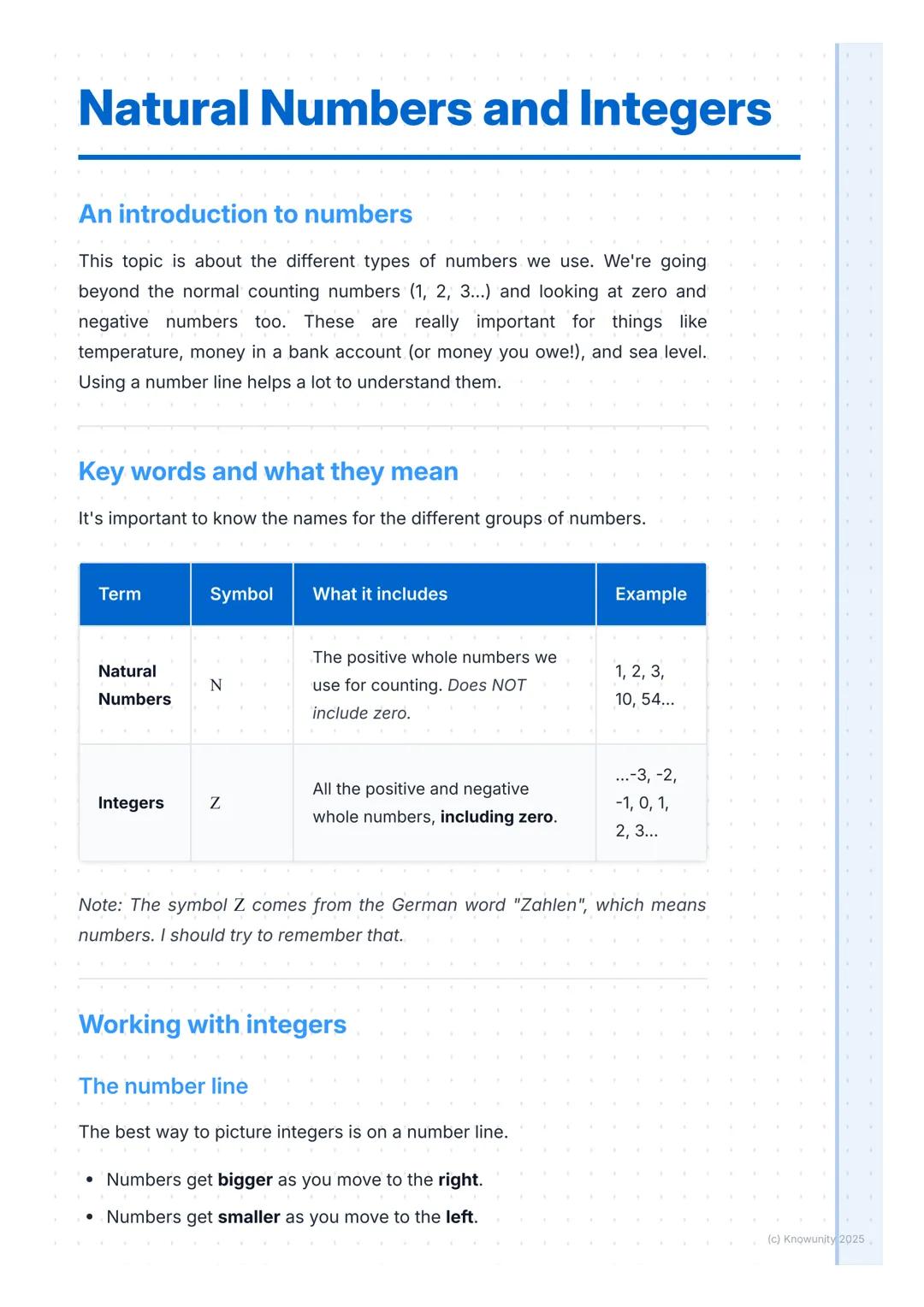
Natural Numbers and Integers - The Basics
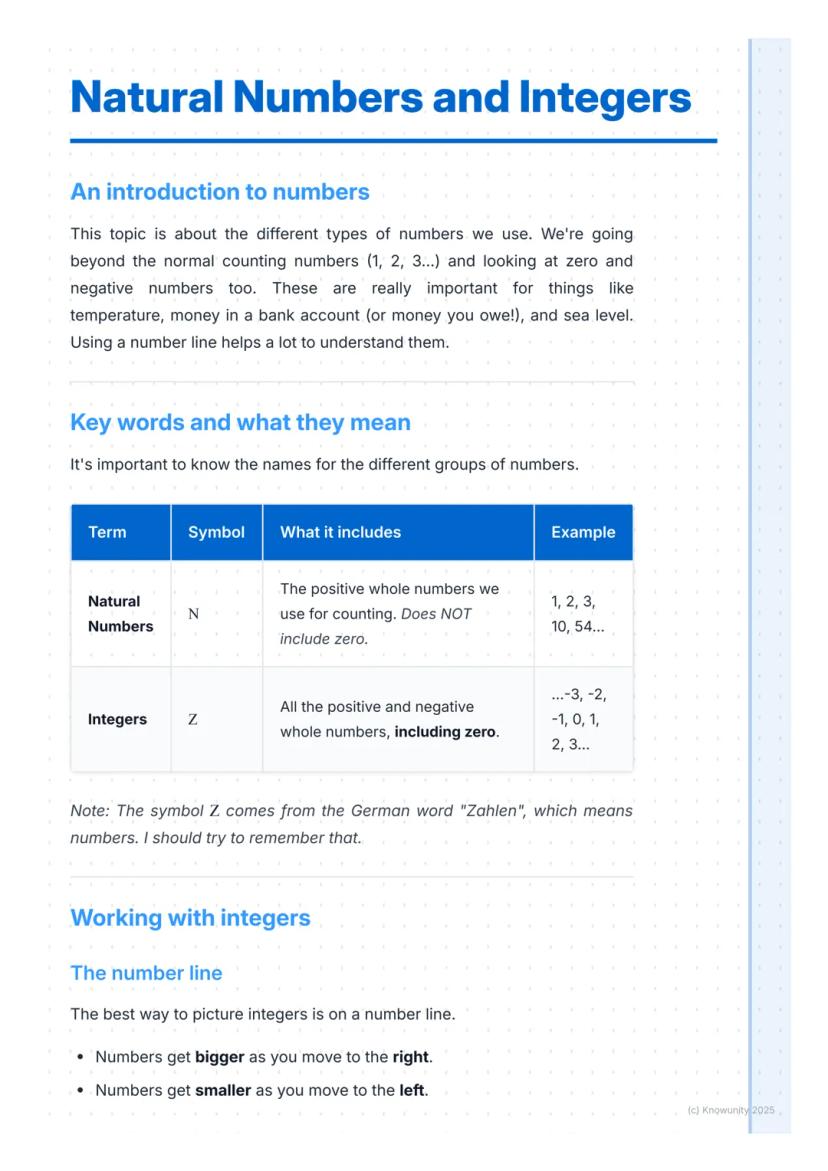
You've been using natural numbers your whole life without realising it! These are simply the counting numbers: 1, 2, 3, 4, and so on. They're called "natural" because they feel natural to use when counting objects.
Integers take things a step further by including zero and all the negative numbers too. Think of them as the complete family: ...-3, -2, -1, 0, 1, 2, 3... The symbol for integers is Z, which comes from the German word "Zahlen" meaning numbers.
Quick Tip: Remember that natural numbers don't include zero, but integers do! This catches lots of students out in tests.
The number line is your best friend here. Numbers get bigger as you move right and smaller as you move left. So -1 is actually bigger than -5 because it's further to the right!
2
of 5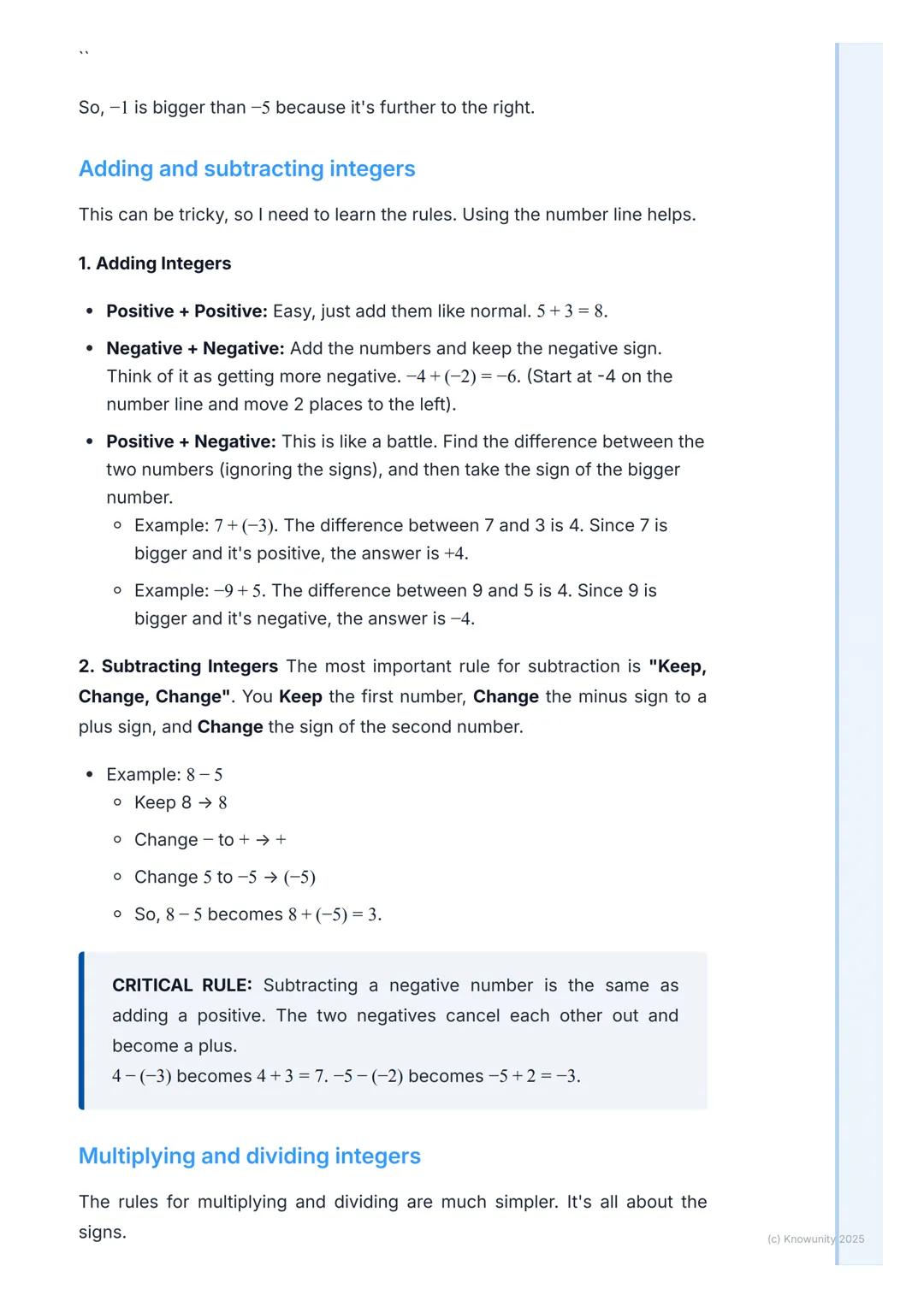
Adding and Subtracting Integers
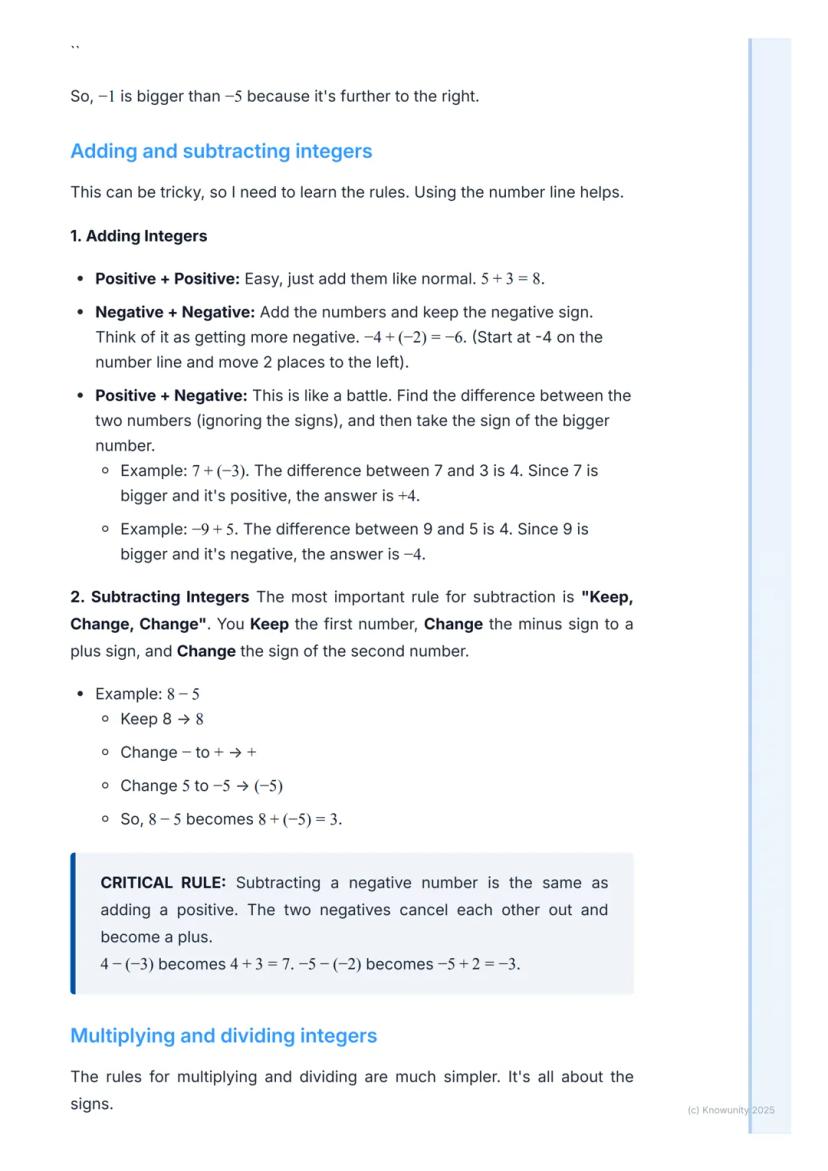
Adding integers might seem tricky at first, but there are simple patterns to follow. When you're adding two positive numbers, it's just normal addition. When adding two negative numbers, add them up and keep the negative sign - think of it as getting "more negative".
The interesting bit happens when you mix positive and negative numbers. Picture it like a battle between the numbers! Find the difference between them (ignore the signs), then use the sign of the bigger number. So 7 + (-3) = 4 because 7 is bigger and positive.
For subtraction, use the "Keep, Change, Change" rule. Keep the first number, change the minus to a plus, and change the sign of the second number. So 8 - 5 becomes 8 + (-5) = 3.
Remember: Subtracting a negative is the same as adding a positive! The two negatives cancel out: 4 - (-3) = 4 + 3 = 7.
3
of 5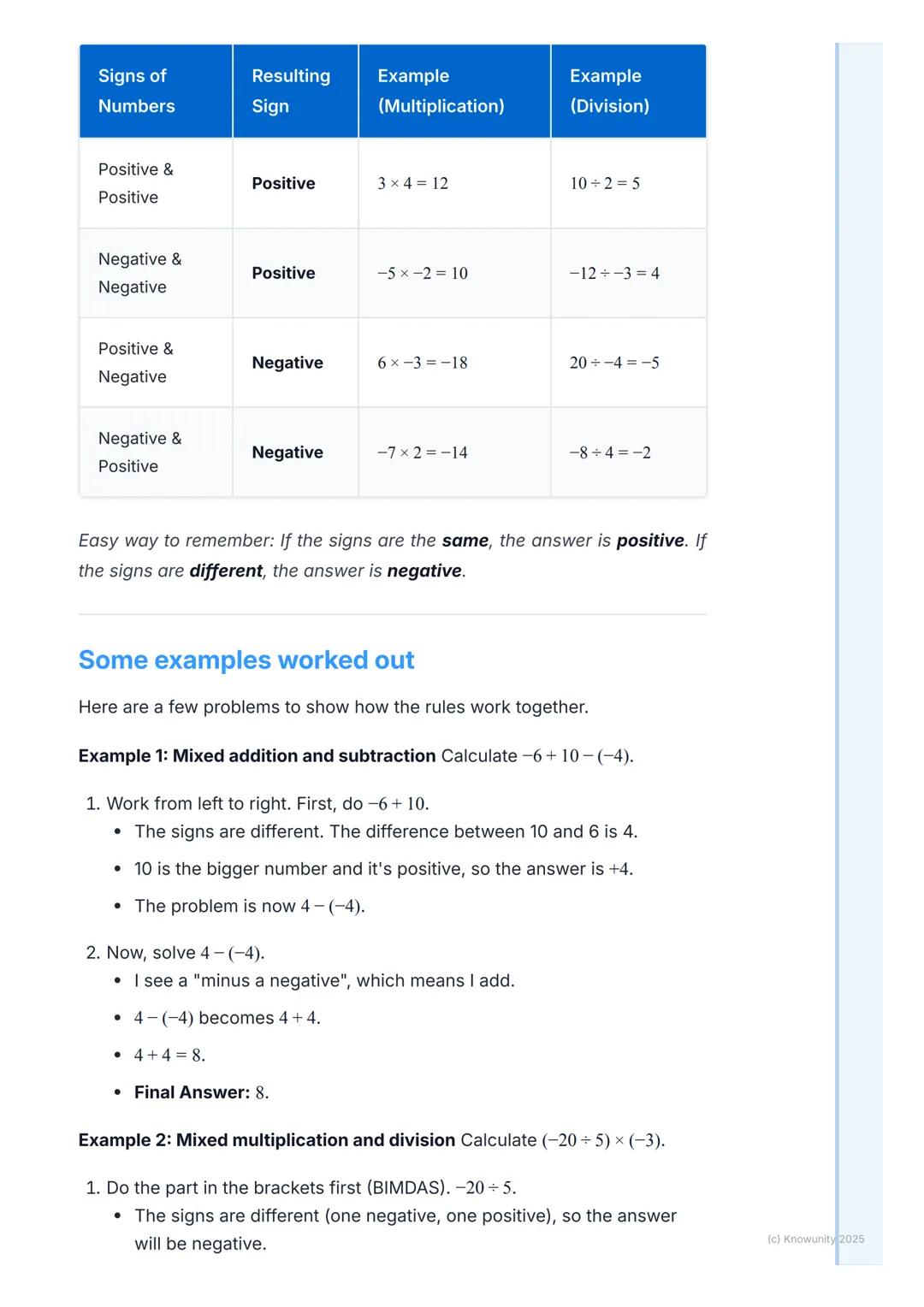
Multiplying and Dividing Integers
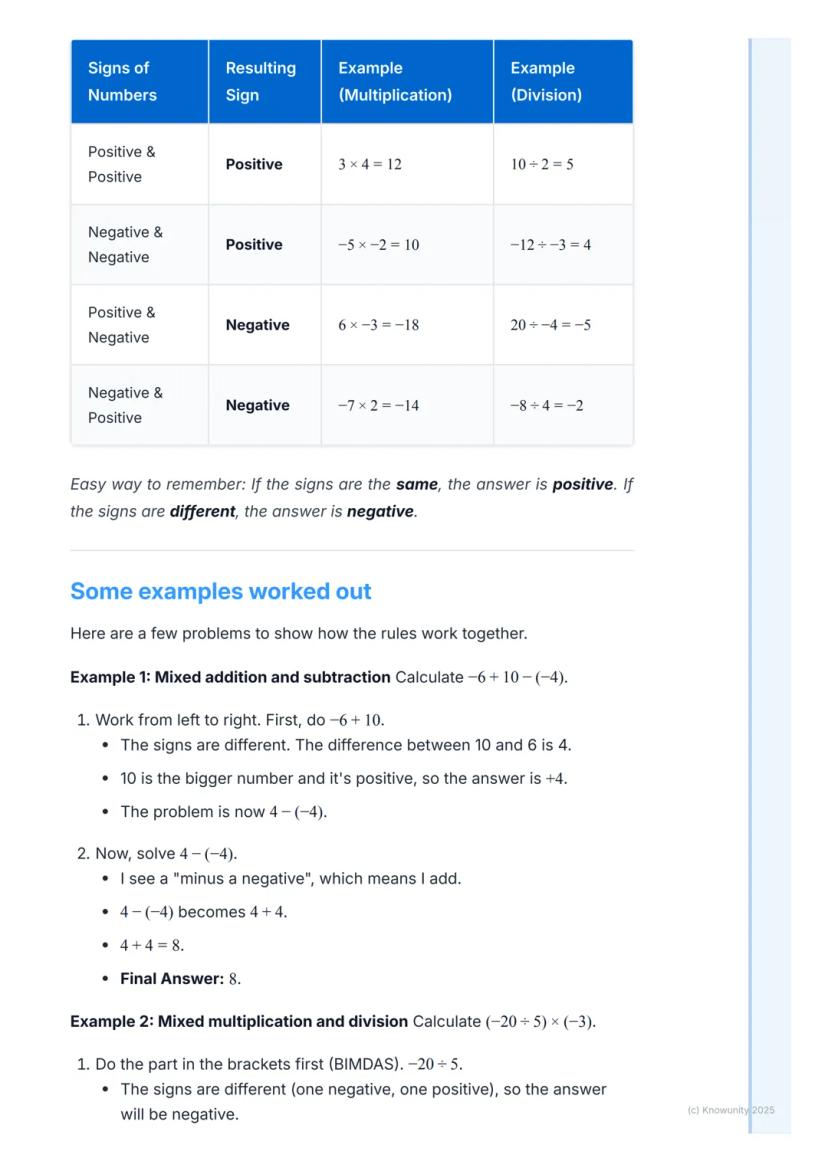
Good news - multiplying and dividing integers is much simpler than adding and subtracting! It's all about the signs, and there's just one rule to remember.
If the signs are the same (both positive or both negative), your answer is positive. If the signs are different (one positive, one negative), your answer is negative. So -5 × -2 = 10 , but 6 × -3 = -18 .
This works exactly the same for division. -12 ÷ -3 = 4 because both numbers are negative (same signs), while 20 ÷ -4 = -5 because the signs are different.
Memory Trick: Think "same = smiley face = positive" and "different = frowny face = negative"!
4
of 5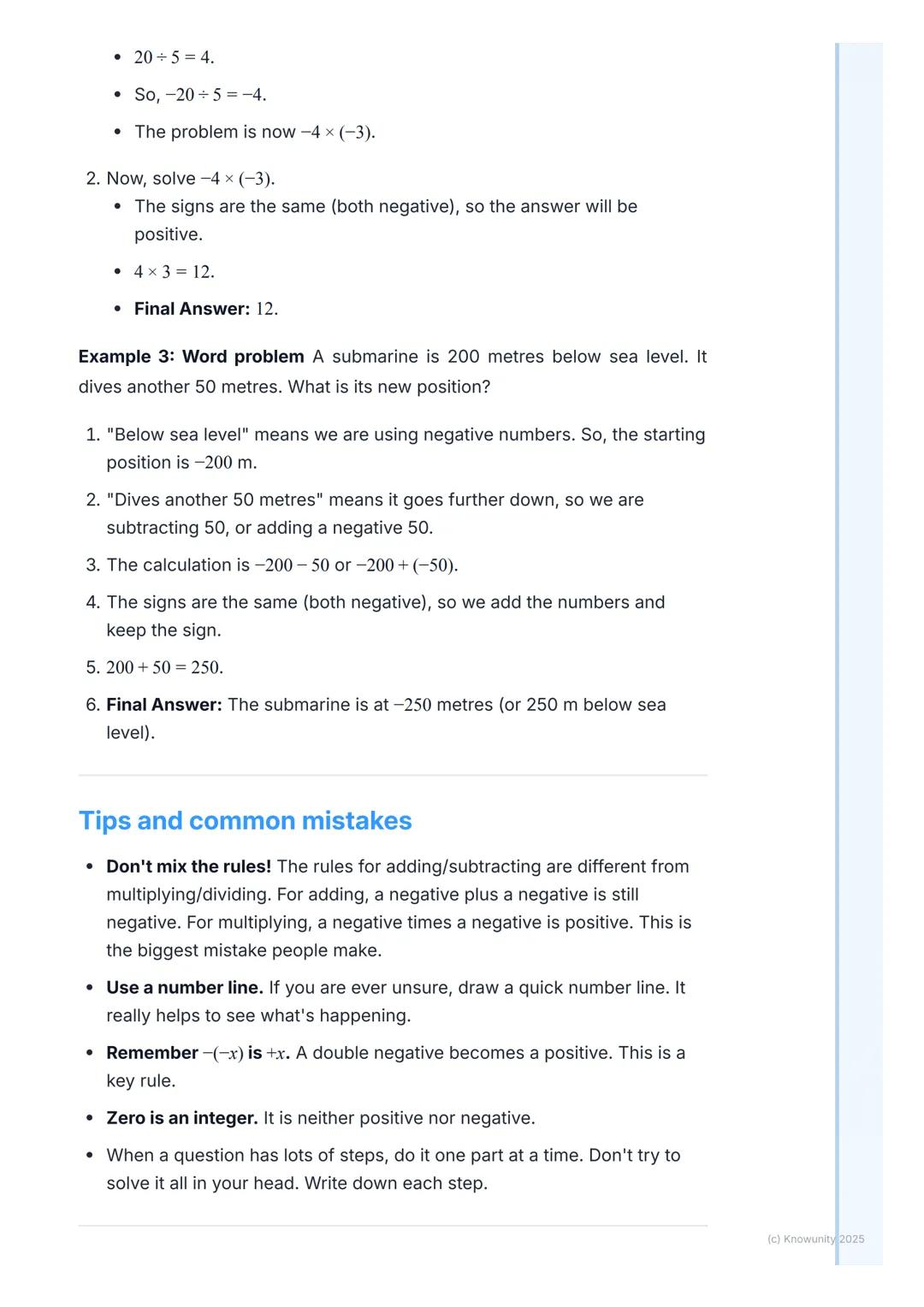
Working Through Examples
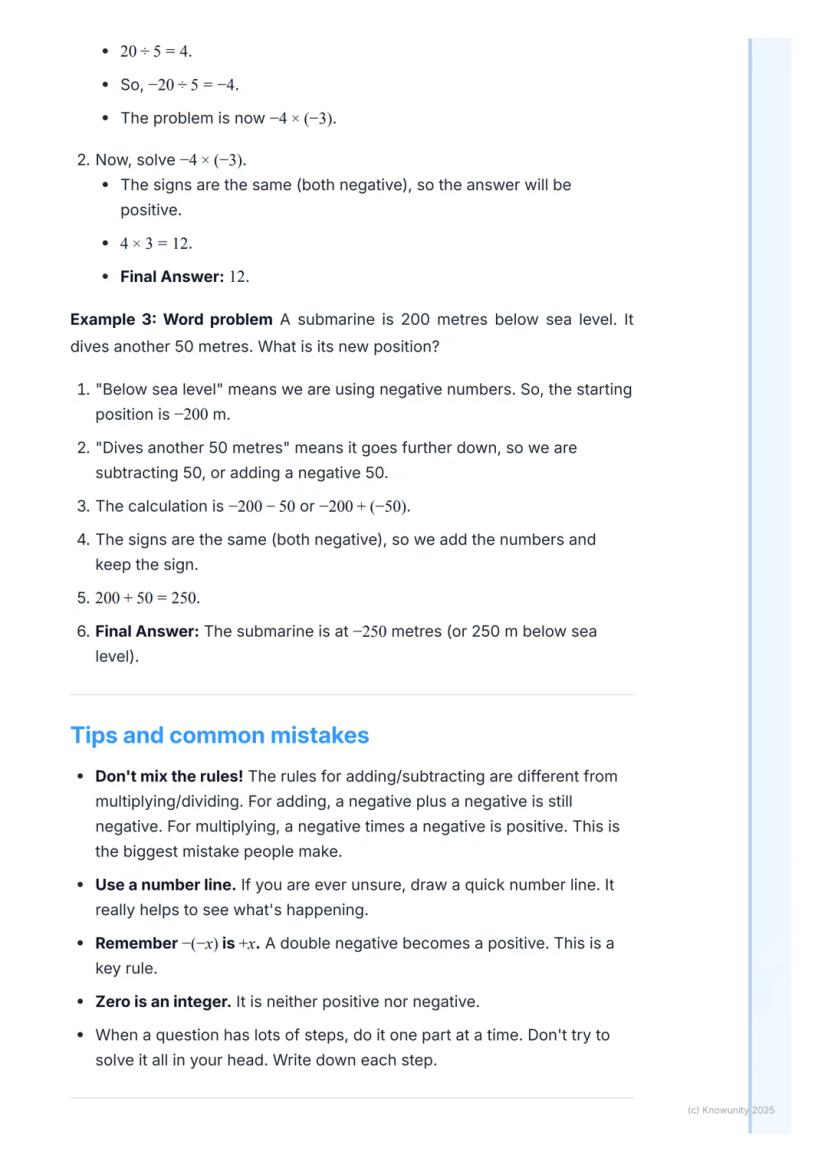
Let's tackle some real problems step by step. For -6 + 10 - (-4), work from left to right. First, -6 + 10 gives us 4 (different signs, so take the bigger number's sign). Then 4 - (-4) becomes 4 + 4 = 8.
Here's a practical example: A submarine starts 200 metres below sea level and dives another 50 metres. Since "below sea level" means negative, we calculate -200 + (-50) = -250m.
When you see brackets, always solve those first! For (-20 ÷ 5) × (-3), first work out -20 ÷ 5 = -4 . Then -4 × (-3) = 12 .
Pro Tip: Don't try to do everything in your head - write down each step. This prevents silly mistakes that cost marks!
5
of 5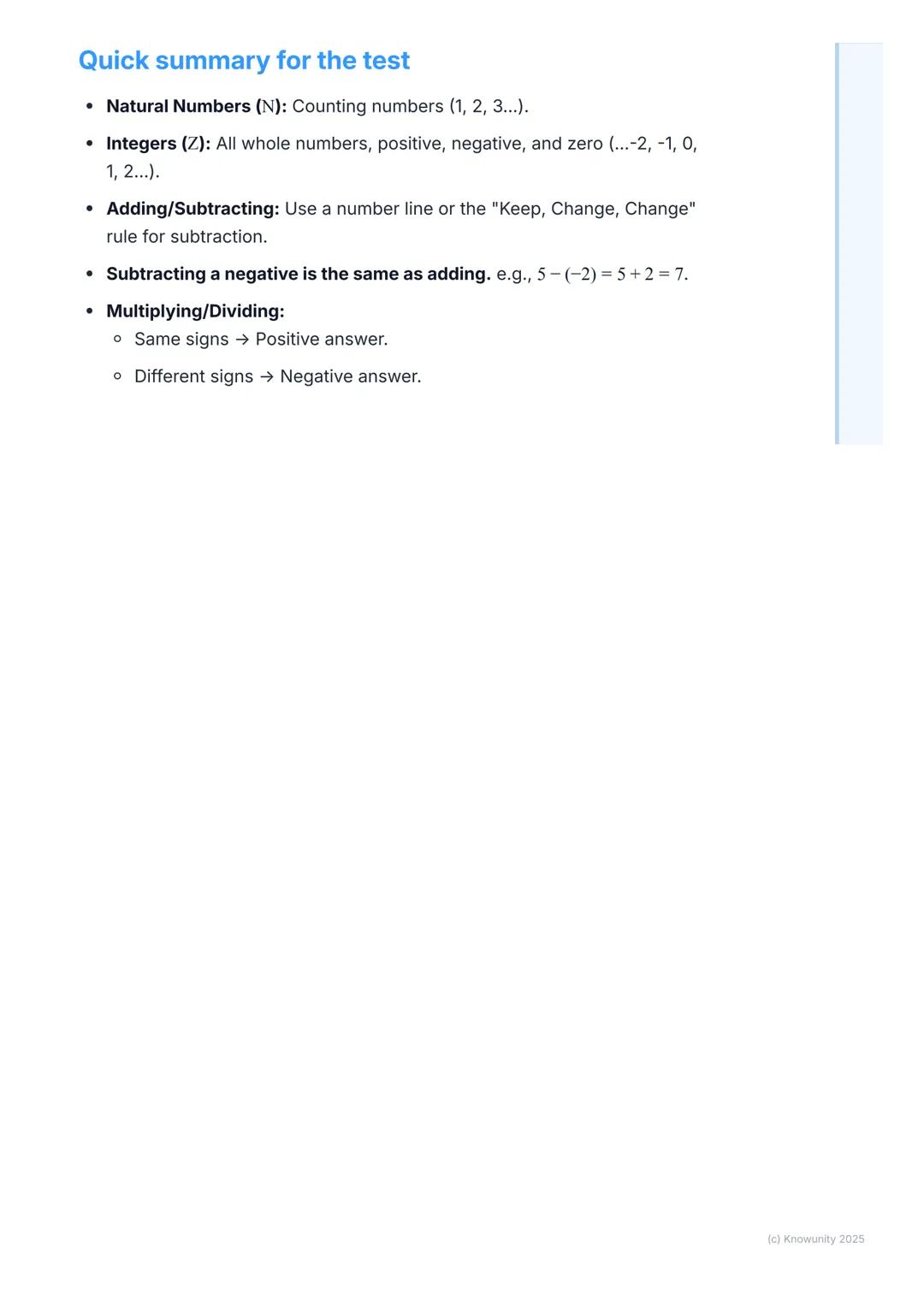
Quick Test Revision
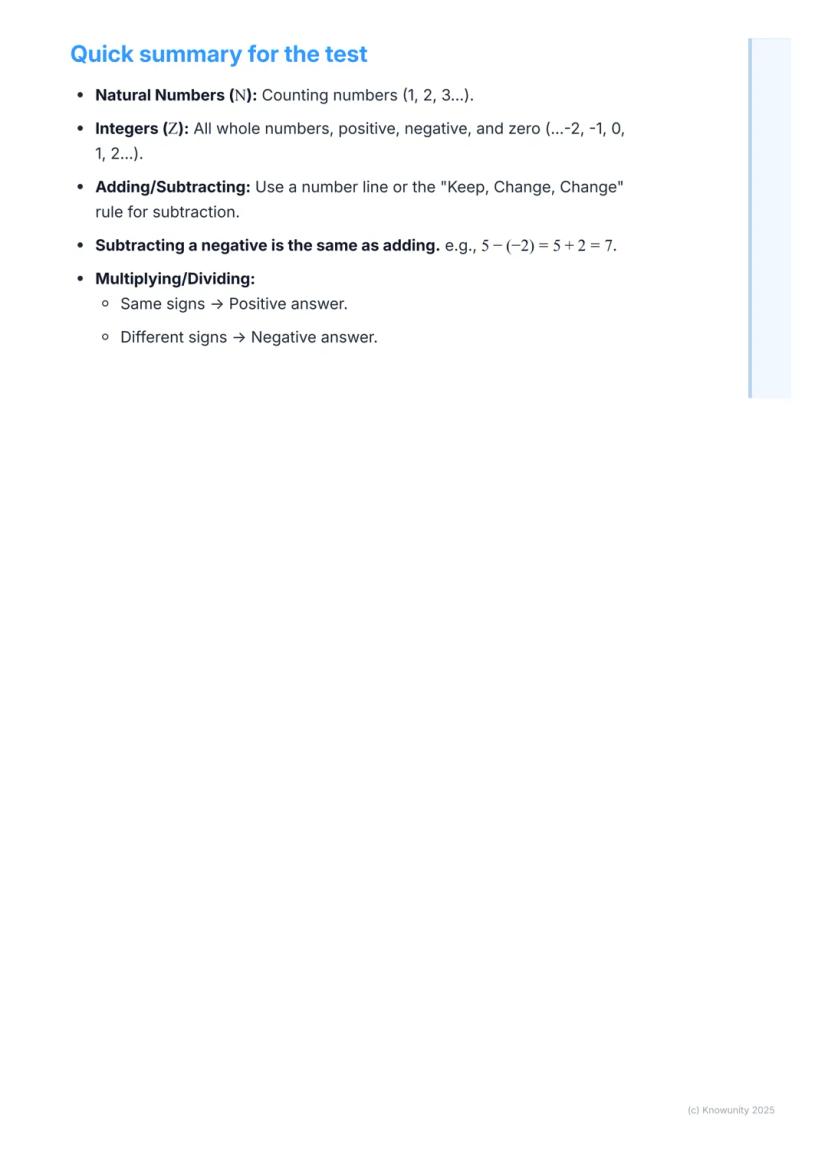
Here's everything you need for your test! Natural numbers are your basic counting numbers (1, 2, 3...), while integers include zero and all negative numbers too (...-2, -1, 0, 1, 2...).
For adding and subtracting, use the number line or remember that subtracting a negative equals adding a positive. The "Keep, Change, Change" rule is your friend for subtraction problems.
Multiplication and division follow one simple rule: same signs give positive answers, different signs give negative answers. Zero is an integer but it's neither positive nor negative.
Final Reminder: The biggest mistake students make is mixing up the rules for different operations. Adding two negatives stays negative, but multiplying two negatives becomes positive!
Hiç sormayacaksın sanmıştık...
Knowunity yapay zeka arkadaşı nedir?
Yapay zeka arkadaşımız öğrencilerin ihtiyaçlarına göre özel olarak tasarlanmıştır. Platformda bulunan milyonlarca içeriğe dayanarak öğrencilere gerçekten anlamlı ve ilgili yanıtlar verebiliyoruz. Ancak mesele sadece cevaplar değil, refakatçi aynı zamanda kişiselleştirilmiş öğrenme planları, sınavlar veya sohbet içerikleri ve öğrencilerin becerilerine ve gelişimlerine dayalı %100 kişiselleştirme ile öğrencilere günlük öğrenme zorluklarında rehberlik ediyor.
Knowunity uygulamasını nereden indirebilirim?
Uygulamayı Google Play Store ve Apple App Store'dan indirebilirsiniz.
Knowunity ücretsiz mi?
Knowunity uygulaması ücretsiz! Uygulamamız çok yakında indirmeye hazır olacak, bekle bizi. 💙
Mathematics dersinin en popüler içerikleri
7En popüler içerikler
9Aradığını bulamıyor musun? Diğer derslere göz at.
Kullanıcılarımızdan yorumlar. Onlar her şeyi çok beğendi — sen de beğeneceksin.
4.6/5App Store
4.7/5Google Play
Uygulama çok kolay kullanılıyor ve güzel tasarlanmış. Şu ana kadar aradığım her şeyi buldum ve sunumlardan çok şey öğrendim! Kesinlikle ödevlerim için hep kullanacağım!
A.S.iOS kullanıcısı
Uygulama çok iyi. Çok fazla ders notu ve yardımlaşma var. Örneğin benim problem yaşadığım bir ders Geometriydi ve ANINDA yardım ettiler beraber hem sorularımı çözdük hem konu anlatımı buldum. Herkese tavsiye ederim.
S.L.Android kullanıcısı
BEN ŞOK. Reklamını sık sık gördüğüm için uygulamayı denedim ve gerçekten hayran kaldım. Bu uygulama okul için tam ihtiyacım olan şey. Anında ödev yardımı, konu anlatımı, örnek sınavlar, flaşkartlar hepsi hepsi var, şiddetle tavsiye ederim ✅
A.iOS kullanıcısı
Mathematics13 görüntüleme·Güncellendi May 27, 2026·5 sayfaUnderstanding Natural Numbers and Integers
Ever wondered why your bank balance can go negative or how we measure temperatures below zero? Understanding natural numbers and integers is the key to making sense of these everyday situations. These number systems help us work with everything from... Daha fazla göster
1
of 5Ders notlarını görmek için kaydol. Ücretsiz!
- Tüm belgeleri görebilirsin
- Notlarını Yükselt
- Milyonlarca öğrenciye katıl
Natural Numbers and Integers - The Basics
You've been using natural numbers your whole life without realising it! These are simply the counting numbers: 1, 2, 3, 4, and so on. They're called "natural" because they feel natural to use when counting objects.
Integers take things a step further by including zero and all the negative numbers too. Think of them as the complete family: ...-3, -2, -1, 0, 1, 2, 3... The symbol for integers is Z, which comes from the German word "Zahlen" meaning numbers.
Quick Tip: Remember that natural numbers don't include zero, but integers do! This catches lots of students out in tests.
The number line is your best friend here. Numbers get bigger as you move right and smaller as you move left. So -1 is actually bigger than -5 because it's further to the right!
2
of 5Ders notlarını görmek için kaydol. Ücretsiz!
- Tüm belgeleri görebilirsin
- Notlarını Yükselt
- Milyonlarca öğrenciye katıl
Adding and Subtracting Integers
Adding integers might seem tricky at first, but there are simple patterns to follow. When you're adding two positive numbers, it's just normal addition. When adding two negative numbers, add them up and keep the negative sign - think of it as getting "more negative".
The interesting bit happens when you mix positive and negative numbers. Picture it like a battle between the numbers! Find the difference between them (ignore the signs), then use the sign of the bigger number. So 7 + (-3) = 4 because 7 is bigger and positive.
For subtraction, use the "Keep, Change, Change" rule. Keep the first number, change the minus to a plus, and change the sign of the second number. So 8 - 5 becomes 8 + (-5) = 3.
Remember: Subtracting a negative is the same as adding a positive! The two negatives cancel out: 4 - (-3) = 4 + 3 = 7.
3
of 5Ders notlarını görmek için kaydol. Ücretsiz!
- Tüm belgeleri görebilirsin
- Notlarını Yükselt
- Milyonlarca öğrenciye katıl
Multiplying and Dividing Integers
Good news - multiplying and dividing integers is much simpler than adding and subtracting! It's all about the signs, and there's just one rule to remember.
If the signs are the same (both positive or both negative), your answer is positive. If the signs are different (one positive, one negative), your answer is negative. So -5 × -2 = 10 , but 6 × -3 = -18 .
This works exactly the same for division. -12 ÷ -3 = 4 because both numbers are negative (same signs), while 20 ÷ -4 = -5 because the signs are different.
Memory Trick: Think "same = smiley face = positive" and "different = frowny face = negative"!
4
of 5Ders notlarını görmek için kaydol. Ücretsiz!
- Tüm belgeleri görebilirsin
- Notlarını Yükselt
- Milyonlarca öğrenciye katıl
Working Through Examples
Let's tackle some real problems step by step. For -6 + 10 - (-4), work from left to right. First, -6 + 10 gives us 4 (different signs, so take the bigger number's sign). Then 4 - (-4) becomes 4 + 4 = 8.
Here's a practical example: A submarine starts 200 metres below sea level and dives another 50 metres. Since "below sea level" means negative, we calculate -200 + (-50) = -250m.
When you see brackets, always solve those first! For (-20 ÷ 5) × (-3), first work out -20 ÷ 5 = -4 . Then -4 × (-3) = 12 .
Pro Tip: Don't try to do everything in your head - write down each step. This prevents silly mistakes that cost marks!
5
of 5Ders notlarını görmek için kaydol. Ücretsiz!
- Tüm belgeleri görebilirsin
- Notlarını Yükselt
- Milyonlarca öğrenciye katıl
Quick Test Revision
Here's everything you need for your test! Natural numbers are your basic counting numbers (1, 2, 3...), while integers include zero and all negative numbers too (...-2, -1, 0, 1, 2...).
For adding and subtracting, use the number line or remember that subtracting a negative equals adding a positive. The "Keep, Change, Change" rule is your friend for subtraction problems.
Multiplication and division follow one simple rule: same signs give positive answers, different signs give negative answers. Zero is an integer but it's neither positive nor negative.
Final Reminder: The biggest mistake students make is mixing up the rules for different operations. Adding two negatives stays negative, but multiplying two negatives becomes positive!
Hiç sormayacaksın sanmıştık...
Knowunity yapay zeka arkadaşı nedir?
Yapay zeka arkadaşımız öğrencilerin ihtiyaçlarına göre özel olarak tasarlanmıştır. Platformda bulunan milyonlarca içeriğe dayanarak öğrencilere gerçekten anlamlı ve ilgili yanıtlar verebiliyoruz. Ancak mesele sadece cevaplar değil, refakatçi aynı zamanda kişiselleştirilmiş öğrenme planları, sınavlar veya sohbet içerikleri ve öğrencilerin becerilerine ve gelişimlerine dayalı %100 kişiselleştirme ile öğrencilere günlük öğrenme zorluklarında rehberlik ediyor.
Knowunity uygulamasını nereden indirebilirim?
Uygulamayı Google Play Store ve Apple App Store'dan indirebilirsiniz.
Knowunity ücretsiz mi?
Knowunity uygulaması ücretsiz! Uygulamamız çok yakında indirmeye hazır olacak, bekle bizi. 💙
Mathematics dersinin en popüler içerikleri
7En popüler içerikler
9Aradığını bulamıyor musun? Diğer derslere göz at.
Kullanıcılarımızdan yorumlar. Onlar her şeyi çok beğendi — sen de beğeneceksin.
4.6/5App Store
4.7/5Google Play
Uygulama çok kolay kullanılıyor ve güzel tasarlanmış. Şu ana kadar aradığım her şeyi buldum ve sunumlardan çok şey öğrendim! Kesinlikle ödevlerim için hep kullanacağım!
A.S.iOS kullanıcısı
Uygulama çok iyi. Çok fazla ders notu ve yardımlaşma var. Örneğin benim problem yaşadığım bir ders Geometriydi ve ANINDA yardım ettiler beraber hem sorularımı çözdük hem konu anlatımı buldum. Herkese tavsiye ederim.
S.L.Android kullanıcısı
BEN ŞOK. Reklamını sık sık gördüğüm için uygulamayı denedim ve gerçekten hayran kaldım. Bu uygulama okul için tam ihtiyacım olan şey. Anında ödev yardımı, konu anlatımı, örnek sınavlar, flaşkartlar hepsi hepsi var, şiddetle tavsiye ederim ✅
A.iOS kullanıcısı