
Probability is everywhere in your life - from the chance... Daha fazla göster
 Mathematics8 görüntüleme·Güncellendi May 29, 2026·5 sayfa
Understanding Basic Probability Concepts
1 / 5
1
of 5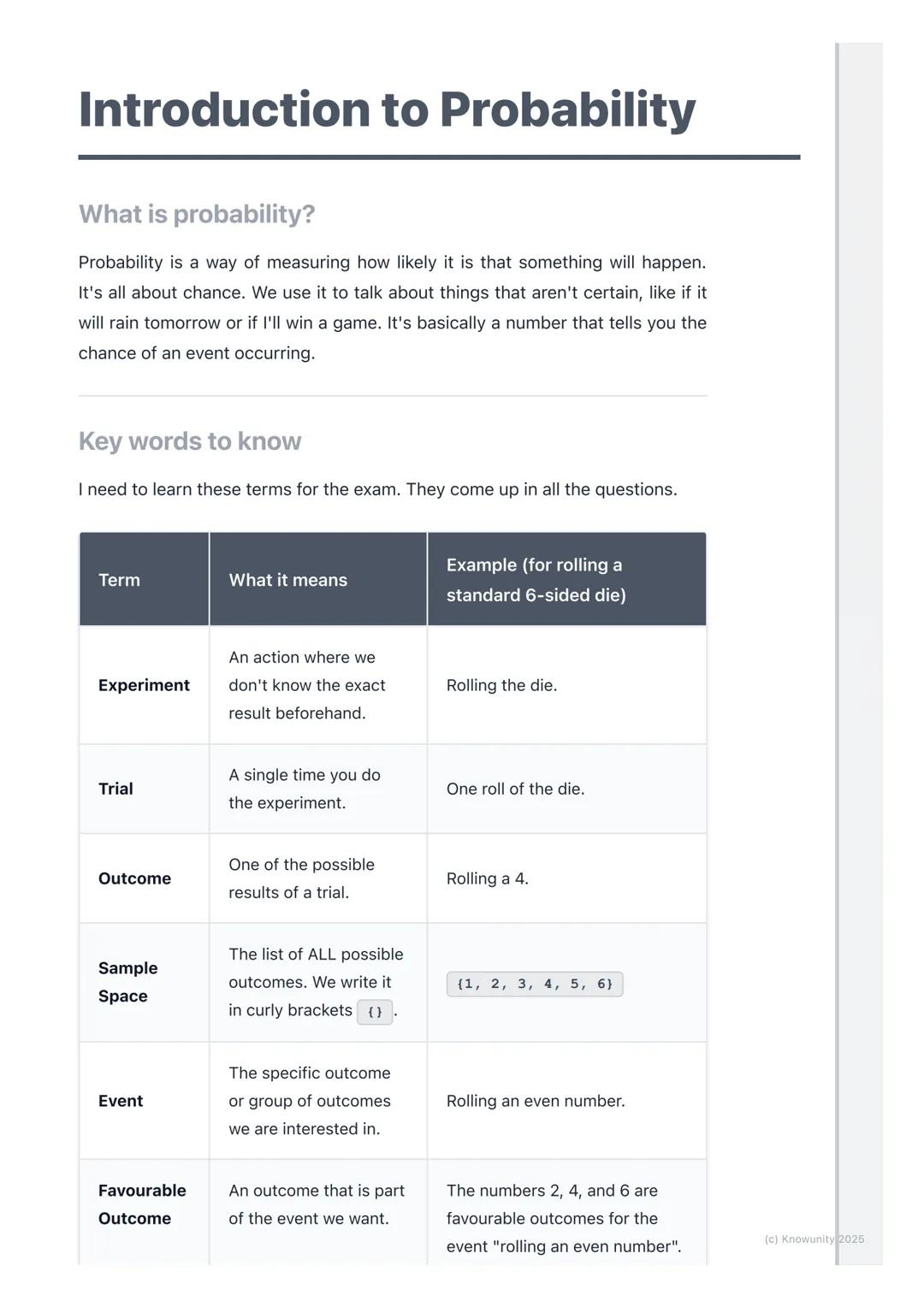
What is Probability?
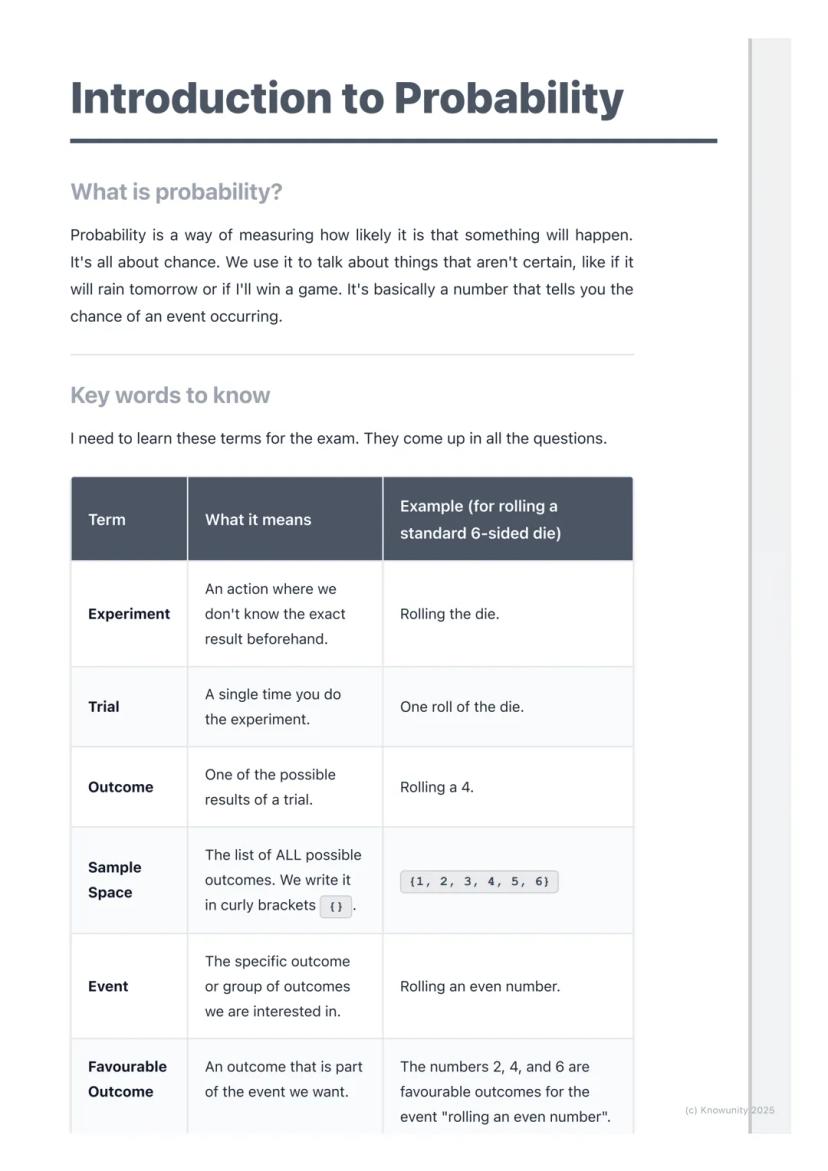
Ever wondered how to work out if something will actually happen? Probability gives you the answer by measuring chance using numbers. It's perfect for situations where you can't be 100% certain of the outcome.
Before diving into calculations, you need to master some key terms that'll pop up in every exam question. An experiment is any action where you don't know the exact result beforehand, like rolling a die. Each single attempt is called a trial.
The sample space lists every possible result in curly brackets - for a standard die, that's {1, 2, 3, 4, 5, 6}. An outcome is just one specific result, whilst an event is what you're actually interested in finding out about.
Quick Tip: Always start by writing down your sample space - it helps you spot all the possibilities and avoid missing any!
2
of 5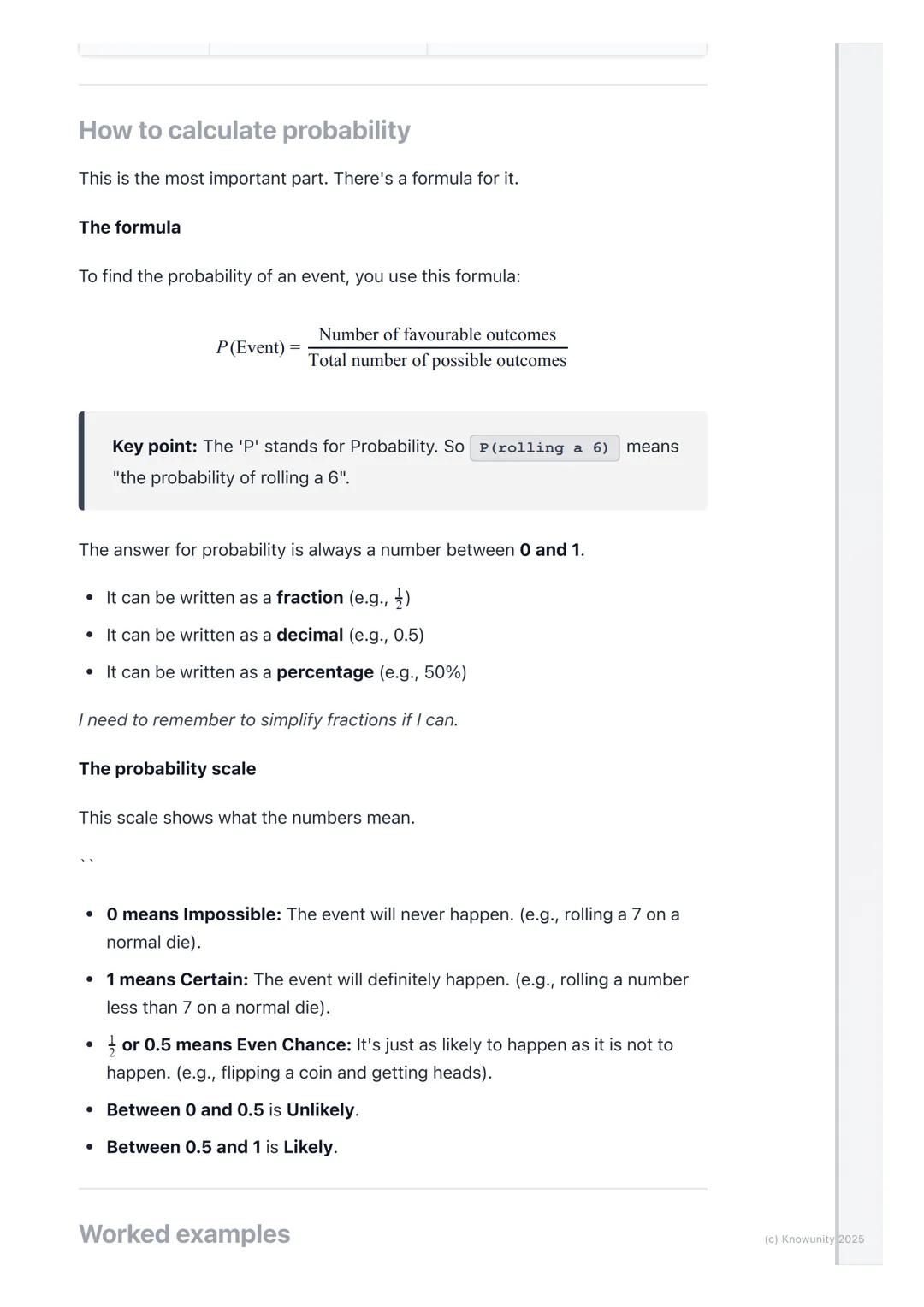
The Probability Formula
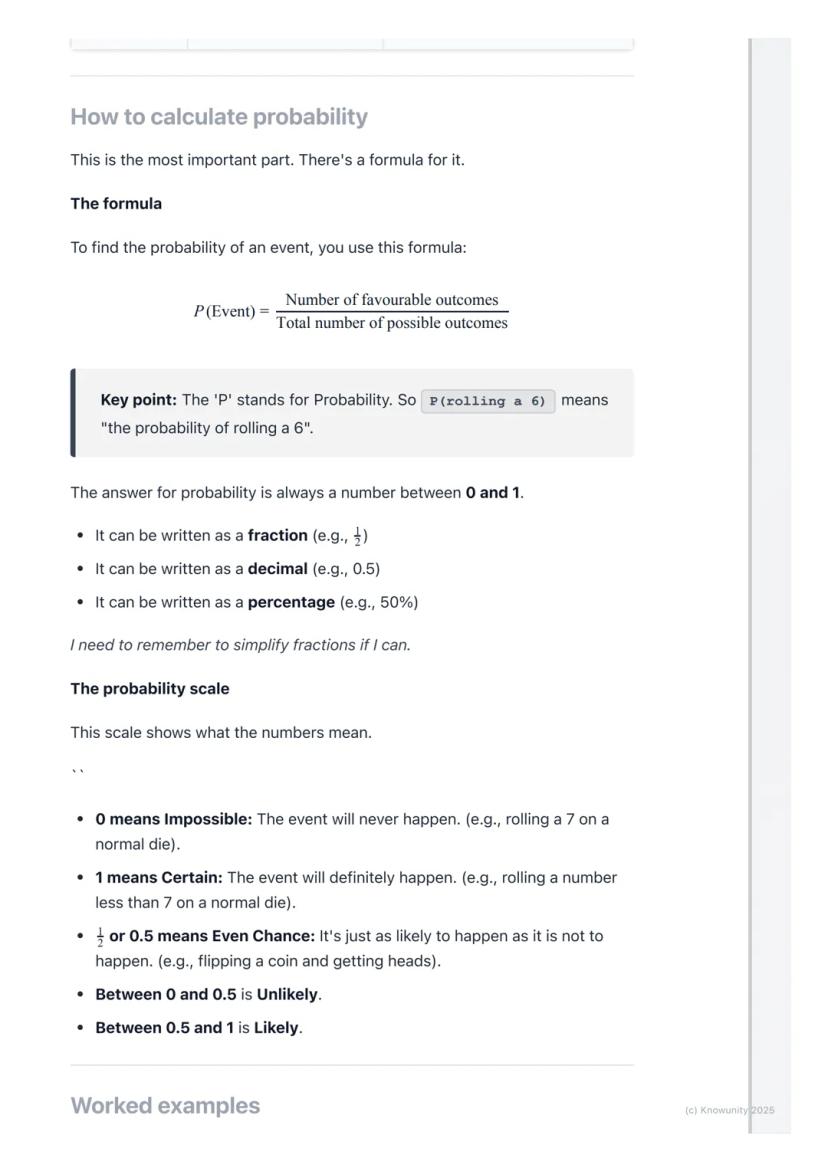
Here's the formula that'll solve every probability problem you'll face: P(Event) = Number of favourable outcomes ÷ Total number of possible outcomes. The 'P' simply stands for probability, so P(rolling a 6) means "the probability of rolling a 6".
Your answer will always be a number between 0 and 1. You can write it as a fraction, decimal, or percentage - just remember to simplify fractions when possible.
The probability scale is dead useful for understanding what your answers mean. 0 means impossible (like rolling a 7 on a normal die), whilst 1 means certain (like rolling less than 7). If you get 0.5, that's an even chance - exactly like flipping a coin.
Remember: Numbers between 0 and 0.5 are unlikely, whilst numbers between 0.5 and 1 are likely to happen.
3
of 5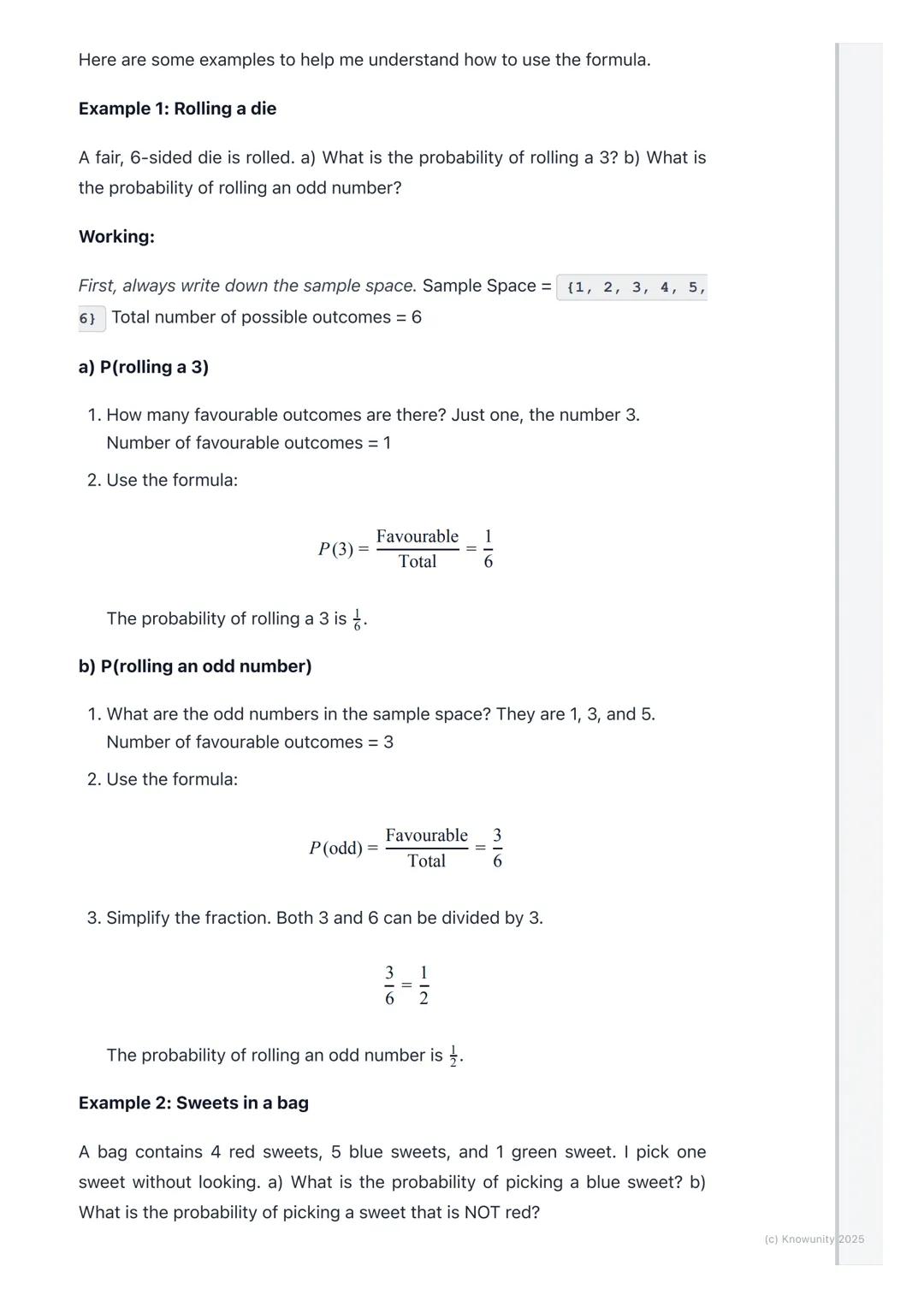
Working Through Examples
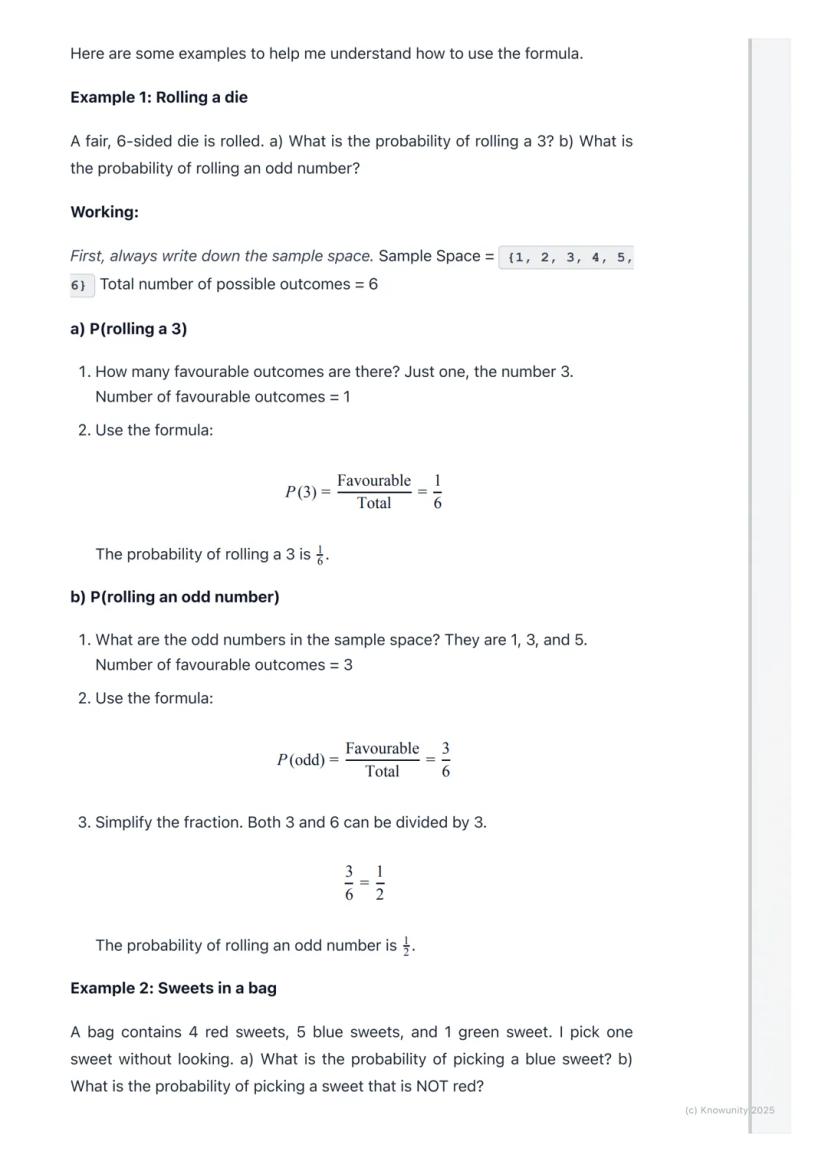
Let's tackle a classic die problem to see the formula in action. When rolling a fair 6-sided die, always start by writing your sample space: {1, 2, 3, 4, 5, 6}, giving you 6 total possible outcomes.
For finding P(rolling a 3), there's only one favourable outcome (the number 3), so you get 1÷6 = 1/6. For P(rolling an odd number), count the odd numbers: 1, 3, and 5 give you 3 favourable outcomes, so 3÷6 = 1/2 after simplifying.
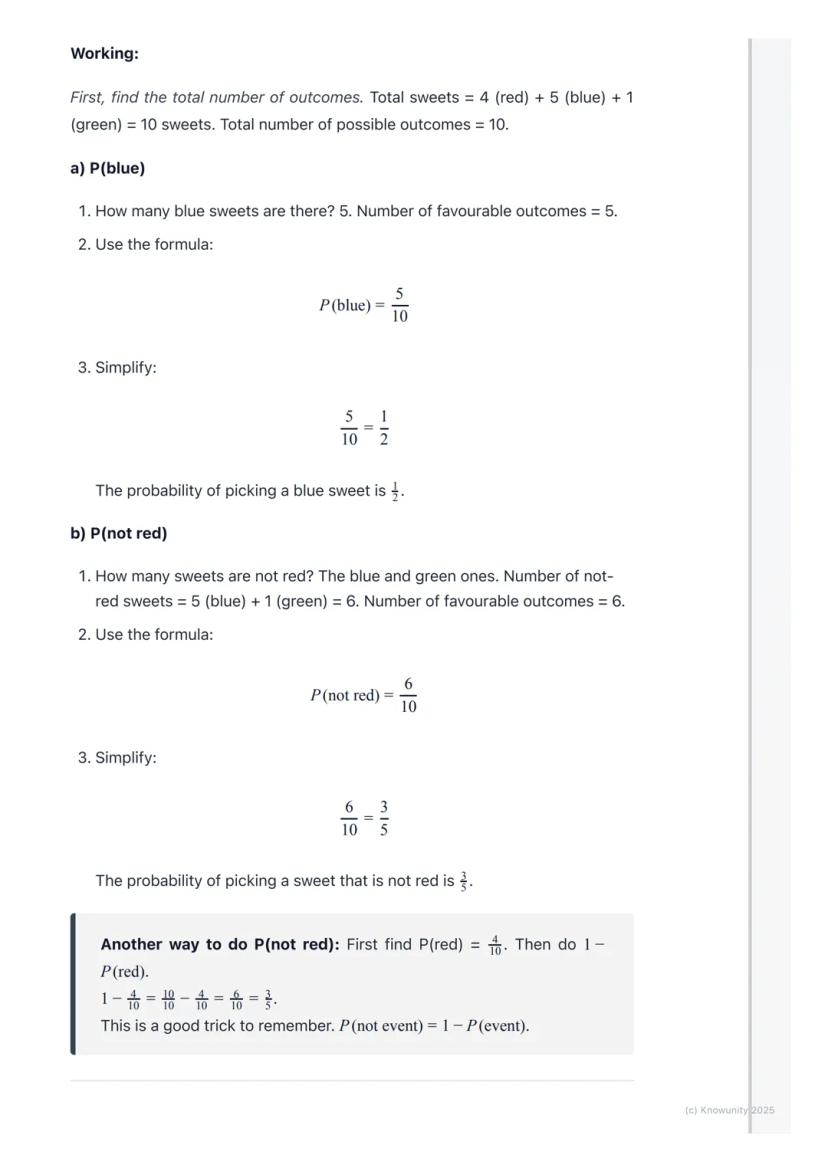
Sweet problems work exactly the same way. With 4 red, 5 blue, and 1 green sweet (10 total), P(blue) = 5÷10 = 1/2. The key is always counting your total first, then identifying what counts as "favourable" for your specific question.
Pro Tip: For "not red" events, you can either count non-red sweets directly, or use the shortcut: 1 - P(red) = 1 - 4/10 = 6/10 = 3/5.
4
of 5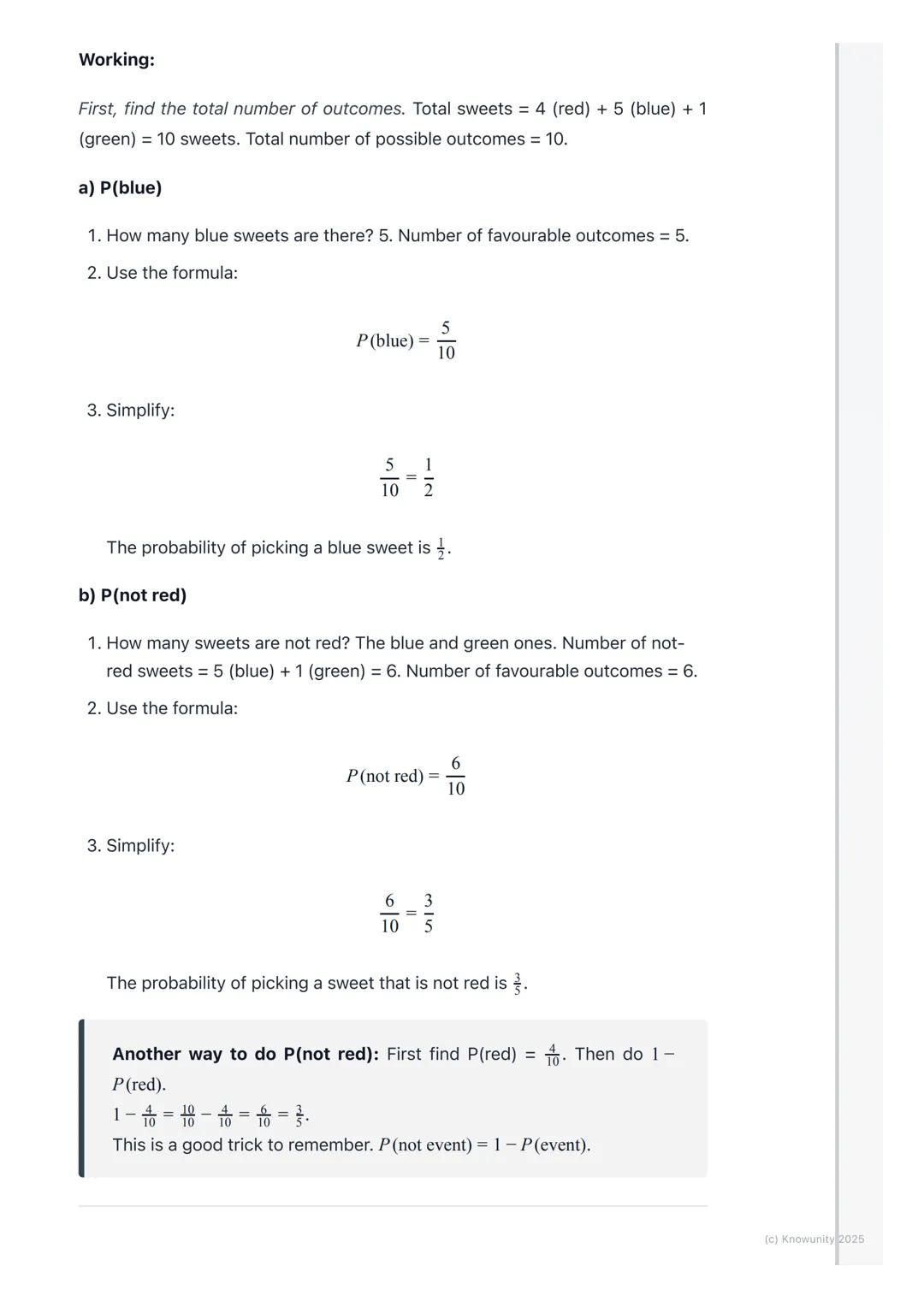
Advanced Techniques and Shortcuts
The "1 minus" trick is brilliant for complementary events. Instead of counting everything that's "not red", just work out P(red) first, then subtract from 1. This method often saves time and reduces mistakes.
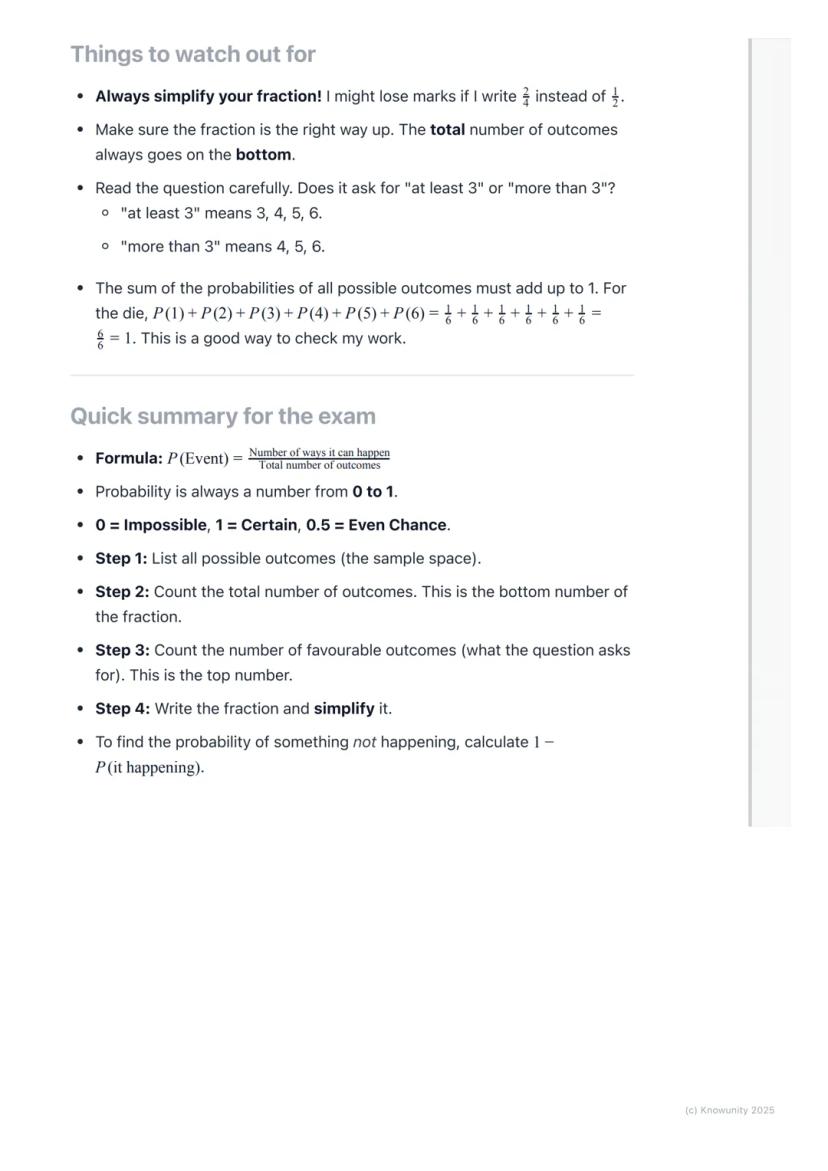
Watch out for tricky wording in questions. "At least 3" includes 3, 4, 5, and 6, whilst "more than 3" only includes 4, 5, and 6. These small differences can completely change your answer.
Here's a clever way to check your work: all probabilities for every possible outcome must add up to 1. For a die, P(1) + P(2) + P(3) + P(4) + P(5) + P(6) = 6 × 1/6 = 1. If your total doesn't equal 1, you've made an error somewhere.
Check Yourself: Always verify that your fraction is the right way up - total outcomes go on the bottom, favourable outcomes on top!
5
of 5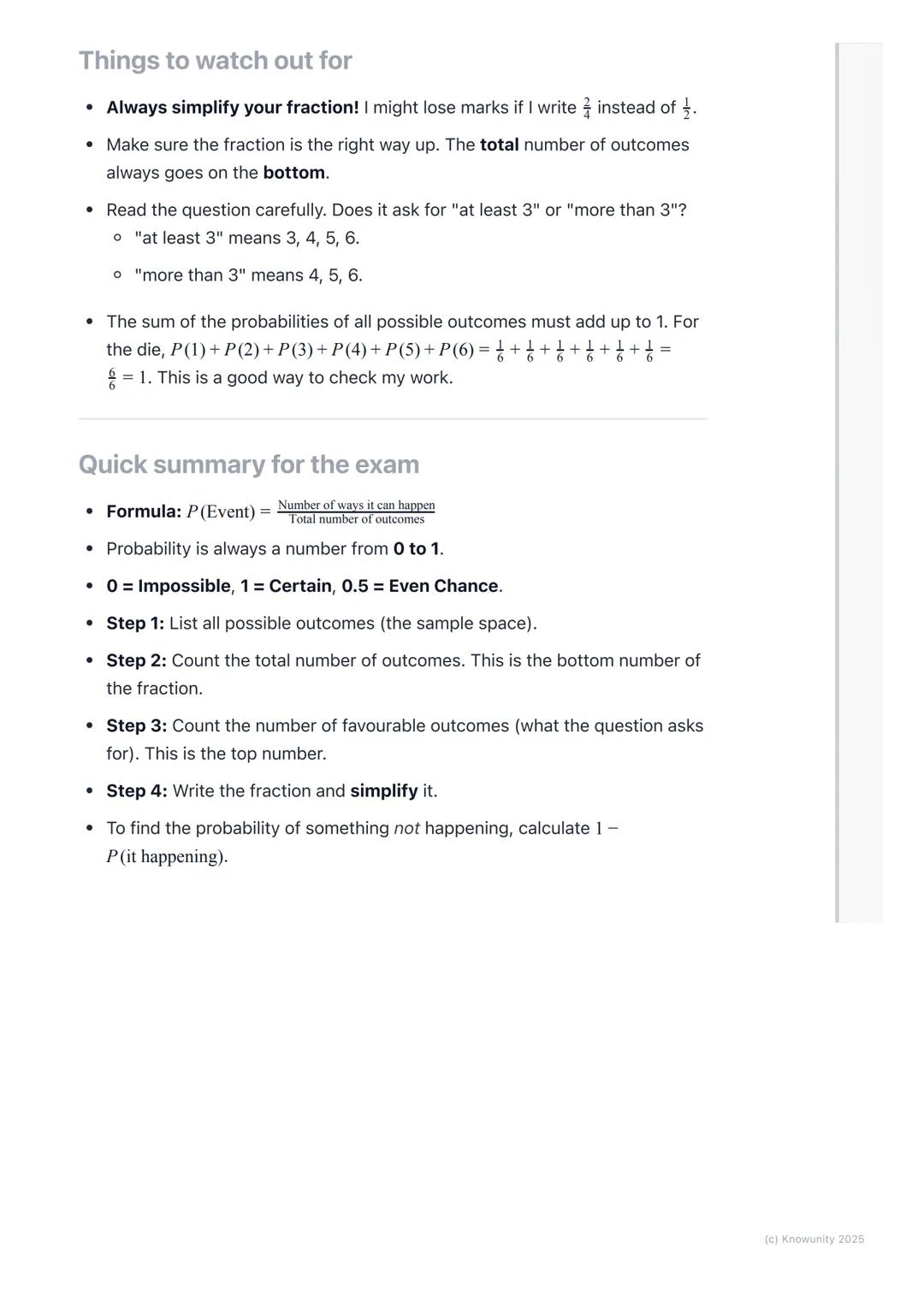
Exam Success Tips
Your step-by-step method should become automatic: list the sample space, count total outcomes (bottom of fraction), count favourable outcomes (top of fraction), then write and simplify your fraction.
Common mistakes to avoid include forgetting to simplify fractions and misreading questions. Always double-check whether the question asks for "at least" or "more than" - they're not the same thing.
Remember that probability always ranges from 0 to 1. If you get a number outside this range, you've definitely made an error. The formula P(Event) = Favourable outcomes ÷ Total outcomes will solve any basic probability problem you encounter.
Final Reminder: Take your time reading questions carefully - most mistakes happen from rushing, not from lack of understanding!
Hiç sormayacaksın sanmıştık...
Knowunity yapay zeka arkadaşı nedir?
Yapay zeka arkadaşımız öğrencilerin ihtiyaçlarına göre özel olarak tasarlanmıştır. Platformda bulunan milyonlarca içeriğe dayanarak öğrencilere gerçekten anlamlı ve ilgili yanıtlar verebiliyoruz. Ancak mesele sadece cevaplar değil, refakatçi aynı zamanda kişiselleştirilmiş öğrenme planları, sınavlar veya sohbet içerikleri ve öğrencilerin becerilerine ve gelişimlerine dayalı %100 kişiselleştirme ile öğrencilere günlük öğrenme zorluklarında rehberlik ediyor.
Knowunity uygulamasını nereden indirebilirim?
Uygulamayı Google Play Store ve Apple App Store'dan indirebilirsiniz.
Knowunity ücretsiz mi?
Knowunity uygulaması ücretsiz! Uygulamamız çok yakında indirmeye hazır olacak, bekle bizi. 💙
Mathematics dersinin en popüler içerikleri
7En popüler içerikler
9Aradığını bulamıyor musun? Diğer derslere göz at.
Kullanıcılarımızdan yorumlar. Onlar her şeyi çok beğendi — sen de beğeneceksin.
4.6/5App Store
4.7/5Google Play
Uygulama çok kolay kullanılıyor ve güzel tasarlanmış. Şu ana kadar aradığım her şeyi buldum ve sunumlardan çok şey öğrendim! Kesinlikle ödevlerim için hep kullanacağım!
A.S.iOS kullanıcısı
Uygulama çok iyi. Çok fazla ders notu ve yardımlaşma var. Örneğin benim problem yaşadığım bir ders Geometriydi ve ANINDA yardım ettiler beraber hem sorularımı çözdük hem konu anlatımı buldum. Herkese tavsiye ederim.
S.L.Android kullanıcısı
BEN ŞOK. Reklamını sık sık gördüğüm için uygulamayı denedim ve gerçekten hayran kaldım. Bu uygulama okul için tam ihtiyacım olan şey. Anında ödev yardımı, konu anlatımı, örnek sınavlar, flaşkartlar hepsi hepsi var, şiddetle tavsiye ederim ✅
A.iOS kullanıcısı
Mathematics8 görüntüleme·Güncellendi May 29, 2026·5 sayfaUnderstanding Basic Probability Concepts
Probability is everywhere in your life - from the chance of rain to winning a game or picking your favourite sweet from a bag. It's simply a way to measure how likely something is to happen, using numbers between 0... Daha fazla göster
1
of 5Ders notlarını görmek için kaydol. Ücretsiz!
- Tüm belgeleri görebilirsin
- Notlarını Yükselt
- Milyonlarca öğrenciye katıl
What is Probability?
Ever wondered how to work out if something will actually happen? Probability gives you the answer by measuring chance using numbers. It's perfect for situations where you can't be 100% certain of the outcome.
Before diving into calculations, you need to master some key terms that'll pop up in every exam question. An experiment is any action where you don't know the exact result beforehand, like rolling a die. Each single attempt is called a trial.
The sample space lists every possible result in curly brackets - for a standard die, that's {1, 2, 3, 4, 5, 6}. An outcome is just one specific result, whilst an event is what you're actually interested in finding out about.
Quick Tip: Always start by writing down your sample space - it helps you spot all the possibilities and avoid missing any!
2
of 5Ders notlarını görmek için kaydol. Ücretsiz!
- Tüm belgeleri görebilirsin
- Notlarını Yükselt
- Milyonlarca öğrenciye katıl
The Probability Formula
Here's the formula that'll solve every probability problem you'll face: P(Event) = Number of favourable outcomes ÷ Total number of possible outcomes. The 'P' simply stands for probability, so P(rolling a 6) means "the probability of rolling a 6".
Your answer will always be a number between 0 and 1. You can write it as a fraction, decimal, or percentage - just remember to simplify fractions when possible.
The probability scale is dead useful for understanding what your answers mean. 0 means impossible (like rolling a 7 on a normal die), whilst 1 means certain (like rolling less than 7). If you get 0.5, that's an even chance - exactly like flipping a coin.
Remember: Numbers between 0 and 0.5 are unlikely, whilst numbers between 0.5 and 1 are likely to happen.
3
of 5Ders notlarını görmek için kaydol. Ücretsiz!
- Tüm belgeleri görebilirsin
- Notlarını Yükselt
- Milyonlarca öğrenciye katıl
Working Through Examples
Let's tackle a classic die problem to see the formula in action. When rolling a fair 6-sided die, always start by writing your sample space: {1, 2, 3, 4, 5, 6}, giving you 6 total possible outcomes.
For finding P(rolling a 3), there's only one favourable outcome (the number 3), so you get 1÷6 = 1/6. For P(rolling an odd number), count the odd numbers: 1, 3, and 5 give you 3 favourable outcomes, so 3÷6 = 1/2 after simplifying.
Sweet problems work exactly the same way. With 4 red, 5 blue, and 1 green sweet (10 total), P(blue) = 5÷10 = 1/2. The key is always counting your total first, then identifying what counts as "favourable" for your specific question.
Pro Tip: For "not red" events, you can either count non-red sweets directly, or use the shortcut: 1 - P(red) = 1 - 4/10 = 6/10 = 3/5.
4
of 5Ders notlarını görmek için kaydol. Ücretsiz!
- Tüm belgeleri görebilirsin
- Notlarını Yükselt
- Milyonlarca öğrenciye katıl
Advanced Techniques and Shortcuts
The "1 minus" trick is brilliant for complementary events. Instead of counting everything that's "not red", just work out P(red) first, then subtract from 1. This method often saves time and reduces mistakes.
Watch out for tricky wording in questions. "At least 3" includes 3, 4, 5, and 6, whilst "more than 3" only includes 4, 5, and 6. These small differences can completely change your answer.
Here's a clever way to check your work: all probabilities for every possible outcome must add up to 1. For a die, P(1) + P(2) + P(3) + P(4) + P(5) + P(6) = 6 × 1/6 = 1. If your total doesn't equal 1, you've made an error somewhere.
Check Yourself: Always verify that your fraction is the right way up - total outcomes go on the bottom, favourable outcomes on top!
5
of 5Ders notlarını görmek için kaydol. Ücretsiz!
- Tüm belgeleri görebilirsin
- Notlarını Yükselt
- Milyonlarca öğrenciye katıl
Exam Success Tips
Your step-by-step method should become automatic: list the sample space, count total outcomes (bottom of fraction), count favourable outcomes (top of fraction), then write and simplify your fraction.
Common mistakes to avoid include forgetting to simplify fractions and misreading questions. Always double-check whether the question asks for "at least" or "more than" - they're not the same thing.
Remember that probability always ranges from 0 to 1. If you get a number outside this range, you've definitely made an error. The formula P(Event) = Favourable outcomes ÷ Total outcomes will solve any basic probability problem you encounter.
Final Reminder: Take your time reading questions carefully - most mistakes happen from rushing, not from lack of understanding!
Hiç sormayacaksın sanmıştık...
Knowunity yapay zeka arkadaşı nedir?
Yapay zeka arkadaşımız öğrencilerin ihtiyaçlarına göre özel olarak tasarlanmıştır. Platformda bulunan milyonlarca içeriğe dayanarak öğrencilere gerçekten anlamlı ve ilgili yanıtlar verebiliyoruz. Ancak mesele sadece cevaplar değil, refakatçi aynı zamanda kişiselleştirilmiş öğrenme planları, sınavlar veya sohbet içerikleri ve öğrencilerin becerilerine ve gelişimlerine dayalı %100 kişiselleştirme ile öğrencilere günlük öğrenme zorluklarında rehberlik ediyor.
Knowunity uygulamasını nereden indirebilirim?
Uygulamayı Google Play Store ve Apple App Store'dan indirebilirsiniz.
Knowunity ücretsiz mi?
Knowunity uygulaması ücretsiz! Uygulamamız çok yakında indirmeye hazır olacak, bekle bizi. 💙
Mathematics dersinin en popüler içerikleri
7En popüler içerikler
9Aradığını bulamıyor musun? Diğer derslere göz at.
Kullanıcılarımızdan yorumlar. Onlar her şeyi çok beğendi — sen de beğeneceksin.
4.6/5App Store
4.7/5Google Play
Uygulama çok kolay kullanılıyor ve güzel tasarlanmış. Şu ana kadar aradığım her şeyi buldum ve sunumlardan çok şey öğrendim! Kesinlikle ödevlerim için hep kullanacağım!
A.S.iOS kullanıcısı
Uygulama çok iyi. Çok fazla ders notu ve yardımlaşma var. Örneğin benim problem yaşadığım bir ders Geometriydi ve ANINDA yardım ettiler beraber hem sorularımı çözdük hem konu anlatımı buldum. Herkese tavsiye ederim.
S.L.Android kullanıcısı
BEN ŞOK. Reklamını sık sık gördüğüm için uygulamayı denedim ve gerçekten hayran kaldım. Bu uygulama okul için tam ihtiyacım olan şey. Anında ödev yardımı, konu anlatımı, örnek sınavlar, flaşkartlar hepsi hepsi var, şiddetle tavsiye ederim ✅
A.iOS kullanıcısı