
Stability and balance are fundamental principles in biomechanics that impact...
 LCPE8 görüntüleme·Güncellendi Jun 13, 2026·5 sayfa
Understanding Stability and Balance

1 / 5
1
of 5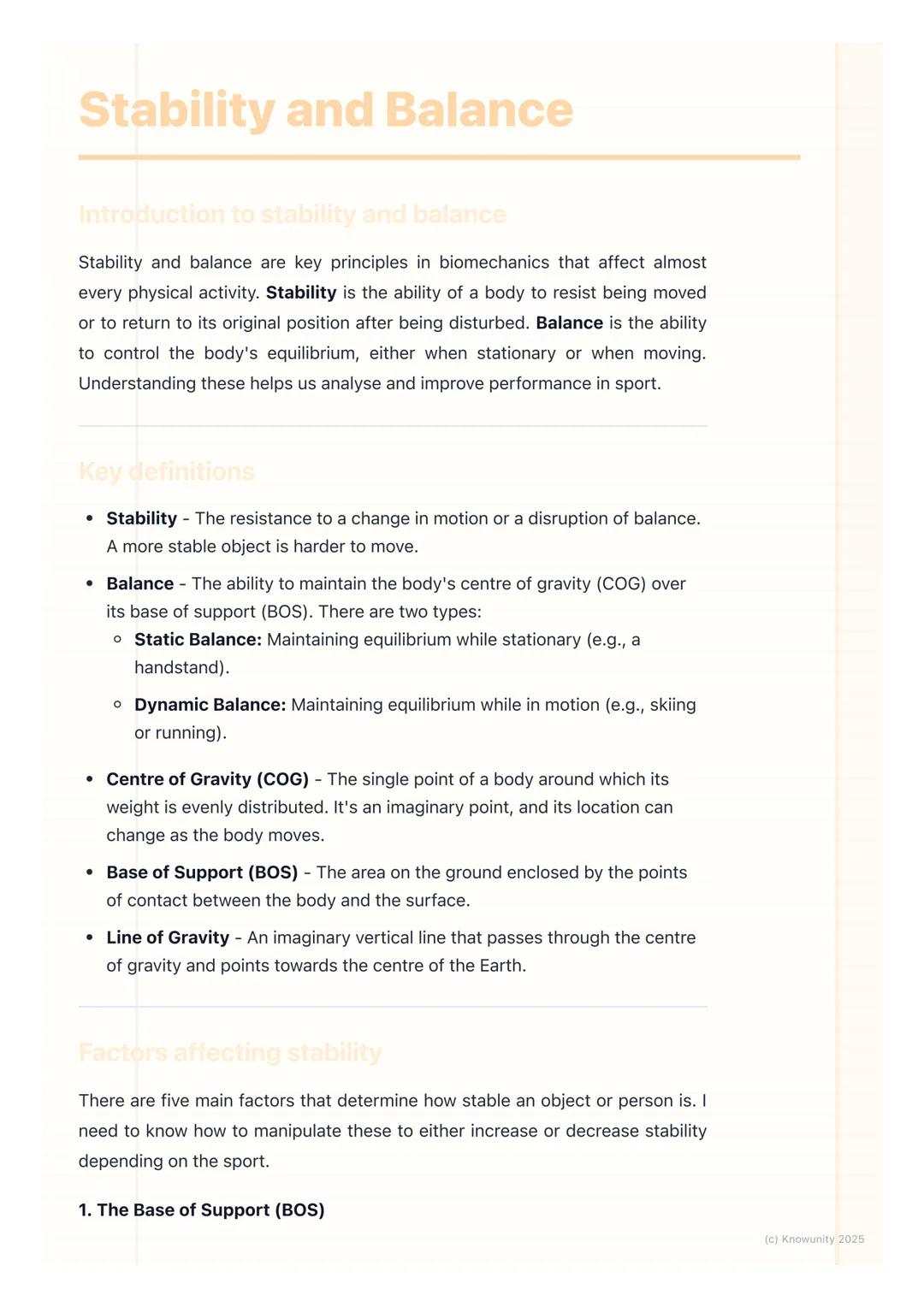
Understanding Stability and Balance
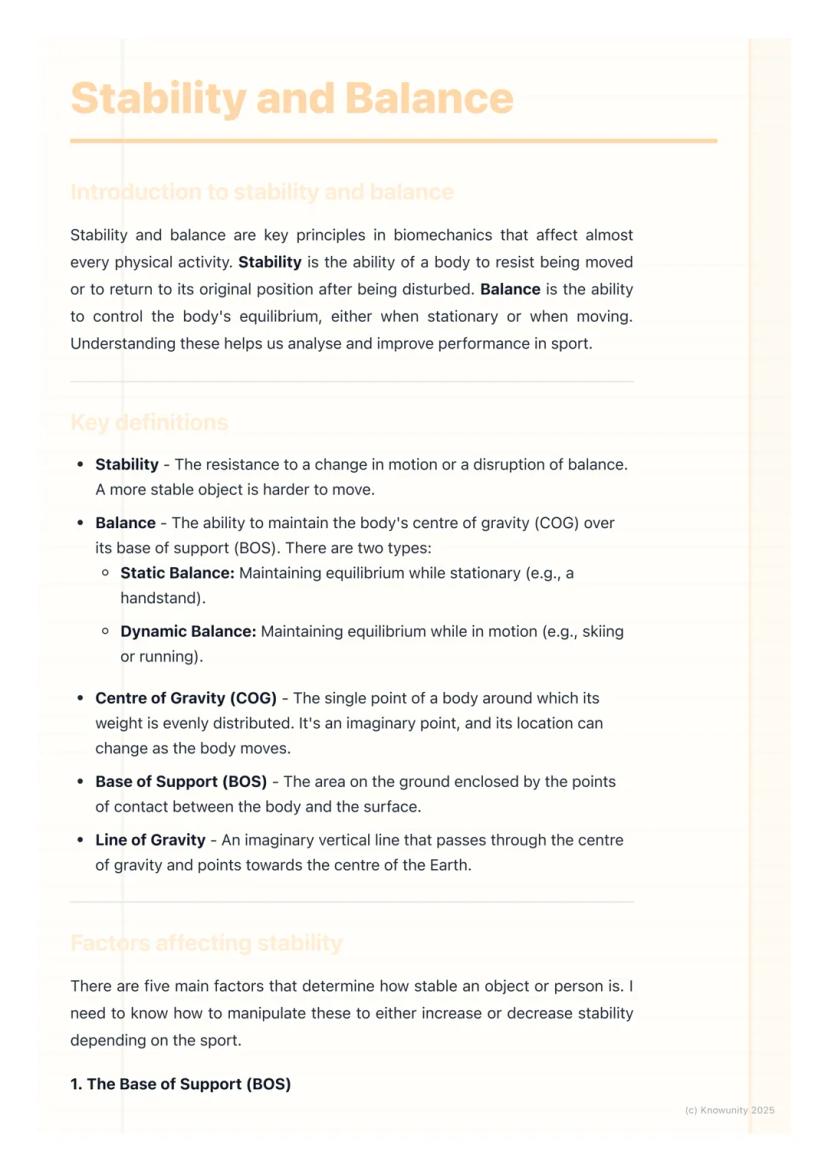
Stability is your body's ability to resist movement or return to its original position when disturbed. Balance, meanwhile, is how you control your body's equilibrium, whether you're standing still (static balance) or moving (dynamic balance).
The foundation of stability relies on understanding several key elements. Your Centre of Gravity (COG) is the single point around which your body weight is evenly distributed—it's an imaginary point that shifts as you move. The Base of Support (BOS) is the area between all points of contact with the ground. For example, when standing, it's the area between and including your feet.
The Line of Gravity is an imaginary vertical line passing through your centre of gravity toward the Earth's centre. When this line falls within your base of support, you maintain balance; when it moves outside, you'll either fall or need to adjust your position.
Did you know? You don't need to be highly stable in all sports! Sometimes being less stable allows for quicker movement and better performance, like in badminton where players need to change direction rapidly.
2
of 5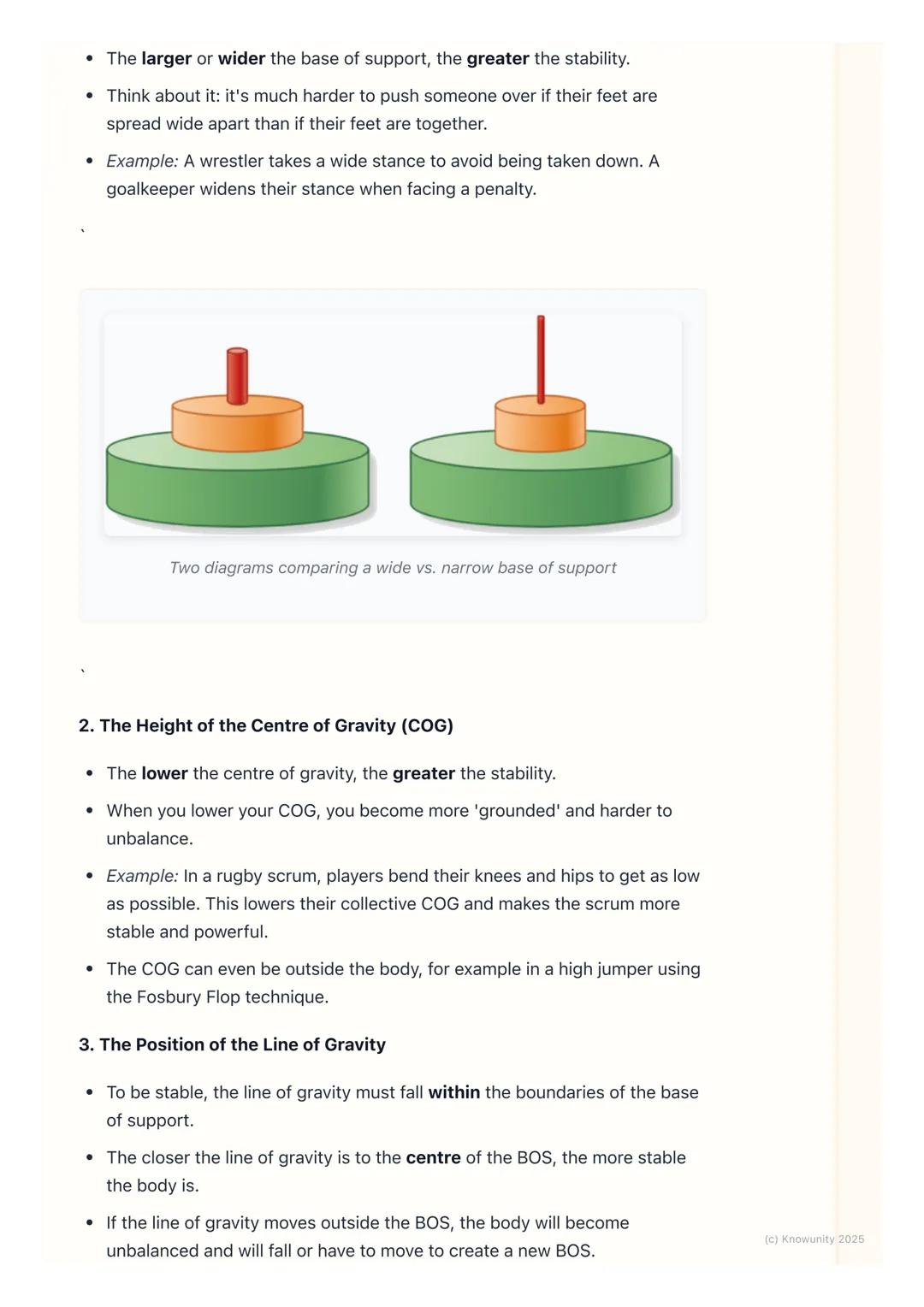
Factors Affecting Stability
Your stability is influenced by five key factors that you can manipulate to either increase or decrease stability depending on what your sport requires.
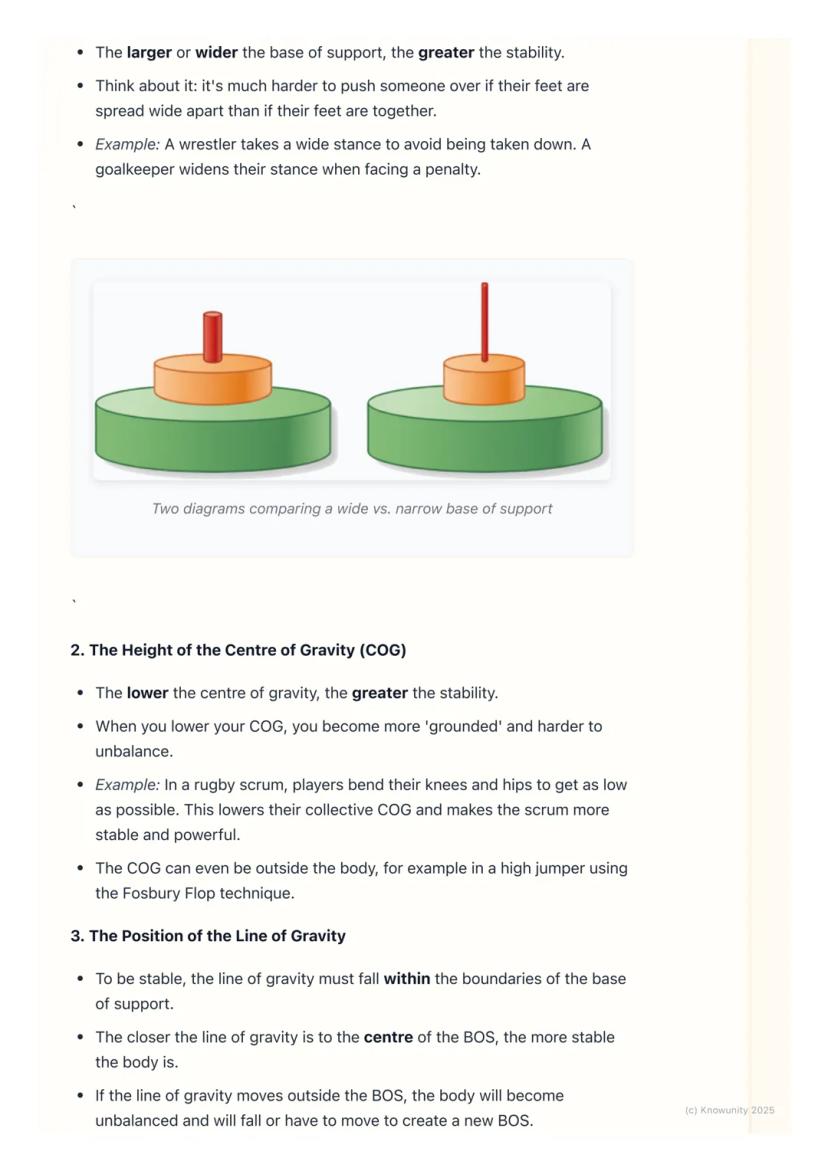
1. Base of Support (BOS) - A wider base makes you more stable. Think about how difficult it is to push someone over when their feet are spread apart compared to when they're close together. Rugby players in a scrum take wide stances to resist being moved, while gymnasts often use narrow stances when they need to rotate quickly.
2. Height of Centre of Gravity (COG) - The lower your centre of gravity, the more stable you become. That's why rugby players bend their knees and hips to get low in a scrum, increasing their stability. Interestingly, in the Fosbury Flop high jump technique, the athlete's centre of gravity actually passes underneath the bar while their body goes over it!
3. Position of Line of Gravity - For optimal stability, your line of gravity should fall in the centre of your base of support. The closer it gets to the edge, the less stable you become. Athletes sometimes intentionally create "controlled instability" by shifting their line of gravity toward the edge of their base to help them start moving quickly—like sprinters in the blocks.
3
of 5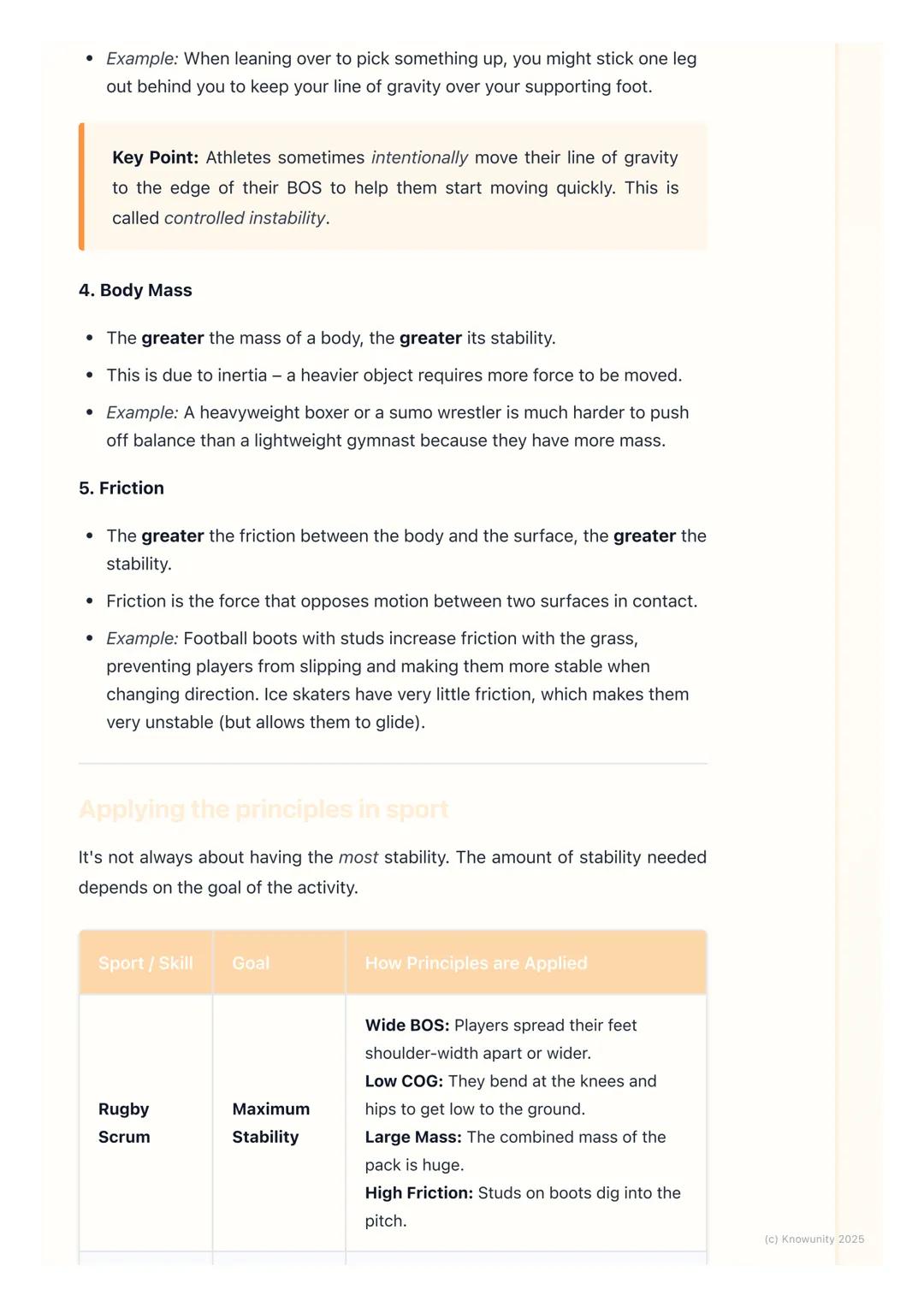
More Stability Factors and Sport Applications
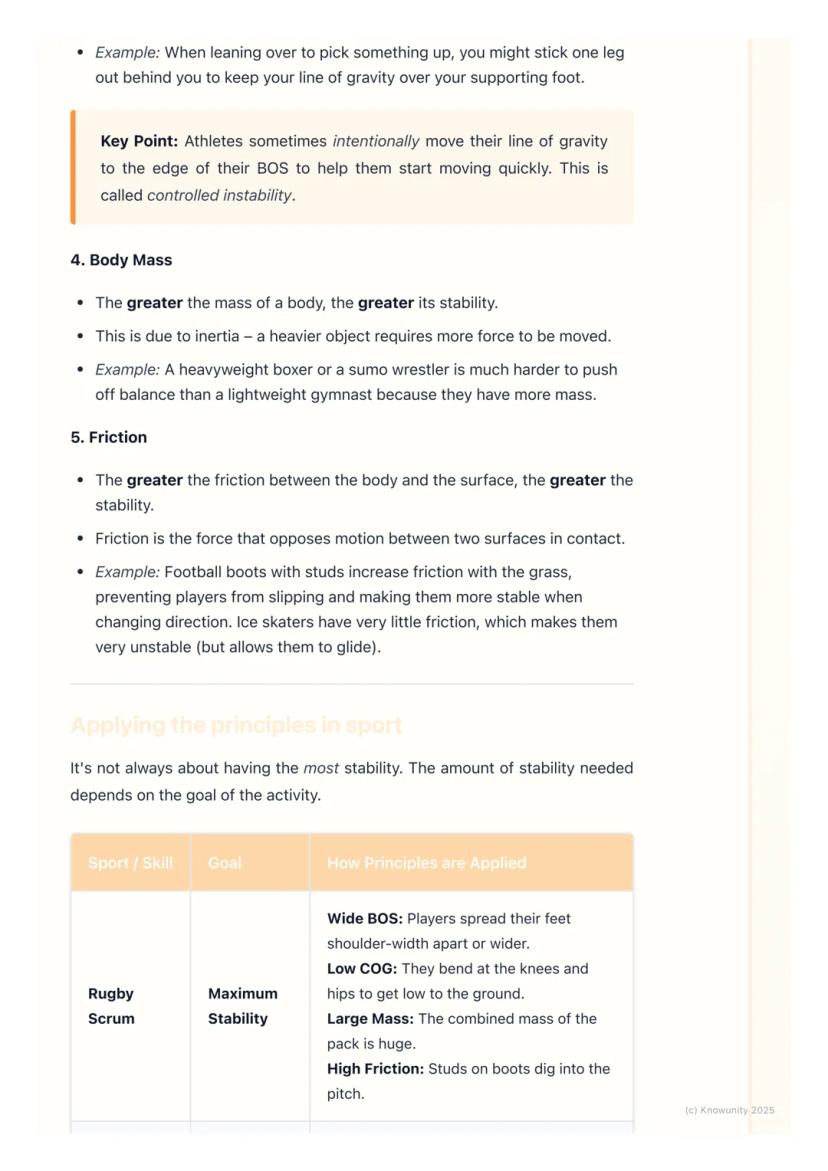
4. Body Mass - Greater mass means greater stability due to inertia. Heavier objects require more force to move. This is why heavyweight boxers or sumo wrestlers are significantly more difficult to unbalance than lightweight gymnasts.
5. Friction - More friction between your body and the surface increases stability. Football boots with studs create friction with the grass, preventing slipping and enhancing stability when changing direction. Conversely, ice skaters work with very little friction, which reduces stability but enables gliding.
The amount of stability needed varies dramatically depending on your sport's objectives. Different activities require different stability strategies:
Top Tip: When analysing sports performance, always ask yourself whether the athlete needs to be stable and immovable or whether they need mobility and quick movement. This will help you understand how they should apply stability principles.
Sports often involve a trade-off between stability and mobility. High stability typically means lower mobility (like a sumo wrestler), while low stability allows greater mobility (like a badminton player needing quick directional changes).
4
of 5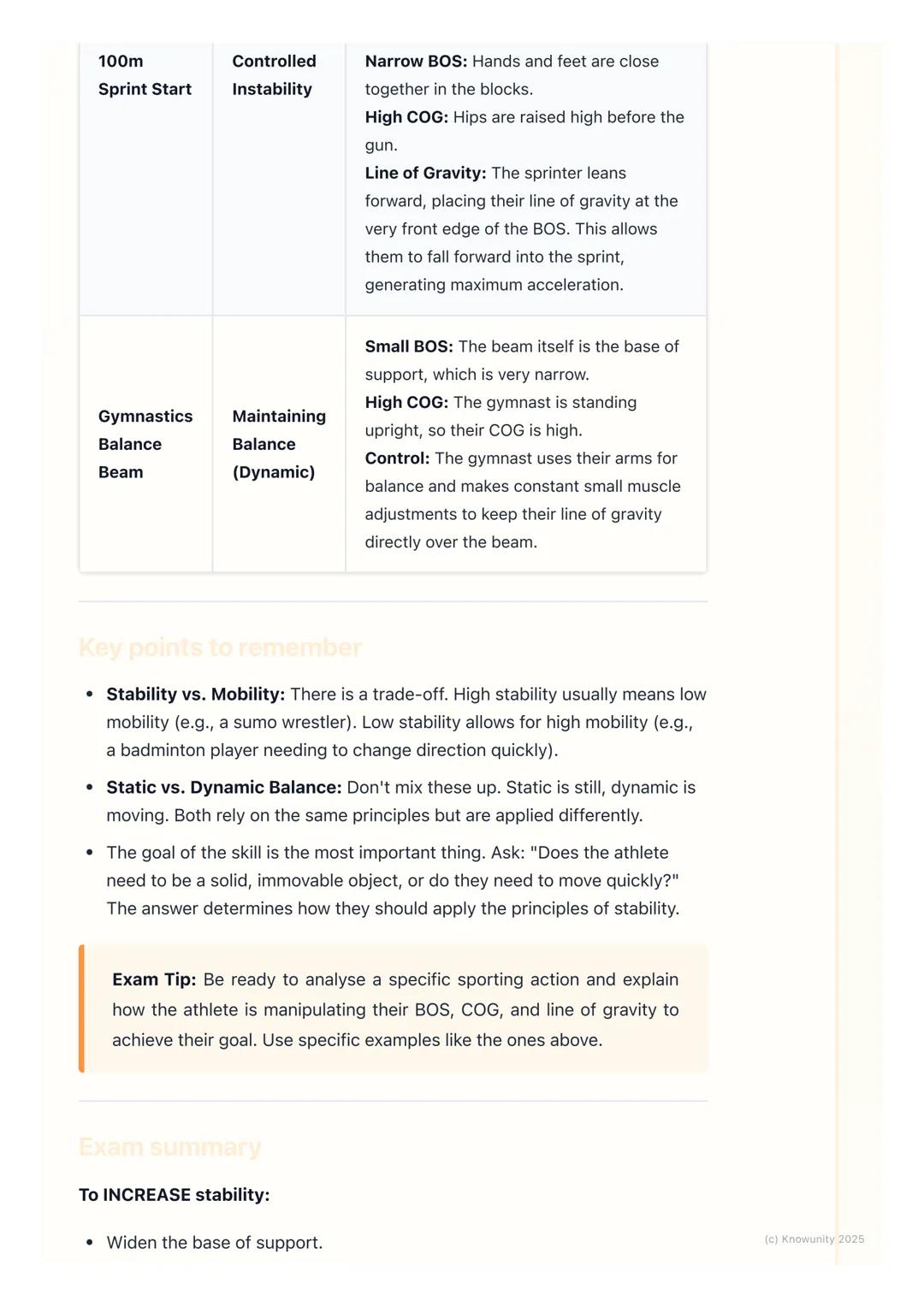
Applying Stability Principles in Sport
Let's look at how athletes manipulate stability principles in specific sports:
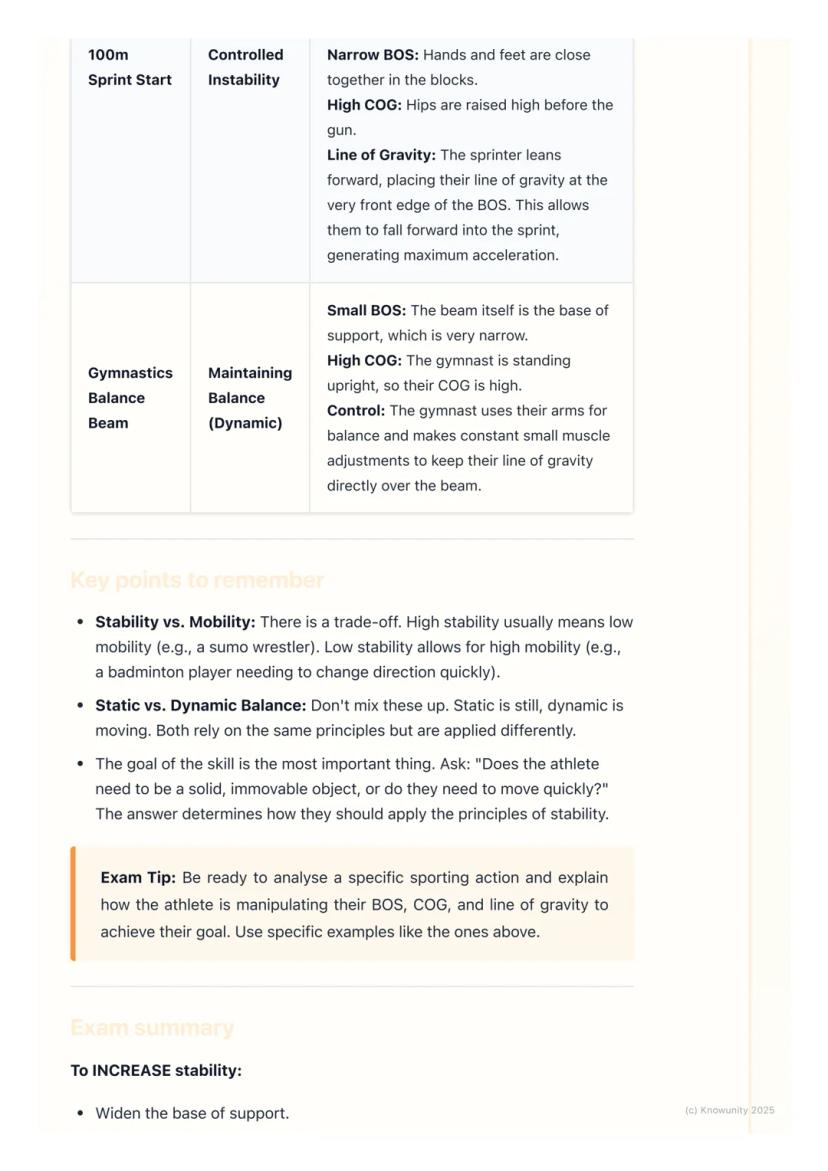
100m Sprint Start - Sprinters use controlled instability to their advantage. They create a narrow base of support in the blocks, raise their hips to elevate their centre of gravity, and lean forward to place their line of gravity at the front edge of their base. This deliberate instability allows them to "fall" forward into their first steps, generating maximum acceleration.
Gymnastics Balance Beam - Gymnasts face the challenge of maintaining balance on an extremely narrow base of support. With a high centre of gravity while standing upright, they must make constant small muscle adjustments to keep their line of gravity directly over the beam. They often use their arms as counterbalances to maintain this precarious equilibrium.
Understanding these principles helps you analyse techniques across any sport. For example, a basketball player widening their stance when defending, a goalkeeper spreading their arms and legs when facing a shot, or a skier lowering their body position when taking a turn are all applications of stability principles.
Exam Tip: When asked about stability in exams, always relate your answer to a specific sporting action and explain precisely how the athlete manipulates their base of support, centre of gravity, and line of gravity to achieve their goal.
5
of 5
Practical Applications for Stability Control
Knowing how to manipulate stability gives you a powerful tool for analysing and improving sporting performance. Here's a quick summary of how to adjust stability:
To increase stability:
- Widen your base of support (spread your feet)
- Lower your centre of gravity (bend knees, crouch)
- Keep your line of gravity centred in your base of support
- Increase body mass (more relevant for sports like rugby or sumo)
- Increase friction (appropriate footwear for the surface)
To decrease stability (for quicker movement):
- Narrow your base of support
- Raise your centre of gravity
- Move your line of gravity toward the edge of your base of support
Being able to identify and explain these principles in various sporting contexts will help you excel in both practical performance and theoretical examinations. Remember that different sports require different stability strategies, and the best athletes instinctively know when to prioritize stability and when to sacrifice it for mobility.
Hiç sormayacaksın sanmıştık...
Knowunity yapay zeka arkadaşı nedir?
Yapay zeka arkadaşımız öğrencilerin ihtiyaçlarına göre özel olarak tasarlanmıştır. Platformda bulunan milyonlarca içeriğe dayanarak öğrencilere gerçekten anlamlı ve ilgili yanıtlar verebiliyoruz. Ancak mesele sadece cevaplar değil, refakatçi aynı zamanda kişiselleştirilmiş öğrenme planları, sınavlar veya sohbet içerikleri ve öğrencilerin becerilerine ve gelişimlerine dayalı %100 kişiselleştirme ile öğrencilere günlük öğrenme zorluklarında rehberlik ediyor.
Knowunity uygulamasını nereden indirebilirim?
Uygulamayı Google Play Store ve Apple App Store'dan indirebilirsiniz.
Knowunity ücretsiz mi?
Knowunity uygulaması ücretsiz! Uygulamamız çok yakında indirmeye hazır olacak, bekle bizi. 💙
LCPE dersinin en popüler içerikleri
4LCPEHealthy Eating Guidelines
This section explores national healthy eating guidelines, such as the food pyramid or healthy eating plate, to promote balanced dietary choices.
5th Year50
LCPEBiomechanics of Movement
Applying fundamental biomechanical principles such as force, motion, levers, and stability to analyse and improve human movement efficiency and performance in sport.
6th Year200
LCPEFactors effecting sports psychology ( confidence and self efficacy)
Higher Level LCPE psychological preprration notes
5th Year230
LCPETechnology in Sport
Investigating how technology is used in areas such as performance analysis, equipment design, officiating, and athlete monitoring to enhance training and competition.
6th Year50
En popüler içerikler
9 Irish
IrishIrish oral questions and answers
Questions and answers for the leaving cert oral
5th Year4264
 English
Key Quotes : Sive
Key Quotes and explanations: Sive
6th Year2842
IrishIrish oral questions
Outline of oral questions
5th Year2055
IrishIníon- le hÁine Durkin
Aine Durkin’s poem, Iníon: Themes & summary
5th Year850
IrishIrish poetry 2027
Iníon + Dínit an Bhróin
5th Year1133
IrishLC HL notes- Iníon (poem)
Includes poem in English and Irish, theme, key words & phrases
5th Year2284
EnglishCultural Context : Shawshank Redemption : Sive : Small Things Like These
Comparative Study : Cultural Context : Shawshank Redemption, Sive and Small Things Like These
6th Year1430
IrishMo Ghrá-sa (Idir Lúibíní)
Notes on mo ghrá-sa
5th Year380
IrishAn Gaeilge Aiste
Irish Language essay
6th Year1320
Aradığını bulamıyor musun? Diğer derslere göz at.
Kullanıcılarımızdan yorumlar. Onlar her şeyi çok beğendi — sen de beğeneceksin.
4.6/5App Store
4.7/5Google Play
Uygulama çok kolay kullanılıyor ve güzel tasarlanmış. Şu ana kadar aradığım her şeyi buldum ve sunumlardan çok şey öğrendim! Kesinlikle ödevlerim için hep kullanacağım!
A.S.iOS kullanıcısı
Uygulama çok iyi. Çok fazla ders notu ve yardımlaşma var. Örneğin benim problem yaşadığım bir ders Geometriydi ve ANINDA yardım ettiler beraber hem sorularımı çözdük hem konu anlatımı buldum. Herkese tavsiye ederim.
S.L.Android kullanıcısı
BEN ŞOK. Reklamını sık sık gördüğüm için uygulamayı denedim ve gerçekten hayran kaldım. Bu uygulama okul için tam ihtiyacım olan şey. Anında ödev yardımı, konu anlatımı, örnek sınavlar, flaşkartlar hepsi hepsi var, şiddetle tavsiye ederim ✅
A.iOS kullanıcısı
LCPE8 görüntüleme·Güncellendi Jun 13, 2026·5 sayfaUnderstanding Stability and Balance
Stability and balance are fundamental principles in biomechanics that impact virtually every sport and physical activity. These concepts help us understand how athletes maintain control over their bodies and how they can manipulate these factors to optimize their performance. Mastering...
1
of 5
Ders notlarını görmek için kaydol. Ücretsiz!
- Tüm belgeleri görebilirsin
- Notlarını Yükselt
- Milyonlarca öğrenciye katıl
Understanding Stability and Balance
Stability is your body's ability to resist movement or return to its original position when disturbed. Balance, meanwhile, is how you control your body's equilibrium, whether you're standing still (static balance) or moving (dynamic balance).
The foundation of stability relies on understanding several key elements. Your Centre of Gravity (COG) is the single point around which your body weight is evenly distributed—it's an imaginary point that shifts as you move. The Base of Support (BOS) is the area between all points of contact with the ground. For example, when standing, it's the area between and including your feet.
The Line of Gravity is an imaginary vertical line passing through your centre of gravity toward the Earth's centre. When this line falls within your base of support, you maintain balance; when it moves outside, you'll either fall or need to adjust your position.
Did you know? You don't need to be highly stable in all sports! Sometimes being less stable allows for quicker movement and better performance, like in badminton where players need to change direction rapidly.
2
of 5Ders notlarını görmek için kaydol. Ücretsiz!
- Tüm belgeleri görebilirsin
- Notlarını Yükselt
- Milyonlarca öğrenciye katıl
Factors Affecting Stability
Your stability is influenced by five key factors that you can manipulate to either increase or decrease stability depending on what your sport requires.
1. Base of Support (BOS) - A wider base makes you more stable. Think about how difficult it is to push someone over when their feet are spread apart compared to when they're close together. Rugby players in a scrum take wide stances to resist being moved, while gymnasts often use narrow stances when they need to rotate quickly.
2. Height of Centre of Gravity (COG) - The lower your centre of gravity, the more stable you become. That's why rugby players bend their knees and hips to get low in a scrum, increasing their stability. Interestingly, in the Fosbury Flop high jump technique, the athlete's centre of gravity actually passes underneath the bar while their body goes over it!
3. Position of Line of Gravity - For optimal stability, your line of gravity should fall in the centre of your base of support. The closer it gets to the edge, the less stable you become. Athletes sometimes intentionally create "controlled instability" by shifting their line of gravity toward the edge of their base to help them start moving quickly—like sprinters in the blocks.
3
of 5Ders notlarını görmek için kaydol. Ücretsiz!
- Tüm belgeleri görebilirsin
- Notlarını Yükselt
- Milyonlarca öğrenciye katıl
More Stability Factors and Sport Applications
4. Body Mass - Greater mass means greater stability due to inertia. Heavier objects require more force to move. This is why heavyweight boxers or sumo wrestlers are significantly more difficult to unbalance than lightweight gymnasts.
5. Friction - More friction between your body and the surface increases stability. Football boots with studs create friction with the grass, preventing slipping and enhancing stability when changing direction. Conversely, ice skaters work with very little friction, which reduces stability but enables gliding.
The amount of stability needed varies dramatically depending on your sport's objectives. Different activities require different stability strategies:
Top Tip: When analysing sports performance, always ask yourself whether the athlete needs to be stable and immovable or whether they need mobility and quick movement. This will help you understand how they should apply stability principles.
Sports often involve a trade-off between stability and mobility. High stability typically means lower mobility (like a sumo wrestler), while low stability allows greater mobility (like a badminton player needing quick directional changes).
4
of 5Ders notlarını görmek için kaydol. Ücretsiz!
- Tüm belgeleri görebilirsin
- Notlarını Yükselt
- Milyonlarca öğrenciye katıl
Applying Stability Principles in Sport
Let's look at how athletes manipulate stability principles in specific sports:
100m Sprint Start - Sprinters use controlled instability to their advantage. They create a narrow base of support in the blocks, raise their hips to elevate their centre of gravity, and lean forward to place their line of gravity at the front edge of their base. This deliberate instability allows them to "fall" forward into their first steps, generating maximum acceleration.
Gymnastics Balance Beam - Gymnasts face the challenge of maintaining balance on an extremely narrow base of support. With a high centre of gravity while standing upright, they must make constant small muscle adjustments to keep their line of gravity directly over the beam. They often use their arms as counterbalances to maintain this precarious equilibrium.
Understanding these principles helps you analyse techniques across any sport. For example, a basketball player widening their stance when defending, a goalkeeper spreading their arms and legs when facing a shot, or a skier lowering their body position when taking a turn are all applications of stability principles.
Exam Tip: When asked about stability in exams, always relate your answer to a specific sporting action and explain precisely how the athlete manipulates their base of support, centre of gravity, and line of gravity to achieve their goal.
5
of 5Ders notlarını görmek için kaydol. Ücretsiz!
- Tüm belgeleri görebilirsin
- Notlarını Yükselt
- Milyonlarca öğrenciye katıl
Practical Applications for Stability Control
Knowing how to manipulate stability gives you a powerful tool for analysing and improving sporting performance. Here's a quick summary of how to adjust stability:
To increase stability:
- Widen your base of support (spread your feet)
- Lower your centre of gravity (bend knees, crouch)
- Keep your line of gravity centred in your base of support
- Increase body mass (more relevant for sports like rugby or sumo)
- Increase friction (appropriate footwear for the surface)
To decrease stability (for quicker movement):
- Narrow your base of support
- Raise your centre of gravity
- Move your line of gravity toward the edge of your base of support
Being able to identify and explain these principles in various sporting contexts will help you excel in both practical performance and theoretical examinations. Remember that different sports require different stability strategies, and the best athletes instinctively know when to prioritize stability and when to sacrifice it for mobility.
Hiç sormayacaksın sanmıştık...
Knowunity yapay zeka arkadaşı nedir?
Yapay zeka arkadaşımız öğrencilerin ihtiyaçlarına göre özel olarak tasarlanmıştır. Platformda bulunan milyonlarca içeriğe dayanarak öğrencilere gerçekten anlamlı ve ilgili yanıtlar verebiliyoruz. Ancak mesele sadece cevaplar değil, refakatçi aynı zamanda kişiselleştirilmiş öğrenme planları, sınavlar veya sohbet içerikleri ve öğrencilerin becerilerine ve gelişimlerine dayalı %100 kişiselleştirme ile öğrencilere günlük öğrenme zorluklarında rehberlik ediyor.
Knowunity uygulamasını nereden indirebilirim?
Uygulamayı Google Play Store ve Apple App Store'dan indirebilirsiniz.
Knowunity ücretsiz mi?
Knowunity uygulaması ücretsiz! Uygulamamız çok yakında indirmeye hazır olacak, bekle bizi. 💙
LCPE dersinin en popüler içerikleri
4LCPEHealthy Eating Guidelines
This section explores national healthy eating guidelines, such as the food pyramid or healthy eating plate, to promote balanced dietary choices.
5th Year50
LCPEBiomechanics of Movement
Applying fundamental biomechanical principles such as force, motion, levers, and stability to analyse and improve human movement efficiency and performance in sport.
6th Year200
LCPEFactors effecting sports psychology ( confidence and self efficacy)
Higher Level LCPE psychological preprration notes
5th Year230
LCPETechnology in Sport
Investigating how technology is used in areas such as performance analysis, equipment design, officiating, and athlete monitoring to enhance training and competition.
6th Year50
En popüler içerikler
9IrishIrish oral questions and answers
Questions and answers for the leaving cert oral
5th Year4264
EnglishKey Quotes : Sive
Key Quotes and explanations: Sive
6th Year2842
IrishIrish oral questions
Outline of oral questions
5th Year2055
IrishIníon- le hÁine Durkin
Aine Durkin’s poem, Iníon: Themes & summary
5th Year850
IrishIrish poetry 2027
Iníon + Dínit an Bhróin
5th Year1133
IrishLC HL notes- Iníon (poem)
Includes poem in English and Irish, theme, key words & phrases
5th Year2284
EnglishCultural Context : Shawshank Redemption : Sive : Small Things Like These
Comparative Study : Cultural Context : Shawshank Redemption, Sive and Small Things Like These
6th Year1430
IrishMo Ghrá-sa (Idir Lúibíní)
Notes on mo ghrá-sa
5th Year380
IrishAn Gaeilge Aiste
Irish Language essay
6th Year1320
Aradığını bulamıyor musun? Diğer derslere göz at.
Kullanıcılarımızdan yorumlar. Onlar her şeyi çok beğendi — sen de beğeneceksin.
4.6/5App Store
4.7/5Google Play
Uygulama çok kolay kullanılıyor ve güzel tasarlanmış. Şu ana kadar aradığım her şeyi buldum ve sunumlardan çok şey öğrendim! Kesinlikle ödevlerim için hep kullanacağım!
A.S.iOS kullanıcısı
Uygulama çok iyi. Çok fazla ders notu ve yardımlaşma var. Örneğin benim problem yaşadığım bir ders Geometriydi ve ANINDA yardım ettiler beraber hem sorularımı çözdük hem konu anlatımı buldum. Herkese tavsiye ederim.
S.L.Android kullanıcısı
BEN ŞOK. Reklamını sık sık gördüğüm için uygulamayı denedim ve gerçekten hayran kaldım. Bu uygulama okul için tam ihtiyacım olan şey. Anında ödev yardımı, konu anlatımı, örnek sınavlar, flaşkartlar hepsi hepsi var, şiddetle tavsiye ederim ✅
A.iOS kullanıcısı