
Ever wondered why some training sessions feel like torture whilst...
 LCPE1 görüntüleme·Güncellendi Jun 14, 2026·6 sayfa
Types of Practice Methods

1 / 6
1
of 6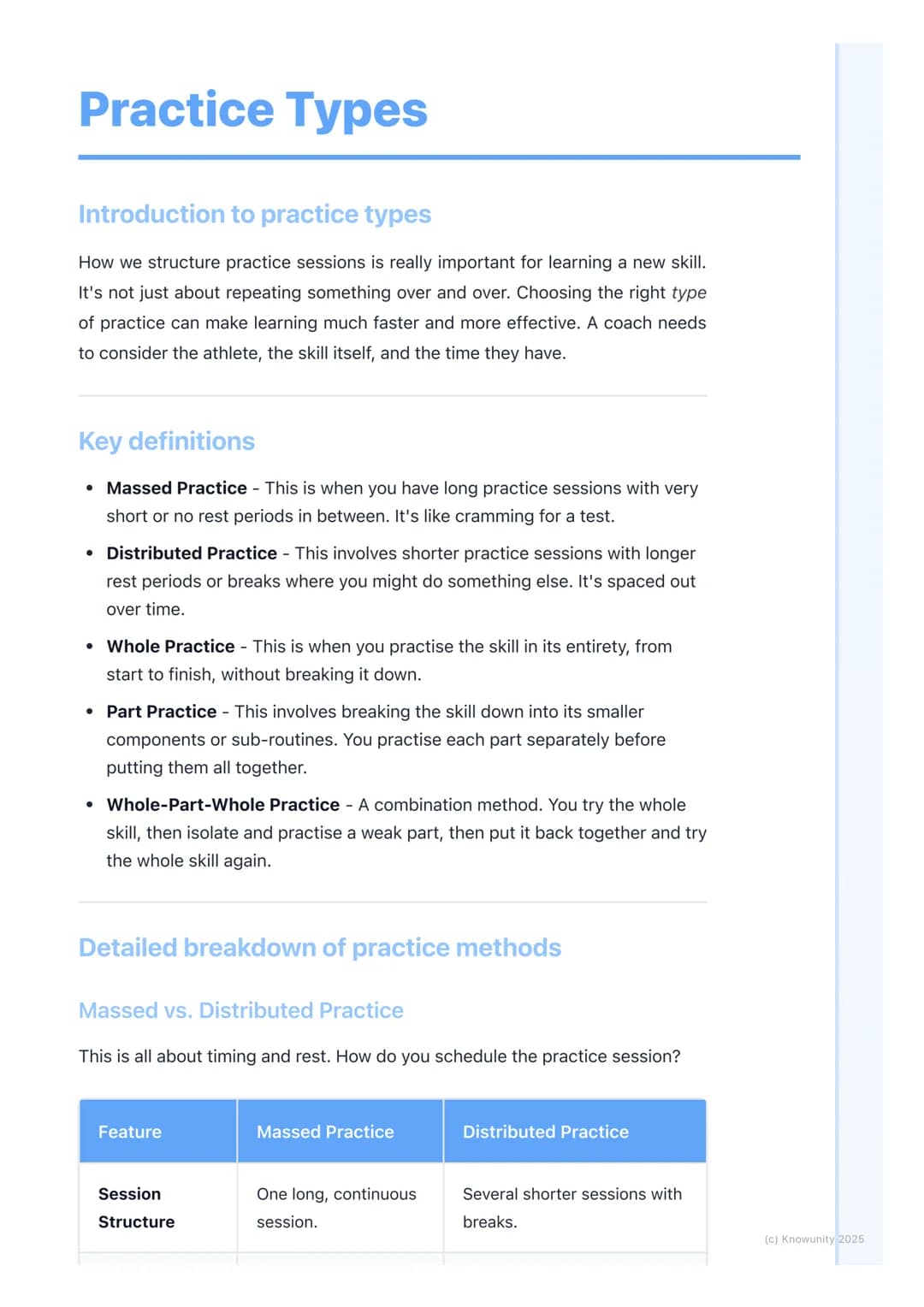
Introduction to Practice Types
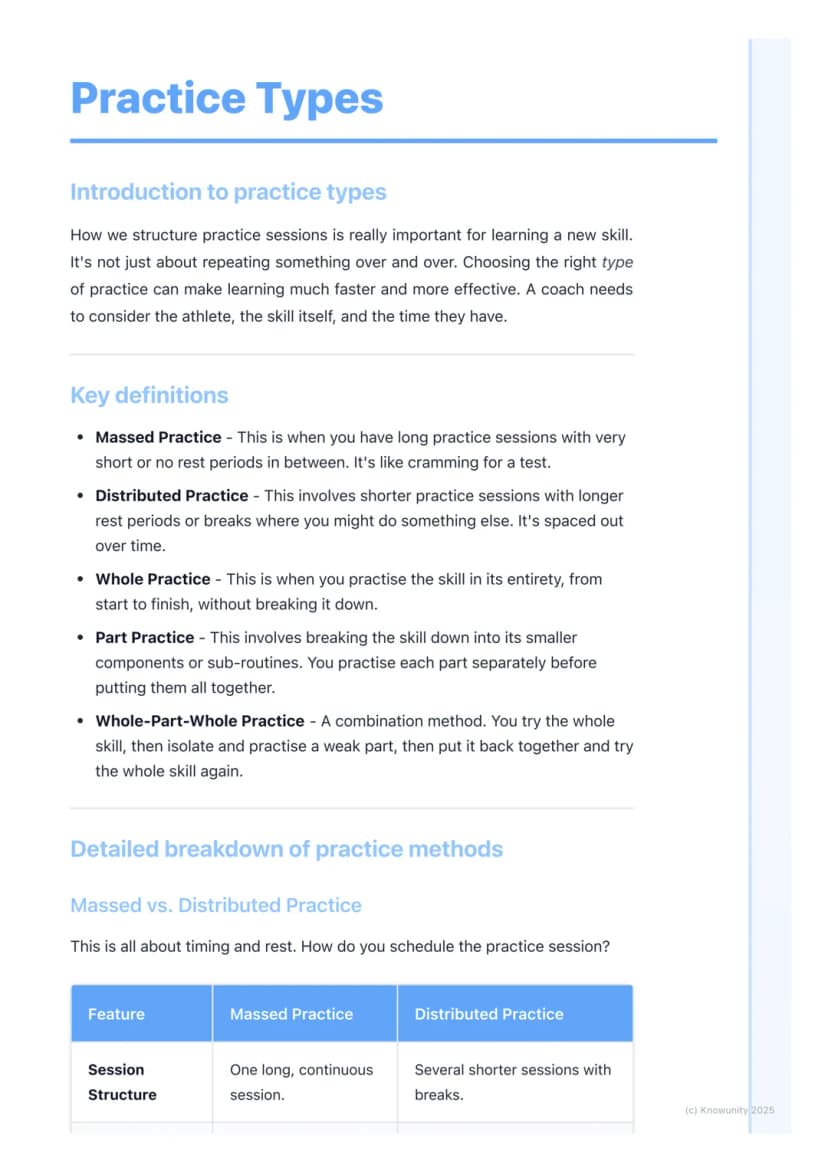
Practice isn't just about repeating something until you're sick of it. How you structure your training sessions massively affects how quickly you'll learn new skills and how well you'll perform under pressure.
Coaches need to think about three key things when planning practice: the athlete (are they a beginner or experienced?), the skill itself (is it simple or complex?), and the situation (how much time do we have?). Get this right, and learning becomes much more effective.
There are four main ways to organise practice sessions. Massed practice means long sessions with barely any breaks - like cramming for an exam. Distributed practice involves shorter sessions with proper rest periods. Whole practice means doing the complete skill from start to finish, whilst part practice breaks skills down into smaller chunks.
Quick Tip: Most complex sports skills benefit from distributed practice rather than marathon training sessions that leave you exhausted.
2
of 6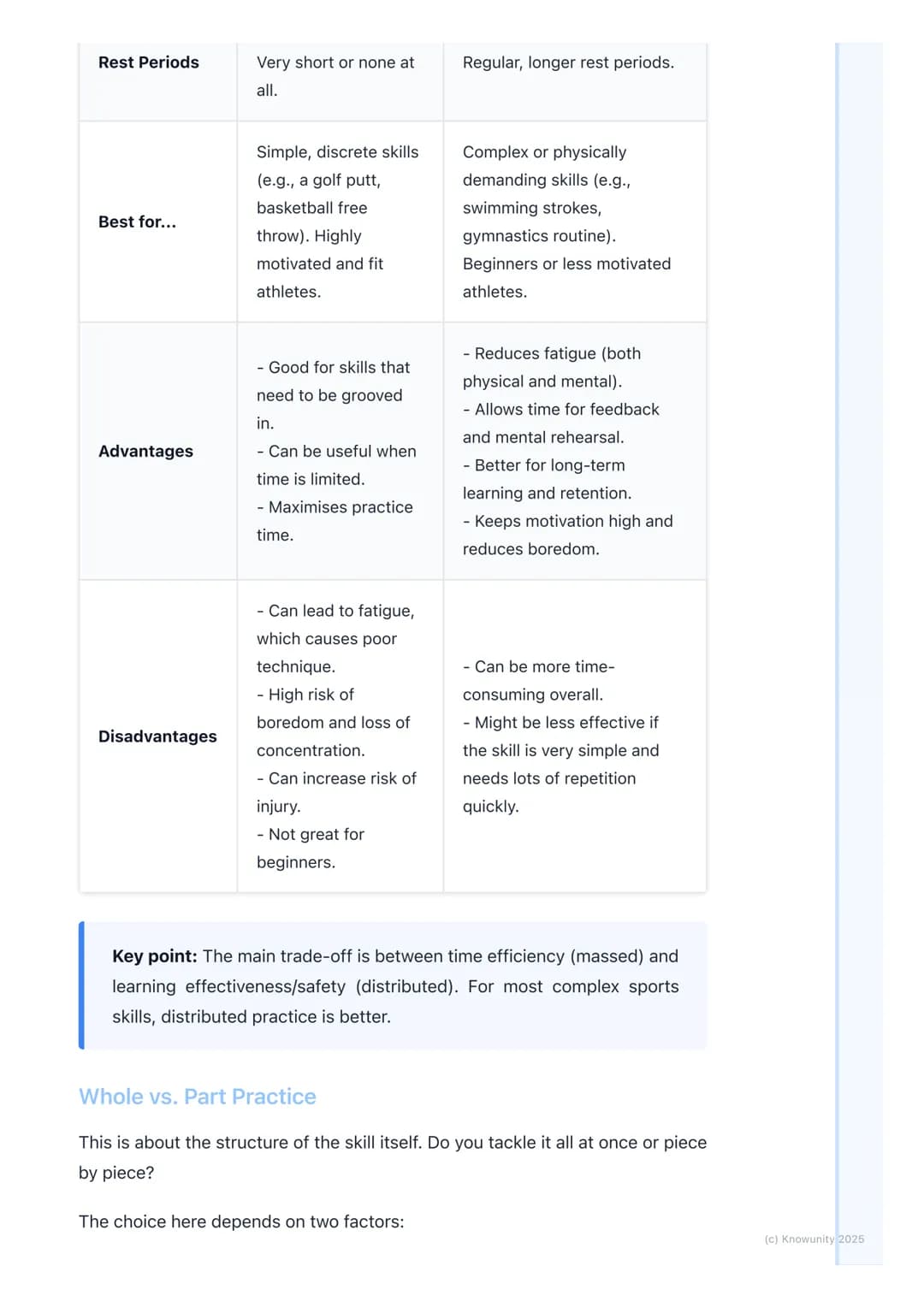
Massed vs. Distributed Practice
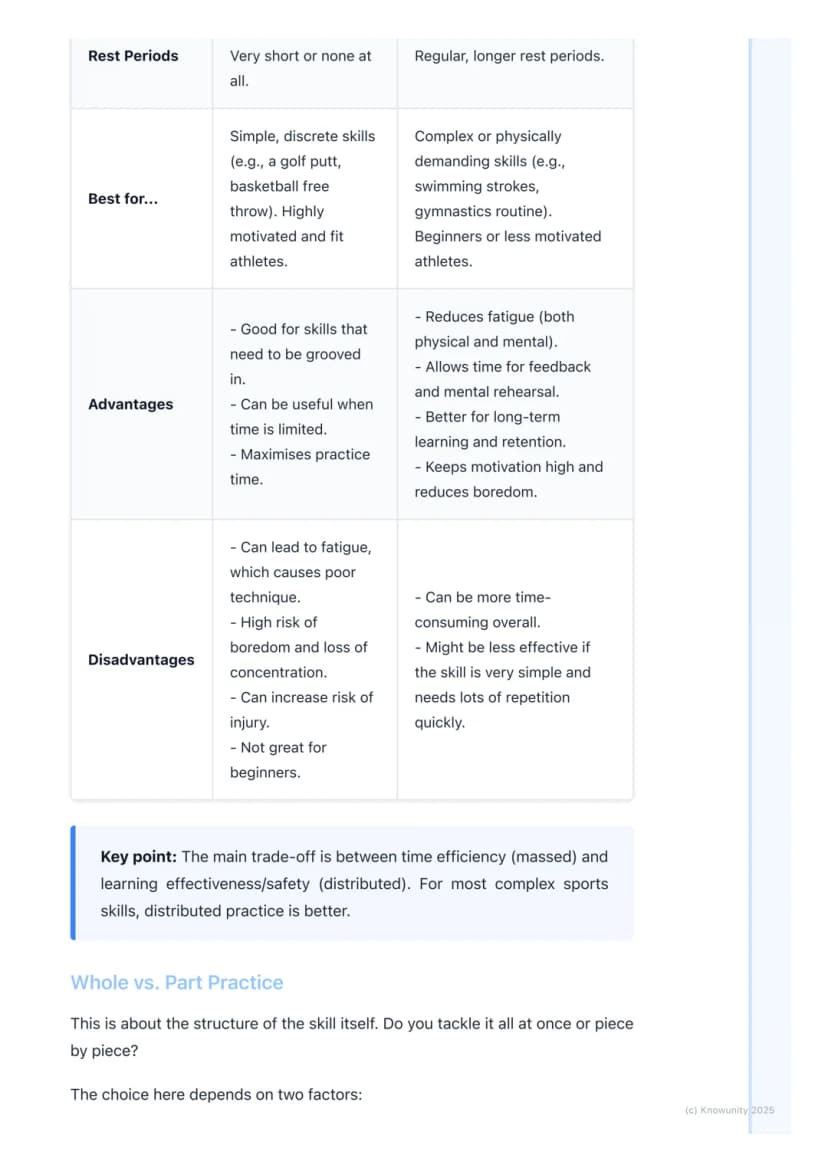
This is all about timing your practice sessions and rest periods. Think of it like the difference between binge-watching an entire series in one night versus watching an episode each evening.
Massed practice works best for simple, discrete skills like free throws or golf putts, especially with highly motivated and fit athletes. You get maximum practice time and can really groove in the movement pattern. However, it's a recipe for disaster with complex skills because fatigue leads to sloppy technique and potential injuries.
Distributed practice is brilliant for complex or physically demanding skills like swimming strokes or gymnastics routines. The regular breaks prevent fatigue, keep motivation high, and give time for feedback and mental rehearsal. Yes, it takes more time overall, but the learning quality is much better.
The key trade-off is simple: massed practice saves time but distributed practice actually works better for learning. For most sports skills you'll encounter, distributed practice is the smarter choice.
Reality Check: If you're getting tired and your technique is falling apart, you're probably doing massed practice when you should be taking breaks.
3
of 6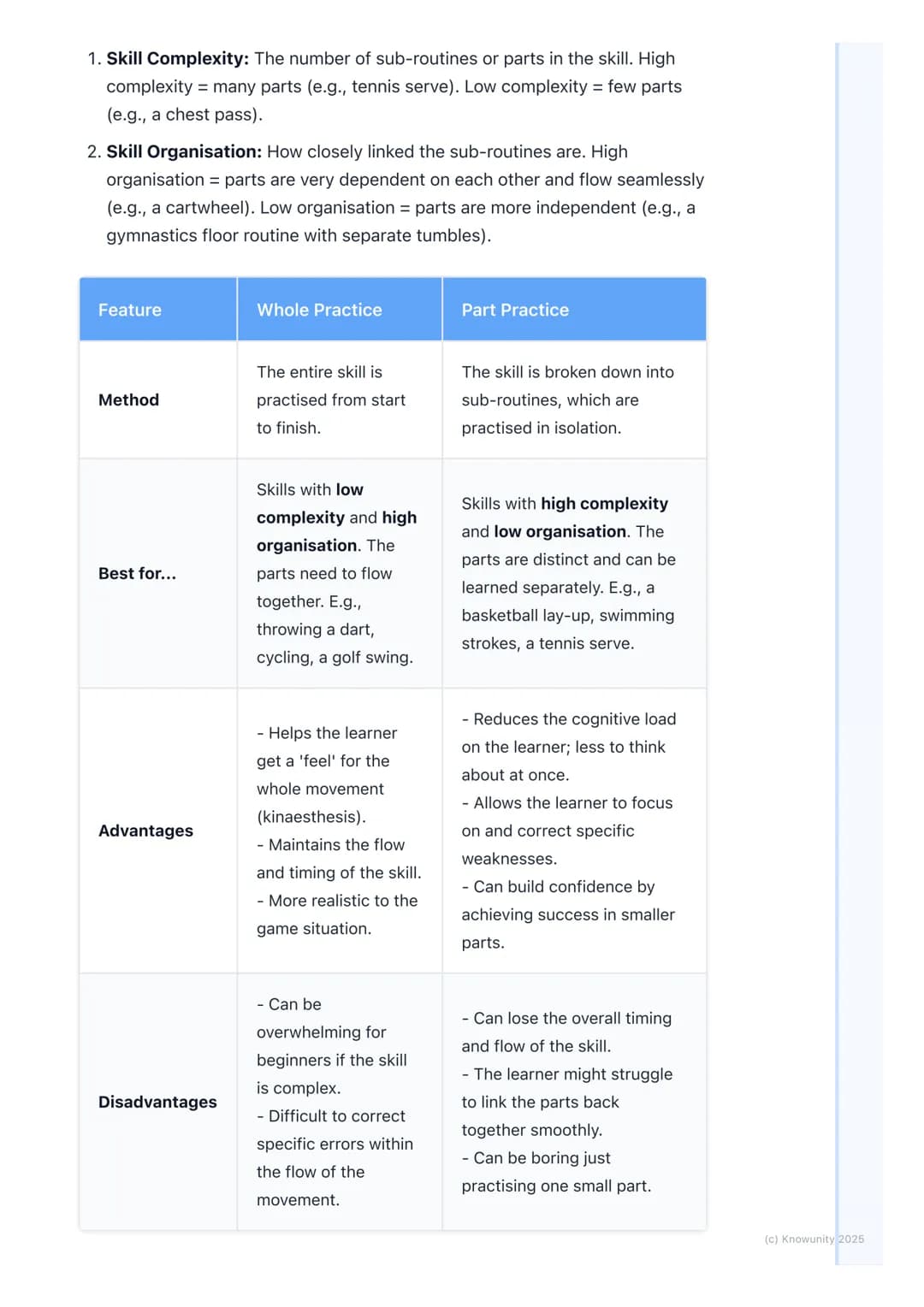
Whole vs. Part Practice
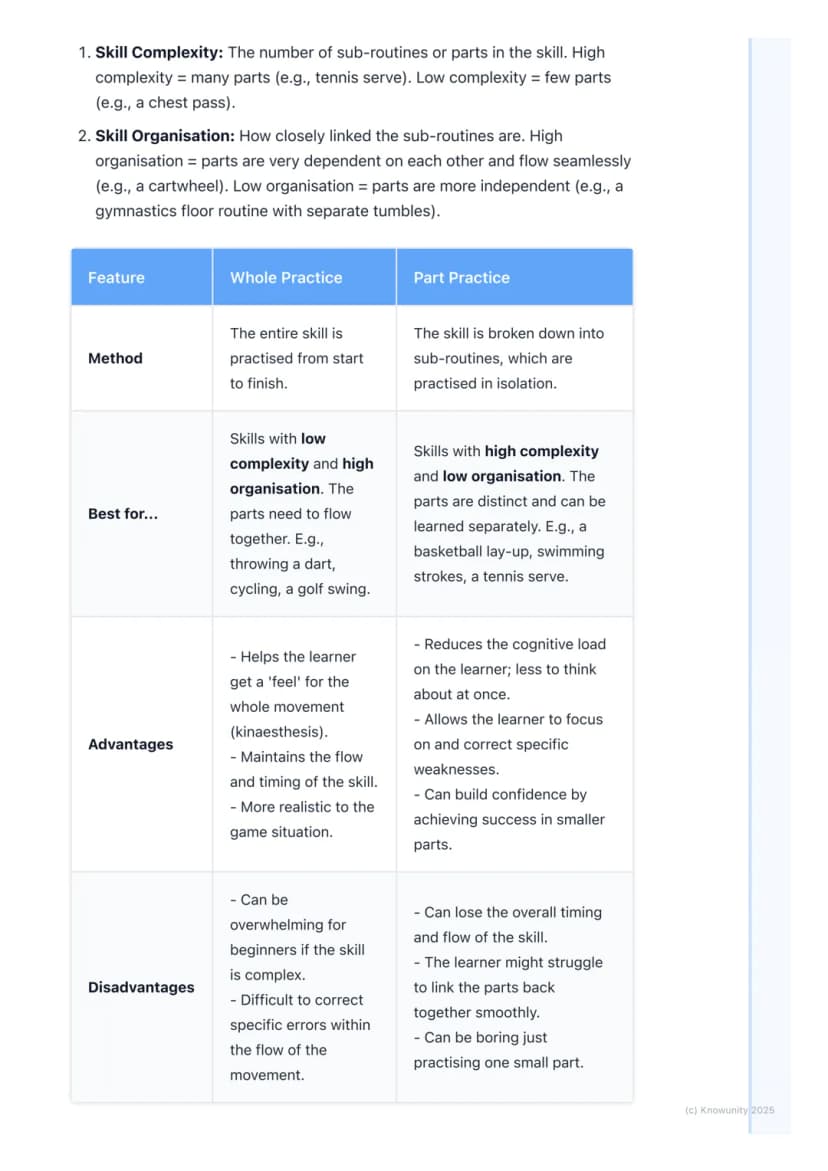
This decision depends on two crucial factors about the skill itself. Skill complexity refers to how many parts or sub-routines the skill has - a tennis serve has loads of parts (high complexity) whilst a chest pass has few (low complexity).
Skill organisation is about how tightly linked these parts are. In a cartwheel, everything flows seamlessly together (high organisation), but in a gymnastics floor routine, you can separate the different tumbles (low organisation).
Whole practice works brilliantly for skills that are simple and flow naturally together. Breaking these down would actually mess up the rhythm and feel of the movement. Think golf swings or penalty kicks - they need to be practised as complete movements.
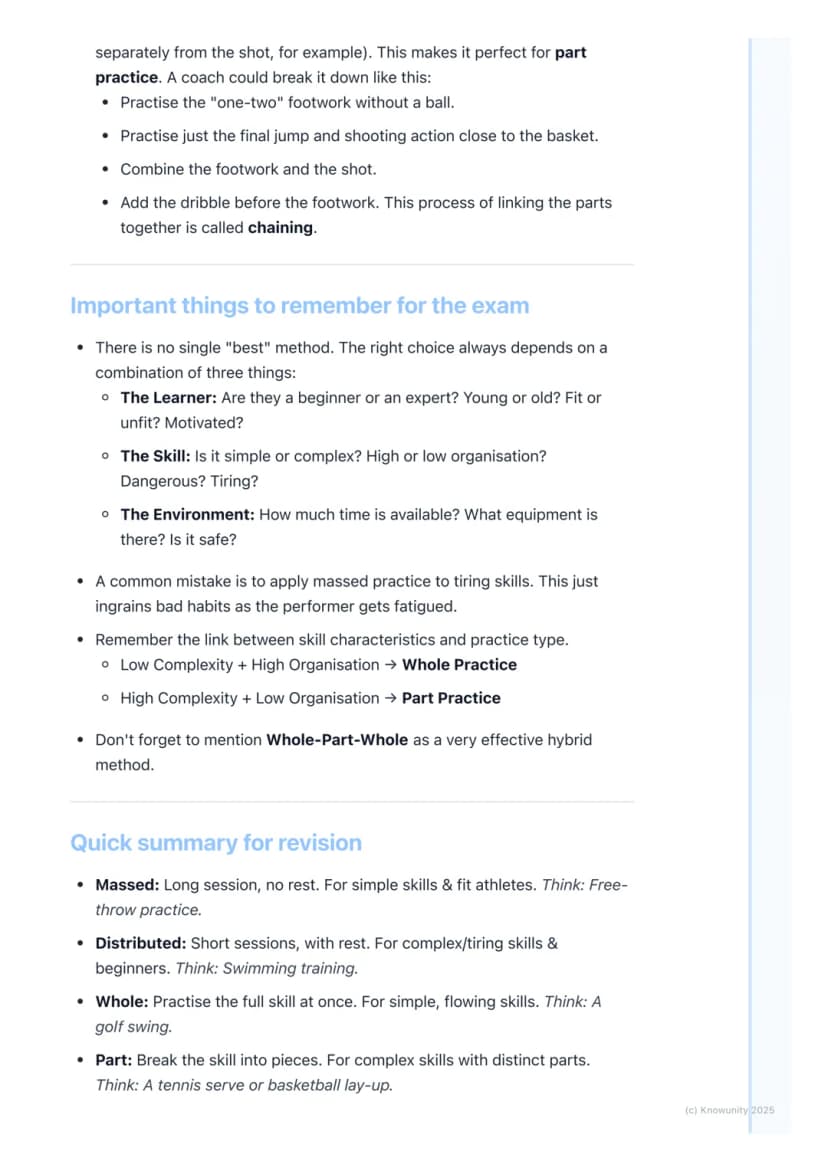
Part practice is perfect for complex skills where the parts can be separated. A basketball lay-up, for example, has distinct elements (dribble, footwork, jump, shoot) that can be practised individually before being linked together through a process called chaining.
Coach's Secret: The sweet spot is often whole-part-whole practice - try the full skill, isolate the weak bit, then put it back together.
4
of 6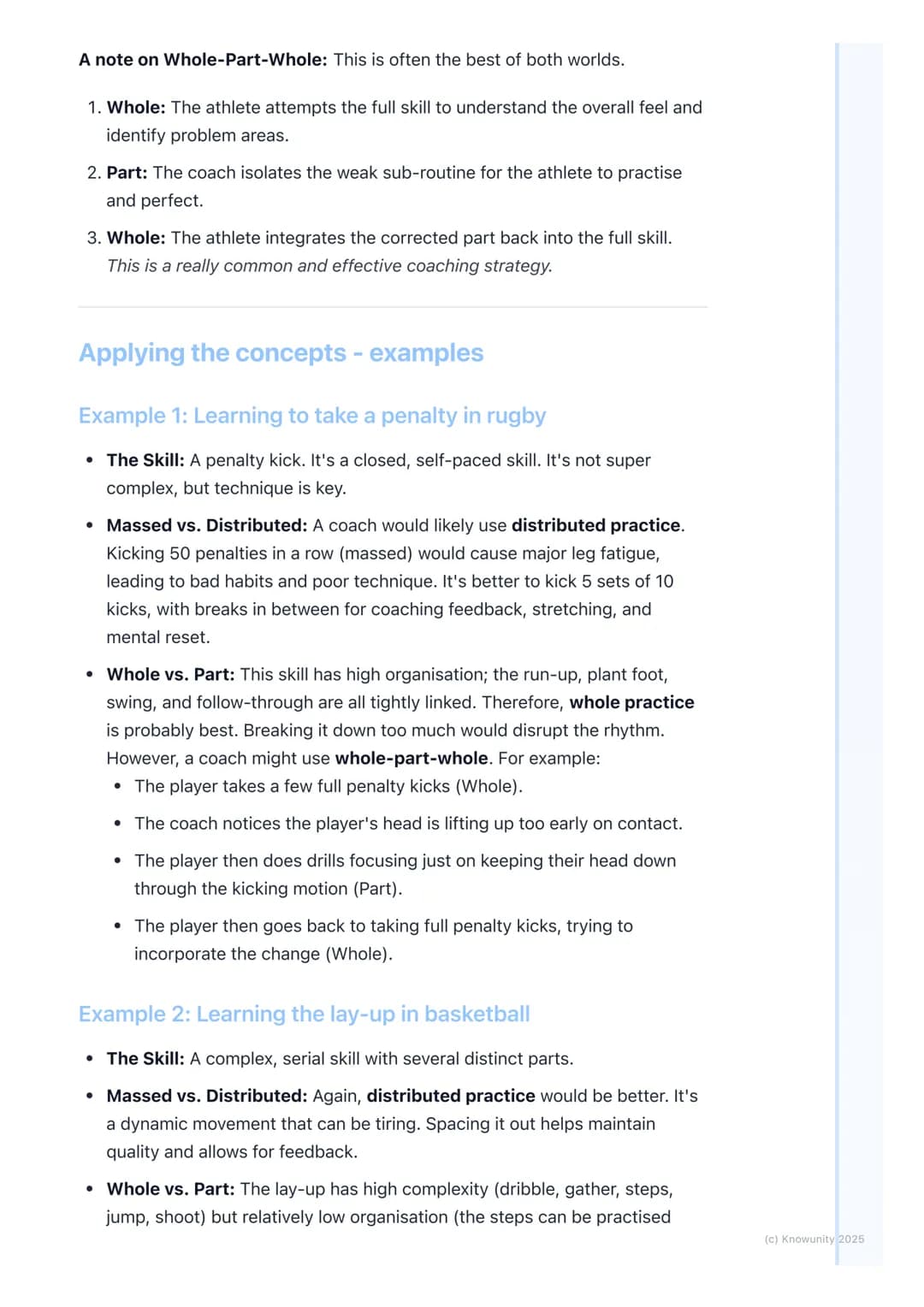
Putting It Into Practice
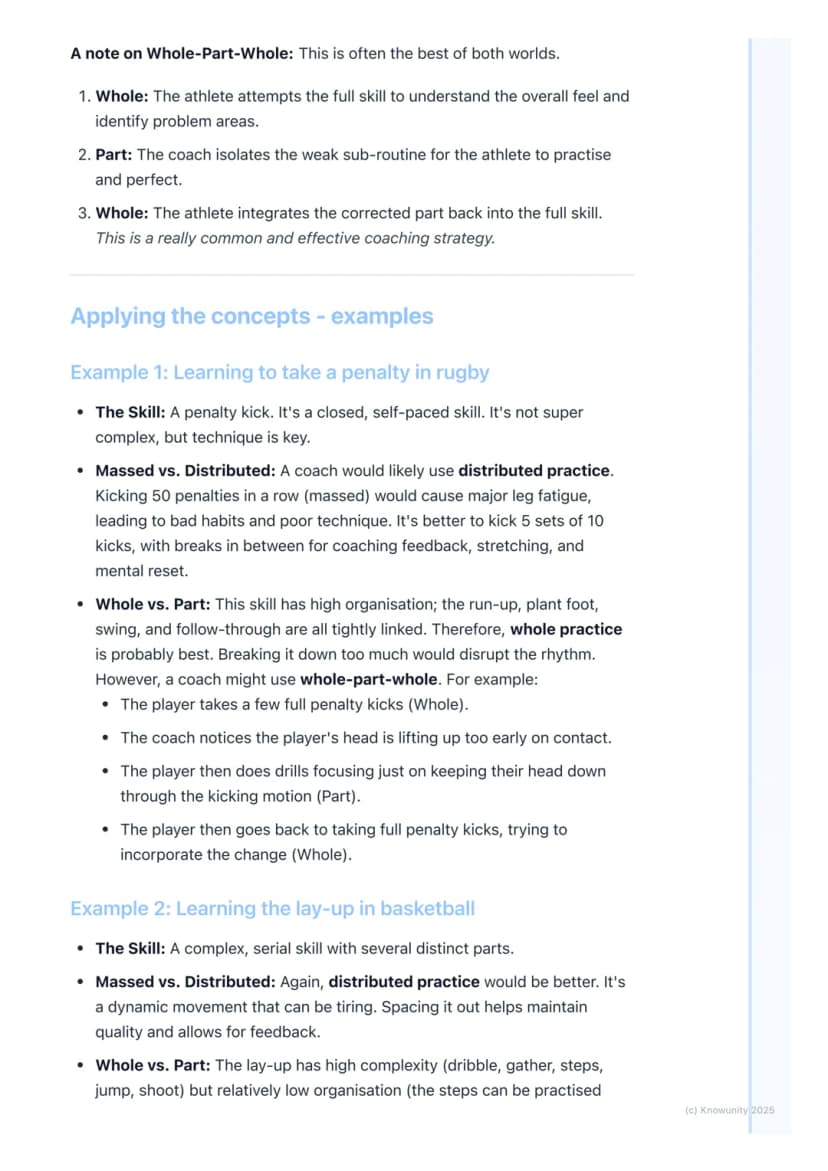
Whole-part-whole practice is often the most effective approach because it combines the benefits of both methods. You start with the complete skill to get the overall feel, isolate any problem areas for focused work, then integrate everything back together.
Let's look at learning a rugby penalty kick. This skill has high organisation (everything flows together), so you'd mainly use whole practice. However, you might use distributed practice with breaks between sets of kicks to prevent leg fatigue and maintain technique quality.
For a basketball lay-up, you'd probably choose part practice because it's highly complex but has parts that can be separated. Start with footwork without the ball, add the shooting motion, then gradually chain everything together including the dribble approach.
The key insight is that there's no universal "best" method. The right choice always depends on matching the practice type to the specific learner, skill, and situation you're dealing with.
Exam Gold: Always consider the learner, the skill characteristics, and the environment when choosing practice methods - mentioning all three shows proper understanding.
5
of 6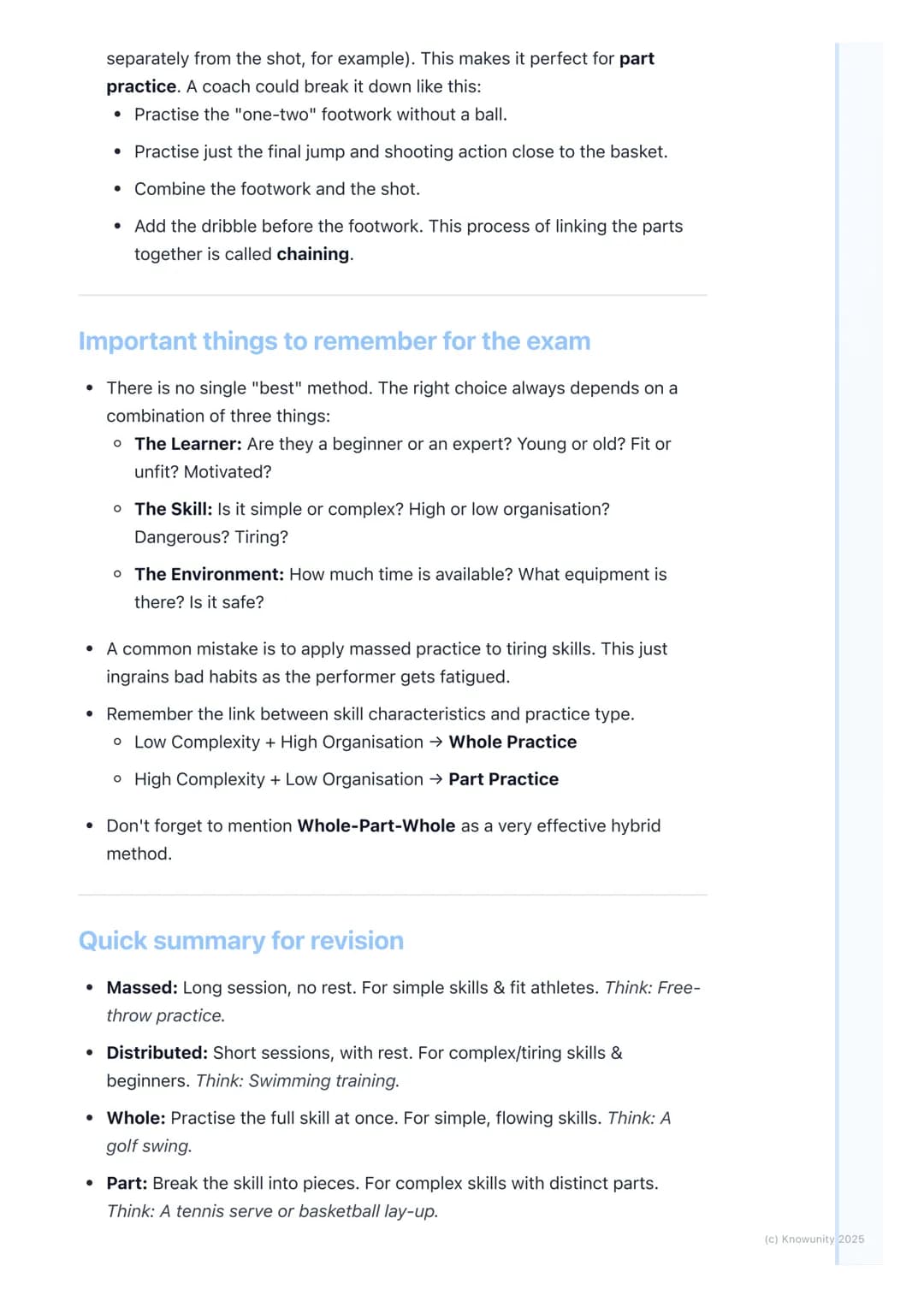
Key Points for Success
Remember that fatigue is the enemy of good technique. A common coaching mistake is using massed practice for tiring skills, which just ingrains bad habits as performance deteriorates. If you're getting tired and making mistakes, take a break.
The connection between skill characteristics and practice choice is crucial: low complexity + high organisation = whole practice, whilst high complexity + low organisation = part practice. This gives you a reliable framework for making decisions.
Distributed practice generally wins out over massed practice for most sports skills because it maintains quality, reduces injury risk, and leads to better long-term learning. The only time massed practice really shines is with very simple skills that need lots of repetition.
Don't forget that whole-part-whole practice is often the most practical solution. It allows athletes to understand the complete skill whilst still addressing specific weaknesses through focused part practice.
Revision Reminder: Think "Free-throw = massed, Swimming = distributed, Golf swing = whole, Tennis serve = part" as quick memory aids for each practice type.
6
of 6
Hiç sormayacaksın sanmıştık...
Knowunity yapay zeka arkadaşı nedir?
Yapay zeka arkadaşımız öğrencilerin ihtiyaçlarına göre özel olarak tasarlanmıştır. Platformda bulunan milyonlarca içeriğe dayanarak öğrencilere gerçekten anlamlı ve ilgili yanıtlar verebiliyoruz. Ancak mesele sadece cevaplar değil, refakatçi aynı zamanda kişiselleştirilmiş öğrenme planları, sınavlar veya sohbet içerikleri ve öğrencilerin becerilerine ve gelişimlerine dayalı %100 kişiselleştirme ile öğrencilere günlük öğrenme zorluklarında rehberlik ediyor.
Knowunity uygulamasını nereden indirebilirim?
Uygulamayı Google Play Store ve Apple App Store'dan indirebilirsiniz.
Knowunity ücretsiz mi?
Knowunity uygulaması ücretsiz! Uygulamamız çok yakında indirmeye hazır olacak, bekle bizi. 💙
LCPE dersinin en popüler içerikleri
4LCPEHealthy Eating Guidelines
This section explores national healthy eating guidelines, such as the food pyramid or healthy eating plate, to promote balanced dietary choices.
5th Year50
LCPEBiomechanics of Movement
Applying fundamental biomechanical principles such as force, motion, levers, and stability to analyse and improve human movement efficiency and performance in sport.
6th Year200
LCPEFactors effecting sports psychology ( confidence and self efficacy)
Higher Level LCPE psychological preprration notes
5th Year230
LCPETechnology in Sport
Investigating how technology is used in areas such as performance analysis, equipment design, officiating, and athlete monitoring to enhance training and competition.
6th Year50
En popüler içerikler
9 Irish
IrishIrish oral questions and answers
Questions and answers for the leaving cert oral
5th Year4264
 English
Key Quotes : Sive
Key Quotes and explanations: Sive
6th Year2842
IrishIrish oral questions
Outline of oral questions
5th Year2055
IrishIníon- le hÁine Durkin
Aine Durkin’s poem, Iníon: Themes & summary
5th Year890
IrishIrish poetry 2027
Iníon + Dínit an Bhróin
5th Year1153
IrishLC HL notes- Iníon (poem)
Includes poem in English and Irish, theme, key words & phrases
5th Year2304
EnglishCultural Context : Shawshank Redemption : Sive : Small Things Like These
Comparative Study : Cultural Context : Shawshank Redemption, Sive and Small Things Like These
6th Year1430
IrishMo Ghrá-sa (Idir Lúibíní)
Notes on mo ghrá-sa
5th Year380
IrishAn Gaeilge Aiste
Irish Language essay
6th Year1320
Aradığını bulamıyor musun? Diğer derslere göz at.
Kullanıcılarımızdan yorumlar. Onlar her şeyi çok beğendi — sen de beğeneceksin.
4.6/5App Store
4.7/5Google Play
Uygulama çok kolay kullanılıyor ve güzel tasarlanmış. Şu ana kadar aradığım her şeyi buldum ve sunumlardan çok şey öğrendim! Kesinlikle ödevlerim için hep kullanacağım!
A.S.iOS kullanıcısı
Uygulama çok iyi. Çok fazla ders notu ve yardımlaşma var. Örneğin benim problem yaşadığım bir ders Geometriydi ve ANINDA yardım ettiler beraber hem sorularımı çözdük hem konu anlatımı buldum. Herkese tavsiye ederim.
S.L.Android kullanıcısı
BEN ŞOK. Reklamını sık sık gördüğüm için uygulamayı denedim ve gerçekten hayran kaldım. Bu uygulama okul için tam ihtiyacım olan şey. Anında ödev yardımı, konu anlatımı, örnek sınavlar, flaşkartlar hepsi hepsi var, şiddetle tavsiye ederim ✅
A.iOS kullanıcısı
LCPE1 görüntüleme·Güncellendi Jun 14, 2026·6 sayfaTypes of Practice Methods
Ever wondered why some training sessions feel like torture whilst others actually help you improve? The secret lies in how coaches structure practice sessions. Choosing the right practice method can make the difference between mastering a skill quickly or getting...
1
of 6
Ders notlarını görmek için kaydol. Ücretsiz!
- Tüm belgeleri görebilirsin
- Notlarını Yükselt
- Milyonlarca öğrenciye katıl
Introduction to Practice Types
Practice isn't just about repeating something until you're sick of it. How you structure your training sessions massively affects how quickly you'll learn new skills and how well you'll perform under pressure.
Coaches need to think about three key things when planning practice: the athlete (are they a beginner or experienced?), the skill itself (is it simple or complex?), and the situation (how much time do we have?). Get this right, and learning becomes much more effective.
There are four main ways to organise practice sessions. Massed practice means long sessions with barely any breaks - like cramming for an exam. Distributed practice involves shorter sessions with proper rest periods. Whole practice means doing the complete skill from start to finish, whilst part practice breaks skills down into smaller chunks.
Quick Tip: Most complex sports skills benefit from distributed practice rather than marathon training sessions that leave you exhausted.
2
of 6Ders notlarını görmek için kaydol. Ücretsiz!
- Tüm belgeleri görebilirsin
- Notlarını Yükselt
- Milyonlarca öğrenciye katıl
Massed vs. Distributed Practice
This is all about timing your practice sessions and rest periods. Think of it like the difference between binge-watching an entire series in one night versus watching an episode each evening.
Massed practice works best for simple, discrete skills like free throws or golf putts, especially with highly motivated and fit athletes. You get maximum practice time and can really groove in the movement pattern. However, it's a recipe for disaster with complex skills because fatigue leads to sloppy technique and potential injuries.
Distributed practice is brilliant for complex or physically demanding skills like swimming strokes or gymnastics routines. The regular breaks prevent fatigue, keep motivation high, and give time for feedback and mental rehearsal. Yes, it takes more time overall, but the learning quality is much better.
The key trade-off is simple: massed practice saves time but distributed practice actually works better for learning. For most sports skills you'll encounter, distributed practice is the smarter choice.
Reality Check: If you're getting tired and your technique is falling apart, you're probably doing massed practice when you should be taking breaks.
3
of 6Ders notlarını görmek için kaydol. Ücretsiz!
- Tüm belgeleri görebilirsin
- Notlarını Yükselt
- Milyonlarca öğrenciye katıl
Whole vs. Part Practice
This decision depends on two crucial factors about the skill itself. Skill complexity refers to how many parts or sub-routines the skill has - a tennis serve has loads of parts (high complexity) whilst a chest pass has few (low complexity).
Skill organisation is about how tightly linked these parts are. In a cartwheel, everything flows seamlessly together (high organisation), but in a gymnastics floor routine, you can separate the different tumbles (low organisation).
Whole practice works brilliantly for skills that are simple and flow naturally together. Breaking these down would actually mess up the rhythm and feel of the movement. Think golf swings or penalty kicks - they need to be practised as complete movements.
Part practice is perfect for complex skills where the parts can be separated. A basketball lay-up, for example, has distinct elements (dribble, footwork, jump, shoot) that can be practised individually before being linked together through a process called chaining.
Coach's Secret: The sweet spot is often whole-part-whole practice - try the full skill, isolate the weak bit, then put it back together.
4
of 6Ders notlarını görmek için kaydol. Ücretsiz!
- Tüm belgeleri görebilirsin
- Notlarını Yükselt
- Milyonlarca öğrenciye katıl
Putting It Into Practice
Whole-part-whole practice is often the most effective approach because it combines the benefits of both methods. You start with the complete skill to get the overall feel, isolate any problem areas for focused work, then integrate everything back together.
Let's look at learning a rugby penalty kick. This skill has high organisation (everything flows together), so you'd mainly use whole practice. However, you might use distributed practice with breaks between sets of kicks to prevent leg fatigue and maintain technique quality.
For a basketball lay-up, you'd probably choose part practice because it's highly complex but has parts that can be separated. Start with footwork without the ball, add the shooting motion, then gradually chain everything together including the dribble approach.
The key insight is that there's no universal "best" method. The right choice always depends on matching the practice type to the specific learner, skill, and situation you're dealing with.
Exam Gold: Always consider the learner, the skill characteristics, and the environment when choosing practice methods - mentioning all three shows proper understanding.
5
of 6Ders notlarını görmek için kaydol. Ücretsiz!
- Tüm belgeleri görebilirsin
- Notlarını Yükselt
- Milyonlarca öğrenciye katıl
Key Points for Success
Remember that fatigue is the enemy of good technique. A common coaching mistake is using massed practice for tiring skills, which just ingrains bad habits as performance deteriorates. If you're getting tired and making mistakes, take a break.
The connection between skill characteristics and practice choice is crucial: low complexity + high organisation = whole practice, whilst high complexity + low organisation = part practice. This gives you a reliable framework for making decisions.
Distributed practice generally wins out over massed practice for most sports skills because it maintains quality, reduces injury risk, and leads to better long-term learning. The only time massed practice really shines is with very simple skills that need lots of repetition.
Don't forget that whole-part-whole practice is often the most practical solution. It allows athletes to understand the complete skill whilst still addressing specific weaknesses through focused part practice.
Revision Reminder: Think "Free-throw = massed, Swimming = distributed, Golf swing = whole, Tennis serve = part" as quick memory aids for each practice type.
6
of 6Ders notlarını görmek için kaydol. Ücretsiz!
- Tüm belgeleri görebilirsin
- Notlarını Yükselt
- Milyonlarca öğrenciye katıl
Hiç sormayacaksın sanmıştık...
Knowunity yapay zeka arkadaşı nedir?
Yapay zeka arkadaşımız öğrencilerin ihtiyaçlarına göre özel olarak tasarlanmıştır. Platformda bulunan milyonlarca içeriğe dayanarak öğrencilere gerçekten anlamlı ve ilgili yanıtlar verebiliyoruz. Ancak mesele sadece cevaplar değil, refakatçi aynı zamanda kişiselleştirilmiş öğrenme planları, sınavlar veya sohbet içerikleri ve öğrencilerin becerilerine ve gelişimlerine dayalı %100 kişiselleştirme ile öğrencilere günlük öğrenme zorluklarında rehberlik ediyor.
Knowunity uygulamasını nereden indirebilirim?
Uygulamayı Google Play Store ve Apple App Store'dan indirebilirsiniz.
Knowunity ücretsiz mi?
Knowunity uygulaması ücretsiz! Uygulamamız çok yakında indirmeye hazır olacak, bekle bizi. 💙
LCPE dersinin en popüler içerikleri
4LCPEHealthy Eating Guidelines
This section explores national healthy eating guidelines, such as the food pyramid or healthy eating plate, to promote balanced dietary choices.
5th Year50
LCPEBiomechanics of Movement
Applying fundamental biomechanical principles such as force, motion, levers, and stability to analyse and improve human movement efficiency and performance in sport.
6th Year200
LCPEFactors effecting sports psychology ( confidence and self efficacy)
Higher Level LCPE psychological preprration notes
5th Year230
LCPETechnology in Sport
Investigating how technology is used in areas such as performance analysis, equipment design, officiating, and athlete monitoring to enhance training and competition.
6th Year50
En popüler içerikler
9IrishIrish oral questions and answers
Questions and answers for the leaving cert oral
5th Year4264
EnglishKey Quotes : Sive
Key Quotes and explanations: Sive
6th Year2842
IrishIrish oral questions
Outline of oral questions
5th Year2055
IrishIníon- le hÁine Durkin
Aine Durkin’s poem, Iníon: Themes & summary
5th Year890
IrishIrish poetry 2027
Iníon + Dínit an Bhróin
5th Year1153
IrishLC HL notes- Iníon (poem)
Includes poem in English and Irish, theme, key words & phrases
5th Year2304
EnglishCultural Context : Shawshank Redemption : Sive : Small Things Like These
Comparative Study : Cultural Context : Shawshank Redemption, Sive and Small Things Like These
6th Year1430
IrishMo Ghrá-sa (Idir Lúibíní)
Notes on mo ghrá-sa
5th Year380
IrishAn Gaeilge Aiste
Irish Language essay
6th Year1320
Aradığını bulamıyor musun? Diğer derslere göz at.
Kullanıcılarımızdan yorumlar. Onlar her şeyi çok beğendi — sen de beğeneceksin.
4.6/5App Store
4.7/5Google Play
Uygulama çok kolay kullanılıyor ve güzel tasarlanmış. Şu ana kadar aradığım her şeyi buldum ve sunumlardan çok şey öğrendim! Kesinlikle ödevlerim için hep kullanacağım!
A.S.iOS kullanıcısı
Uygulama çok iyi. Çok fazla ders notu ve yardımlaşma var. Örneğin benim problem yaşadığım bir ders Geometriydi ve ANINDA yardım ettiler beraber hem sorularımı çözdük hem konu anlatımı buldum. Herkese tavsiye ederim.
S.L.Android kullanıcısı
BEN ŞOK. Reklamını sık sık gördüğüm için uygulamayı denedim ve gerçekten hayran kaldım. Bu uygulama okul için tam ihtiyacım olan şey. Anında ödev yardımı, konu anlatımı, örnek sınavlar, flaşkartlar hepsi hepsi var, şiddetle tavsiye ederim ✅
A.iOS kullanıcısı