
Ever wondered how historians figure out what really happened centuries...
 History5 görüntüleme·Güncellendi Jun 16, 2026·5 sayfa
Exploring Types of Historical Sources
1 / 5
1
of 5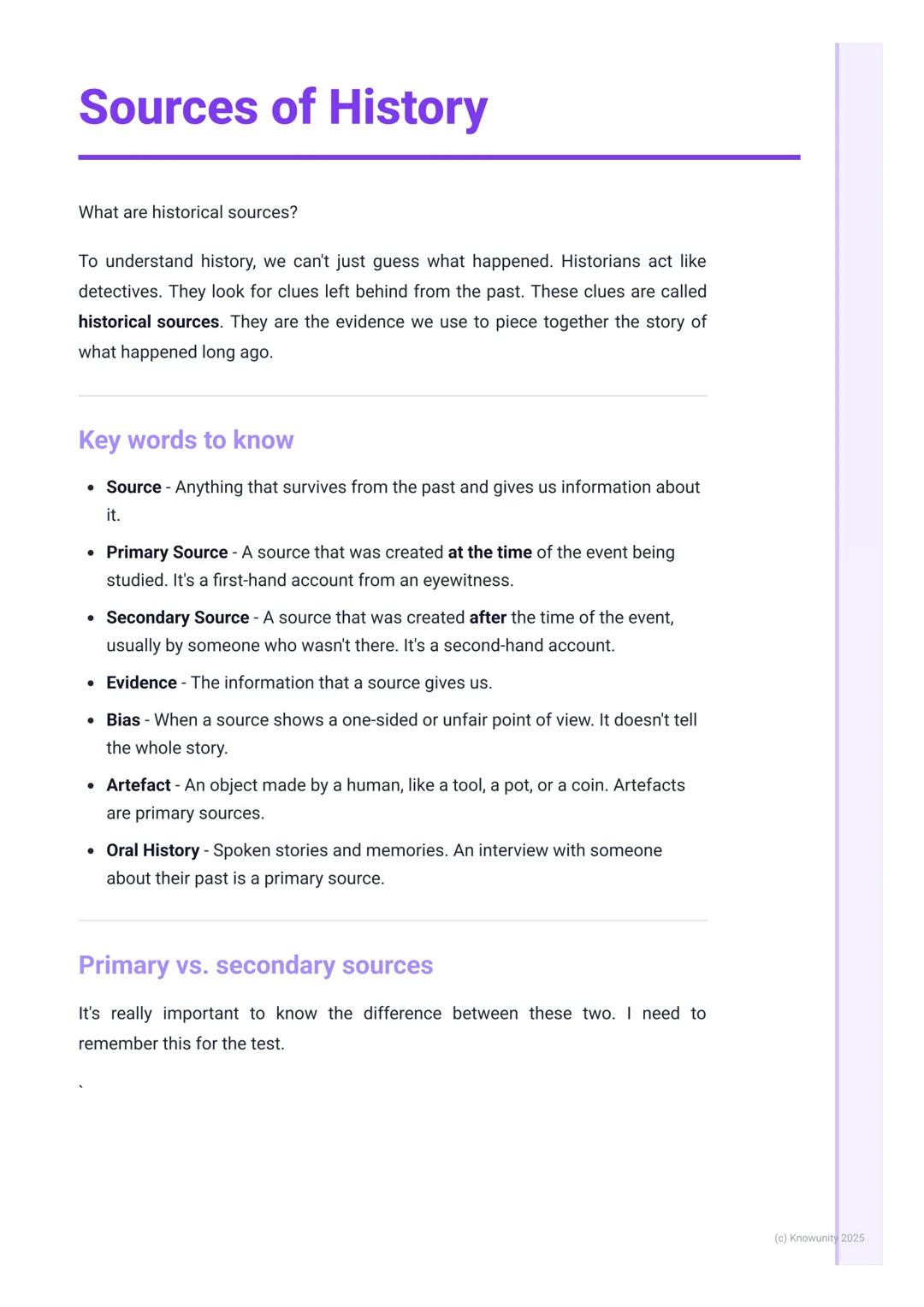
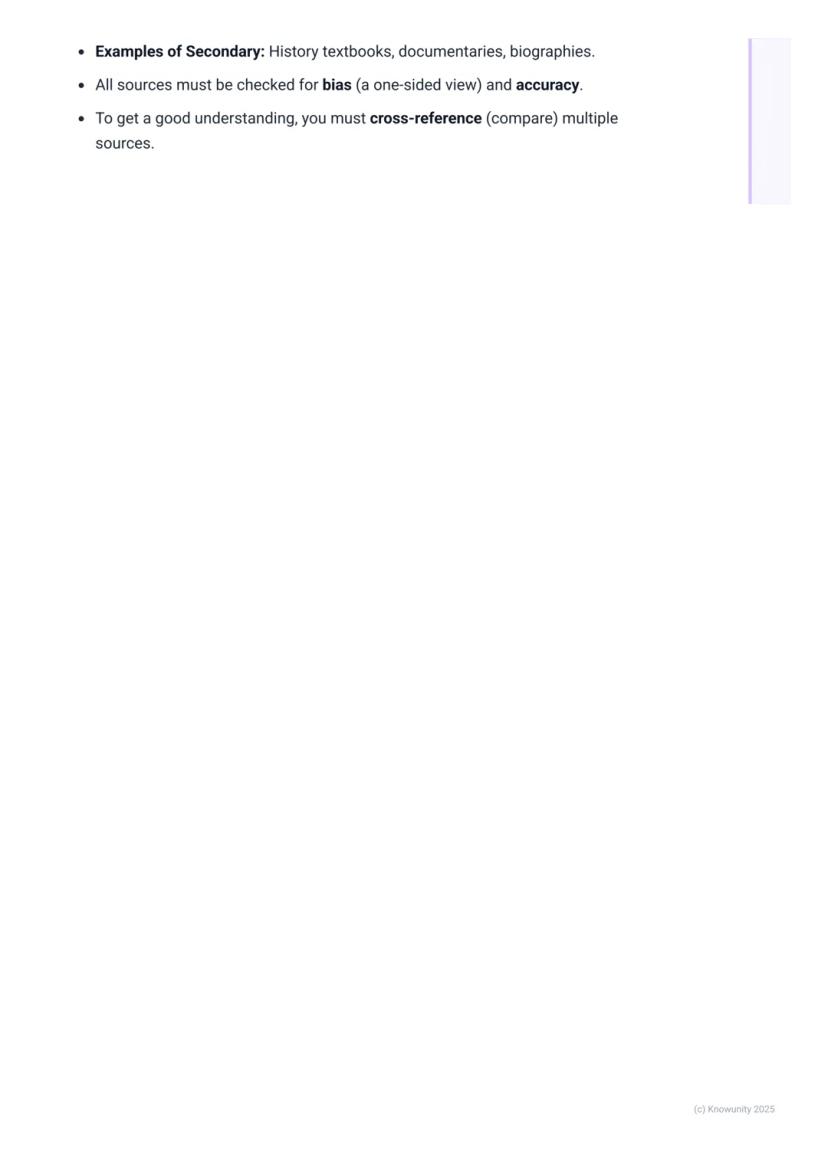
What Are Historical Sources?
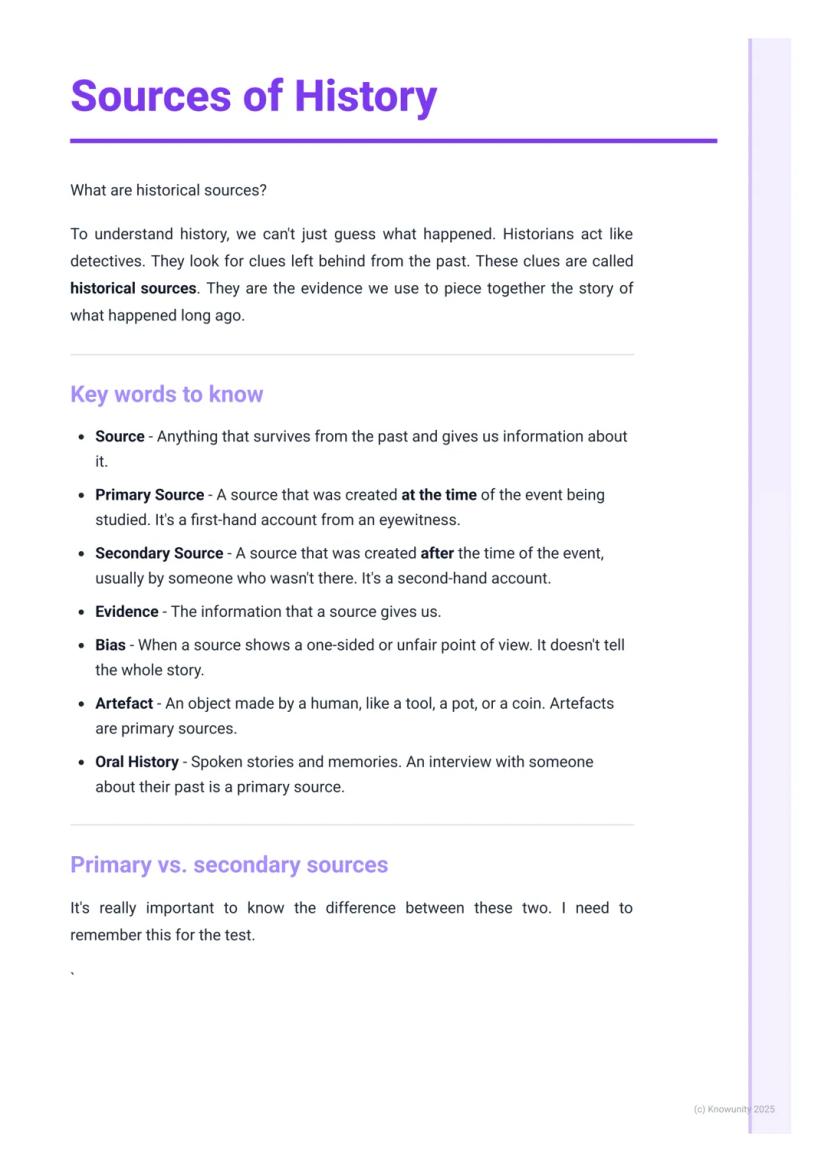
Think of historians as detectives solving ancient mysteries. Instead of fingerprints and DNA, they use historical sources - anything that survived from the past to tell us what happened. These sources are your evidence, and without them, we'd just be guessing about history!
You'll need to master some key terms for your exams. A source is simply anything from the past that gives us information. Evidence is what that source actually tells us. Watch out for bias though - that's when a source shows only one side of the story, like when your mate tells you about a football match where their team lost!
The most important distinction you'll face in tests is between primary and secondary sources. Get this right, and you're already ahead of the game. Artefacts and oral history (recorded memories from people who were there) are types of sources you'll encounter regularly.
💡 Quick Tip: Remember that being a primary source doesn't automatically make something more reliable - even eyewitnesses can be wrong or biased!
2
of 5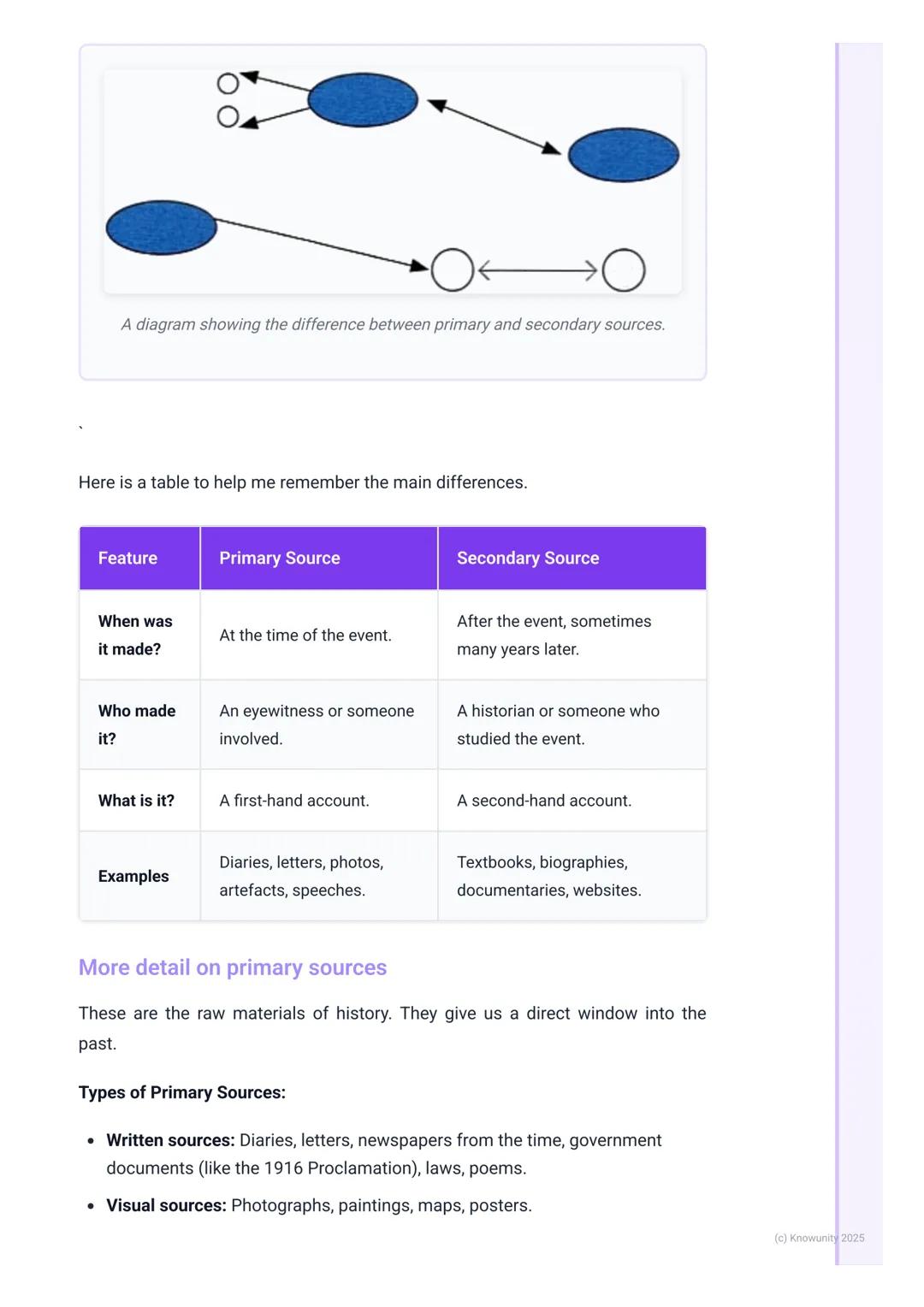
Primary vs Secondary Sources - The Big Difference
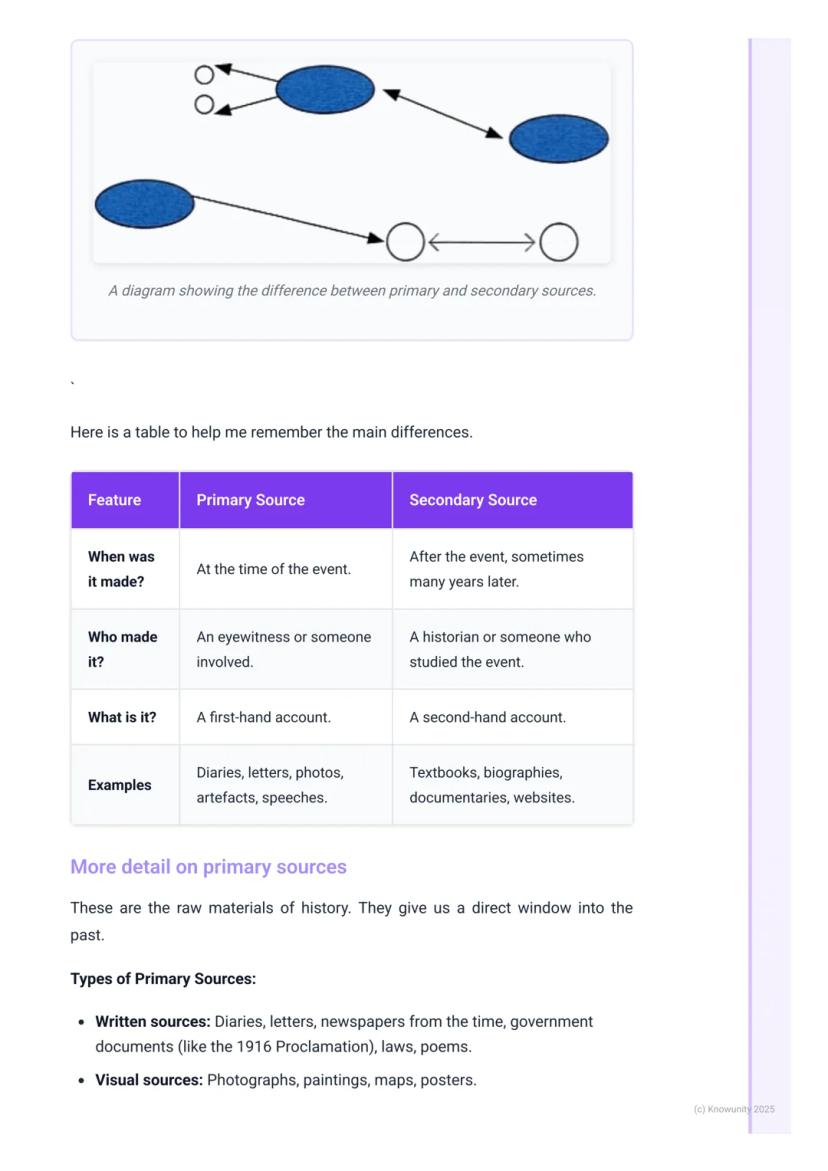
Here's the breakdown that'll save you marks in exams: primary sources were created at the time of the event by someone who was actually there. Secondary sources were made later by people studying the event.
| **Primary Source** | **Secondary Source** |
|---|---|
| Made during the event | Made after the event |
| By eyewitnesses | By historians/researchers |
| First-hand account | Second-hand account |
| Diaries, photos, artefacts | Textbooks, documentaries |
Primary sources are the raw materials of history. They include written sources like diaries and government documents (think the 1916 Proclamation), visual sources like old photographs and paintings, and physical artefacts like Viking swords or medieval pottery.
A letter from a Titanic passenger? That's primary because they were actually on the ship. Your history textbook about the Titanic? That's secondary because it was written by modern historians who studied the evidence.
💡 Memory Trick: Primary = Present at the time. Secondary = Second-hand information.
3
of 5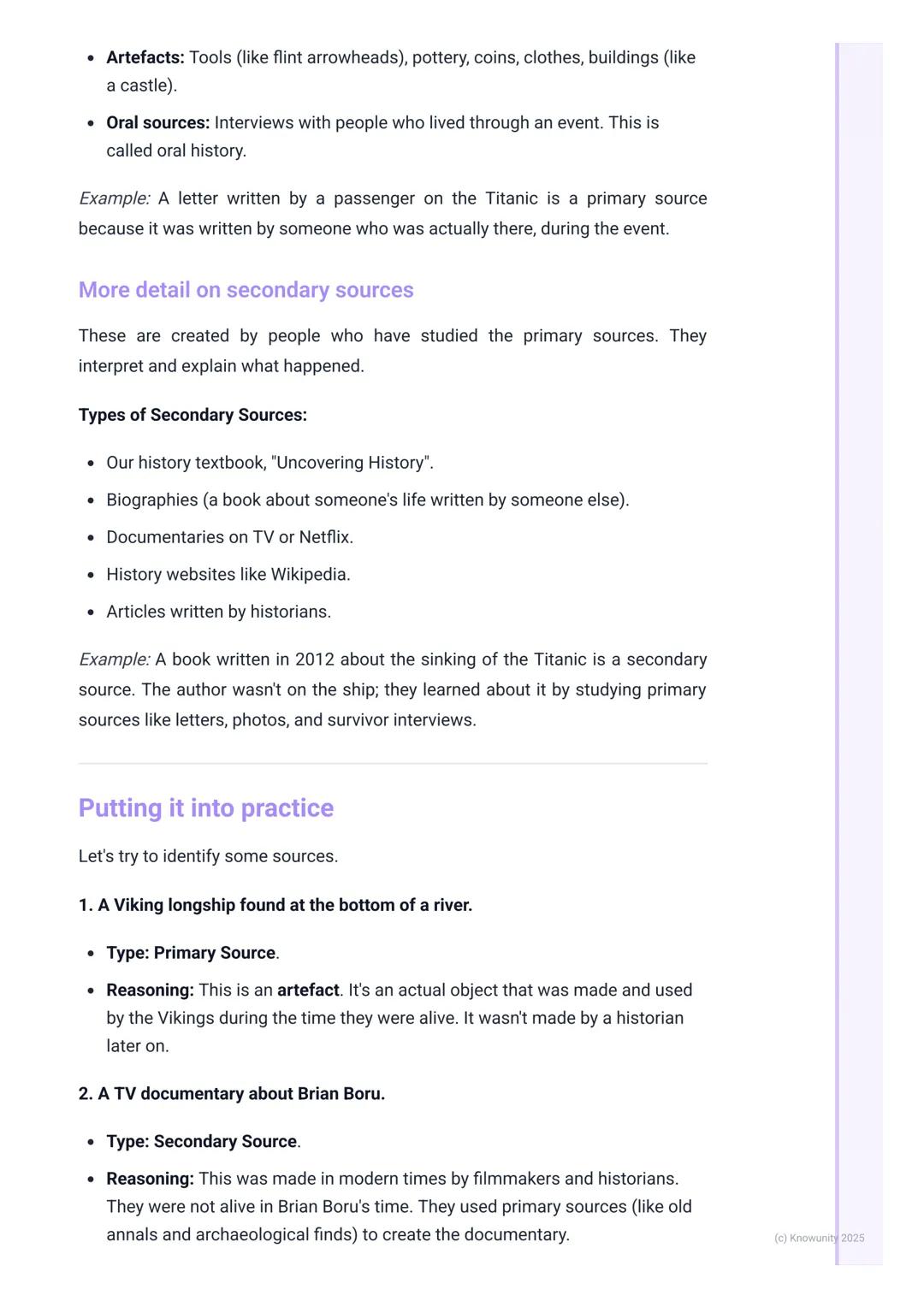
Secondary Sources and Putting Knowledge into Practice
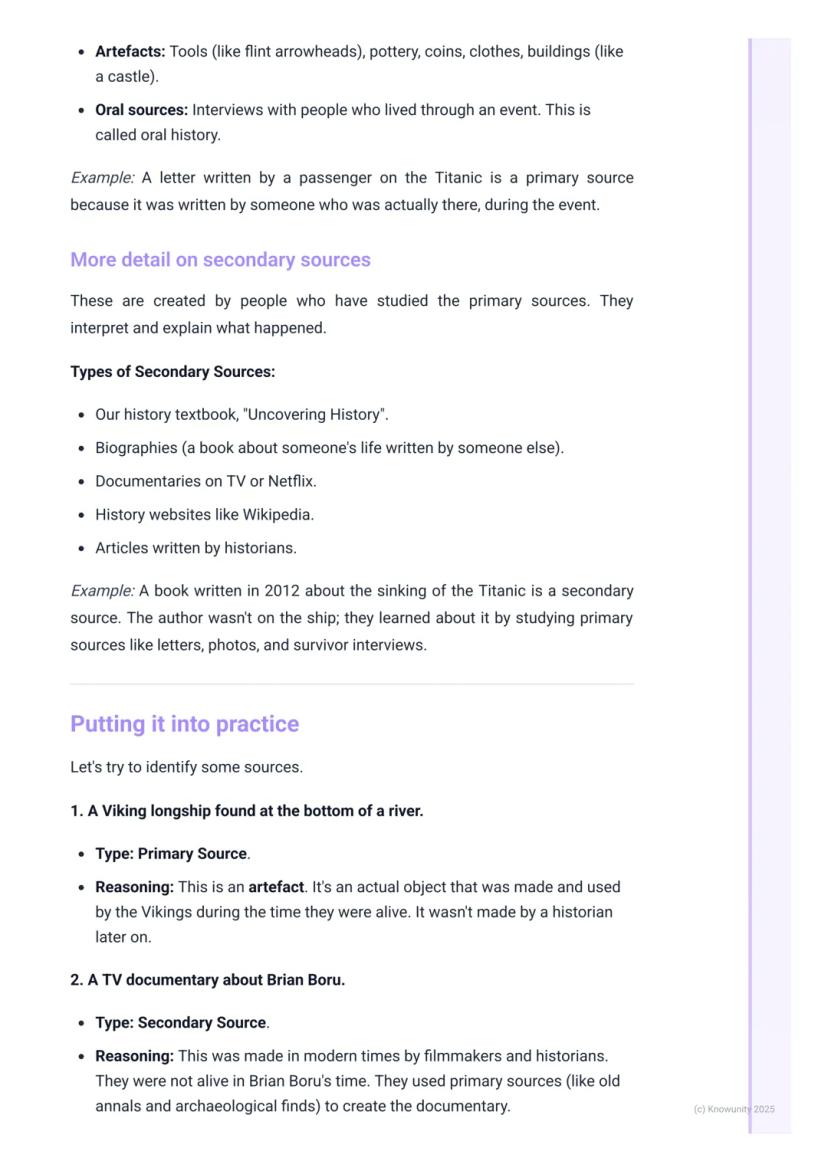
Secondary sources are created by people who've studied the primary sources and interpreted what happened. Your "Uncovering History" textbook, Netflix documentaries about Irish history, and biographies of historical figures all fall into this category.
Let's practice with some examples you might see in tests. A Viking longship found in a river? That's primary - it's an actual artefact made and used by Vikings. A TV documentary about Brian Boru? Secondary - modern filmmakers weren't alive in his time!
Your grandad's 1950s school report is trickier. It's actually primary because it was created at the time and tells us directly about 1950s education. These identification questions are common in exams, so practice them!
The key is asking yourself: "Was this made at the time by someone who was there?" If yes, it's primary. If no, it's secondary.
💡 Exam Strategy: Always explain your reasoning when identifying sources - don't just give the answer!
4
of 5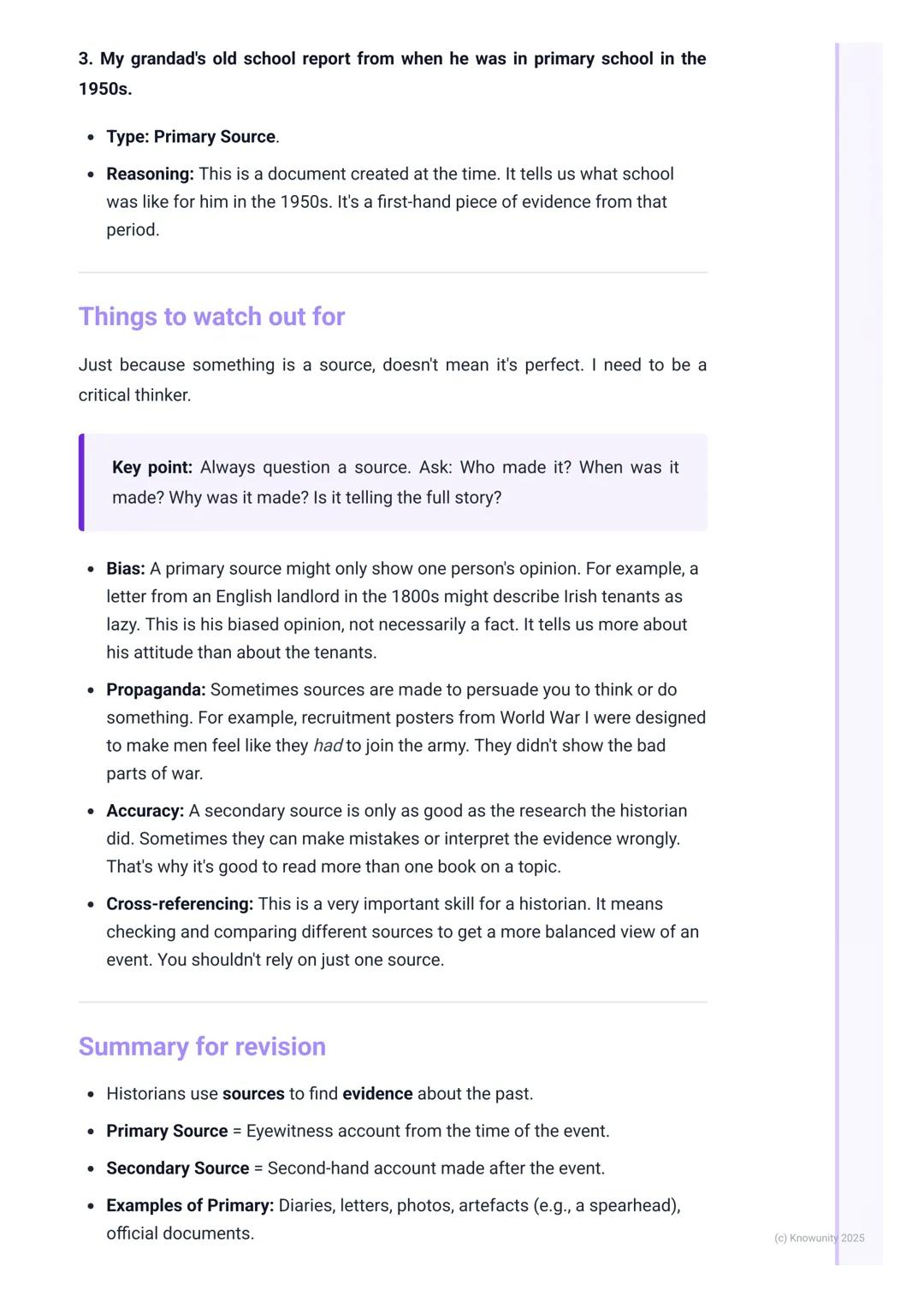
Being a Critical Thinker - Spotting the Problems
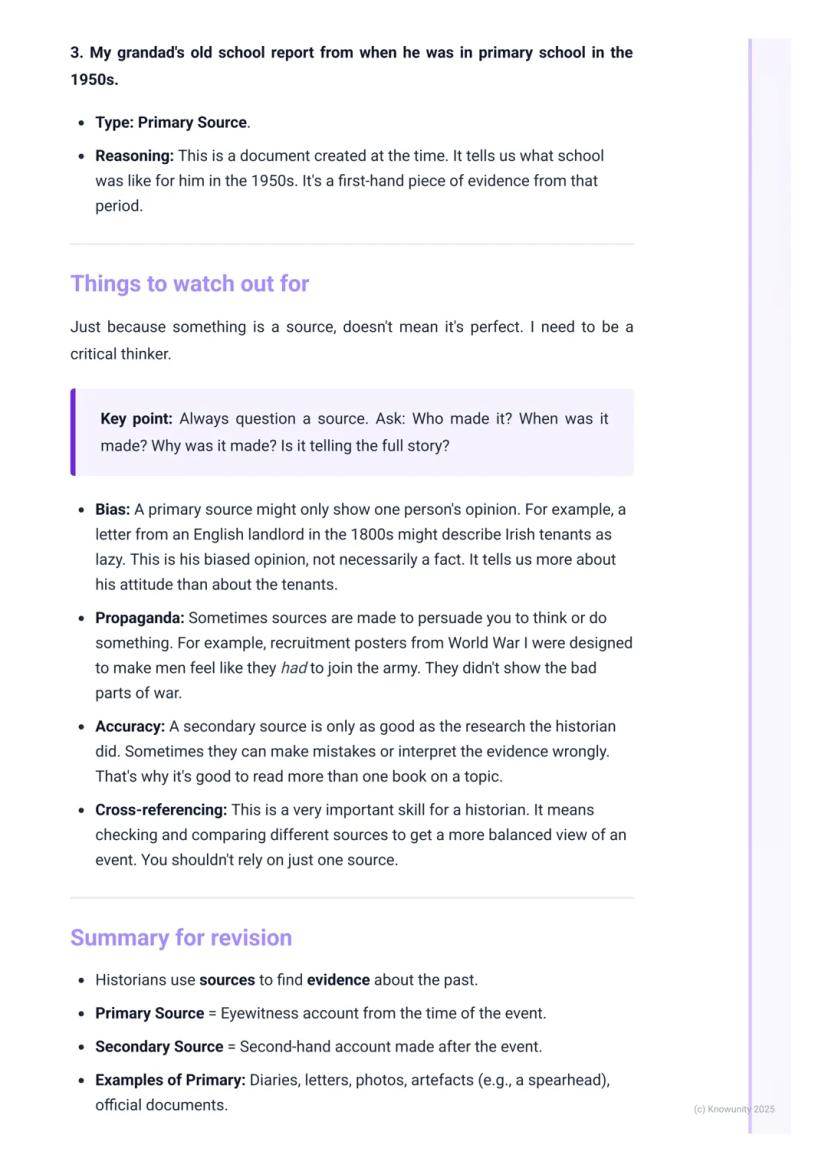
Here's where you level up from just identifying sources to actually analysing them properly. Not all sources tell the whole truth, and recognising this makes you a proper historian.
Bias is your biggest challenge. A source might only show one person's opinion. An English landlord's letter from the 1800s calling Irish tenants "lazy" tells us more about his prejudiced attitudes than about the tenants themselves. Always ask: who made this and why?
Watch out for propaganda - sources designed to persuade you. WWI recruitment posters made war look exciting and heroic, but they deliberately hid the horrific reality. They're still valuable sources, but you need to understand their purpose.
Cross-referencing is your secret weapon. This means comparing multiple sources to get a balanced view. Never rely on just one source - that's like judging a football match by only listening to one team's supporters!
💡 Critical Questions: Who made it? When? Why? What's missing from this story?
5
of 5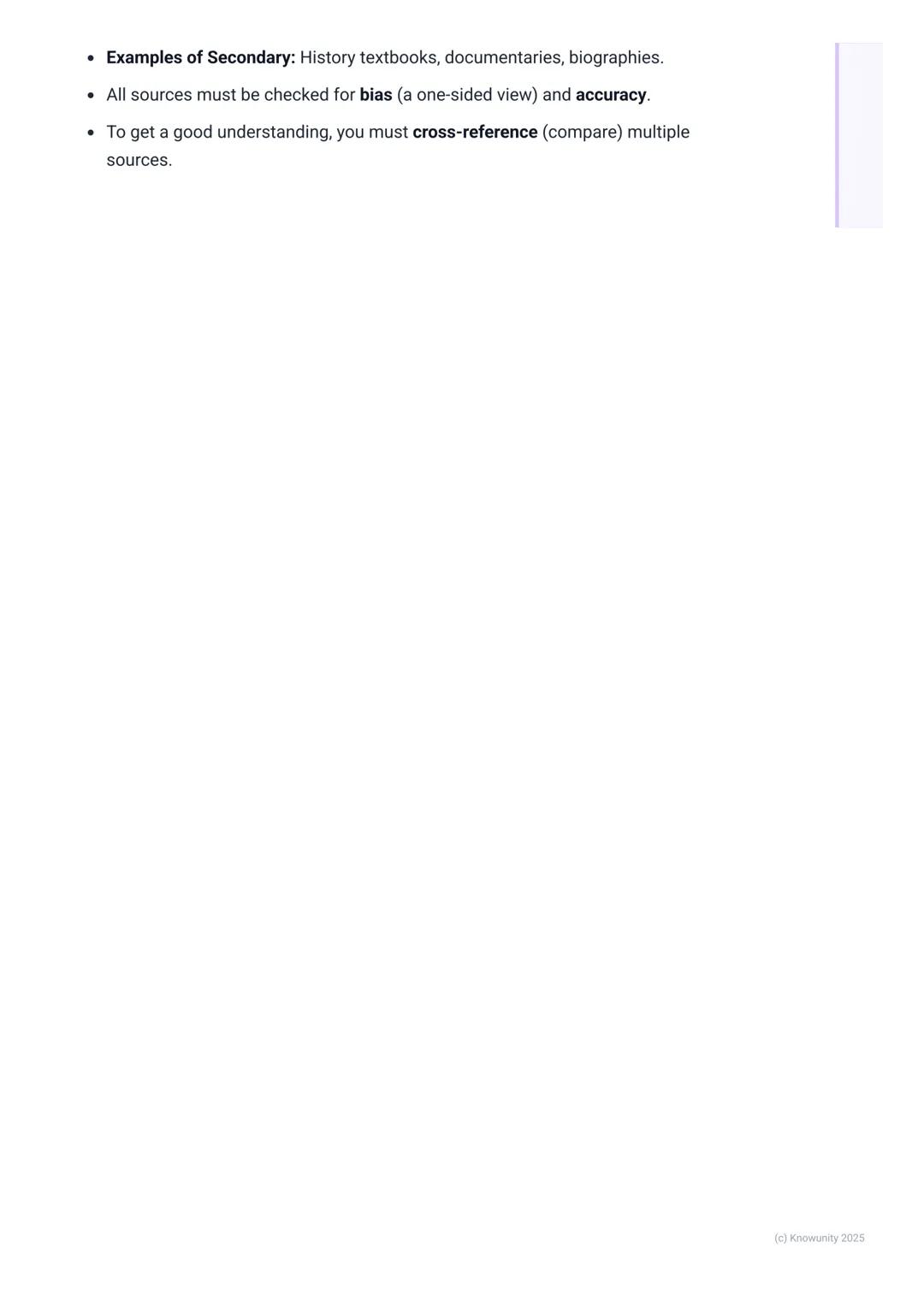
Summary for Revision Success
You've got this! Remember that historians use sources as evidence to understand the past. Primary sources come from eyewitnesses at the time of events, while secondary sources are created later by people studying those events.
Primary examples include diaries, photographs, artefacts like ancient tools, and official documents. Secondary examples are your textbooks, documentaries, and biographies written by modern historians.
Never take sources at face value - always check for bias and compare multiple sources through cross-referencing. This critical thinking approach will earn you top marks and help you understand history properly.
Practice identifying sources regularly, and always explain your reasoning in exam answers. With these skills, you'll tackle any history source question with confidence!
💡 Revision Tip: Make flashcards with different source examples and practice identifying them as primary or secondary until it becomes automatic!
Hiç sormayacaksın sanmıştık...
Knowunity yapay zeka arkadaşı nedir?
Yapay zeka arkadaşımız öğrencilerin ihtiyaçlarına göre özel olarak tasarlanmıştır. Platformda bulunan milyonlarca içeriğe dayanarak öğrencilere gerçekten anlamlı ve ilgili yanıtlar verebiliyoruz. Ancak mesele sadece cevaplar değil, refakatçi aynı zamanda kişiselleştirilmiş öğrenme planları, sınavlar veya sohbet içerikleri ve öğrencilerin becerilerine ve gelişimlerine dayalı %100 kişiselleştirme ile öğrencilere günlük öğrenme zorluklarında rehberlik ediyor.
Knowunity uygulamasını nereden indirebilirim?
Uygulamayı Google Play Store ve Apple App Store'dan indirebilirsiniz.
Knowunity ücretsiz mi?
Knowunity uygulaması ücretsiz! Uygulamamız çok yakında indirmeye hazır olacak, bekle bizi. 💙
History dersinin en popüler içerikleri
9HistoryThe Great Famine (An Gorta Mór)
Students will learn about the causes, devastating impact, and long-term consequences of the potato famine on Irish population and society.
2nd Year282
HistoryThe renaissance
junior cert renaissance summary
1st Year361
HistoryCauses and Consequences of World War II
This subtopic covers the origins of the Second World War, its global scale, and its devastating human and political consequences, including the atomic bomb.
3rd Year152
HistoryThe 1798 Rebellion in Ireland
Learning about the causes, events, and aftermath of the United Irishmen's rebellion against British rule, inspired by revolutionary ideals.
3rd Year211
HistoryAmerican revolution
junior cert american revolution summary
1st Year442
HistoryThe Great Famine (An Gorta Mór)
This critical subtopic examines the causes, devastating impact, and long-term consequences of the potato famine on Irish society, population, and emigration.
3rd Year140
HistoryThe Renaissance
Students will learn about a time of 'rebirth' in Europe, where new ideas in art, science, and literature flourished.
1st Year140
History1916 Rising Revison Sheet
revision sheet
3rd Year211
HistoryThe Reformation in Europe
Students will learn about the causes and key figures of the Protestant Reformation and its impact on European society and politics.
3rd Year110
En popüler içerikler
9 Irish
IrishIrish oral questions and answers
Questions and answers for the leaving cert oral
5th Year4264
 English
Key Quotes : Sive
Key Quotes and explanations: Sive
6th Year2842
IrishIrish oral questions
Outline of oral questions
5th Year2055
IrishIníon- le hÁine Durkin
Aine Durkin’s poem, Iníon: Themes & summary
5th Year890
IrishIrish poetry 2027
Iníon + Dínit an Bhróin
5th Year1153
IrishLC HL notes- Iníon (poem)
Includes poem in English and Irish, theme, key words & phrases
5th Year2304
EnglishCultural Context : Shawshank Redemption : Sive : Small Things Like These
Comparative Study : Cultural Context : Shawshank Redemption, Sive and Small Things Like These
6th Year1430
IrishMo Ghrá-sa (Idir Lúibíní)
Notes on mo ghrá-sa
5th Year380
IrishAn Gaeilge Aiste
Irish Language essay
6th Year1320
Aradığını bulamıyor musun? Diğer derslere göz at.
Kullanıcılarımızdan yorumlar. Onlar her şeyi çok beğendi — sen de beğeneceksin.
4.6/5App Store
4.7/5Google Play
Uygulama çok kolay kullanılıyor ve güzel tasarlanmış. Şu ana kadar aradığım her şeyi buldum ve sunumlardan çok şey öğrendim! Kesinlikle ödevlerim için hep kullanacağım!
A.S.iOS kullanıcısı
Uygulama çok iyi. Çok fazla ders notu ve yardımlaşma var. Örneğin benim problem yaşadığım bir ders Geometriydi ve ANINDA yardım ettiler beraber hem sorularımı çözdük hem konu anlatımı buldum. Herkese tavsiye ederim.
S.L.Android kullanıcısı
BEN ŞOK. Reklamını sık sık gördüğüm için uygulamayı denedim ve gerçekten hayran kaldım. Bu uygulama okul için tam ihtiyacım olan şey. Anında ödev yardımı, konu anlatımı, örnek sınavlar, flaşkartlar hepsi hepsi var, şiddetle tavsiye ederim ✅
A.iOS kullanıcısı
History5 görüntüleme·Güncellendi Jun 16, 2026·5 sayfaExploring Types of Historical Sources
Ever wondered how historians figure out what really happened centuries ago? They're basically detectives hunting for clues from the past! These clues are called historical sources, and learning to identify and analyse them is a crucial skill you'll need for...
1
of 5
Ders notlarını görmek için kaydol. Ücretsiz!
- Tüm belgeleri görebilirsin
- Notlarını Yükselt
- Milyonlarca öğrenciye katıl
What Are Historical Sources?
Think of historians as detectives solving ancient mysteries. Instead of fingerprints and DNA, they use historical sources - anything that survived from the past to tell us what happened. These sources are your evidence, and without them, we'd just be guessing about history!
You'll need to master some key terms for your exams. A source is simply anything from the past that gives us information. Evidence is what that source actually tells us. Watch out for bias though - that's when a source shows only one side of the story, like when your mate tells you about a football match where their team lost!
The most important distinction you'll face in tests is between primary and secondary sources. Get this right, and you're already ahead of the game. Artefacts and oral history (recorded memories from people who were there) are types of sources you'll encounter regularly.
💡 Quick Tip: Remember that being a primary source doesn't automatically make something more reliable - even eyewitnesses can be wrong or biased!
2
of 5Ders notlarını görmek için kaydol. Ücretsiz!
- Tüm belgeleri görebilirsin
- Notlarını Yükselt
- Milyonlarca öğrenciye katıl
Primary vs Secondary Sources - The Big Difference
Here's the breakdown that'll save you marks in exams: primary sources were created at the time of the event by someone who was actually there. Secondary sources were made later by people studying the event.
| **Primary Source** | **Secondary Source** |
|---|---|
| Made during the event | Made after the event |
| By eyewitnesses | By historians/researchers |
| First-hand account | Second-hand account |
| Diaries, photos, artefacts | Textbooks, documentaries |
Primary sources are the raw materials of history. They include written sources like diaries and government documents (think the 1916 Proclamation), visual sources like old photographs and paintings, and physical artefacts like Viking swords or medieval pottery.
A letter from a Titanic passenger? That's primary because they were actually on the ship. Your history textbook about the Titanic? That's secondary because it was written by modern historians who studied the evidence.
💡 Memory Trick: Primary = Present at the time. Secondary = Second-hand information.
3
of 5Ders notlarını görmek için kaydol. Ücretsiz!
- Tüm belgeleri görebilirsin
- Notlarını Yükselt
- Milyonlarca öğrenciye katıl
Secondary Sources and Putting Knowledge into Practice
Secondary sources are created by people who've studied the primary sources and interpreted what happened. Your "Uncovering History" textbook, Netflix documentaries about Irish history, and biographies of historical figures all fall into this category.
Let's practice with some examples you might see in tests. A Viking longship found in a river? That's primary - it's an actual artefact made and used by Vikings. A TV documentary about Brian Boru? Secondary - modern filmmakers weren't alive in his time!
Your grandad's 1950s school report is trickier. It's actually primary because it was created at the time and tells us directly about 1950s education. These identification questions are common in exams, so practice them!
The key is asking yourself: "Was this made at the time by someone who was there?" If yes, it's primary. If no, it's secondary.
💡 Exam Strategy: Always explain your reasoning when identifying sources - don't just give the answer!
4
of 5Ders notlarını görmek için kaydol. Ücretsiz!
- Tüm belgeleri görebilirsin
- Notlarını Yükselt
- Milyonlarca öğrenciye katıl
Being a Critical Thinker - Spotting the Problems
Here's where you level up from just identifying sources to actually analysing them properly. Not all sources tell the whole truth, and recognising this makes you a proper historian.
Bias is your biggest challenge. A source might only show one person's opinion. An English landlord's letter from the 1800s calling Irish tenants "lazy" tells us more about his prejudiced attitudes than about the tenants themselves. Always ask: who made this and why?
Watch out for propaganda - sources designed to persuade you. WWI recruitment posters made war look exciting and heroic, but they deliberately hid the horrific reality. They're still valuable sources, but you need to understand their purpose.
Cross-referencing is your secret weapon. This means comparing multiple sources to get a balanced view. Never rely on just one source - that's like judging a football match by only listening to one team's supporters!
💡 Critical Questions: Who made it? When? Why? What's missing from this story?
5
of 5Ders notlarını görmek için kaydol. Ücretsiz!
- Tüm belgeleri görebilirsin
- Notlarını Yükselt
- Milyonlarca öğrenciye katıl
Summary for Revision Success
You've got this! Remember that historians use sources as evidence to understand the past. Primary sources come from eyewitnesses at the time of events, while secondary sources are created later by people studying those events.
Primary examples include diaries, photographs, artefacts like ancient tools, and official documents. Secondary examples are your textbooks, documentaries, and biographies written by modern historians.
Never take sources at face value - always check for bias and compare multiple sources through cross-referencing. This critical thinking approach will earn you top marks and help you understand history properly.
Practice identifying sources regularly, and always explain your reasoning in exam answers. With these skills, you'll tackle any history source question with confidence!
💡 Revision Tip: Make flashcards with different source examples and practice identifying them as primary or secondary until it becomes automatic!
Hiç sormayacaksın sanmıştık...
Knowunity yapay zeka arkadaşı nedir?
Yapay zeka arkadaşımız öğrencilerin ihtiyaçlarına göre özel olarak tasarlanmıştır. Platformda bulunan milyonlarca içeriğe dayanarak öğrencilere gerçekten anlamlı ve ilgili yanıtlar verebiliyoruz. Ancak mesele sadece cevaplar değil, refakatçi aynı zamanda kişiselleştirilmiş öğrenme planları, sınavlar veya sohbet içerikleri ve öğrencilerin becerilerine ve gelişimlerine dayalı %100 kişiselleştirme ile öğrencilere günlük öğrenme zorluklarında rehberlik ediyor.
Knowunity uygulamasını nereden indirebilirim?
Uygulamayı Google Play Store ve Apple App Store'dan indirebilirsiniz.
Knowunity ücretsiz mi?
Knowunity uygulaması ücretsiz! Uygulamamız çok yakında indirmeye hazır olacak, bekle bizi. 💙
History dersinin en popüler içerikleri
9HistoryThe Great Famine (An Gorta Mór)
Students will learn about the causes, devastating impact, and long-term consequences of the potato famine on Irish population and society.
2nd Year282
HistoryThe renaissance
junior cert renaissance summary
1st Year361
HistoryCauses and Consequences of World War II
This subtopic covers the origins of the Second World War, its global scale, and its devastating human and political consequences, including the atomic bomb.
3rd Year152
HistoryThe 1798 Rebellion in Ireland
Learning about the causes, events, and aftermath of the United Irishmen's rebellion against British rule, inspired by revolutionary ideals.
3rd Year211
HistoryAmerican revolution
junior cert american revolution summary
1st Year442
HistoryThe Great Famine (An Gorta Mór)
This critical subtopic examines the causes, devastating impact, and long-term consequences of the potato famine on Irish society, population, and emigration.
3rd Year140
HistoryThe Renaissance
Students will learn about a time of 'rebirth' in Europe, where new ideas in art, science, and literature flourished.
1st Year140
History1916 Rising Revison Sheet
revision sheet
3rd Year211
HistoryThe Reformation in Europe
Students will learn about the causes and key figures of the Protestant Reformation and its impact on European society and politics.
3rd Year110
En popüler içerikler
9IrishIrish oral questions and answers
Questions and answers for the leaving cert oral
5th Year4264
EnglishKey Quotes : Sive
Key Quotes and explanations: Sive
6th Year2842
IrishIrish oral questions
Outline of oral questions
5th Year2055
IrishIníon- le hÁine Durkin
Aine Durkin’s poem, Iníon: Themes & summary
5th Year890
IrishIrish poetry 2027
Iníon + Dínit an Bhróin
5th Year1153
IrishLC HL notes- Iníon (poem)
Includes poem in English and Irish, theme, key words & phrases
5th Year2304
EnglishCultural Context : Shawshank Redemption : Sive : Small Things Like These
Comparative Study : Cultural Context : Shawshank Redemption, Sive and Small Things Like These
6th Year1430
IrishMo Ghrá-sa (Idir Lúibíní)
Notes on mo ghrá-sa
5th Year380
IrishAn Gaeilge Aiste
Irish Language essay
6th Year1320
Aradığını bulamıyor musun? Diğer derslere göz at.
Kullanıcılarımızdan yorumlar. Onlar her şeyi çok beğendi — sen de beğeneceksin.
4.6/5App Store
4.7/5Google Play
Uygulama çok kolay kullanılıyor ve güzel tasarlanmış. Şu ana kadar aradığım her şeyi buldum ve sunumlardan çok şey öğrendim! Kesinlikle ödevlerim için hep kullanacağım!
A.S.iOS kullanıcısı
Uygulama çok iyi. Çok fazla ders notu ve yardımlaşma var. Örneğin benim problem yaşadığım bir ders Geometriydi ve ANINDA yardım ettiler beraber hem sorularımı çözdük hem konu anlatımı buldum. Herkese tavsiye ederim.
S.L.Android kullanıcısı
BEN ŞOK. Reklamını sık sık gördüğüm için uygulamayı denedim ve gerçekten hayran kaldım. Bu uygulama okul için tam ihtiyacım olan şey. Anında ödev yardımı, konu anlatımı, örnek sınavlar, flaşkartlar hepsi hepsi var, şiddetle tavsiye ederim ✅
A.iOS kullanıcısı