
Ever wondered how to describe your daily routine in French?...
 French2 görüntüleme·Güncellendi Jun 5, 2026·6 sayfa
Ma journée typique : Une routine quotidienne illustrée

1 / 6
1
of 6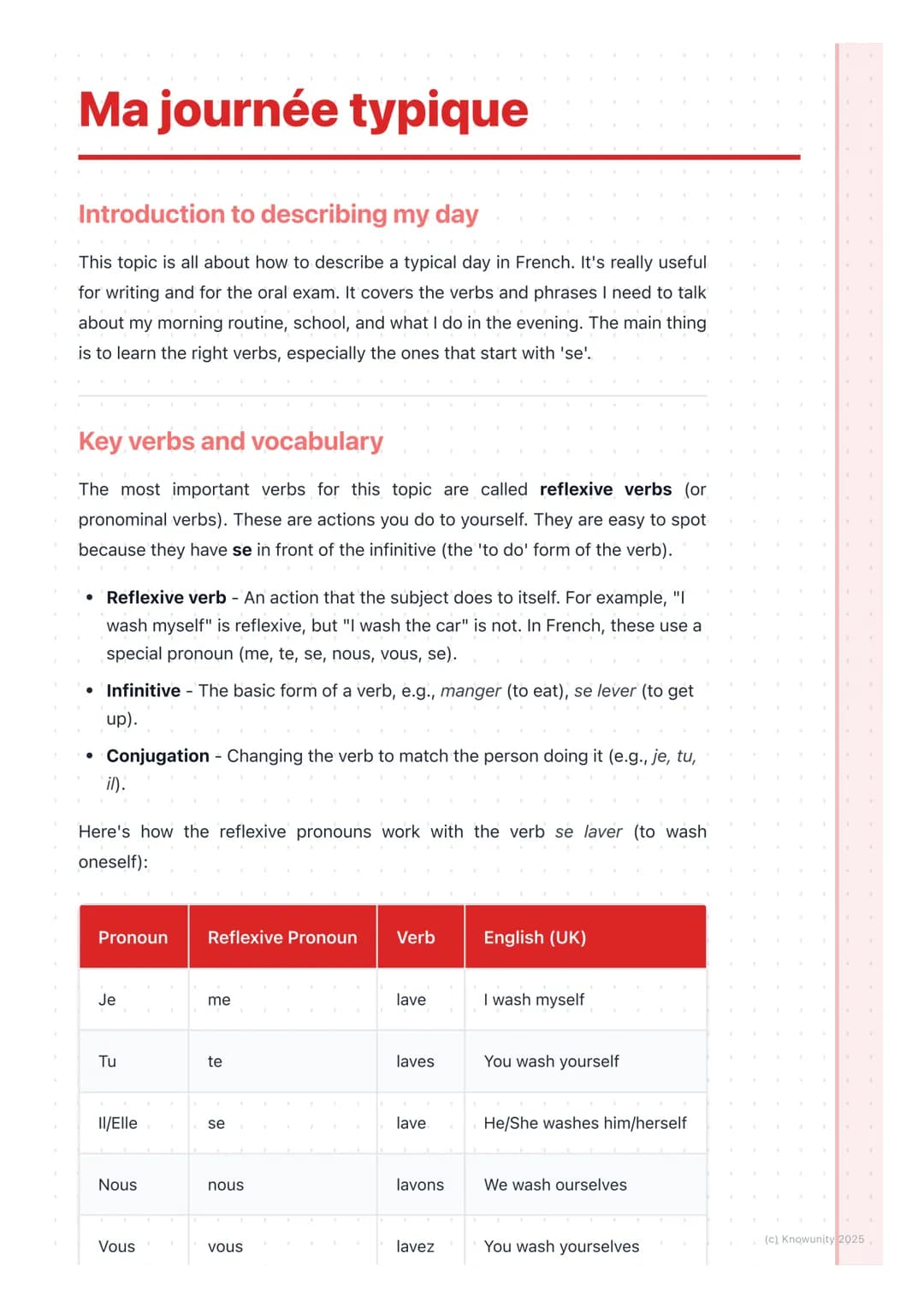
Getting Started with Daily Routines
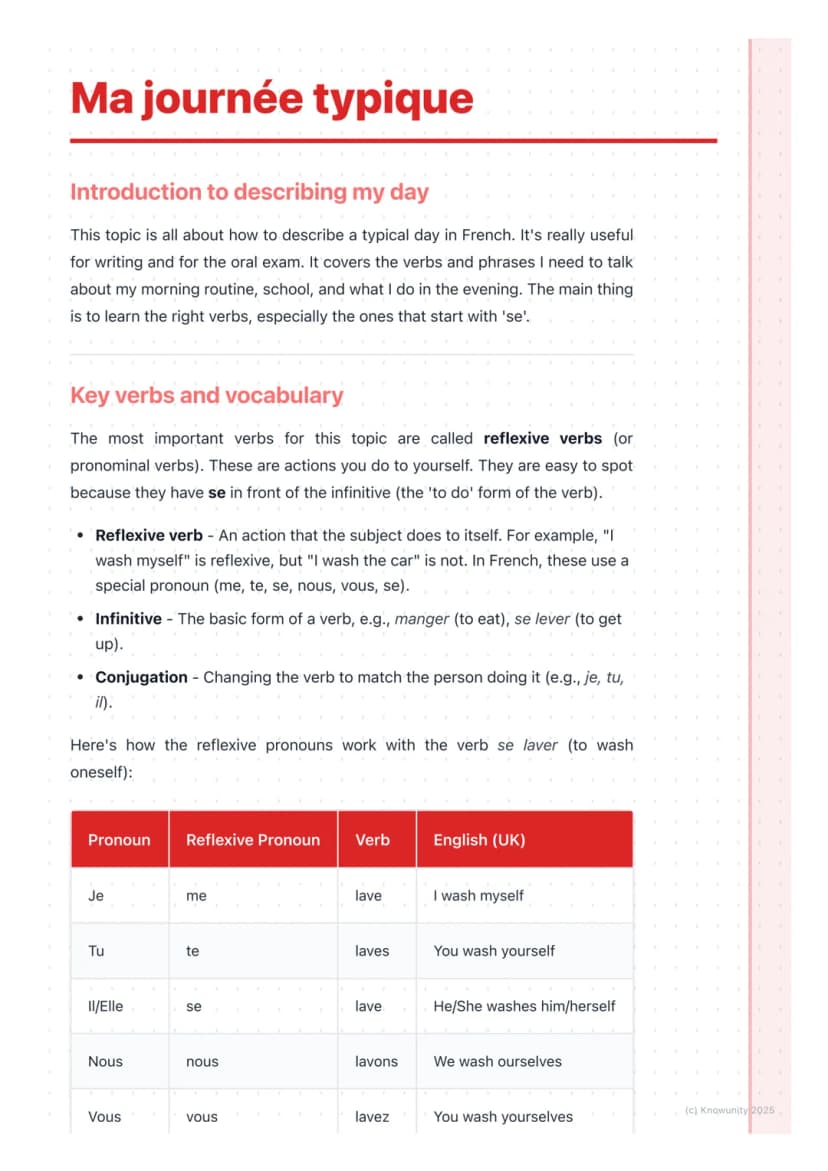
Learning to describe your day in French is actually dead useful - you'll use it loads in your exams and it's proper practical for real conversations. The key is mastering reflexive verbs, which are actions you do to yourself like washing or getting dressed.
Reflexive verbs are easy to spot because they have 'se' in front of them when you see them in the dictionary. Think of "se laver" (to wash oneself) - the 'se' tells you it's something you do to yourself, not to someone else.
The magic happens with reflexive pronouns - these little words (me, te, se) go right before the verb. So "I wash myself" becomes "je me lave". Dead simple once you get the hang of it!
Top Tip: For verbs starting with a vowel, 'me' becomes 'm' - so it's "je m'habille" (I get dressed), not "je me habille".
2
of 6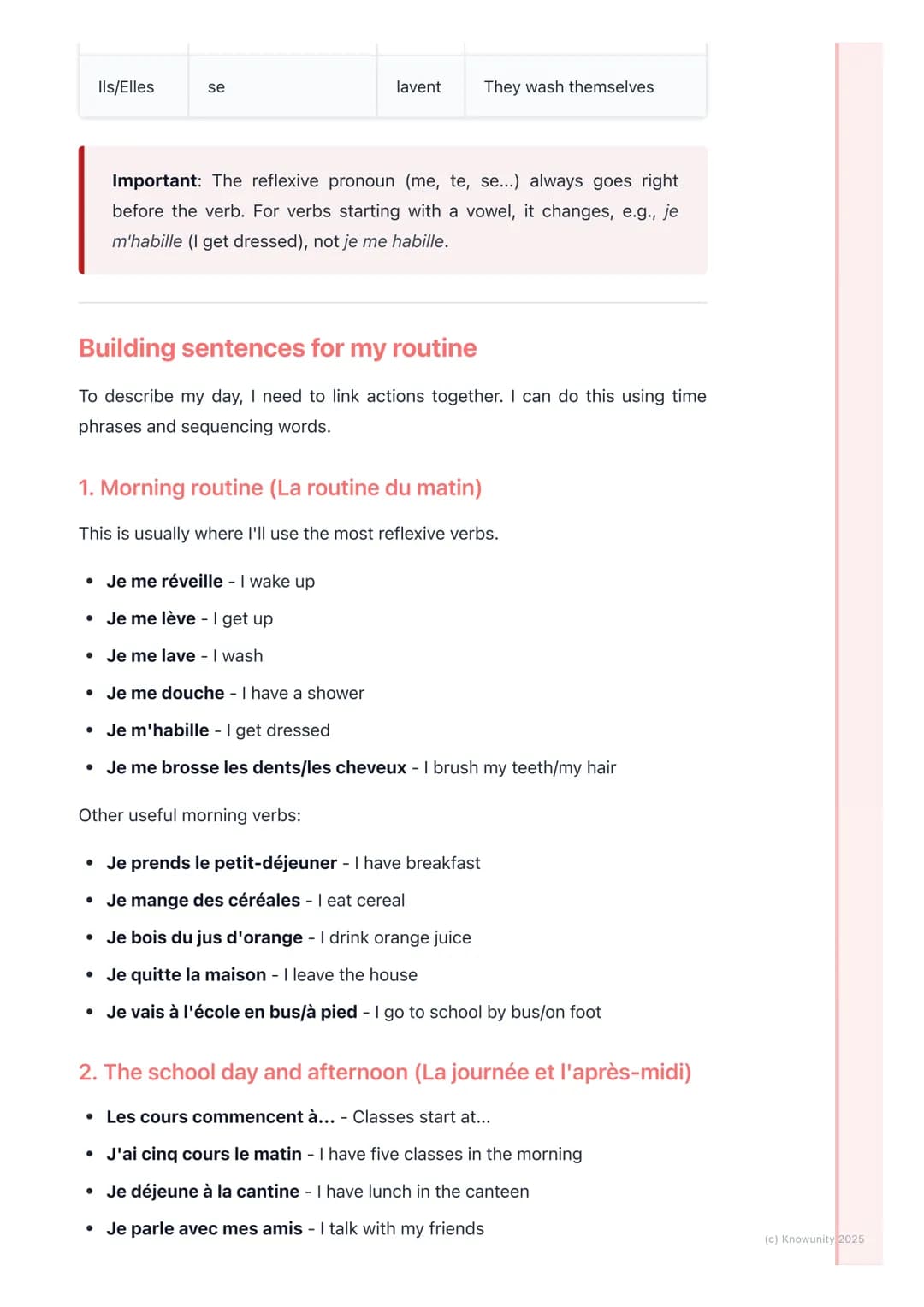
Morning Routine Vocabulary
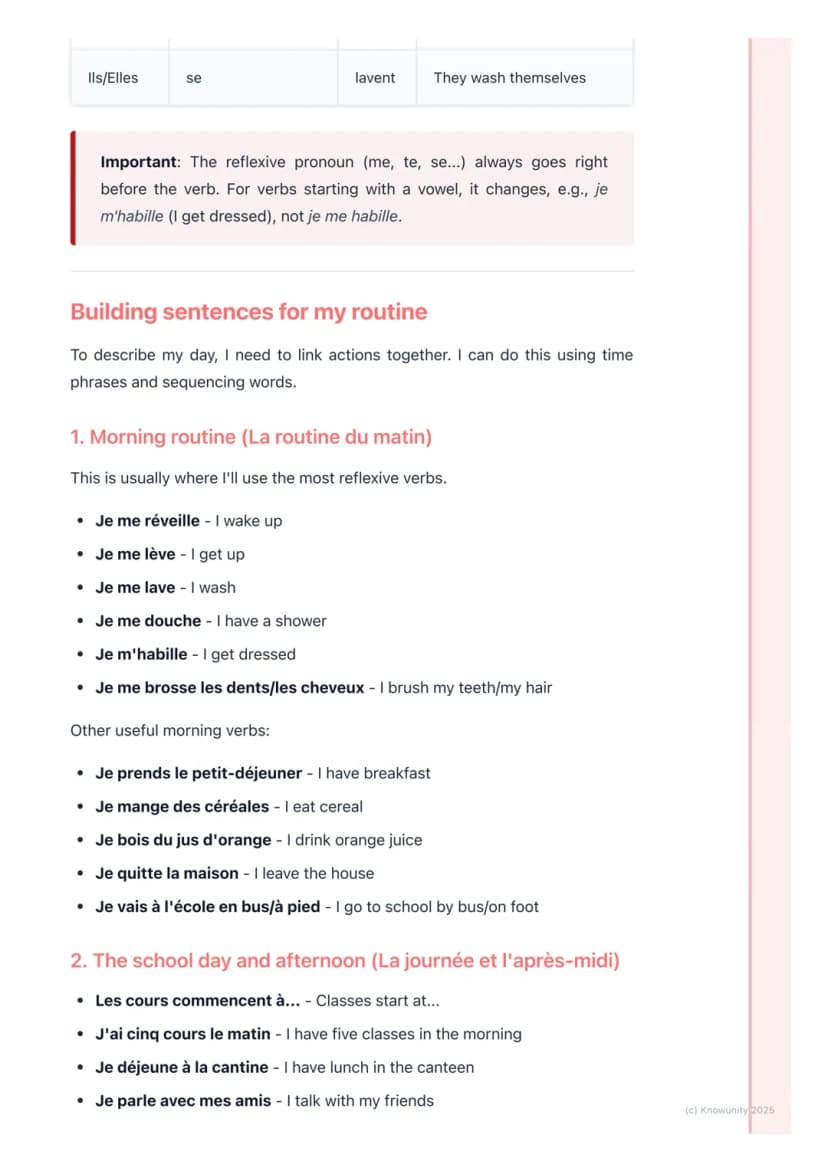
Your morning routine is where you'll use loads of reflexive verbs, so let's nail these first. Start with the basics: je me réveille (I wake up), je me lève (I get up), and je me douche (I have a shower).
Getting dressed and ready involves je m'habille (I get dressed) and je me brosse les dents (I brush my teeth). Don't forget breakfast vocabulary too - je prends le petit-déjeuner covers having breakfast in general.
For getting to school, you'll want je quitte la maison (I leave the house) and je vais à l'école (I go to school). Add "en bus" for by bus or "à pied" if you walk.
Remember: The reflexive pronoun always sits right before the verb - never forget that little 'me'!
3
of 6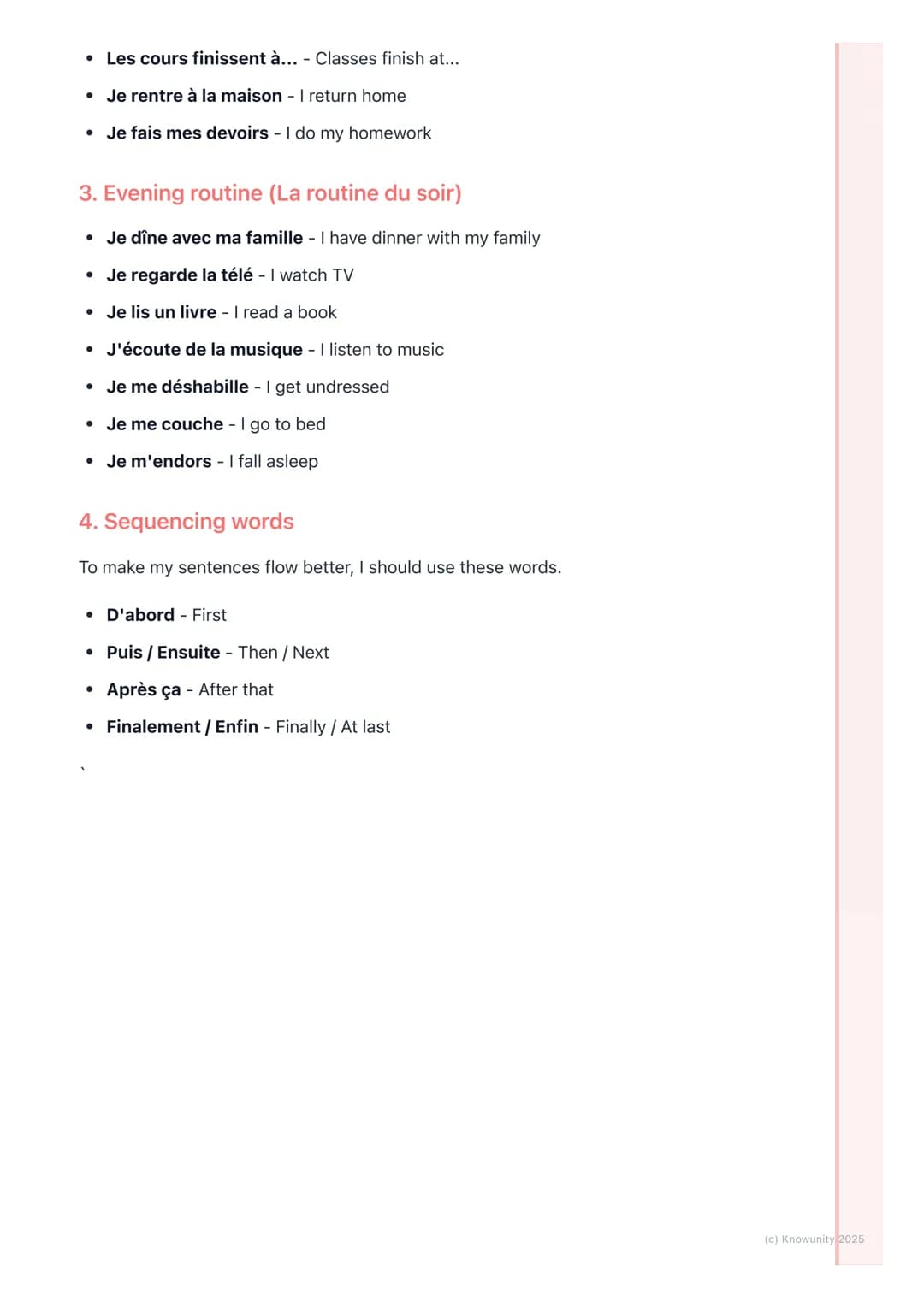
School Day and Evening Activities
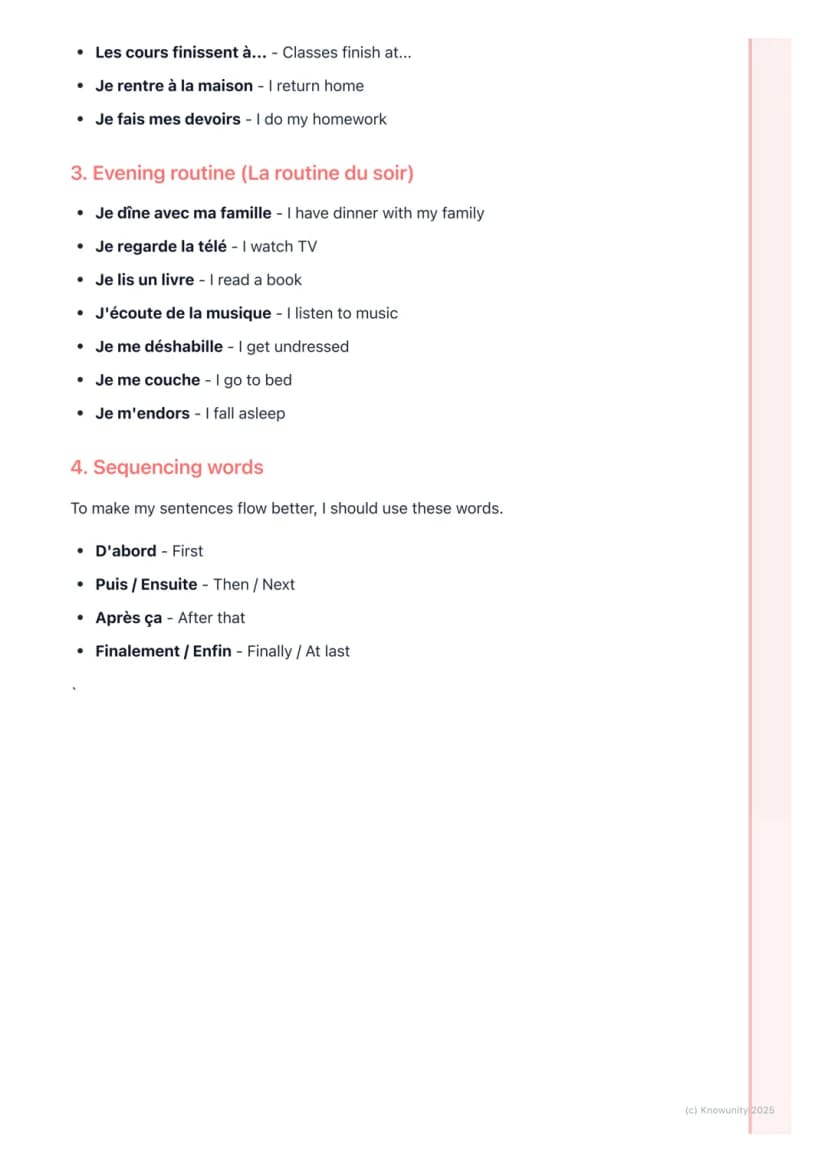
The school day gives you loads of chances to use regular verbs alongside your reflexives. Les cours commencent à... (classes start at...) and les cours finissent à... (classes finish at...) are brilliant for showing off your time-telling skills.
For afternoon activities, try je fais mes devoirs (I do my homework) - though you might want to add "c'est ennuyeux!" (it's boring!) to make it more interesting. Je déjeune à la cantine (I have lunch in the canteen) shows you know school vocabulary too.
Evening routines bring back those reflexive verbs: je me déshabille (I get undressed), je me couche (I go to bed), and je m'endors (I fall asleep). Mix these with regular verbs like je regarde la télé (I watch TV) for variety.
Quick Check: Don't mix up "se coucher" (getting into bed) with "dormir" (being asleep) - they're different actions!
4
of 6
Linking It All Together
Sequencing words are your secret weapon for making your French sound natural and flowing. Start with "d'abord" (first), then use "puis" or "ensuite" , and finish with "finalement" (finally).
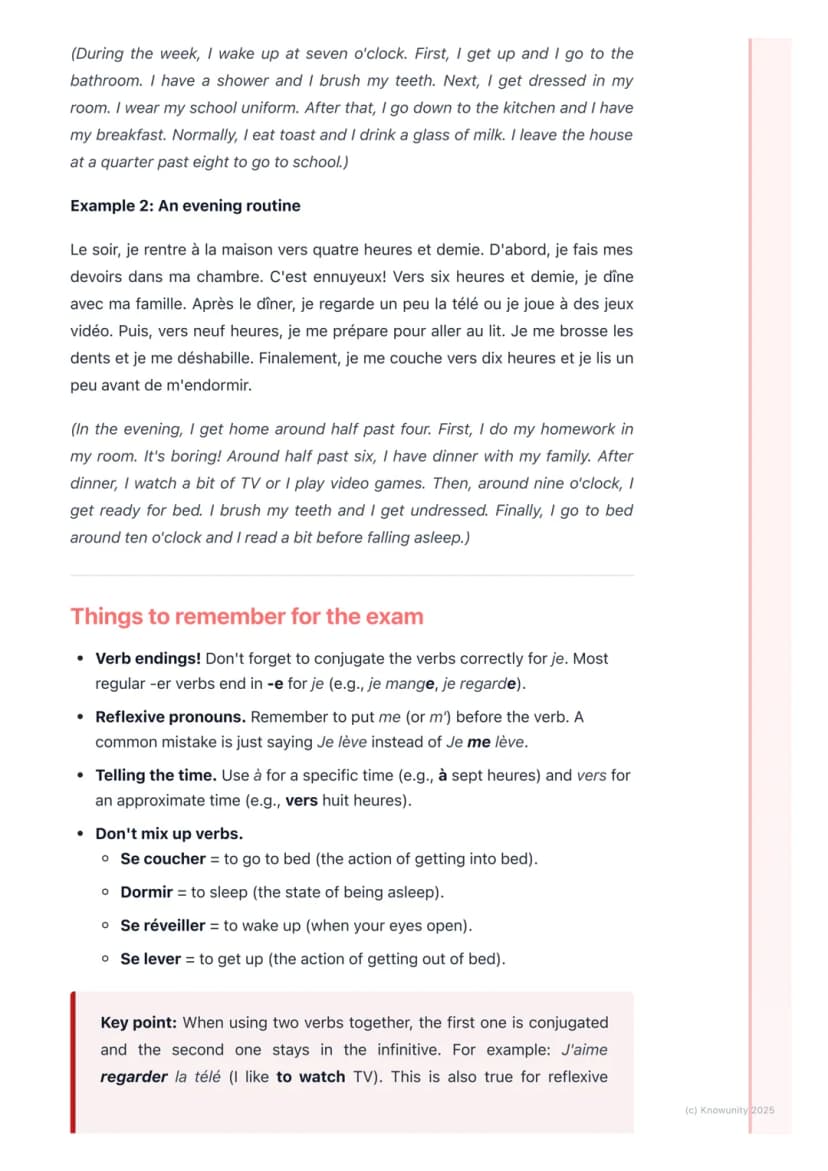
Time expressions make everything sound more authentic. Use "à" for exact times (à sept heures) and "vers" for approximate times (vers huit heures). This adds proper detail to your descriptions.
Here's a cracking example: "D'abord, je me réveille à sept heures. Ensuite, je me douche et je m'habille. Finalement, je prends mon petit-déjeuner." See how it flows nicely?
Pro Tip: When using two verbs together, only conjugate the first one - "Je vais me coucher" (I'm going to go to bed), not "Je vais me couche"!
5
of 6
Putting It Into Practice
Now you can build proper paragraphs about your day. Start simple - pick your most important morning activities and link them with sequencing words. Something like: "Je me réveille à sept heures. D'abord, je me lève et je vais dans la salle de bains."
Don't forget to add personality to your writing! Say what you normally eat (je mange des toasts) or mention your school uniform (je porte mon uniforme scolaire). These details make your French more interesting and realistic.
For evening routines, try mixing activities: "Le soir, je fais mes devoirs - c'est ennuyeux! Puis je regarde la télé avec ma famille." This shows you can handle different types of verbs and opinions.
Exam Gold: Always check your verb endings - most regular -er verbs with 'je' end in -e, and don't forget those reflexive pronouns!
6
of 6
Quick Revision Essentials
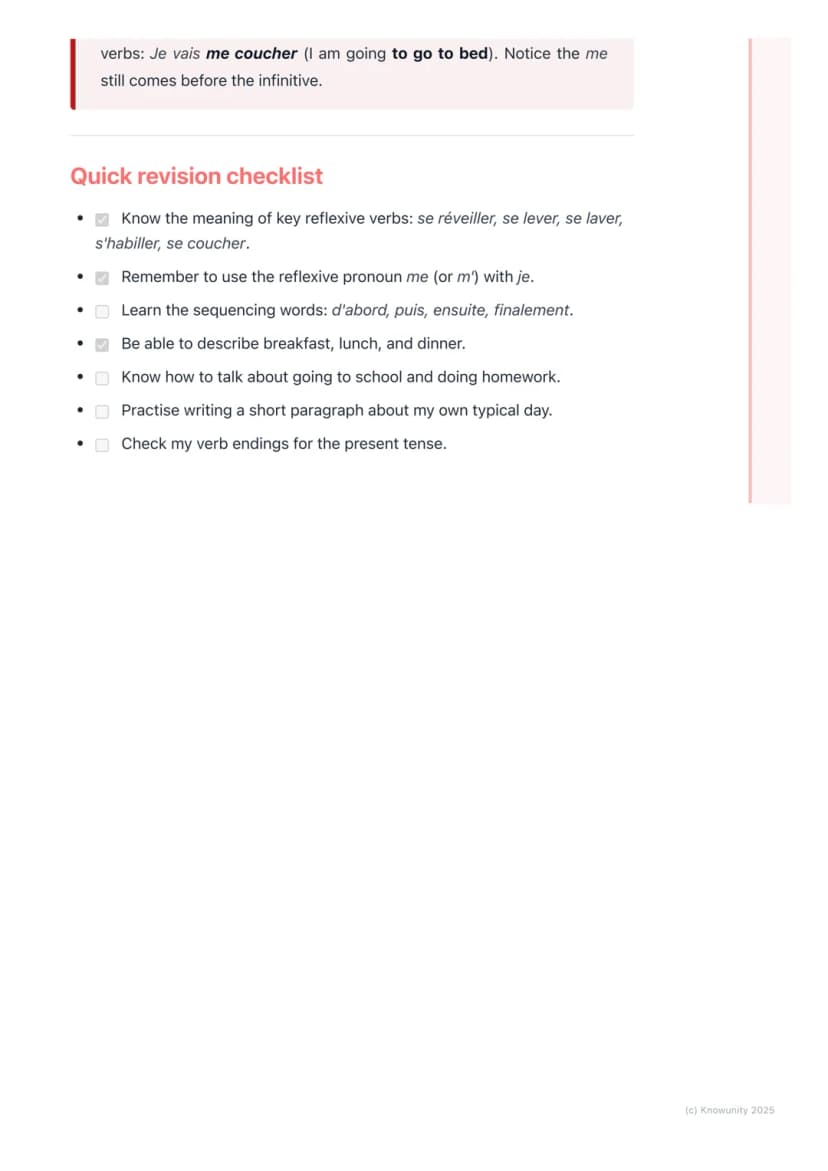
You're nearly sorted! Make sure you can rattle off the main reflexive verbs: se réveiller, se lever, se laver, s'habiller, se coucher. Remember, they all need that reflexive pronoun 'me' with 'je'.
Sequencing words are dead important for flowing sentences - d'abord, puis, ensuite, finalement. These make you sound like you really know what you're doing. Practice linking at least three activities together smoothly.
Finally, nail your time expressions and don't mix up similar verbs. Se réveiller is opening your eyes, se lever is getting out of bed - they're different actions! Get these right and you'll smash your exams.
Final Check: Write a short paragraph about your own day, check all your verb endings, and make sure every reflexive verb has its pronoun. You've got this!
Hiç sormayacaksın sanmıştık...
Knowunity yapay zeka arkadaşı nedir?
Yapay zeka arkadaşımız öğrencilerin ihtiyaçlarına göre özel olarak tasarlanmıştır. Platformda bulunan milyonlarca içeriğe dayanarak öğrencilere gerçekten anlamlı ve ilgili yanıtlar verebiliyoruz. Ancak mesele sadece cevaplar değil, refakatçi aynı zamanda kişiselleştirilmiş öğrenme planları, sınavlar veya sohbet içerikleri ve öğrencilerin becerilerine ve gelişimlerine dayalı %100 kişiselleştirme ile öğrencilere günlük öğrenme zorluklarında rehberlik ediyor.
Knowunity uygulamasını nereden indirebilirim?
Uygulamayı Google Play Store ve Apple App Store'dan indirebilirsiniz.
Knowunity ücretsiz mi?
Knowunity uygulaması ücretsiz! Uygulamamız çok yakında indirmeye hazır olacak, bekle bizi. 💙
French dersinin en popüler içerikleri
2En popüler içerikler
9 Irish
IrishIrish oral questions and answers
Questions and answers for the leaving cert oral
5th Year4264
 English
Key Quotes : Sive
Key Quotes and explanations: Sive
6th Year2842
IrishIrish oral questions
Outline of oral questions
5th Year2055
IrishIníon- le hÁine Durkin
Aine Durkin’s poem, Iníon: Themes & summary
5th Year890
IrishIrish poetry 2027
Iníon + Dínit an Bhróin
5th Year1153
IrishLC HL notes- Iníon (poem)
Includes poem in English and Irish, theme, key words & phrases
5th Year2304
EnglishCultural Context : Shawshank Redemption : Sive : Small Things Like These
Comparative Study : Cultural Context : Shawshank Redemption, Sive and Small Things Like These
6th Year1430
IrishMo Ghrá-sa (Idir Lúibíní)
Notes on mo ghrá-sa
5th Year380
IrishAn Gaeilge Aiste
Irish Language essay
6th Year1320
Aradığını bulamıyor musun? Diğer derslere göz at.
Kullanıcılarımızdan yorumlar. Onlar her şeyi çok beğendi — sen de beğeneceksin.
4.6/5App Store
4.7/5Google Play
Uygulama çok kolay kullanılıyor ve güzel tasarlanmış. Şu ana kadar aradığım her şeyi buldum ve sunumlardan çok şey öğrendim! Kesinlikle ödevlerim için hep kullanacağım!
A.S.iOS kullanıcısı
Uygulama çok iyi. Çok fazla ders notu ve yardımlaşma var. Örneğin benim problem yaşadığım bir ders Geometriydi ve ANINDA yardım ettiler beraber hem sorularımı çözdük hem konu anlatımı buldum. Herkese tavsiye ederim.
S.L.Android kullanıcısı
BEN ŞOK. Reklamını sık sık gördüğüm için uygulamayı denedim ve gerçekten hayran kaldım. Bu uygulama okul için tam ihtiyacım olan şey. Anında ödev yardımı, konu anlatımı, örnek sınavlar, flaşkartlar hepsi hepsi var, şiddetle tavsiye ederim ✅
A.iOS kullanıcısı
French2 görüntüleme·Güncellendi Jun 5, 2026·6 sayfaMa journée typique : Une routine quotidienne illustrée
Ever wondered how to describe your daily routine in French? This topic covers all the essential vocabulary and grammar you need to talk about your typical day, from waking up to going to bed. It's brilliant for both writing tasks...
1
of 6
Ders notlarını görmek için kaydol. Ücretsiz!
- Tüm belgeleri görebilirsin
- Notlarını Yükselt
- Milyonlarca öğrenciye katıl
Getting Started with Daily Routines
Learning to describe your day in French is actually dead useful - you'll use it loads in your exams and it's proper practical for real conversations. The key is mastering reflexive verbs, which are actions you do to yourself like washing or getting dressed.
Reflexive verbs are easy to spot because they have 'se' in front of them when you see them in the dictionary. Think of "se laver" (to wash oneself) - the 'se' tells you it's something you do to yourself, not to someone else.
The magic happens with reflexive pronouns - these little words (me, te, se) go right before the verb. So "I wash myself" becomes "je me lave". Dead simple once you get the hang of it!
Top Tip: For verbs starting with a vowel, 'me' becomes 'm' - so it's "je m'habille" (I get dressed), not "je me habille".
2
of 6Ders notlarını görmek için kaydol. Ücretsiz!
- Tüm belgeleri görebilirsin
- Notlarını Yükselt
- Milyonlarca öğrenciye katıl
Morning Routine Vocabulary
Your morning routine is where you'll use loads of reflexive verbs, so let's nail these first. Start with the basics: je me réveille (I wake up), je me lève (I get up), and je me douche (I have a shower).
Getting dressed and ready involves je m'habille (I get dressed) and je me brosse les dents (I brush my teeth). Don't forget breakfast vocabulary too - je prends le petit-déjeuner covers having breakfast in general.
For getting to school, you'll want je quitte la maison (I leave the house) and je vais à l'école (I go to school). Add "en bus" for by bus or "à pied" if you walk.
Remember: The reflexive pronoun always sits right before the verb - never forget that little 'me'!
3
of 6Ders notlarını görmek için kaydol. Ücretsiz!
- Tüm belgeleri görebilirsin
- Notlarını Yükselt
- Milyonlarca öğrenciye katıl
School Day and Evening Activities
The school day gives you loads of chances to use regular verbs alongside your reflexives. Les cours commencent à... (classes start at...) and les cours finissent à... (classes finish at...) are brilliant for showing off your time-telling skills.
For afternoon activities, try je fais mes devoirs (I do my homework) - though you might want to add "c'est ennuyeux!" (it's boring!) to make it more interesting. Je déjeune à la cantine (I have lunch in the canteen) shows you know school vocabulary too.
Evening routines bring back those reflexive verbs: je me déshabille (I get undressed), je me couche (I go to bed), and je m'endors (I fall asleep). Mix these with regular verbs like je regarde la télé (I watch TV) for variety.
Quick Check: Don't mix up "se coucher" (getting into bed) with "dormir" (being asleep) - they're different actions!
4
of 6Ders notlarını görmek için kaydol. Ücretsiz!
- Tüm belgeleri görebilirsin
- Notlarını Yükselt
- Milyonlarca öğrenciye katıl
Linking It All Together
Sequencing words are your secret weapon for making your French sound natural and flowing. Start with "d'abord" (first), then use "puis" or "ensuite" , and finish with "finalement" (finally).
Time expressions make everything sound more authentic. Use "à" for exact times (à sept heures) and "vers" for approximate times (vers huit heures). This adds proper detail to your descriptions.
Here's a cracking example: "D'abord, je me réveille à sept heures. Ensuite, je me douche et je m'habille. Finalement, je prends mon petit-déjeuner." See how it flows nicely?
Pro Tip: When using two verbs together, only conjugate the first one - "Je vais me coucher" (I'm going to go to bed), not "Je vais me couche"!
5
of 6Ders notlarını görmek için kaydol. Ücretsiz!
- Tüm belgeleri görebilirsin
- Notlarını Yükselt
- Milyonlarca öğrenciye katıl
Putting It Into Practice
Now you can build proper paragraphs about your day. Start simple - pick your most important morning activities and link them with sequencing words. Something like: "Je me réveille à sept heures. D'abord, je me lève et je vais dans la salle de bains."
Don't forget to add personality to your writing! Say what you normally eat (je mange des toasts) or mention your school uniform (je porte mon uniforme scolaire). These details make your French more interesting and realistic.
For evening routines, try mixing activities: "Le soir, je fais mes devoirs - c'est ennuyeux! Puis je regarde la télé avec ma famille." This shows you can handle different types of verbs and opinions.
Exam Gold: Always check your verb endings - most regular -er verbs with 'je' end in -e, and don't forget those reflexive pronouns!
6
of 6Ders notlarını görmek için kaydol. Ücretsiz!
- Tüm belgeleri görebilirsin
- Notlarını Yükselt
- Milyonlarca öğrenciye katıl
Quick Revision Essentials
You're nearly sorted! Make sure you can rattle off the main reflexive verbs: se réveiller, se lever, se laver, s'habiller, se coucher. Remember, they all need that reflexive pronoun 'me' with 'je'.
Sequencing words are dead important for flowing sentences - d'abord, puis, ensuite, finalement. These make you sound like you really know what you're doing. Practice linking at least three activities together smoothly.
Finally, nail your time expressions and don't mix up similar verbs. Se réveiller is opening your eyes, se lever is getting out of bed - they're different actions! Get these right and you'll smash your exams.
Final Check: Write a short paragraph about your own day, check all your verb endings, and make sure every reflexive verb has its pronoun. You've got this!
Hiç sormayacaksın sanmıştık...
Knowunity yapay zeka arkadaşı nedir?
Yapay zeka arkadaşımız öğrencilerin ihtiyaçlarına göre özel olarak tasarlanmıştır. Platformda bulunan milyonlarca içeriğe dayanarak öğrencilere gerçekten anlamlı ve ilgili yanıtlar verebiliyoruz. Ancak mesele sadece cevaplar değil, refakatçi aynı zamanda kişiselleştirilmiş öğrenme planları, sınavlar veya sohbet içerikleri ve öğrencilerin becerilerine ve gelişimlerine dayalı %100 kişiselleştirme ile öğrencilere günlük öğrenme zorluklarında rehberlik ediyor.
Knowunity uygulamasını nereden indirebilirim?
Uygulamayı Google Play Store ve Apple App Store'dan indirebilirsiniz.
Knowunity ücretsiz mi?
Knowunity uygulaması ücretsiz! Uygulamamız çok yakında indirmeye hazır olacak, bekle bizi. 💙
French dersinin en popüler içerikleri
2En popüler içerikler
9IrishIrish oral questions and answers
Questions and answers for the leaving cert oral
5th Year4264
EnglishKey Quotes : Sive
Key Quotes and explanations: Sive
6th Year2842
IrishIrish oral questions
Outline of oral questions
5th Year2055
IrishIníon- le hÁine Durkin
Aine Durkin’s poem, Iníon: Themes & summary
5th Year890
IrishIrish poetry 2027
Iníon + Dínit an Bhróin
5th Year1153
IrishLC HL notes- Iníon (poem)
Includes poem in English and Irish, theme, key words & phrases
5th Year2304
EnglishCultural Context : Shawshank Redemption : Sive : Small Things Like These
Comparative Study : Cultural Context : Shawshank Redemption, Sive and Small Things Like These
6th Year1430
IrishMo Ghrá-sa (Idir Lúibíní)
Notes on mo ghrá-sa
5th Year380
IrishAn Gaeilge Aiste
Irish Language essay
6th Year1320
Aradığını bulamıyor musun? Diğer derslere göz at.
Kullanıcılarımızdan yorumlar. Onlar her şeyi çok beğendi — sen de beğeneceksin.
4.6/5App Store
4.7/5Google Play
Uygulama çok kolay kullanılıyor ve güzel tasarlanmış. Şu ana kadar aradığım her şeyi buldum ve sunumlardan çok şey öğrendim! Kesinlikle ödevlerim için hep kullanacağım!
A.S.iOS kullanıcısı
Uygulama çok iyi. Çok fazla ders notu ve yardımlaşma var. Örneğin benim problem yaşadığım bir ders Geometriydi ve ANINDA yardım ettiler beraber hem sorularımı çözdük hem konu anlatımı buldum. Herkese tavsiye ederim.
S.L.Android kullanıcısı
BEN ŞOK. Reklamını sık sık gördüğüm için uygulamayı denedim ve gerçekten hayran kaldım. Bu uygulama okul için tam ihtiyacım olan şey. Anında ödev yardımı, konu anlatımı, örnek sınavlar, flaşkartlar hepsi hepsi var, şiddetle tavsiye ederim ✅
A.iOS kullanıcısı