
Verb tenses tell us when actions happen in time. They...
 English11 görüntüleme·Güncellendi Jun 10, 2026·5 sayfa
Mastering Verb Tenses: Past, Present, and Future
1 / 5
1
of 5
Verb Tenses
Verb tenses show us exactly when an action happens. These tenses are super important because they tell your reader or listener if something already happened, is happening now, or will happen later.
Think of verbs as the "doing" words in your sentences. The tense of a verb acts like a time machine, taking your reader to the right point in time - past, present, or future.
Getting your tenses right means people will understand exactly what you mean. It's all about being clear about when things happen!
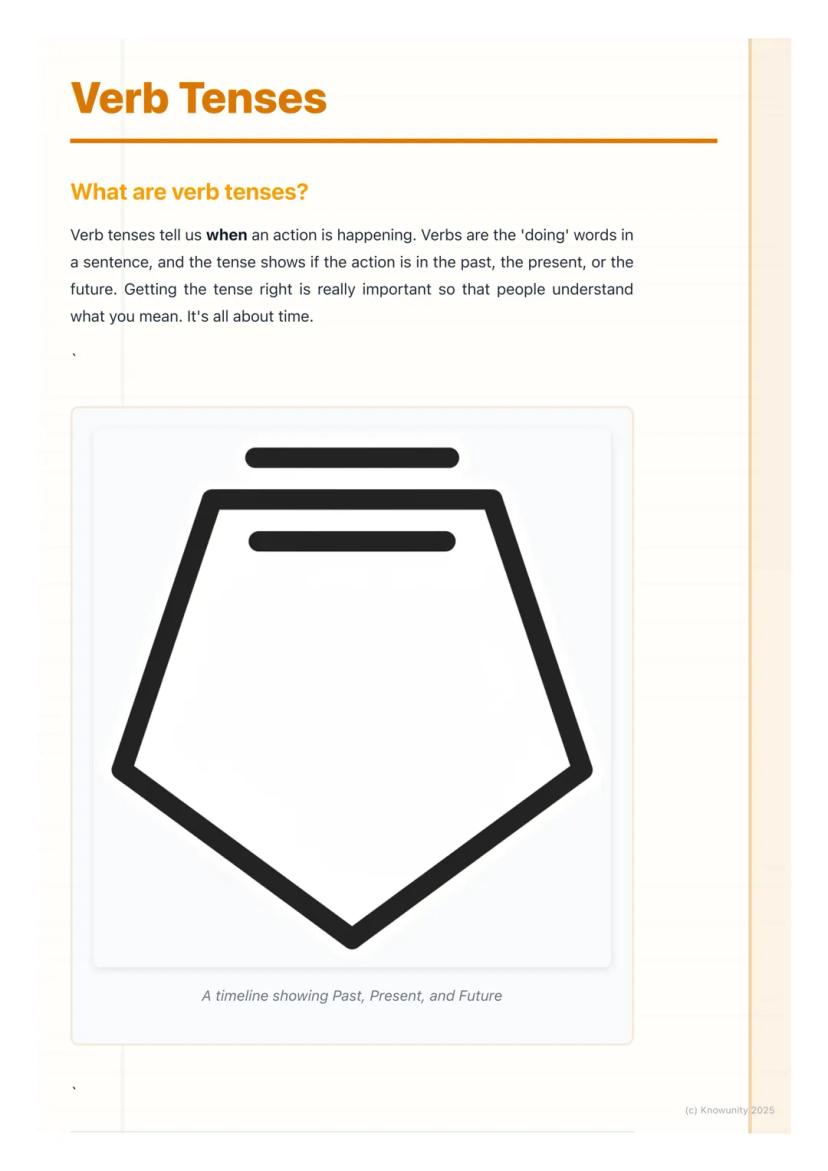
Quick Tip: Imagine a timeline with three sections: Past (yesterday), Present (now), and Future (tomorrow). Every action you describe fits somewhere on this timeline!
2
of 5
The Three Main Tenses
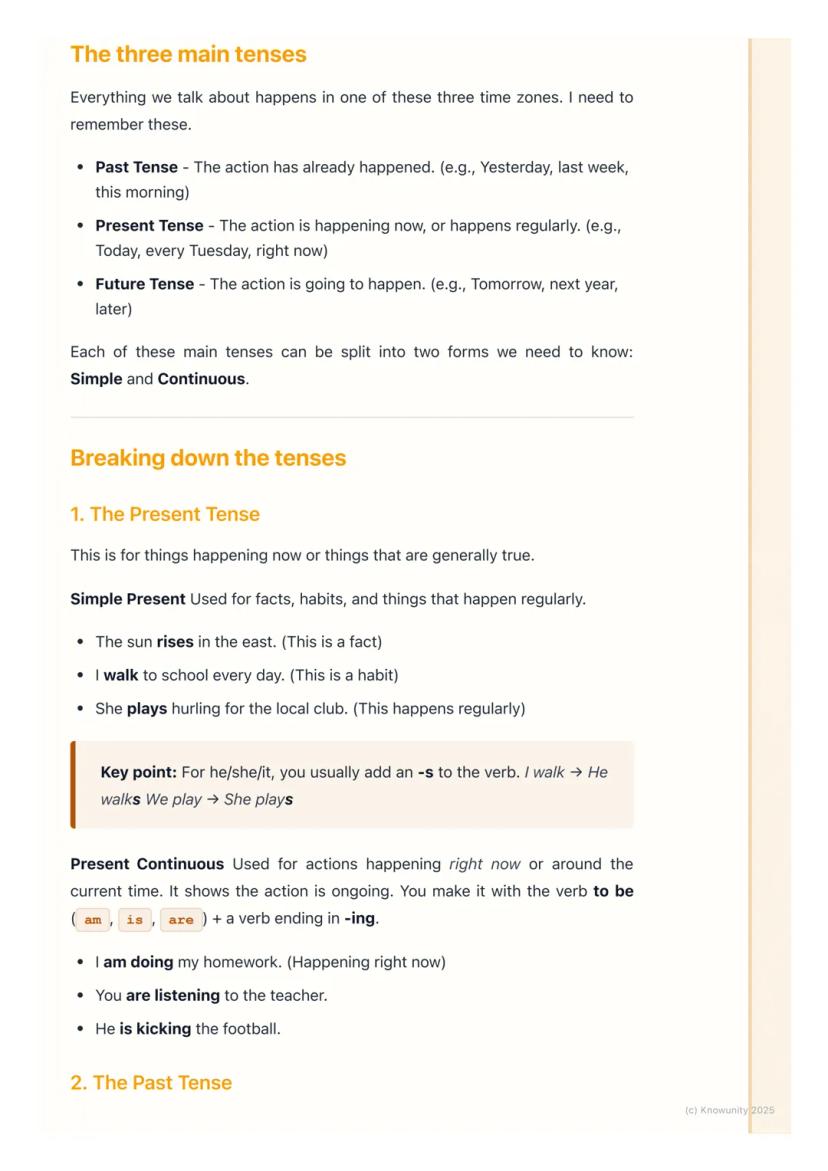
Everything we talk about happens in one of three time zones. These are the building blocks of talking about time:
Past Tense is used when the action has already finished. Think of words like yesterday, last week, or this morning when something has already happened.
Present Tense shows action happening now or regularly. We use this with words like today, every Tuesday, or right now.
Future Tense is for actions that haven't happened yet. Look for time markers like tomorrow, next year, or later.
Each main tense can be either Simple or Continuous, which gives us more specific ways to talk about when things happen.
Remember: The three main tenses are like three different rooms in the house of time - past, present and future!
3
of 5
Breaking Down the Tenses
Let's explore how each tense works in more detail:
Simple Present is for facts, habits and regular actions. For example: "The sun rises in the east" (fact) or "I walk to school every day" (habit). Remember to add -s for he/she/it (She walks, He plays).
Present Continuous shows actions happening right now. We form it with am/is/are + verb-ing. For example: "I am doing my homework" or "She is kicking the football."
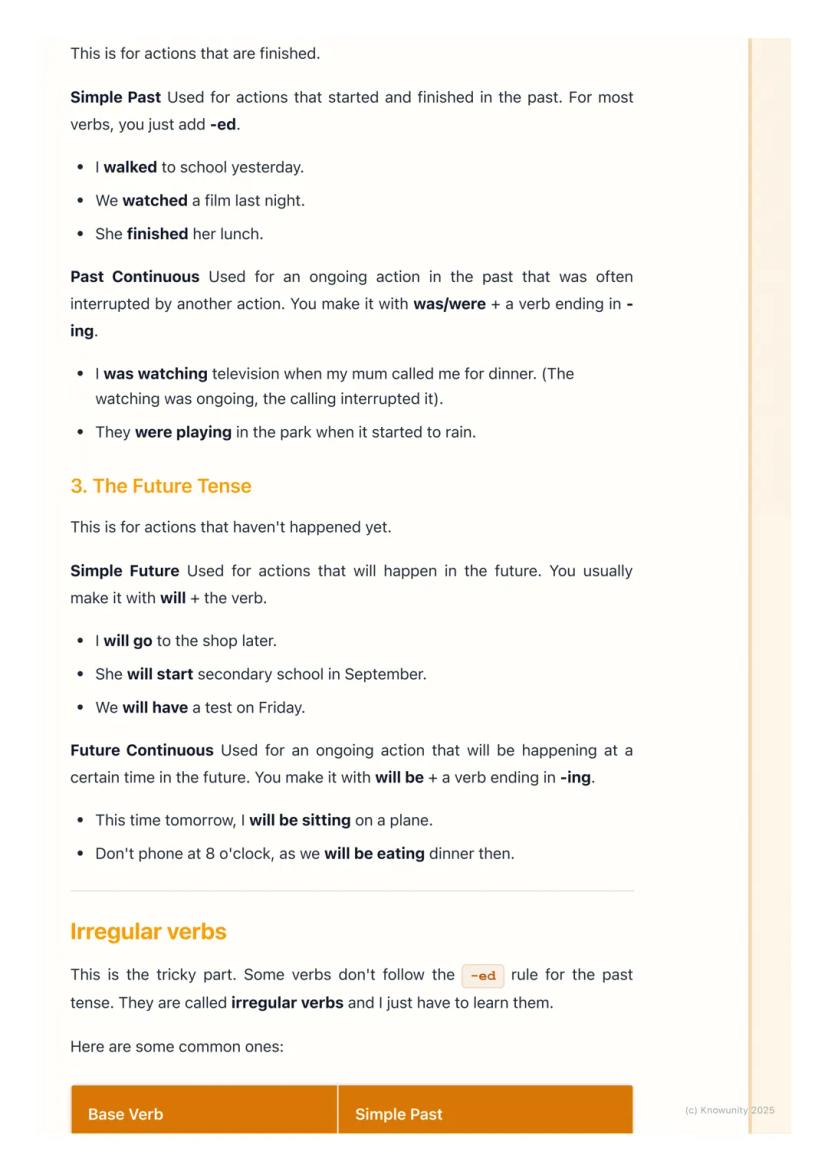
Simple Past is for completed actions. Most verbs just add -ed: "I walked to school yesterday" or "We watched a film last night."
Past Continuous describes ongoing past actions, often interrupted. Form it with was/were + verb-ing: "I was watching television when my mum called."
Got it? Think of Simple tenses as taking a snapshot, while Continuous tenses are more like short videos showing action in progress.
4
of 5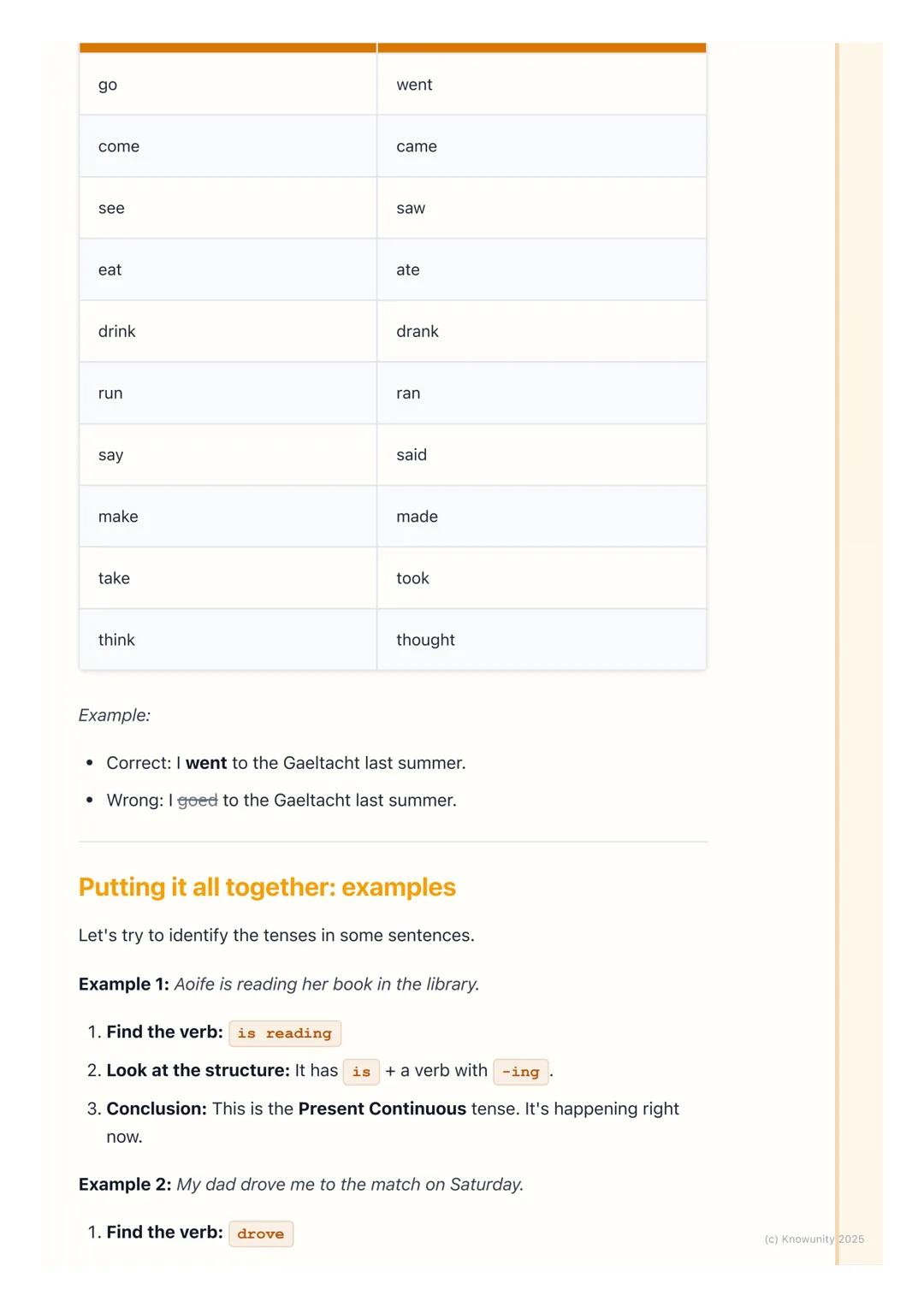
Future Tense and Irregular Verbs
Simple Future describes actions that will happen. Form it with will + verb: "I will go to the shop later" or "We will have a test on Friday."
Future Continuous shows ongoing future actions at a specific time. Use will be + verb-ing: "This time tomorrow, I will be sitting on a plane."
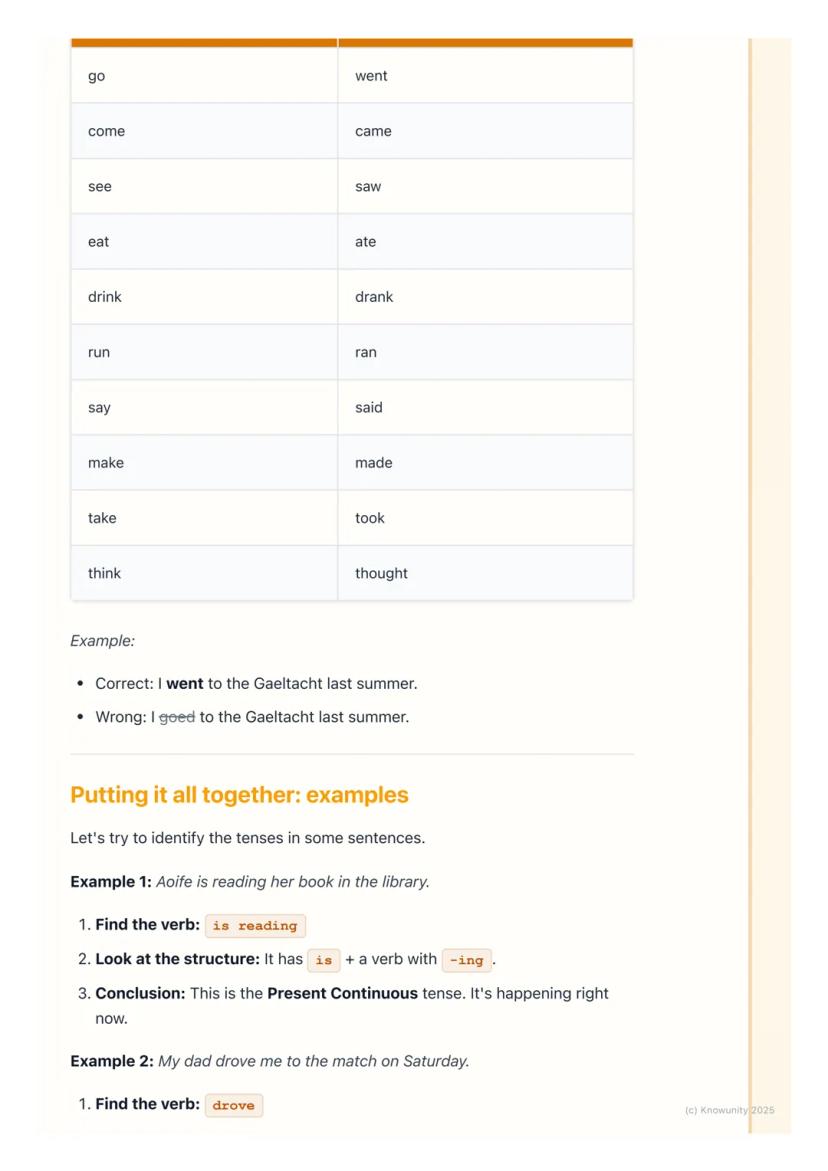
Irregular Verbs are the tricky ones! They don't follow the -ed rule for past tense. You need to learn these by heart:
- go → went
- come → came
- see → saw
- eat → ate
- run → ran
- say → said
- make → made
- take → took
- think → thought
For example, you'd say "I went to the Gaeltacht" (correct), not "I goed to the Gaeltacht" (wrong).
Don't worry! Even though irregular verbs seem difficult, you already know many of them from everyday speaking. With practice, they'll become second nature!
5
of 5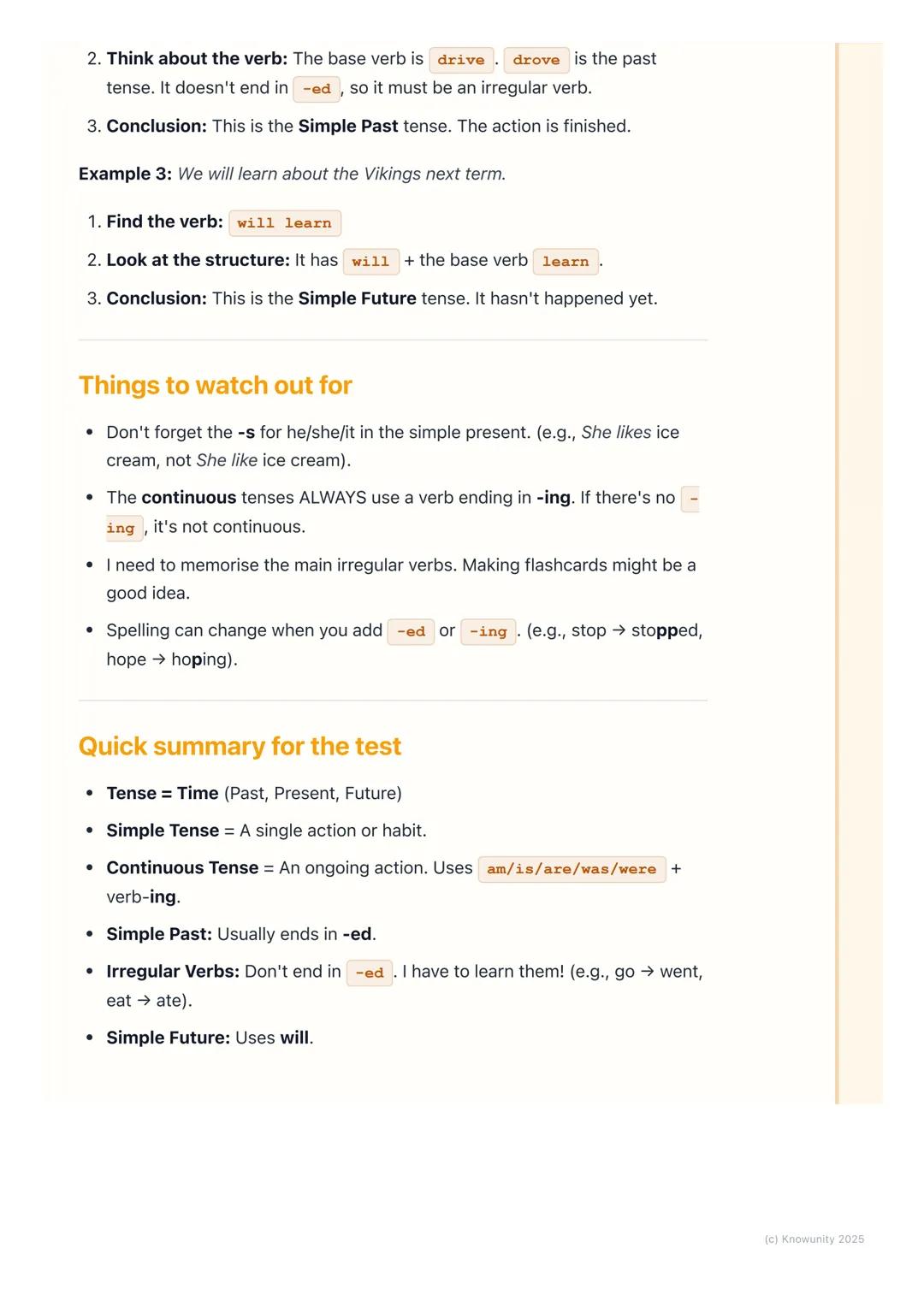
Putting It All Together
Let's identify tenses in some example sentences:
"Aoife is reading her book in the library." This is Present Continuous because it has "is" + "reading" . It's happening right now.
"My dad drove me to the match on Saturday." This is Simple Past using the irregular verb "drove" (from "drive"). The action is finished.
"We will learn about the Vikings next term." This is Simple Future because it uses "will" + the base verb "learn". It hasn't happened yet.
Things to watch out for:
- Add -s for he/she/it in simple present (She likes ice cream)
- Continuous tenses ALWAYS need -ing
- Learn those irregular verbs - flashcards can help!
- Watch for spelling changes when adding -ed or -ing (stop → stopped, hope → hoping)
You've got this! When you're stuck on which tense to use, just ask yourself: "When is this happening?" Past, present, or future will point you in the right direction.
Hiç sormayacaksın sanmıştık...
Knowunity yapay zeka arkadaşı nedir?
Yapay zeka arkadaşımız öğrencilerin ihtiyaçlarına göre özel olarak tasarlanmıştır. Platformda bulunan milyonlarca içeriğe dayanarak öğrencilere gerçekten anlamlı ve ilgili yanıtlar verebiliyoruz. Ancak mesele sadece cevaplar değil, refakatçi aynı zamanda kişiselleştirilmiş öğrenme planları, sınavlar veya sohbet içerikleri ve öğrencilerin becerilerine ve gelişimlerine dayalı %100 kişiselleştirme ile öğrencilere günlük öğrenme zorluklarında rehberlik ediyor.
Knowunity uygulamasını nereden indirebilirim?
Uygulamayı Google Play Store ve Apple App Store'dan indirebilirsiniz.
Knowunity ücretsiz mi?
Knowunity uygulaması ücretsiz! Uygulamamız çok yakında indirmeye hazır olacak, bekle bizi. 💙
English dersinin en popüler içerikleri
9EnglishKey Quotes : Sive
Key Quotes and explanations: Sive
6th Year2842
EnglishCultural Context : Shawshank Redemption : Sive : Small Things Like These
Comparative Study : Cultural Context : Shawshank Redemption, Sive and Small Things Like These
6th Year1430
EnglishElizabeth Bishop notes
Elizabeth Bishop notes
6th Year1271
EnglishPoetry
Paula Meehan - the statue of the virgin at granard speaks, the exact moment i became a poet, prayer for the children of longing, the pattern notes. Seamus Heaney, the forge notes.
6th Year300
EnglishKey Moments of Macbeth
This is a one page summary for key moments of Macbeth including quotes and act numbers
6th Year320
EnglishMud term break
Jc poem english
1st Year141
EnglishBanquo Study Notes
Macbeth
6th Year280
EnglishNotes on Macbeth, poetry and comparative
Notes on Macbeth, dive and comparative
5th Year291
EnglishThe fish-Elizabeth bishop
Overview of Elizabeth bishops poem the fish written in 1940 ,include a summary,tone and mood,key quotes,imagery examples and theme examples
6th Year370
En popüler içerikler
9 Irish
IrishIrish oral questions and answers
Questions and answers for the leaving cert oral
5th Year4264
EnglishKey Quotes : Sive
Key Quotes and explanations: Sive
6th Year2842
IrishIrish oral questions
Outline of oral questions
5th Year2055
IrishIníon- le hÁine Durkin
Aine Durkin’s poem, Iníon: Themes & summary
5th Year890
IrishIrish poetry 2027
Iníon + Dínit an Bhróin
5th Year1153
IrishLC HL notes- Iníon (poem)
Includes poem in English and Irish, theme, key words & phrases
5th Year2304
EnglishCultural Context : Shawshank Redemption : Sive : Small Things Like These
Comparative Study : Cultural Context : Shawshank Redemption, Sive and Small Things Like These
6th Year1430
IrishMo Ghrá-sa (Idir Lúibíní)
Notes on mo ghrá-sa
5th Year380
IrishAn Gaeilge Aiste
Irish Language essay
6th Year1320
Aradığını bulamıyor musun? Diğer derslere göz at.
Kullanıcılarımızdan yorumlar. Onlar her şeyi çok beğendi — sen de beğeneceksin.
4.6/5App Store
4.7/5Google Play
Uygulama çok kolay kullanılıyor ve güzel tasarlanmış. Şu ana kadar aradığım her şeyi buldum ve sunumlardan çok şey öğrendim! Kesinlikle ödevlerim için hep kullanacağım!
A.S.iOS kullanıcısı
Uygulama çok iyi. Çok fazla ders notu ve yardımlaşma var. Örneğin benim problem yaşadığım bir ders Geometriydi ve ANINDA yardım ettiler beraber hem sorularımı çözdük hem konu anlatımı buldum. Herkese tavsiye ederim.
S.L.Android kullanıcısı
BEN ŞOK. Reklamını sık sık gördüğüm için uygulamayı denedim ve gerçekten hayran kaldım. Bu uygulama okul için tam ihtiyacım olan şey. Anında ödev yardımı, konu anlatımı, örnek sınavlar, flaşkartlar hepsi hepsi var, şiddetle tavsiye ederim ✅
A.iOS kullanıcısı
English11 görüntüleme·Güncellendi Jun 10, 2026·5 sayfaMastering Verb Tenses: Past, Present, and Future
Verb tenses tell us when actions happen in time. They help us communicate clearly about the past, present, and future. Understanding verb tenses is key to writing and speaking correctly in English.
1
of 5
Ders notlarını görmek için kaydol. Ücretsiz!
- Tüm belgeleri görebilirsin
- Notlarını Yükselt
- Milyonlarca öğrenciye katıl
Verb Tenses
Verb tenses show us exactly when an action happens. These tenses are super important because they tell your reader or listener if something already happened, is happening now, or will happen later.
Think of verbs as the "doing" words in your sentences. The tense of a verb acts like a time machine, taking your reader to the right point in time - past, present, or future.
Getting your tenses right means people will understand exactly what you mean. It's all about being clear about when things happen!
Quick Tip: Imagine a timeline with three sections: Past (yesterday), Present (now), and Future (tomorrow). Every action you describe fits somewhere on this timeline!
2
of 5Ders notlarını görmek için kaydol. Ücretsiz!
- Tüm belgeleri görebilirsin
- Notlarını Yükselt
- Milyonlarca öğrenciye katıl
The Three Main Tenses
Everything we talk about happens in one of three time zones. These are the building blocks of talking about time:
Past Tense is used when the action has already finished. Think of words like yesterday, last week, or this morning when something has already happened.
Present Tense shows action happening now or regularly. We use this with words like today, every Tuesday, or right now.
Future Tense is for actions that haven't happened yet. Look for time markers like tomorrow, next year, or later.
Each main tense can be either Simple or Continuous, which gives us more specific ways to talk about when things happen.
Remember: The three main tenses are like three different rooms in the house of time - past, present and future!
3
of 5Ders notlarını görmek için kaydol. Ücretsiz!
- Tüm belgeleri görebilirsin
- Notlarını Yükselt
- Milyonlarca öğrenciye katıl
Breaking Down the Tenses
Let's explore how each tense works in more detail:
Simple Present is for facts, habits and regular actions. For example: "The sun rises in the east" (fact) or "I walk to school every day" (habit). Remember to add -s for he/she/it (She walks, He plays).
Present Continuous shows actions happening right now. We form it with am/is/are + verb-ing. For example: "I am doing my homework" or "She is kicking the football."
Simple Past is for completed actions. Most verbs just add -ed: "I walked to school yesterday" or "We watched a film last night."
Past Continuous describes ongoing past actions, often interrupted. Form it with was/were + verb-ing: "I was watching television when my mum called."
Got it? Think of Simple tenses as taking a snapshot, while Continuous tenses are more like short videos showing action in progress.
4
of 5Ders notlarını görmek için kaydol. Ücretsiz!
- Tüm belgeleri görebilirsin
- Notlarını Yükselt
- Milyonlarca öğrenciye katıl
Future Tense and Irregular Verbs
Simple Future describes actions that will happen. Form it with will + verb: "I will go to the shop later" or "We will have a test on Friday."
Future Continuous shows ongoing future actions at a specific time. Use will be + verb-ing: "This time tomorrow, I will be sitting on a plane."
Irregular Verbs are the tricky ones! They don't follow the -ed rule for past tense. You need to learn these by heart:
- go → went
- come → came
- see → saw
- eat → ate
- run → ran
- say → said
- make → made
- take → took
- think → thought
For example, you'd say "I went to the Gaeltacht" (correct), not "I goed to the Gaeltacht" (wrong).
Don't worry! Even though irregular verbs seem difficult, you already know many of them from everyday speaking. With practice, they'll become second nature!
5
of 5Ders notlarını görmek için kaydol. Ücretsiz!
- Tüm belgeleri görebilirsin
- Notlarını Yükselt
- Milyonlarca öğrenciye katıl
Putting It All Together
Let's identify tenses in some example sentences:
"Aoife is reading her book in the library." This is Present Continuous because it has "is" + "reading" . It's happening right now.
"My dad drove me to the match on Saturday." This is Simple Past using the irregular verb "drove" (from "drive"). The action is finished.
"We will learn about the Vikings next term." This is Simple Future because it uses "will" + the base verb "learn". It hasn't happened yet.
Things to watch out for:
- Add -s for he/she/it in simple present (She likes ice cream)
- Continuous tenses ALWAYS need -ing
- Learn those irregular verbs - flashcards can help!
- Watch for spelling changes when adding -ed or -ing (stop → stopped, hope → hoping)
You've got this! When you're stuck on which tense to use, just ask yourself: "When is this happening?" Past, present, or future will point you in the right direction.
Hiç sormayacaksın sanmıştık...
Knowunity yapay zeka arkadaşı nedir?
Yapay zeka arkadaşımız öğrencilerin ihtiyaçlarına göre özel olarak tasarlanmıştır. Platformda bulunan milyonlarca içeriğe dayanarak öğrencilere gerçekten anlamlı ve ilgili yanıtlar verebiliyoruz. Ancak mesele sadece cevaplar değil, refakatçi aynı zamanda kişiselleştirilmiş öğrenme planları, sınavlar veya sohbet içerikleri ve öğrencilerin becerilerine ve gelişimlerine dayalı %100 kişiselleştirme ile öğrencilere günlük öğrenme zorluklarında rehberlik ediyor.
Knowunity uygulamasını nereden indirebilirim?
Uygulamayı Google Play Store ve Apple App Store'dan indirebilirsiniz.
Knowunity ücretsiz mi?
Knowunity uygulaması ücretsiz! Uygulamamız çok yakında indirmeye hazır olacak, bekle bizi. 💙
English dersinin en popüler içerikleri
9EnglishKey Quotes : Sive
Key Quotes and explanations: Sive
6th Year2842
EnglishCultural Context : Shawshank Redemption : Sive : Small Things Like These
Comparative Study : Cultural Context : Shawshank Redemption, Sive and Small Things Like These
6th Year1430
EnglishElizabeth Bishop notes
Elizabeth Bishop notes
6th Year1271
EnglishPoetry
Paula Meehan - the statue of the virgin at granard speaks, the exact moment i became a poet, prayer for the children of longing, the pattern notes. Seamus Heaney, the forge notes.
6th Year300
EnglishKey Moments of Macbeth
This is a one page summary for key moments of Macbeth including quotes and act numbers
6th Year320
EnglishMud term break
Jc poem english
1st Year141
EnglishBanquo Study Notes
Macbeth
6th Year280
EnglishNotes on Macbeth, poetry and comparative
Notes on Macbeth, dive and comparative
5th Year291
EnglishThe fish-Elizabeth bishop
Overview of Elizabeth bishops poem the fish written in 1940 ,include a summary,tone and mood,key quotes,imagery examples and theme examples
6th Year370
En popüler içerikler
9IrishIrish oral questions and answers
Questions and answers for the leaving cert oral
5th Year4264
EnglishKey Quotes : Sive
Key Quotes and explanations: Sive
6th Year2842
IrishIrish oral questions
Outline of oral questions
5th Year2055
IrishIníon- le hÁine Durkin
Aine Durkin’s poem, Iníon: Themes & summary
5th Year890
IrishIrish poetry 2027
Iníon + Dínit an Bhróin
5th Year1153
IrishLC HL notes- Iníon (poem)
Includes poem in English and Irish, theme, key words & phrases
5th Year2304
EnglishCultural Context : Shawshank Redemption : Sive : Small Things Like These
Comparative Study : Cultural Context : Shawshank Redemption, Sive and Small Things Like These
6th Year1430
IrishMo Ghrá-sa (Idir Lúibíní)
Notes on mo ghrá-sa
5th Year380
IrishAn Gaeilge Aiste
Irish Language essay
6th Year1320
Aradığını bulamıyor musun? Diğer derslere göz at.
Kullanıcılarımızdan yorumlar. Onlar her şeyi çok beğendi — sen de beğeneceksin.
4.6/5App Store
4.7/5Google Play
Uygulama çok kolay kullanılıyor ve güzel tasarlanmış. Şu ana kadar aradığım her şeyi buldum ve sunumlardan çok şey öğrendim! Kesinlikle ödevlerim için hep kullanacağım!
A.S.iOS kullanıcısı
Uygulama çok iyi. Çok fazla ders notu ve yardımlaşma var. Örneğin benim problem yaşadığım bir ders Geometriydi ve ANINDA yardım ettiler beraber hem sorularımı çözdük hem konu anlatımı buldum. Herkese tavsiye ederim.
S.L.Android kullanıcısı
BEN ŞOK. Reklamını sık sık gördüğüm için uygulamayı denedim ve gerçekten hayran kaldım. Bu uygulama okul için tam ihtiyacım olan şey. Anında ödev yardımı, konu anlatımı, örnek sınavlar, flaşkartlar hepsi hepsi var, şiddetle tavsiye ederim ✅
A.iOS kullanıcısı