
Ever wondered if that viral social media post or news...
 English64 görüntüleme·Güncellendi Jun 10, 2026·5 sayfa
Understanding Bias and Evaluating Information
1 / 5
1
of 5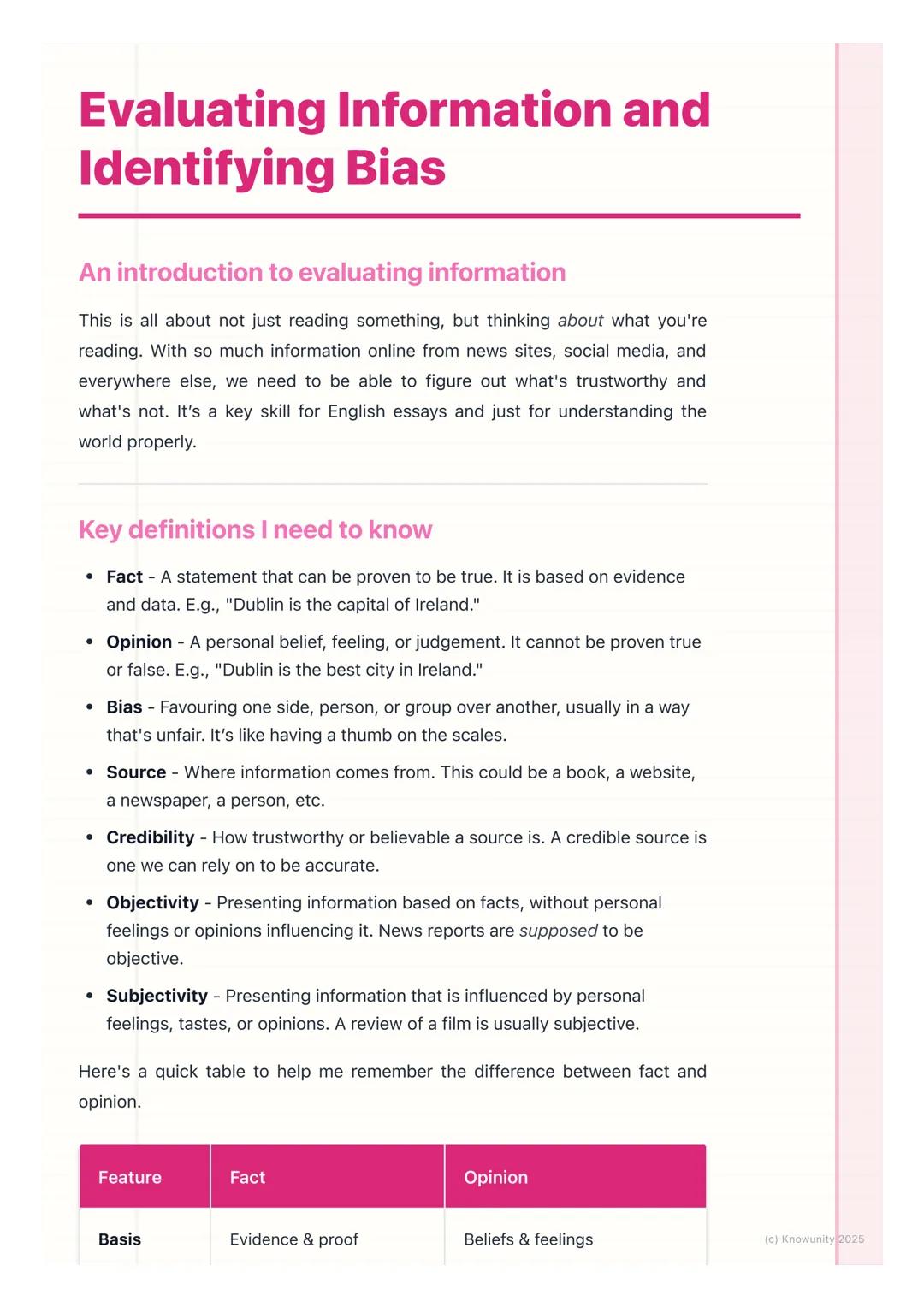
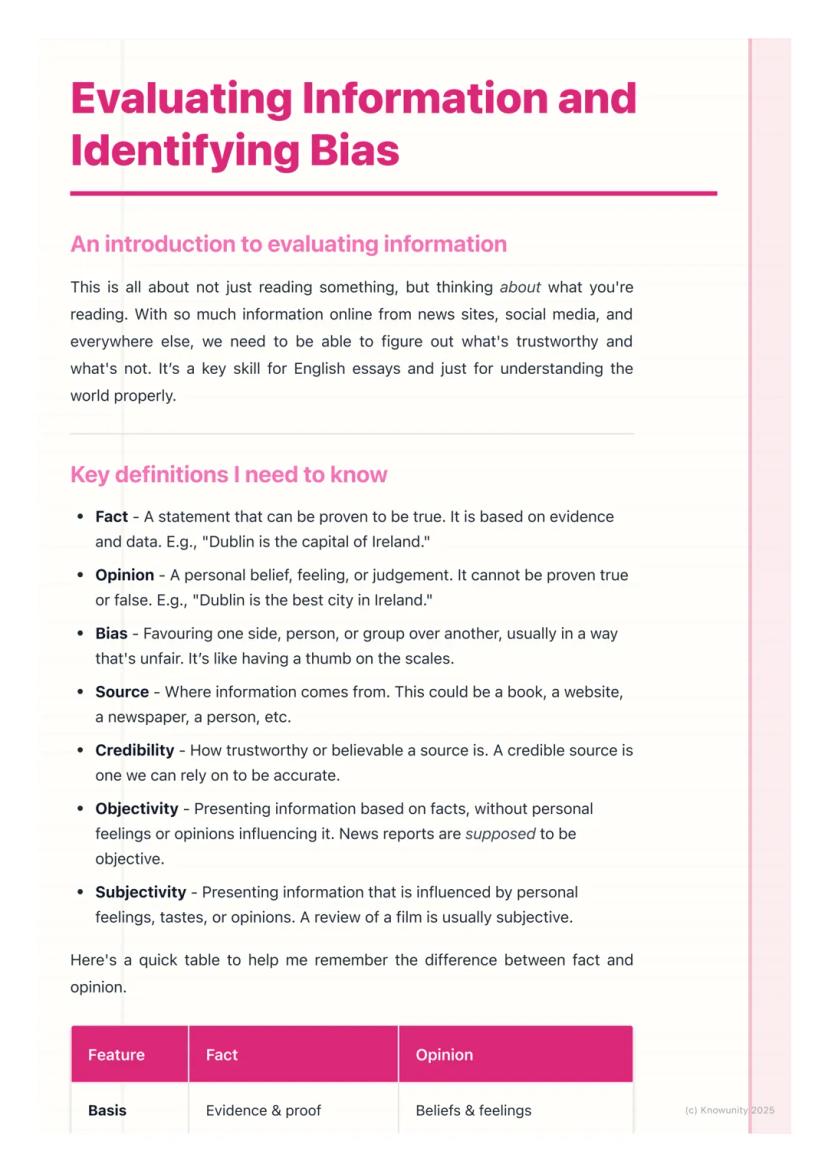
Understanding the Basics
Think of this as your BS detector training! When you're scrolling through social media or researching for an essay, you're not just reading - you're investigating. This skill will save you from embarrassing moments in class and help you write much better arguments.
Facts are statements you can actually prove with evidence - like "Dublin is Ireland's capital." Opinions are personal beliefs or feelings that can't be proven right or wrong - like "Dublin is Ireland's best city." It's that simple, really.
Bias happens when someone unfairly favours one side over another. Imagine a referee who secretly supports one football team - that's bias in action. Meanwhile, credibility is just how trustworthy your source is. You wouldn't ask your mate who failed science to explain photosynthesis, would you?
Quick Check: If you can prove it with evidence, it's a fact. If it's based on feelings or beliefs, it's an opinion.
2
of 5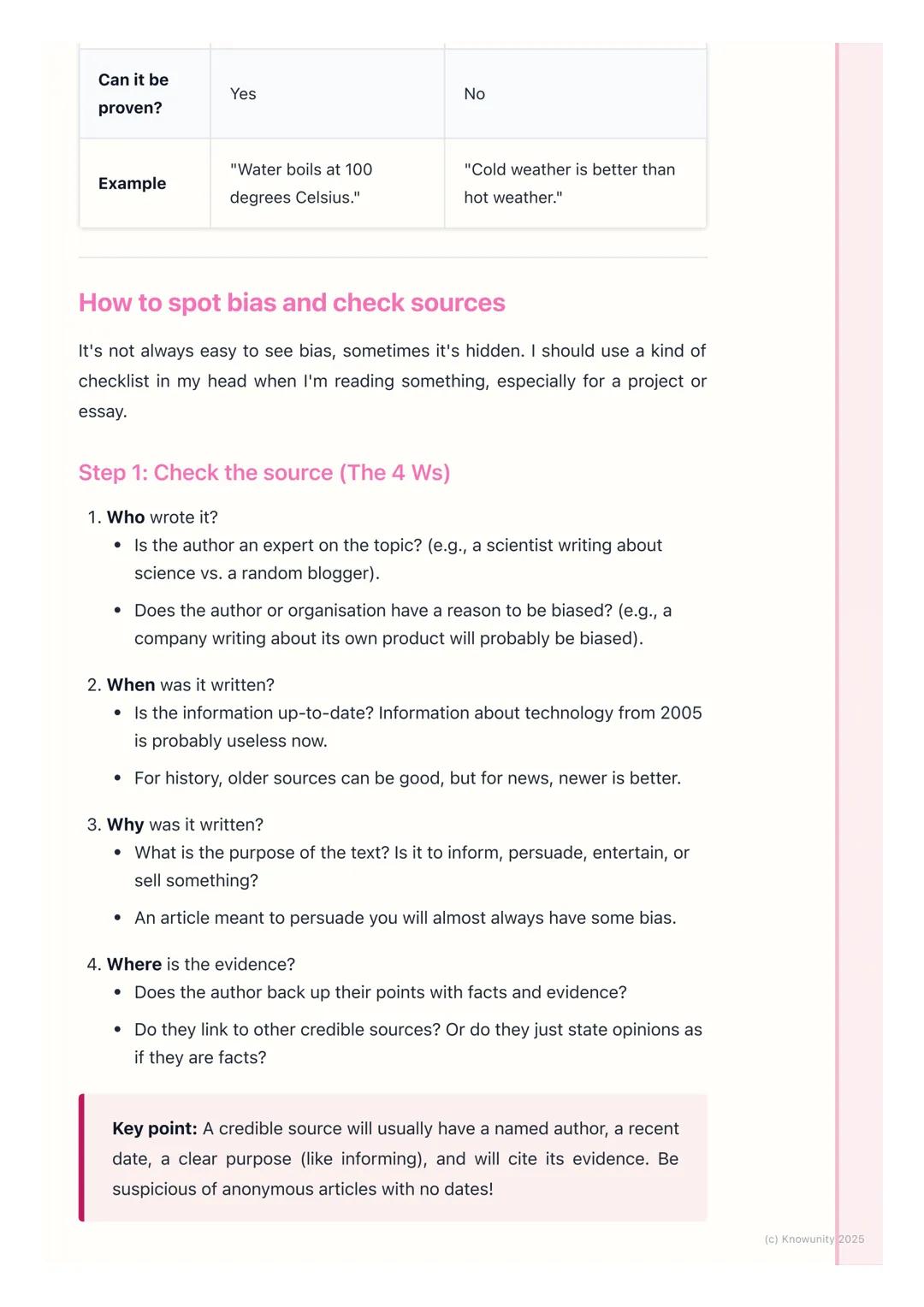
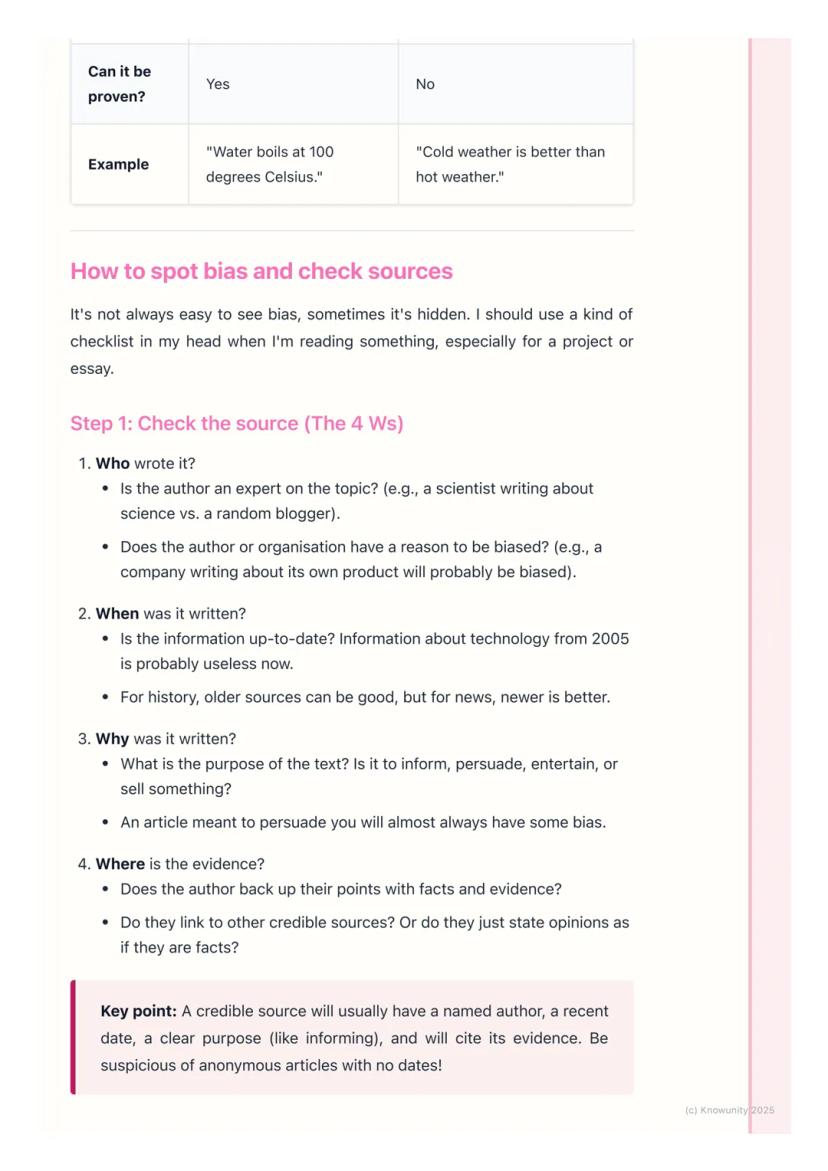
Checking Your Sources (The 4 Ws Method)
Before you believe anything online, run it through this mental checklist. It's like being a detective, but way more useful for your essays!
Who wrote it? Is the author actually an expert, or just someone with strong opinions and a keyboard? A climate scientist writing about global warming carries more weight than a random blogger. Also, does the author have skin in the game - like a company reviewing its own products?
When was it written? Information about smartphones from 2010 is ancient history now. For current events and science, newer is almost always better. Why was it written? Articles meant to sell you something or change your mind will definitely have bias baked in.
Where's the evidence? Credible sources back up their claims with proof and link to other reliable sources. If someone's just stating opinions as facts without evidence, that's a massive red flag.
Pro Tip: Anonymous articles with no dates are basically the equivalent of "my friend's cousin said" - treat them with serious suspicion!
3
of 5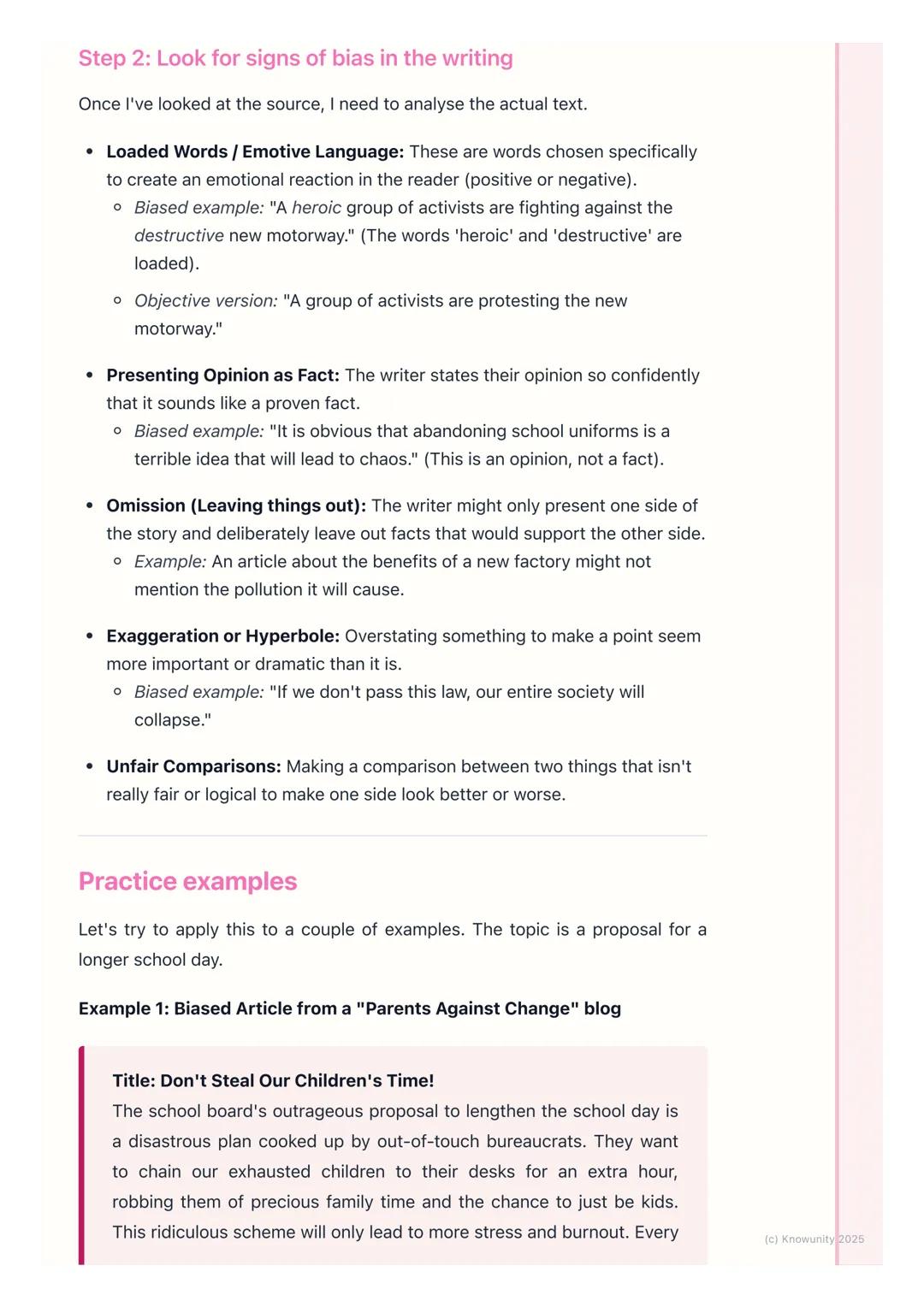
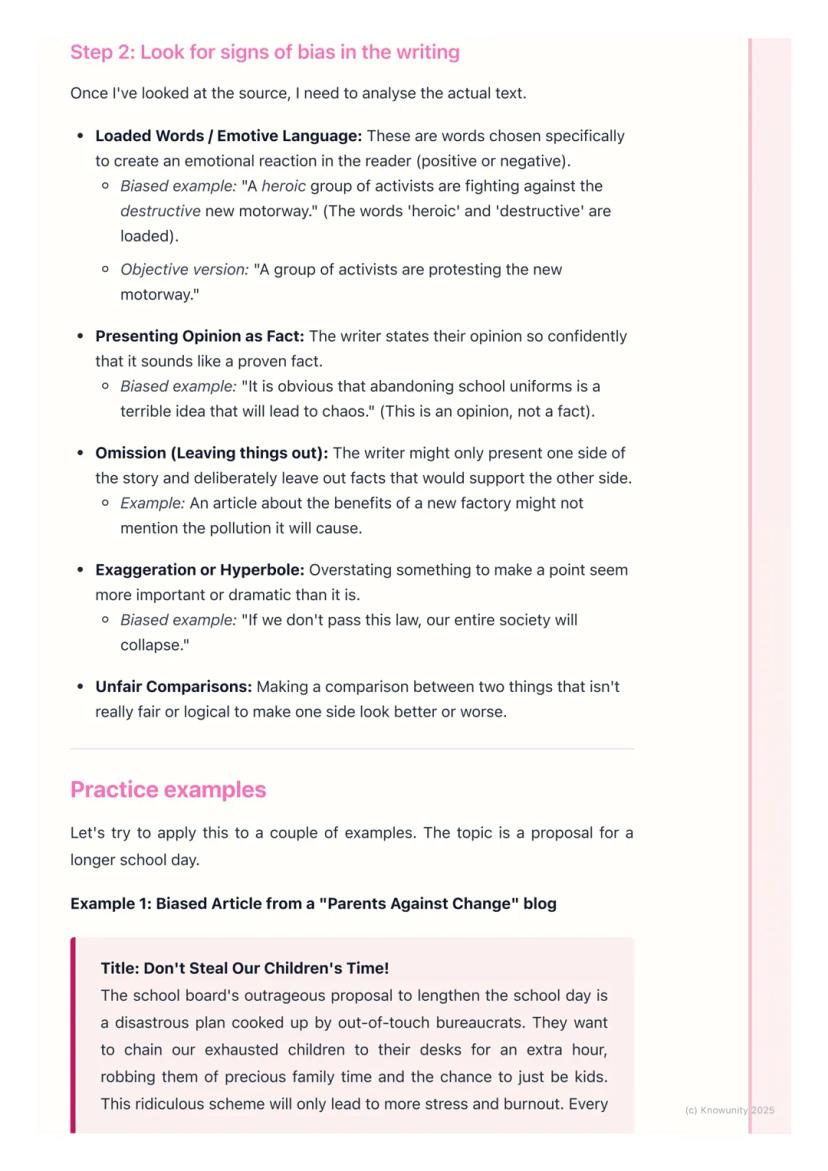
Spotting Bias in Writing
Now for the fun part - becoming a bias-spotting ninja! Writers have sneaky ways of pushing their agenda, but once you know what to look for, it's pretty obvious.
Loaded words are the biggest giveaway. Instead of saying "protesters," a biased writer might say "heroic freedom fighters" or "dangerous troublemakers." Same people, completely different emotional impact. Objective writing keeps the drama to a minimum.
Watch out for opinions disguised as facts. "It's obvious that school uniforms are terrible" sounds confident, but it's still just one person's opinion. Omission is another trick - only telling you the good bits about their favourite side while conveniently forgetting the downsides.
Exaggeration is everywhere online. "If we don't pass this law, society will collapse!" Really? The whole of society? Writers also love making unfair comparisons to make their point seem stronger than it actually is.
Reality Check: Biased writing often sounds very dramatic and emotional, while objective writing feels more balanced and calm.
4
of 5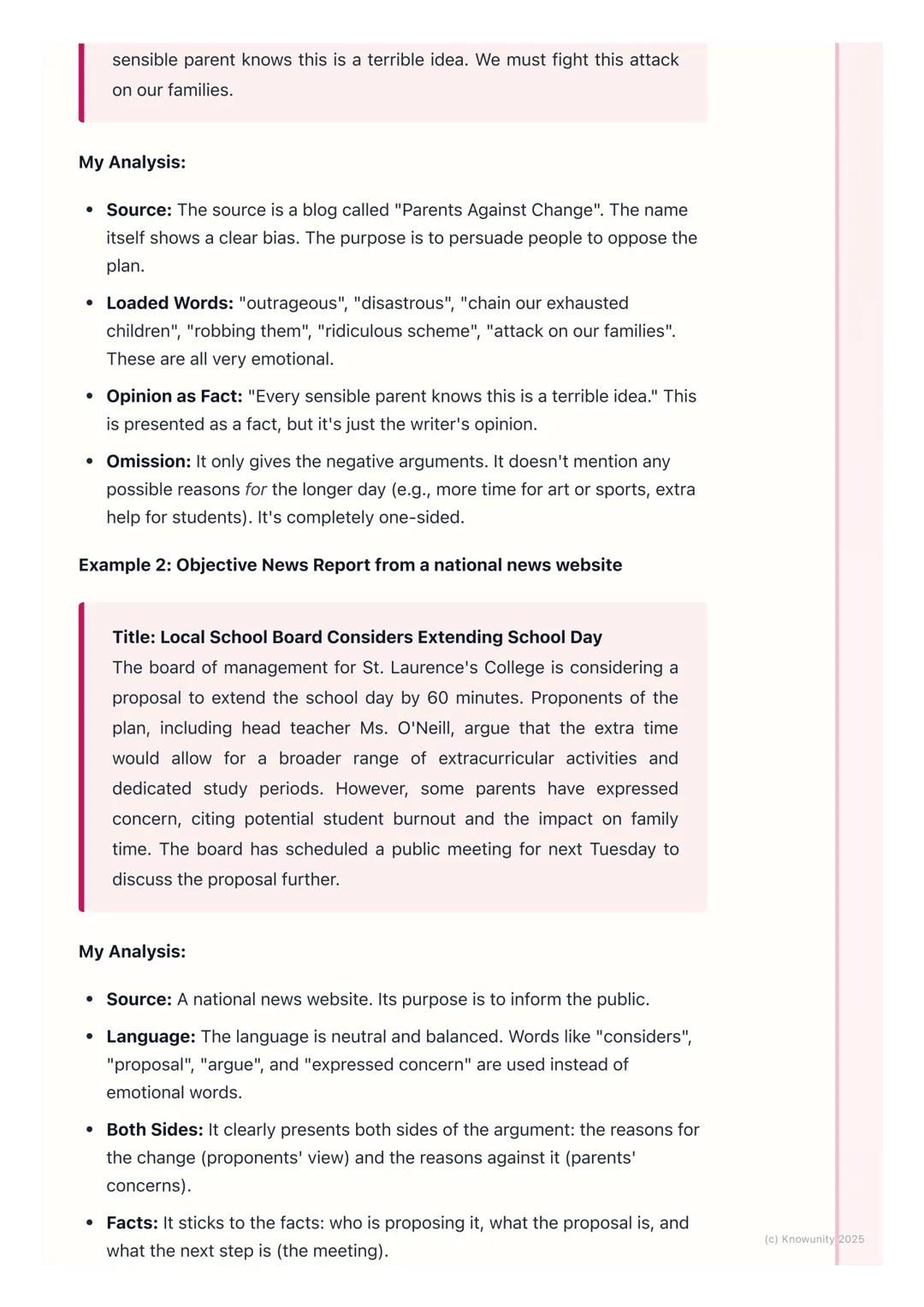
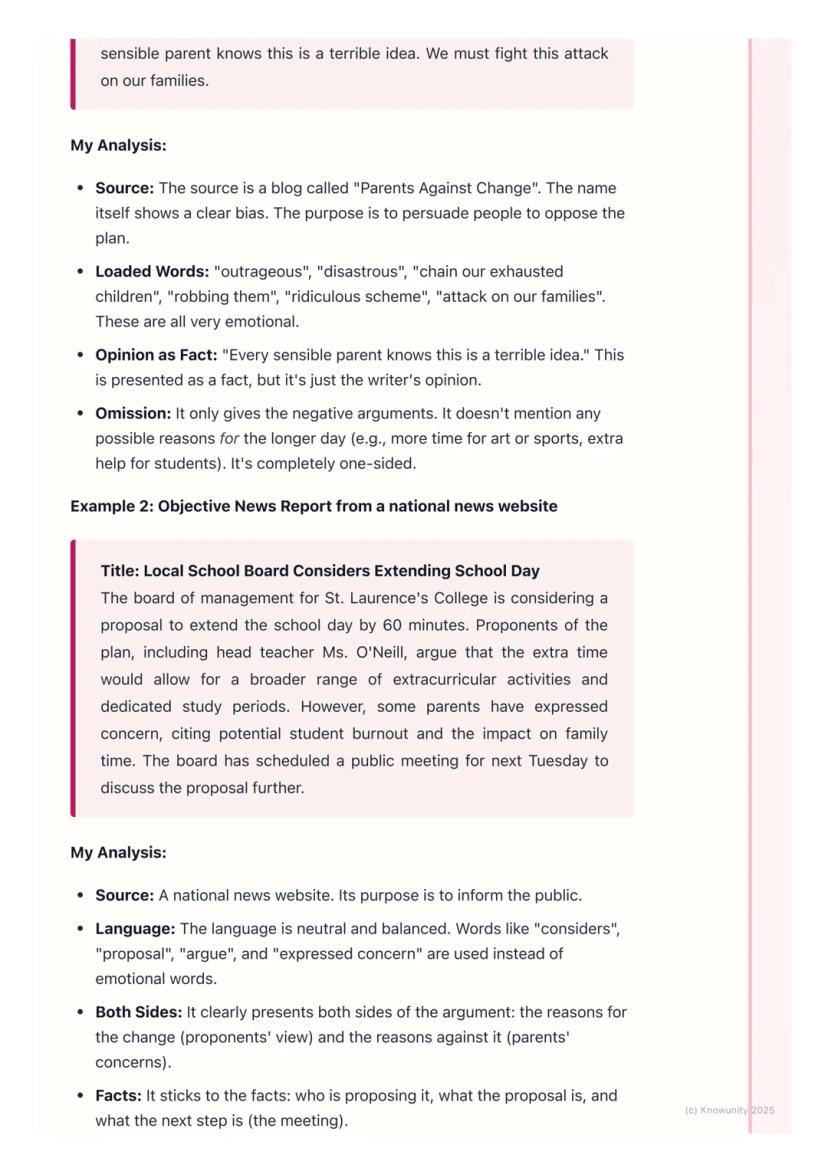
Real Examples in Action
Let's put this into practice with something you'll recognise - arguments about longer school days. You'll see the difference between biased and objective writing immediately.
The biased example screams emotion from the title: "Don't Steal Our Children's Time!" It's packed with loaded words like "outrageous," "chain our exhausted children," and "attack on our families." Pure drama designed to get parents fired up.
It presents opinions as facts ("Every sensible parent knows...") and completely ignores any possible benefits of longer school days. This is omission in full swing - they're only showing you half the story.
Compare that to the objective news report: neutral language, both sides presented fairly, and actual facts about what's happening next. No drama, no manipulation - just information you can use to form your own opinion.
The key difference? One wants to convince you, the other wants to inform you. Once you spot this difference, you'll never unsee it.
Game Changer: Biased sources sound like they're trying to win an argument, while objective sources sound like they're sharing information.
5
of 5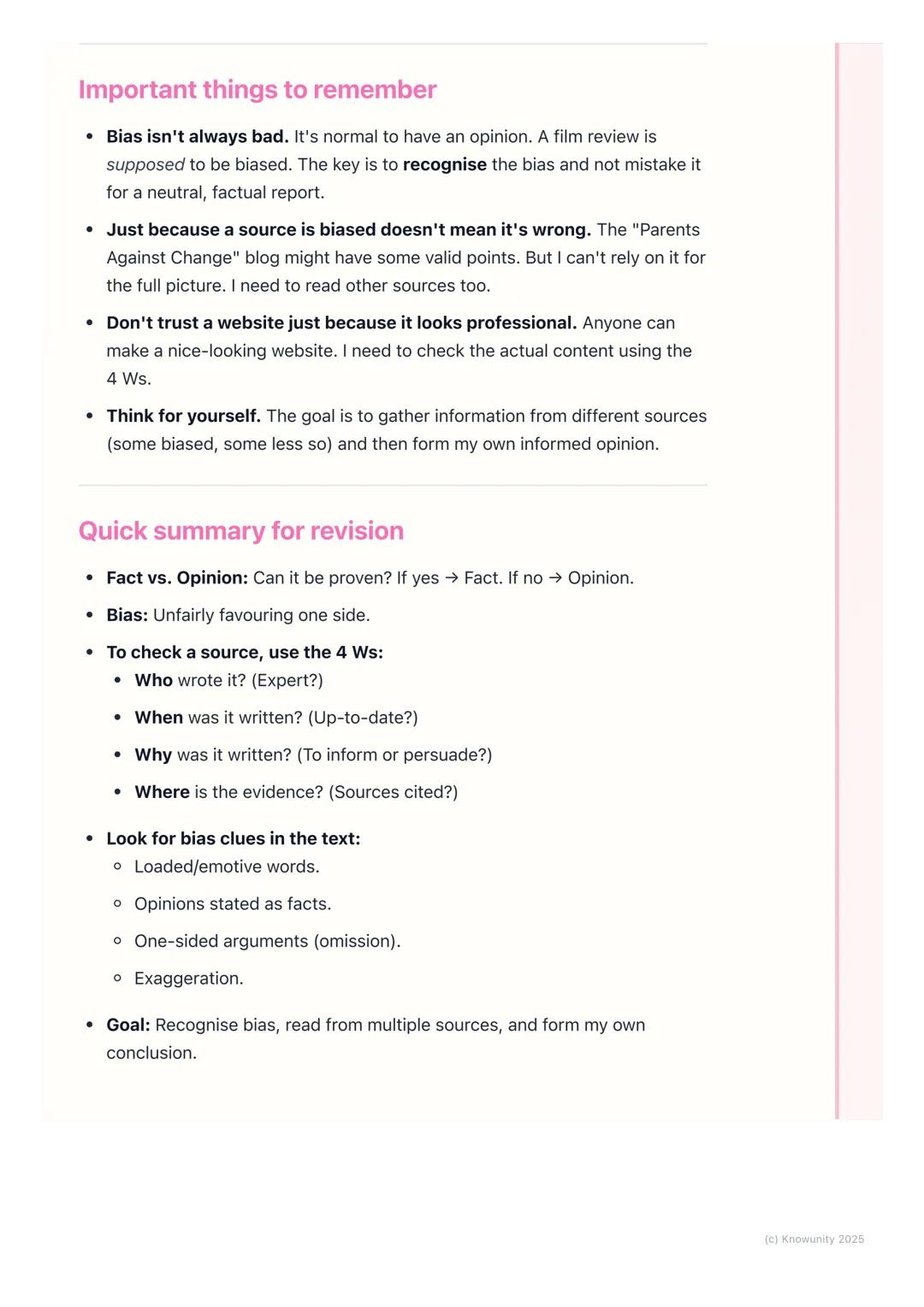
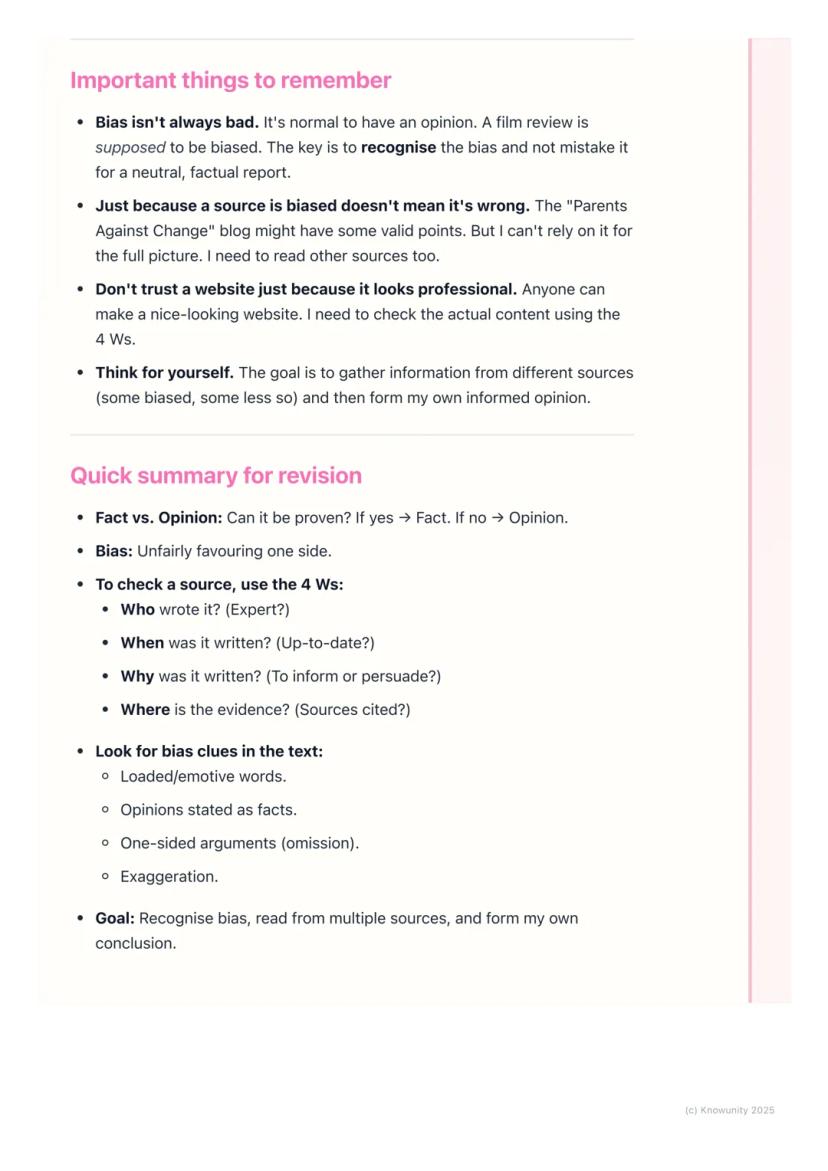
Putting It All Together
Here's the thing - bias isn't automatically evil. Film reviews are supposed to be biased (that's literally the point!), and opinion pieces can make valid arguments. The problem comes when you mistake biased content for neutral, factual reporting.
Even biased sources can have useful information, but you can't rely on just one perspective. Think of it like getting relationship advice - you wouldn't just ask the person's best mate, would you? You'd get multiple viewpoints before forming your own opinion.
Don't be fooled by professional-looking websites either. Anyone can make a site that looks legit these days. Always use your 4 Ws checklist and look for those bias warning signs in the actual content.
Your goal isn't to avoid all bias (that's impossible), but to recognise it, read multiple sources, and then make up your own mind. That's what critical thinking actually means - and it's exactly what your teachers want to see in your essays.
Bottom Line: Collect information from different sources, spot the bias, and then form your own informed opinion. That's how you level up your thinking game.
Hiç sormayacaksın sanmıştık...
Knowunity yapay zeka arkadaşı nedir?
Yapay zeka arkadaşımız öğrencilerin ihtiyaçlarına göre özel olarak tasarlanmıştır. Platformda bulunan milyonlarca içeriğe dayanarak öğrencilere gerçekten anlamlı ve ilgili yanıtlar verebiliyoruz. Ancak mesele sadece cevaplar değil, refakatçi aynı zamanda kişiselleştirilmiş öğrenme planları, sınavlar veya sohbet içerikleri ve öğrencilerin becerilerine ve gelişimlerine dayalı %100 kişiselleştirme ile öğrencilere günlük öğrenme zorluklarında rehberlik ediyor.
Knowunity uygulamasını nereden indirebilirim?
Uygulamayı Google Play Store ve Apple App Store'dan indirebilirsiniz.
Knowunity ücretsiz mi?
Knowunity uygulaması ücretsiz! Uygulamamız çok yakında indirmeye hazır olacak, bekle bizi. 💙
English dersinin en popüler içerikleri
9EnglishKey Quotes : Sive
Key Quotes and explanations: Sive
6th Year2842
EnglishCultural Context : Shawshank Redemption : Sive : Small Things Like These
Comparative Study : Cultural Context : Shawshank Redemption, Sive and Small Things Like These
6th Year1430
EnglishElizabeth Bishop notes
Elizabeth Bishop notes
6th Year1271
EnglishPoetry
Paula Meehan - the statue of the virgin at granard speaks, the exact moment i became a poet, prayer for the children of longing, the pattern notes. Seamus Heaney, the forge notes.
6th Year300
EnglishKey Moments of Macbeth
This is a one page summary for key moments of Macbeth including quotes and act numbers
6th Year320
EnglishMud term break
Jc poem english
1st Year141
EnglishBanquo Study Notes
Macbeth
6th Year280
EnglishNotes on Macbeth, poetry and comparative
Notes on Macbeth, dive and comparative
5th Year291
EnglishThe fish-Elizabeth bishop
Overview of Elizabeth bishops poem the fish written in 1940 ,include a summary,tone and mood,key quotes,imagery examples and theme examples
6th Year370
En popüler içerikler
9 Irish
IrishIrish oral questions and answers
Questions and answers for the leaving cert oral
5th Year4264
EnglishKey Quotes : Sive
Key Quotes and explanations: Sive
6th Year2842
IrishIrish oral questions
Outline of oral questions
5th Year2055
IrishIníon- le hÁine Durkin
Aine Durkin’s poem, Iníon: Themes & summary
5th Year850
IrishIrish poetry 2027
Iníon + Dínit an Bhróin
5th Year1133
IrishLC HL notes- Iníon (poem)
Includes poem in English and Irish, theme, key words & phrases
5th Year2284
EnglishCultural Context : Shawshank Redemption : Sive : Small Things Like These
Comparative Study : Cultural Context : Shawshank Redemption, Sive and Small Things Like These
6th Year1430
IrishMo Ghrá-sa (Idir Lúibíní)
Notes on mo ghrá-sa
5th Year380
IrishAn Gaeilge Aiste
Irish Language essay
6th Year1320
Aradığını bulamıyor musun? Diğer derslere göz at.
Kullanıcılarımızdan yorumlar. Onlar her şeyi çok beğendi — sen de beğeneceksin.
4.6/5App Store
4.7/5Google Play
Uygulama çok kolay kullanılıyor ve güzel tasarlanmış. Şu ana kadar aradığım her şeyi buldum ve sunumlardan çok şey öğrendim! Kesinlikle ödevlerim için hep kullanacağım!
A.S.iOS kullanıcısı
Uygulama çok iyi. Çok fazla ders notu ve yardımlaşma var. Örneğin benim problem yaşadığım bir ders Geometriydi ve ANINDA yardım ettiler beraber hem sorularımı çözdük hem konu anlatımı buldum. Herkese tavsiye ederim.
S.L.Android kullanıcısı
BEN ŞOK. Reklamını sık sık gördüğüm için uygulamayı denedim ve gerçekten hayran kaldım. Bu uygulama okul için tam ihtiyacım olan şey. Anında ödev yardımı, konu anlatımı, örnek sınavlar, flaşkartlar hepsi hepsi var, şiddetle tavsiye ederim ✅
A.iOS kullanıcısı
English64 görüntüleme·Güncellendi Jun 10, 2026·5 sayfaUnderstanding Bias and Evaluating Information
Ever wondered if that viral social media post or news article you're reading is actually true? With information flying at us from all directions online, knowing how to separate facts from opinions and spot biasis basically a superpower for...
1
of 5
Ders notlarını görmek için kaydol. Ücretsiz!
- Tüm belgeleri görebilirsin
- Notlarını Yükselt
- Milyonlarca öğrenciye katıl
Understanding the Basics
Think of this as your BS detector training! When you're scrolling through social media or researching for an essay, you're not just reading - you're investigating. This skill will save you from embarrassing moments in class and help you write much better arguments.
Facts are statements you can actually prove with evidence - like "Dublin is Ireland's capital." Opinions are personal beliefs or feelings that can't be proven right or wrong - like "Dublin is Ireland's best city." It's that simple, really.
Bias happens when someone unfairly favours one side over another. Imagine a referee who secretly supports one football team - that's bias in action. Meanwhile, credibility is just how trustworthy your source is. You wouldn't ask your mate who failed science to explain photosynthesis, would you?
Quick Check: If you can prove it with evidence, it's a fact. If it's based on feelings or beliefs, it's an opinion.
2
of 5Ders notlarını görmek için kaydol. Ücretsiz!
- Tüm belgeleri görebilirsin
- Notlarını Yükselt
- Milyonlarca öğrenciye katıl
Checking Your Sources (The 4 Ws Method)
Before you believe anything online, run it through this mental checklist. It's like being a detective, but way more useful for your essays!
Who wrote it? Is the author actually an expert, or just someone with strong opinions and a keyboard? A climate scientist writing about global warming carries more weight than a random blogger. Also, does the author have skin in the game - like a company reviewing its own products?
When was it written? Information about smartphones from 2010 is ancient history now. For current events and science, newer is almost always better. Why was it written? Articles meant to sell you something or change your mind will definitely have bias baked in.
Where's the evidence? Credible sources back up their claims with proof and link to other reliable sources. If someone's just stating opinions as facts without evidence, that's a massive red flag.
Pro Tip: Anonymous articles with no dates are basically the equivalent of "my friend's cousin said" - treat them with serious suspicion!
3
of 5Ders notlarını görmek için kaydol. Ücretsiz!
- Tüm belgeleri görebilirsin
- Notlarını Yükselt
- Milyonlarca öğrenciye katıl
Spotting Bias in Writing
Now for the fun part - becoming a bias-spotting ninja! Writers have sneaky ways of pushing their agenda, but once you know what to look for, it's pretty obvious.
Loaded words are the biggest giveaway. Instead of saying "protesters," a biased writer might say "heroic freedom fighters" or "dangerous troublemakers." Same people, completely different emotional impact. Objective writing keeps the drama to a minimum.
Watch out for opinions disguised as facts. "It's obvious that school uniforms are terrible" sounds confident, but it's still just one person's opinion. Omission is another trick - only telling you the good bits about their favourite side while conveniently forgetting the downsides.
Exaggeration is everywhere online. "If we don't pass this law, society will collapse!" Really? The whole of society? Writers also love making unfair comparisons to make their point seem stronger than it actually is.
Reality Check: Biased writing often sounds very dramatic and emotional, while objective writing feels more balanced and calm.
4
of 5Ders notlarını görmek için kaydol. Ücretsiz!
- Tüm belgeleri görebilirsin
- Notlarını Yükselt
- Milyonlarca öğrenciye katıl
Real Examples in Action
Let's put this into practice with something you'll recognise - arguments about longer school days. You'll see the difference between biased and objective writing immediately.
The biased example screams emotion from the title: "Don't Steal Our Children's Time!" It's packed with loaded words like "outrageous," "chain our exhausted children," and "attack on our families." Pure drama designed to get parents fired up.
It presents opinions as facts ("Every sensible parent knows...") and completely ignores any possible benefits of longer school days. This is omission in full swing - they're only showing you half the story.
Compare that to the objective news report: neutral language, both sides presented fairly, and actual facts about what's happening next. No drama, no manipulation - just information you can use to form your own opinion.
The key difference? One wants to convince you, the other wants to inform you. Once you spot this difference, you'll never unsee it.
Game Changer: Biased sources sound like they're trying to win an argument, while objective sources sound like they're sharing information.
5
of 5Ders notlarını görmek için kaydol. Ücretsiz!
- Tüm belgeleri görebilirsin
- Notlarını Yükselt
- Milyonlarca öğrenciye katıl
Putting It All Together
Here's the thing - bias isn't automatically evil. Film reviews are supposed to be biased (that's literally the point!), and opinion pieces can make valid arguments. The problem comes when you mistake biased content for neutral, factual reporting.
Even biased sources can have useful information, but you can't rely on just one perspective. Think of it like getting relationship advice - you wouldn't just ask the person's best mate, would you? You'd get multiple viewpoints before forming your own opinion.
Don't be fooled by professional-looking websites either. Anyone can make a site that looks legit these days. Always use your 4 Ws checklist and look for those bias warning signs in the actual content.
Your goal isn't to avoid all bias (that's impossible), but to recognise it, read multiple sources, and then make up your own mind. That's what critical thinking actually means - and it's exactly what your teachers want to see in your essays.
Bottom Line: Collect information from different sources, spot the bias, and then form your own informed opinion. That's how you level up your thinking game.
Hiç sormayacaksın sanmıştık...
Knowunity yapay zeka arkadaşı nedir?
Yapay zeka arkadaşımız öğrencilerin ihtiyaçlarına göre özel olarak tasarlanmıştır. Platformda bulunan milyonlarca içeriğe dayanarak öğrencilere gerçekten anlamlı ve ilgili yanıtlar verebiliyoruz. Ancak mesele sadece cevaplar değil, refakatçi aynı zamanda kişiselleştirilmiş öğrenme planları, sınavlar veya sohbet içerikleri ve öğrencilerin becerilerine ve gelişimlerine dayalı %100 kişiselleştirme ile öğrencilere günlük öğrenme zorluklarında rehberlik ediyor.
Knowunity uygulamasını nereden indirebilirim?
Uygulamayı Google Play Store ve Apple App Store'dan indirebilirsiniz.
Knowunity ücretsiz mi?
Knowunity uygulaması ücretsiz! Uygulamamız çok yakında indirmeye hazır olacak, bekle bizi. 💙
English dersinin en popüler içerikleri
9EnglishKey Quotes : Sive
Key Quotes and explanations: Sive
6th Year2842
EnglishCultural Context : Shawshank Redemption : Sive : Small Things Like These
Comparative Study : Cultural Context : Shawshank Redemption, Sive and Small Things Like These
6th Year1430
EnglishElizabeth Bishop notes
Elizabeth Bishop notes
6th Year1271
EnglishPoetry
Paula Meehan - the statue of the virgin at granard speaks, the exact moment i became a poet, prayer for the children of longing, the pattern notes. Seamus Heaney, the forge notes.
6th Year300
EnglishKey Moments of Macbeth
This is a one page summary for key moments of Macbeth including quotes and act numbers
6th Year320
EnglishMud term break
Jc poem english
1st Year141
EnglishBanquo Study Notes
Macbeth
6th Year280
EnglishNotes on Macbeth, poetry and comparative
Notes on Macbeth, dive and comparative
5th Year291
EnglishThe fish-Elizabeth bishop
Overview of Elizabeth bishops poem the fish written in 1940 ,include a summary,tone and mood,key quotes,imagery examples and theme examples
6th Year370
En popüler içerikler
9IrishIrish oral questions and answers
Questions and answers for the leaving cert oral
5th Year4264
EnglishKey Quotes : Sive
Key Quotes and explanations: Sive
6th Year2842
IrishIrish oral questions
Outline of oral questions
5th Year2055
IrishIníon- le hÁine Durkin
Aine Durkin’s poem, Iníon: Themes & summary
5th Year850
IrishIrish poetry 2027
Iníon + Dínit an Bhróin
5th Year1133
IrishLC HL notes- Iníon (poem)
Includes poem in English and Irish, theme, key words & phrases
5th Year2284
EnglishCultural Context : Shawshank Redemption : Sive : Small Things Like These
Comparative Study : Cultural Context : Shawshank Redemption, Sive and Small Things Like These
6th Year1430
IrishMo Ghrá-sa (Idir Lúibíní)
Notes on mo ghrá-sa
5th Year380
IrishAn Gaeilge Aiste
Irish Language essay
6th Year1320
Aradığını bulamıyor musun? Diğer derslere göz at.
Kullanıcılarımızdan yorumlar. Onlar her şeyi çok beğendi — sen de beğeneceksin.
4.6/5App Store
4.7/5Google Play
Uygulama çok kolay kullanılıyor ve güzel tasarlanmış. Şu ana kadar aradığım her şeyi buldum ve sunumlardan çok şey öğrendim! Kesinlikle ödevlerim için hep kullanacağım!
A.S.iOS kullanıcısı
Uygulama çok iyi. Çok fazla ders notu ve yardımlaşma var. Örneğin benim problem yaşadığım bir ders Geometriydi ve ANINDA yardım ettiler beraber hem sorularımı çözdük hem konu anlatımı buldum. Herkese tavsiye ederim.
S.L.Android kullanıcısı
BEN ŞOK. Reklamını sık sık gördüğüm için uygulamayı denedim ve gerçekten hayran kaldım. Bu uygulama okul için tam ihtiyacım olan şey. Anında ödev yardımı, konu anlatımı, örnek sınavlar, flaşkartlar hepsi hepsi var, şiddetle tavsiye ederim ✅
A.iOS kullanıcısı