
Ever wondered how chemists around the world can understand each...
 Chemistry18 görüntüleme·Güncellendi Jun 13, 2026·7 sayfa
How to Name Alkanes, Alkenes, and Alkynes Using IUPAC Rules
1 / 7
1
of 7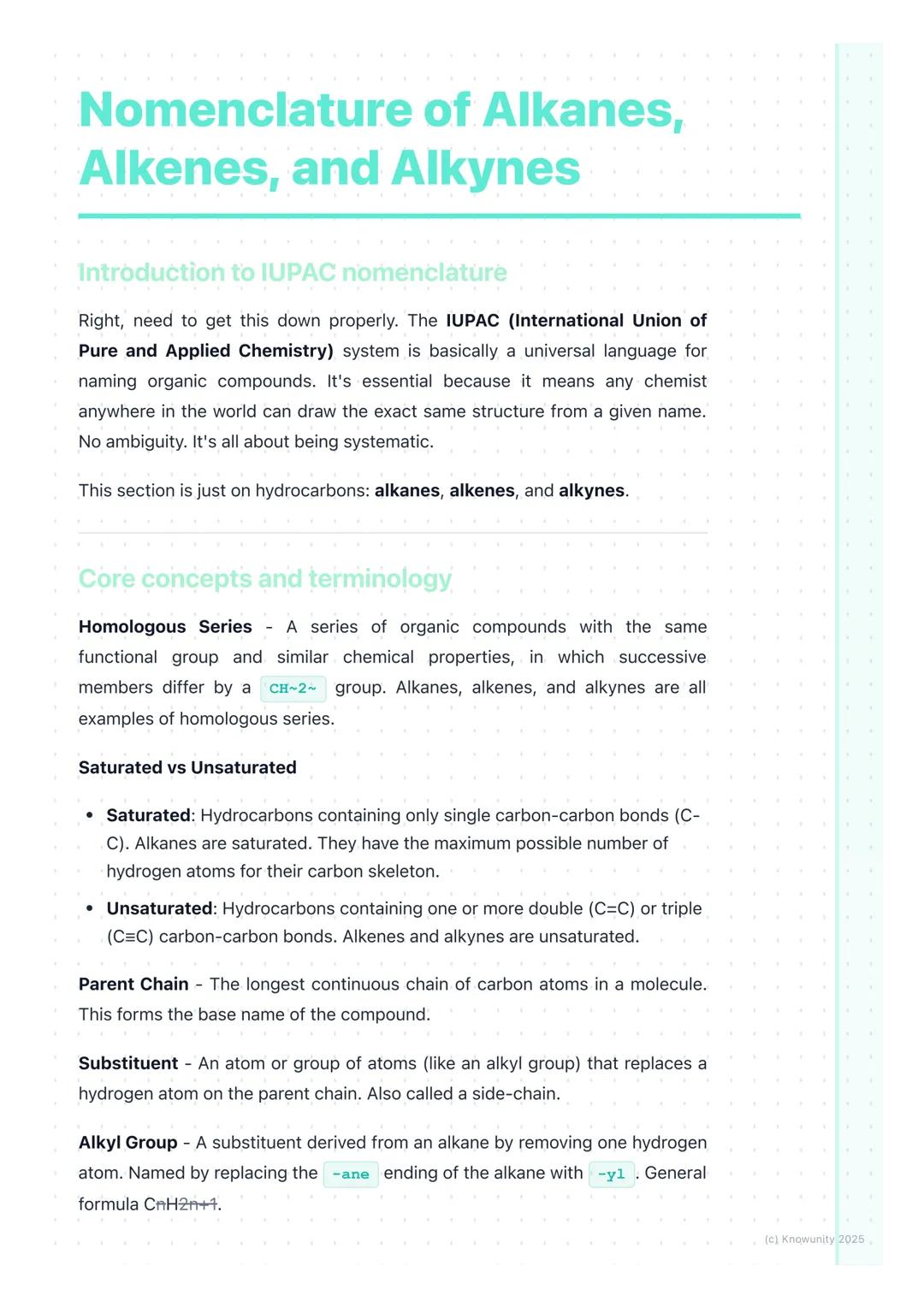
Introduction to IUPAC Nomenclature
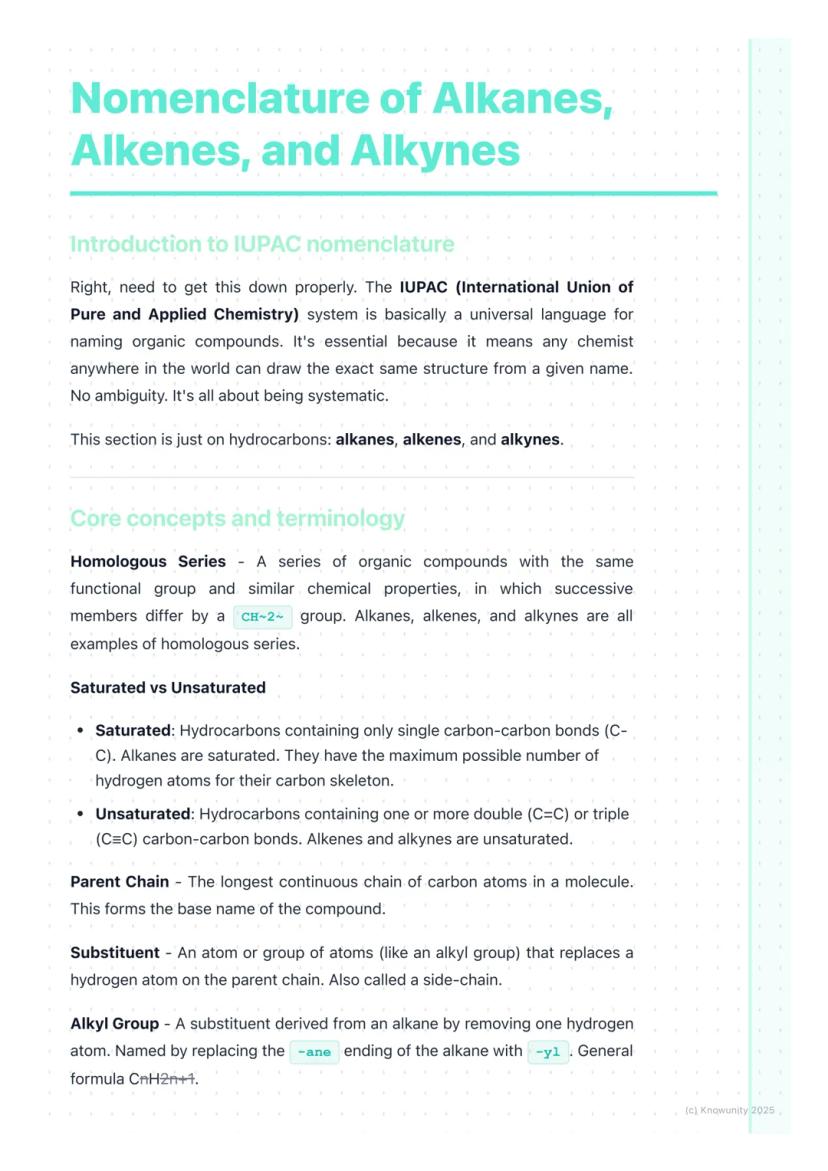
The IUPAC system is your key to unlocking organic chemistry communication. Think of it as Google Translate for molecules - any chemist anywhere can draw the exact same structure from a given name, eliminating confusion completely.
You'll focus on three main homologous series: alkanes, alkenes, and alkynes. Each series has the same functional group and similar properties, with each member differing by just a CH₂ group.
The difference between saturated and unsaturated hydrocarbons is crucial. Alkanes are saturated , whilst alkenes and alkynes are unsaturated (containing double or triple bonds respectively).
💡 Key Insight: The parent chain is always the longest continuous carbon chain - this becomes your base name. Everything else attached are substituents or side-chains.
2
of 7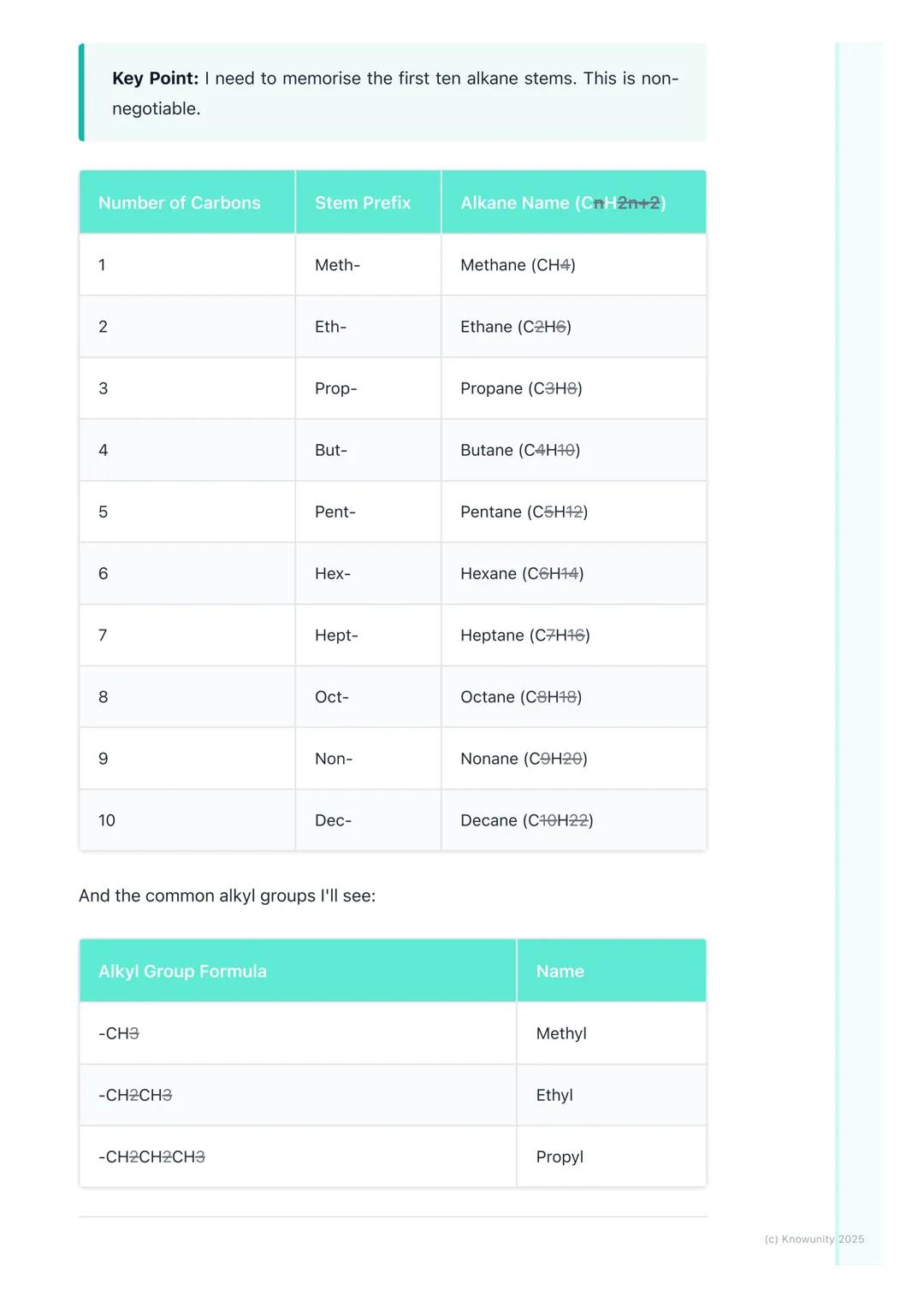
Essential Stems and Alkyl Groups
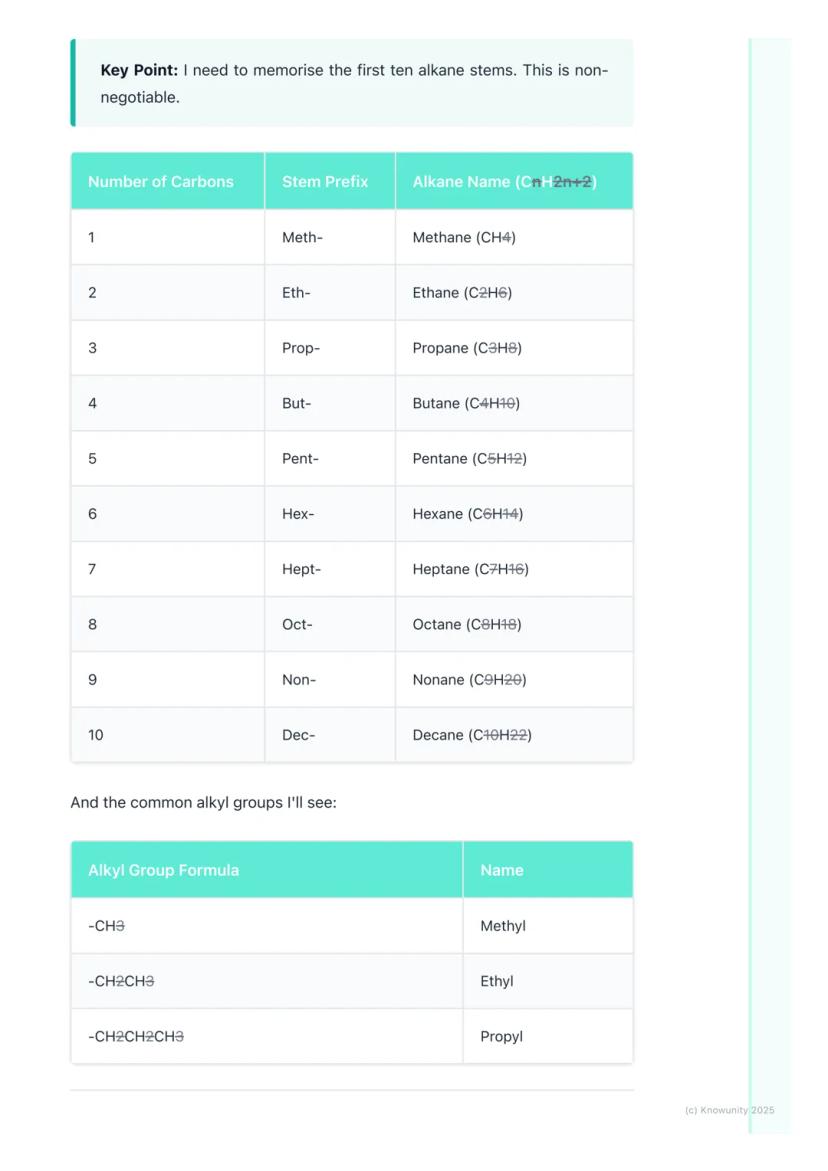
You absolutely must memorise the first ten alkane stems - there's no way around this! From meth- (1 carbon) through to dec- (10 carbons), these form the backbone of all organic naming.
The pattern is straightforward: methane, ethane, propane, butane, pentane, hexane, heptane, octane, nonane, decane. Notice how each follows the general formula CₙH₂ₙ₊₂ for alkanes.
Alkyl groups are equally important - they're basically alkanes with one hydrogen removed. Simply replace the '-ane' ending with '-yl': methyl , ethyl , and propyl are the most common ones you'll encounter.
💡 Study Tip: Make flashcards for these stems - you'll use them constantly throughout organic chemistry!
3
of 7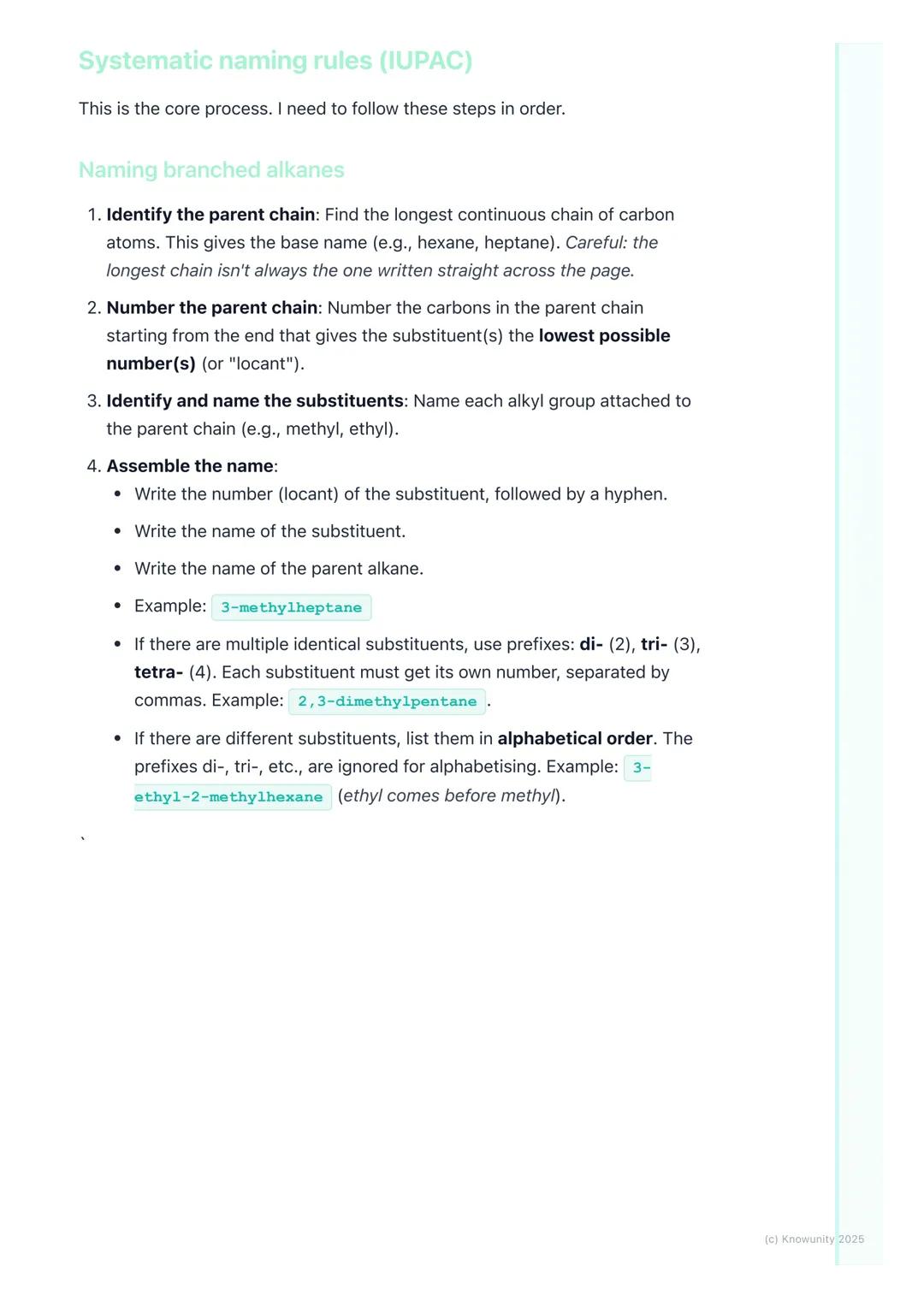
Systematic Naming Rules for Alkanes
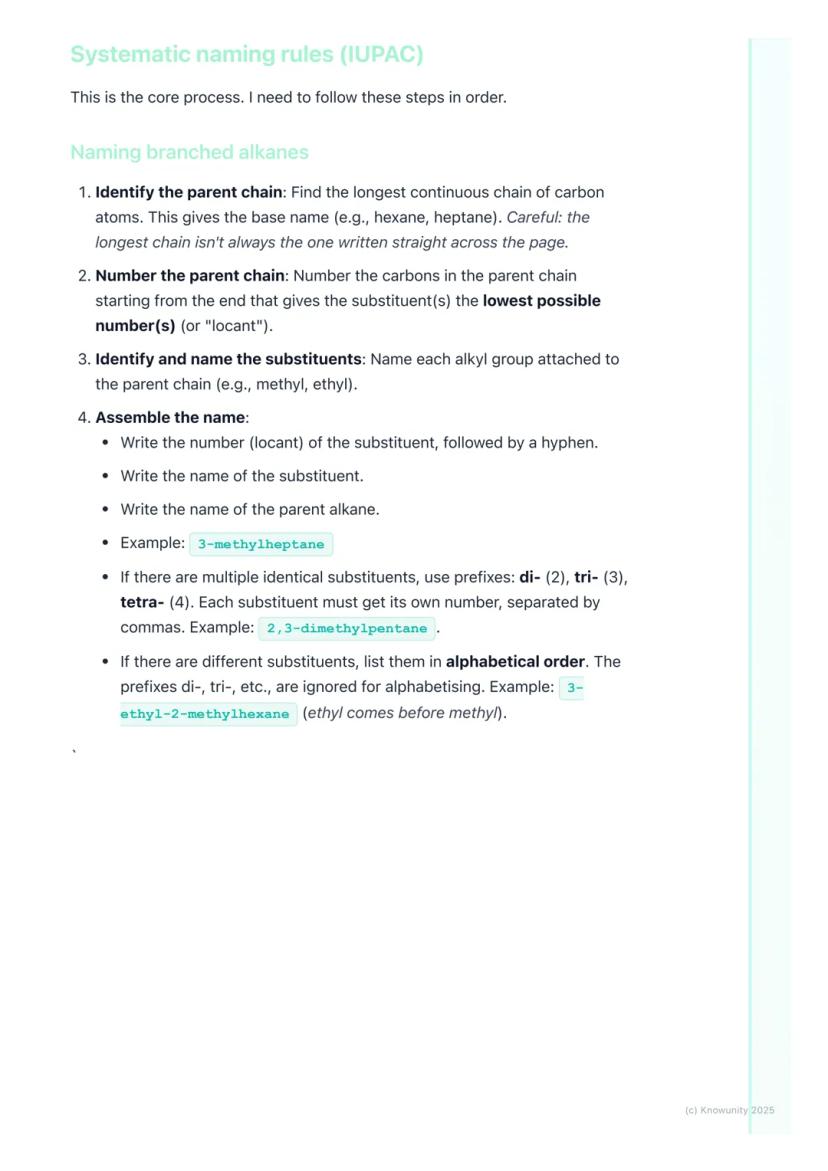
Here's your foolproof four-step process for naming branched alkanes. Follow these steps religiously and you'll nail it every time.
First, identify the parent chain by finding the longest continuous carbon chain - this isn't always the one drawn horizontally! Next, number the carbons starting from whichever end gives your substituents the lowest possible numbers.
Then identify all your substituents (the alkyl groups hanging off the main chain). Finally, assemble everything together: number-substituent-parent name.
For multiple identical substituents, use prefixes like di-, tri-, tetra-. Different substituents go in alphabetical order (ignoring the prefixes when alphabetising). So "3-ethyl-2-methylhexane" puts ethyl before methyl.
💡 Remember: Always aim for the lowest possible set of numbers - compare the full sets, not just individual numbers!
4
of 7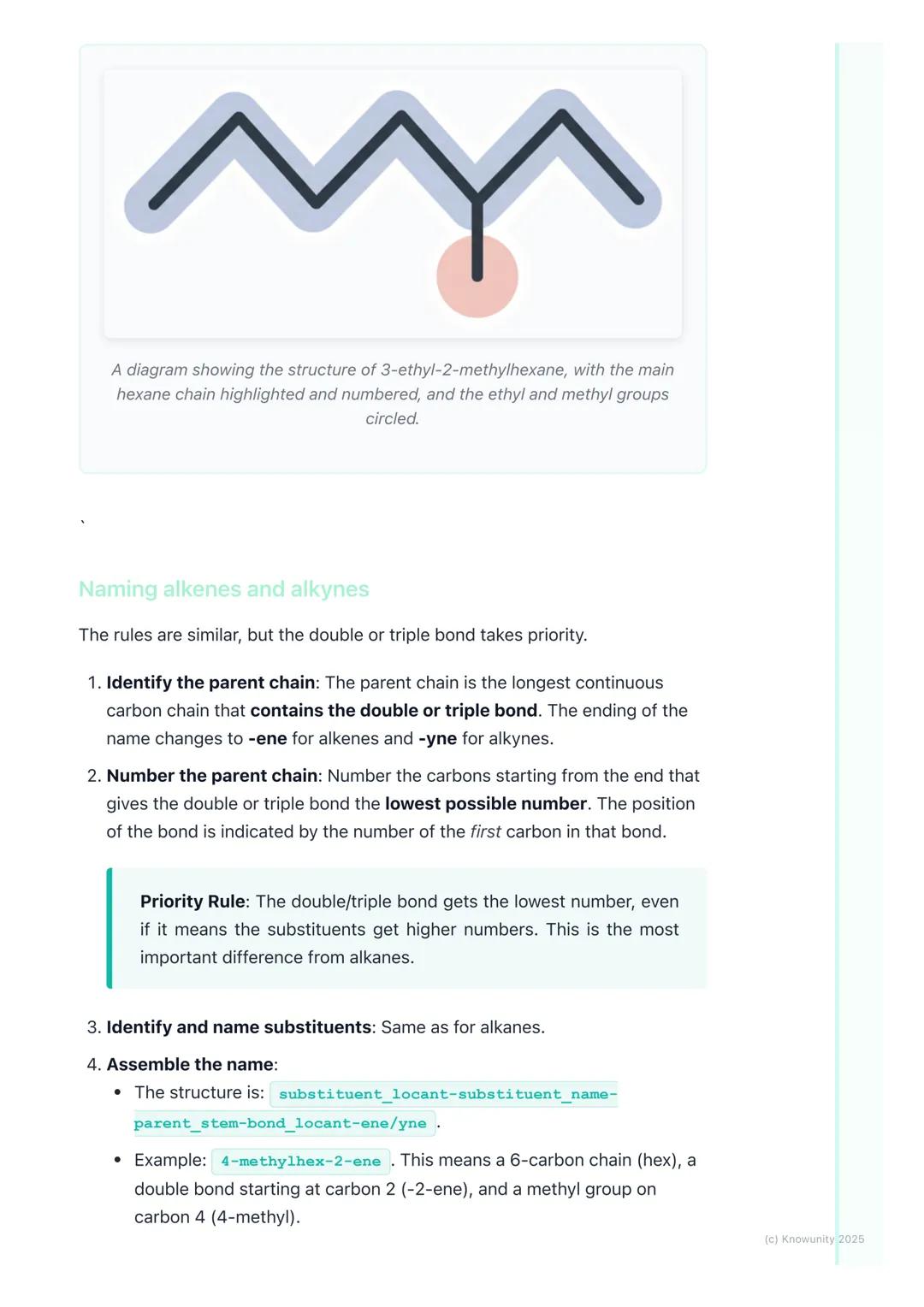
Naming Alkenes and Alkynes
The rules are similar to alkanes, but now the double or triple bond takes priority - this is the game-changer you need to remember.
Your parent chain must be the longest chain containing the multiple bond, ending in '-ene' for alkenes or '-yne' for alkynes. The crucial difference is in numbering: you must give the multiple bond the lowest possible number, even if it means substituents get higher numbers.
The bond position goes right before the ending: "hex-2-ene" means a 6-carbon chain with a double bond starting at carbon 2. Add any substituents with their numbers at the front: "4-methylhex-2-ene".
This priority rule is what trips up many students - the multiple bond always wins when deciding which end to start numbering from.
💡 Priority Order: Multiple bonds always get priority over substituents when numbering your chain!
5
of 7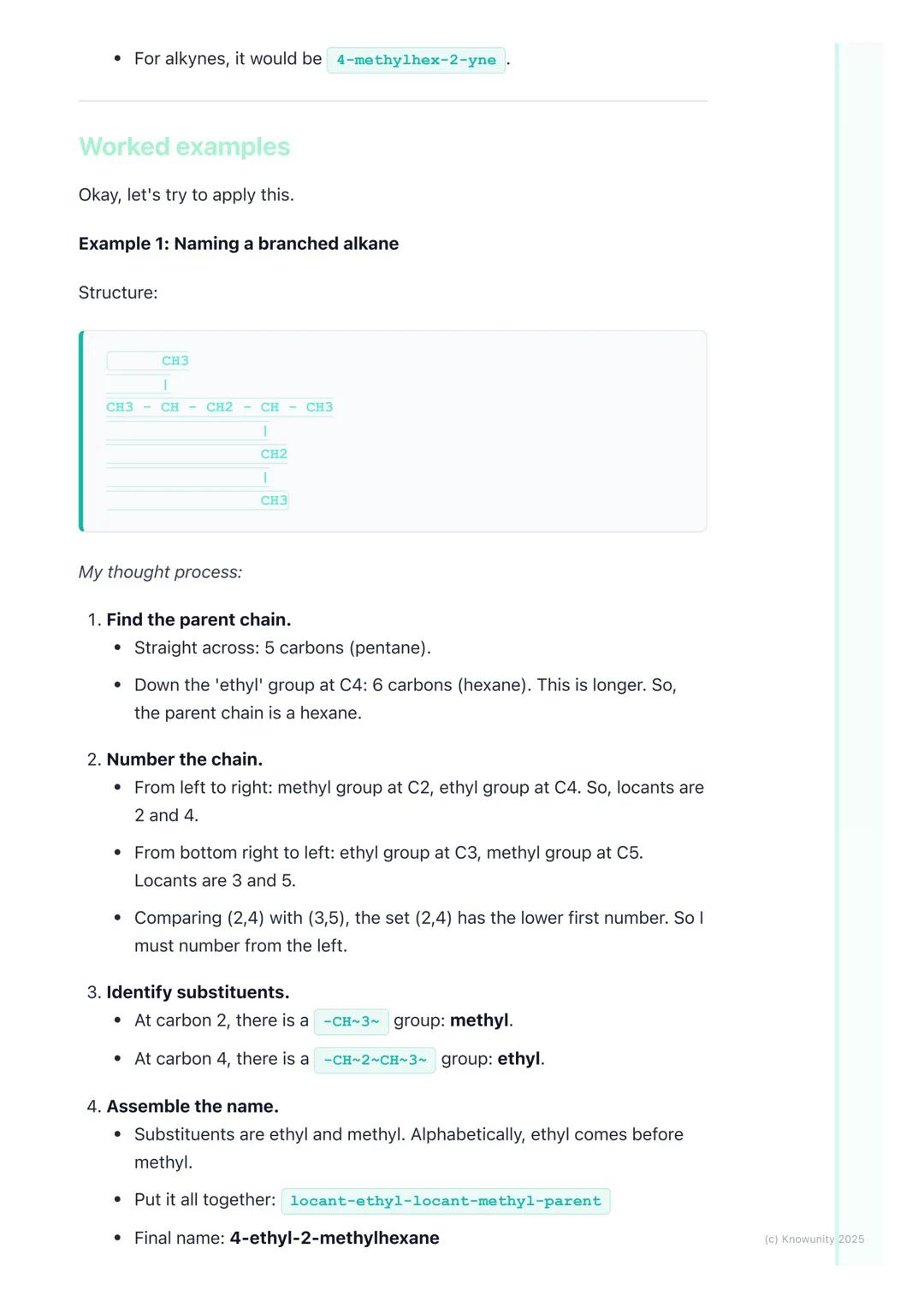
Worked Example: Branched Alkane
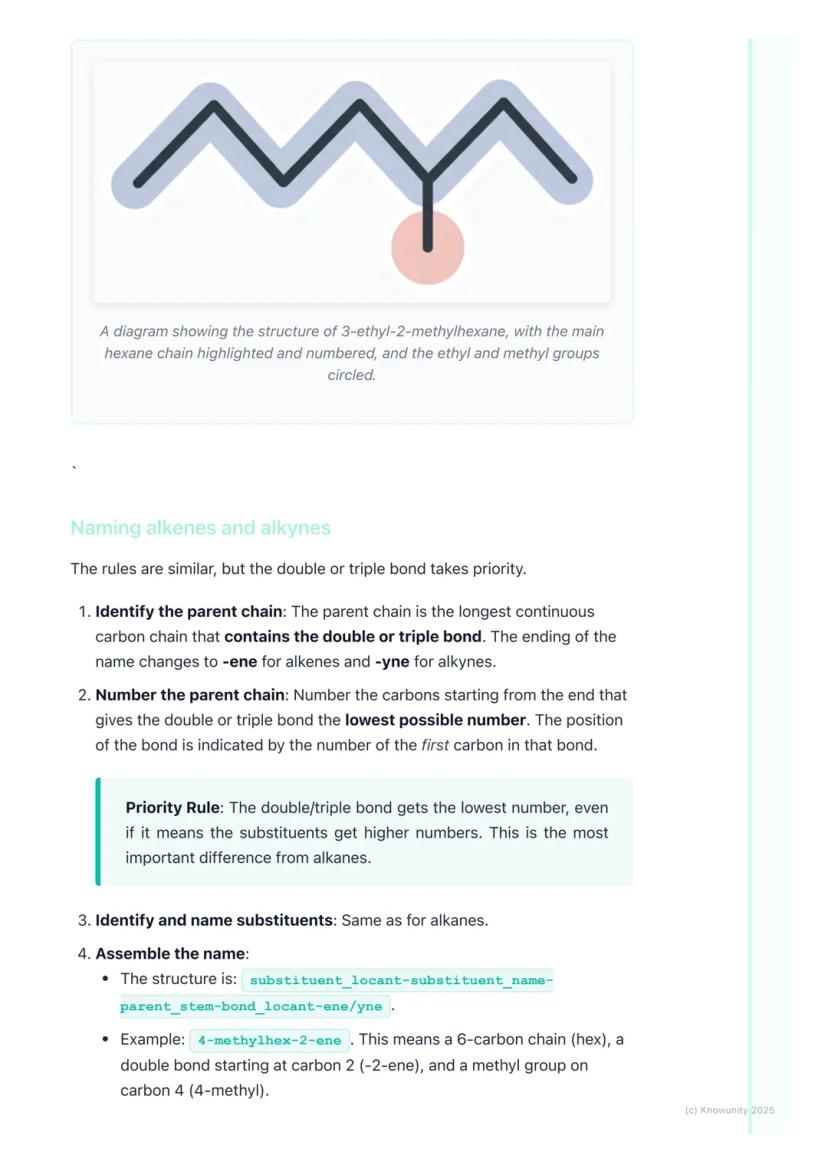
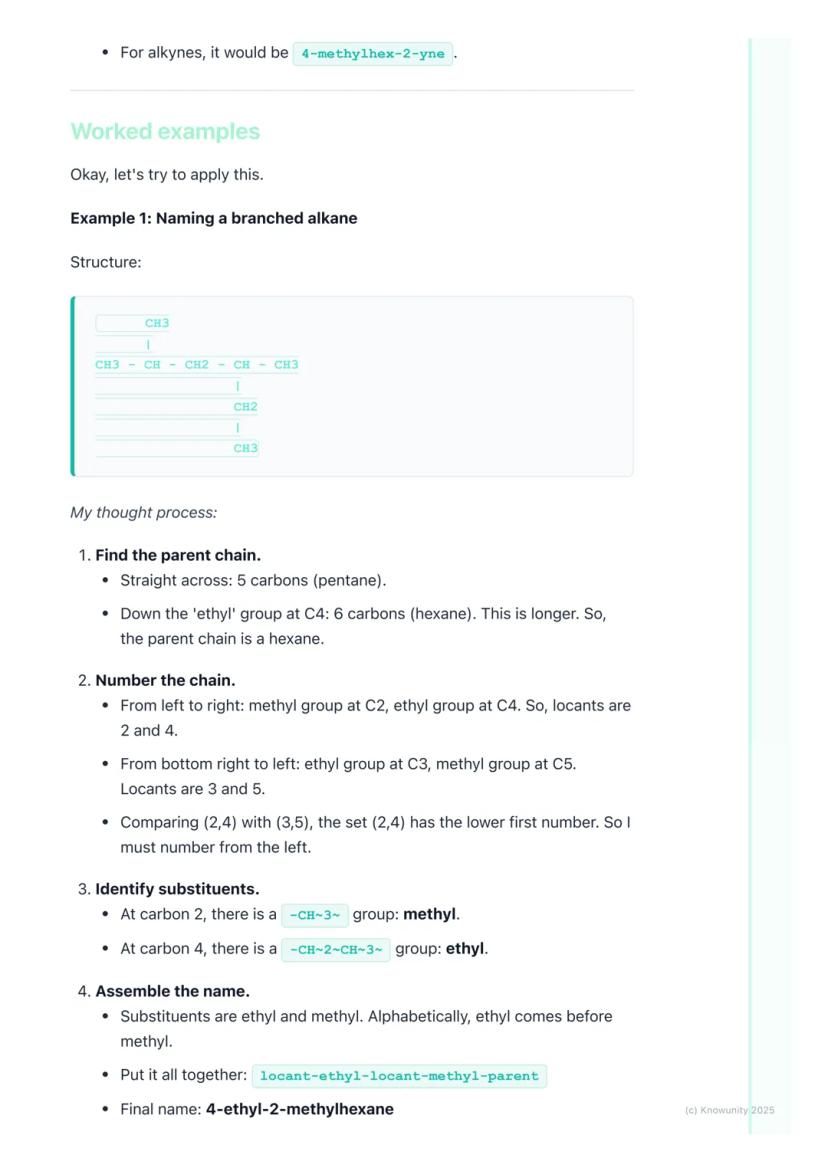
Let's work through a tricky branched alkane to see the method in action. When you see a complex structure, don't panic - just follow your four steps systematically.
First, hunt for the longest chain - don't assume it's the horizontal one! In this example, the longest chain has 6 carbons (hexane), not the obvious 5-carbon chain you might spot first.
Number from the end that gives the lowest set of numbers. Here, numbering left to right gives substituents at positions 2 and 4, whilst right to left gives 3 and 5. Since 2,4 beats 3,5, we number left to right.
The final name becomes 4-ethyl-2-methylhexane - ethyl comes first alphabetically, even though it's at a higher carbon number.
💡 Common Mistake: Always check every possible chain length - the longest one isn't always obvious from the way it's drawn!
6
of 7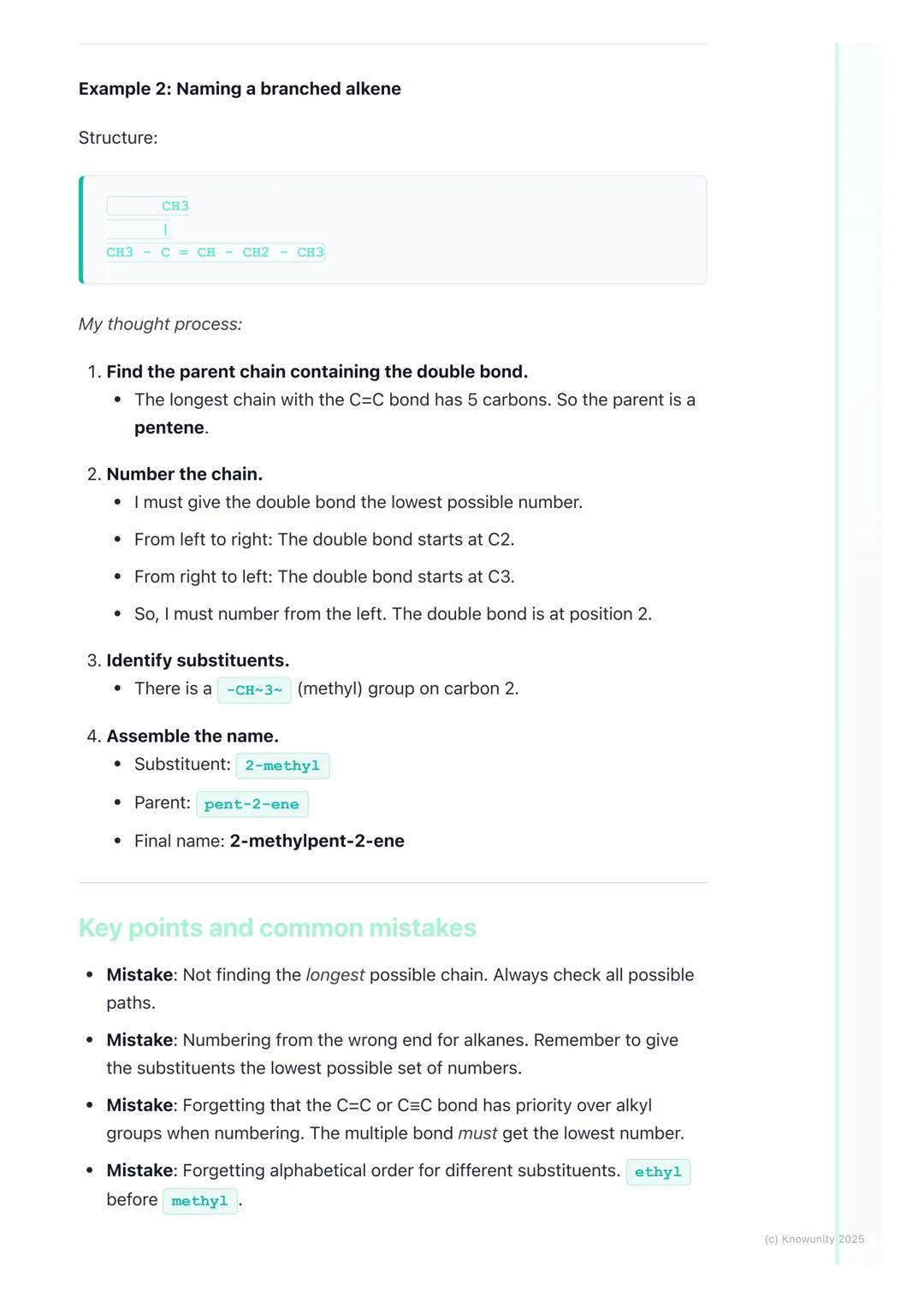
Worked Example: Alkene Naming
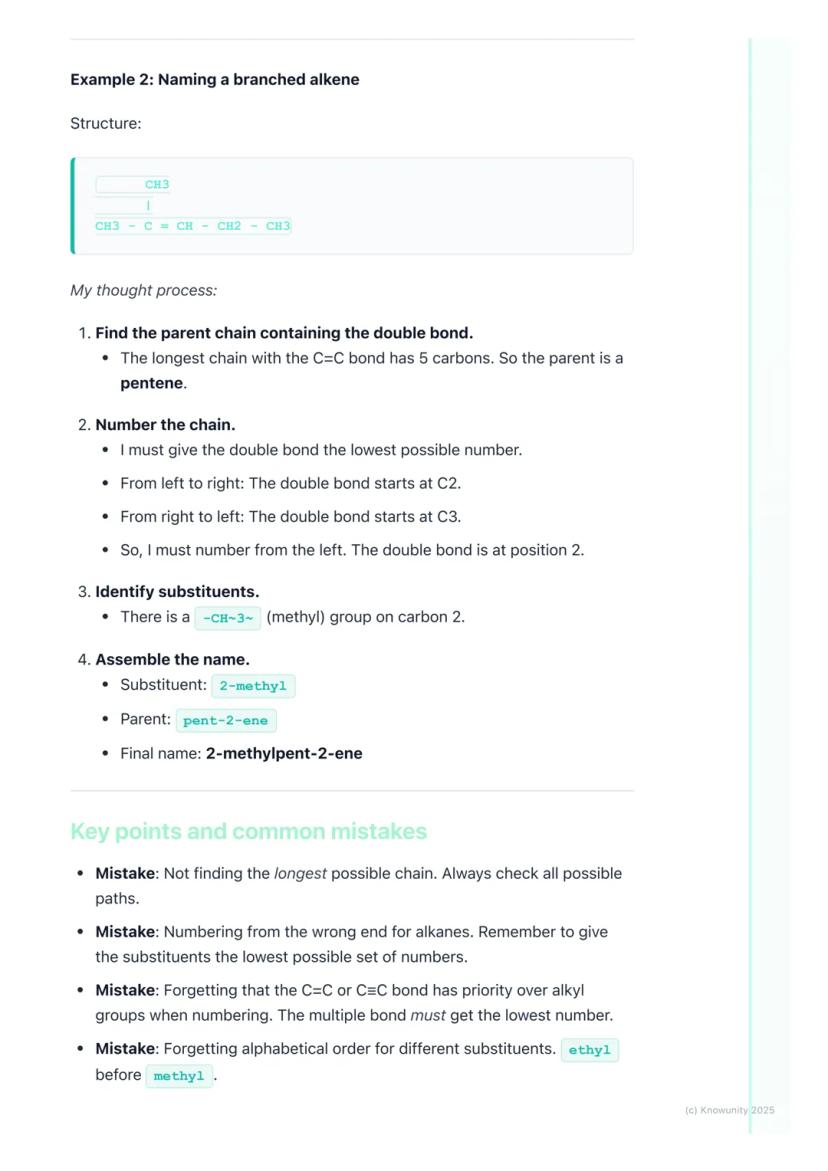
Alkene naming follows similar logic but with that crucial priority twist. Here we've got a 5-carbon chain with a double bond and a methyl substituent.
The parent chain containing the C=C bond has 5 carbons, making it a pentene. Now for the critical numbering decision: the double bond must get the lowest number possible.
Numbering left to right puts the double bond at position 2, whilst right to left puts it at position 3. The double bond wins, so we number left to right, giving us 2-methylpent-2-ene.
Notice how the methyl group and double bond are both at carbon 2 - that's perfectly fine and happens quite often in organic structures.
💡 Key Rule: In alkenes and alkynes, the multiple bond always gets priority over substituents when numbering!
7
of 7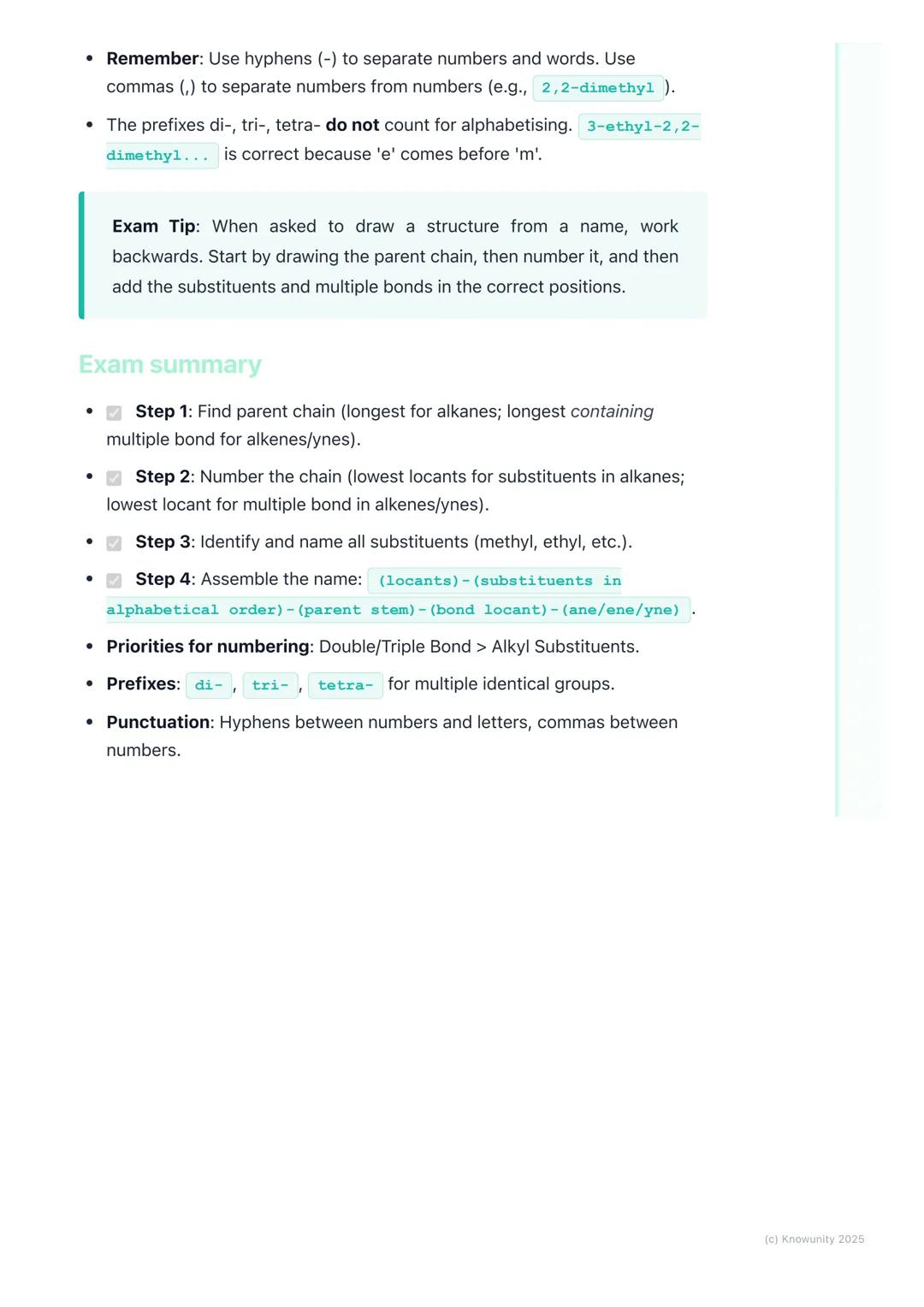
Common Mistakes and Exam Tips
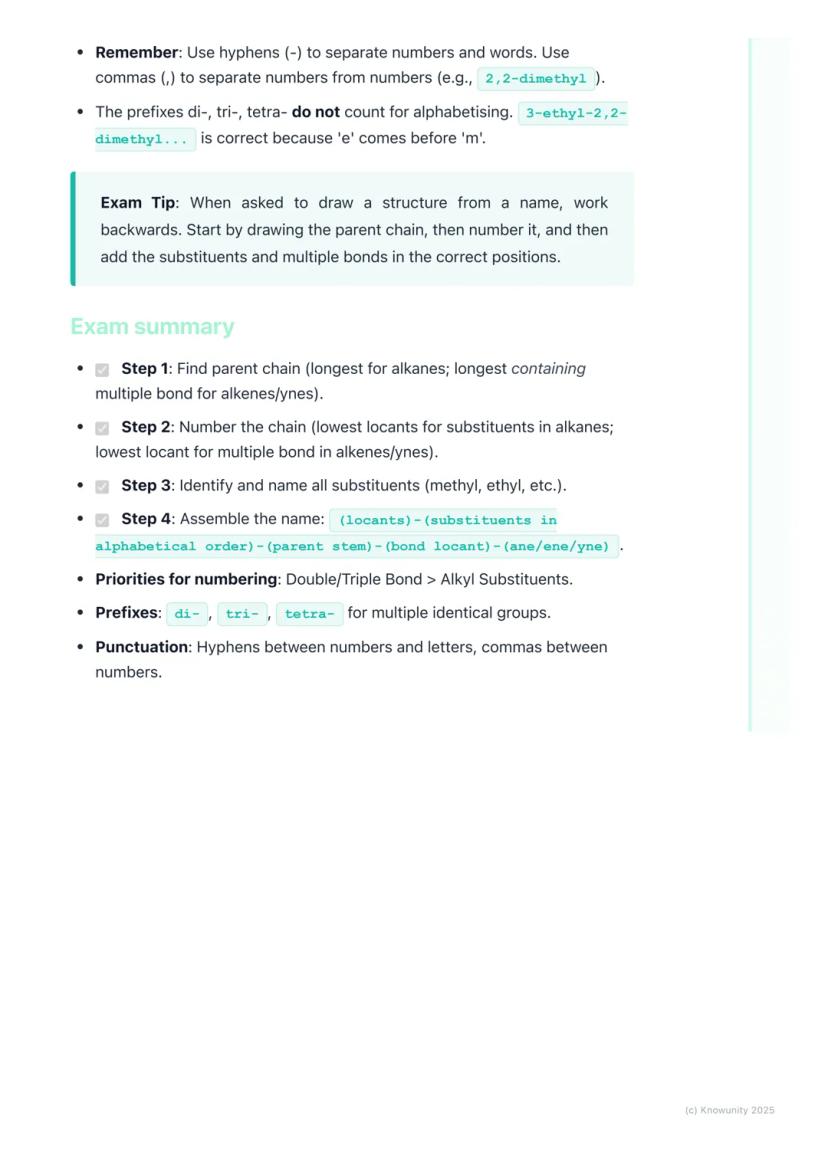
Don't let silly errors cost you marks! The most common mistake is not finding the true longest chain - always trace every possible path through the molecule.
Punctuation matters: use hyphens between numbers and words, commas between numbers. Remember that prefixes like di-, tri-, tetra- don't count for alphabetical ordering.
When drawing structures from names, work backwards: draw the parent chain first, number it, then add substituents and multiple bonds in their correct positions.
Your priority order for numbering is crystal clear: double/triple bonds beat alkyl substituents every single time. Master this hierarchy and you'll avoid the most common exam pitfalls.
💡 Exam Strategy: Always double-check your longest chain and numbering direction - these are where most marks are lost!
Hiç sormayacaksın sanmıştık...
Knowunity yapay zeka arkadaşı nedir?
Yapay zeka arkadaşımız öğrencilerin ihtiyaçlarına göre özel olarak tasarlanmıştır. Platformda bulunan milyonlarca içeriğe dayanarak öğrencilere gerçekten anlamlı ve ilgili yanıtlar verebiliyoruz. Ancak mesele sadece cevaplar değil, refakatçi aynı zamanda kişiselleştirilmiş öğrenme planları, sınavlar veya sohbet içerikleri ve öğrencilerin becerilerine ve gelişimlerine dayalı %100 kişiselleştirme ile öğrencilere günlük öğrenme zorluklarında rehberlik ediyor.
Knowunity uygulamasını nereden indirebilirim?
Uygulamayı Google Play Store ve Apple App Store'dan indirebilirsiniz.
Knowunity ücretsiz mi?
Knowunity uygulaması ücretsiz! Uygulamamız çok yakında indirmeye hazır olacak, bekle bizi. 💙
En popüler içerikler
9 Irish
IrishIrish oral questions and answers
Questions and answers for the leaving cert oral
5th Year4264
 English
Key Quotes : Sive
Key Quotes and explanations: Sive
6th Year2842
IrishIrish oral questions
Outline of oral questions
5th Year2055
IrishIníon- le hÁine Durkin
Aine Durkin’s poem, Iníon: Themes & summary
5th Year850
IrishIrish poetry 2027
Iníon + Dínit an Bhróin
5th Year1133
IrishLC HL notes- Iníon (poem)
Includes poem in English and Irish, theme, key words & phrases
5th Year2284
EnglishCultural Context : Shawshank Redemption : Sive : Small Things Like These
Comparative Study : Cultural Context : Shawshank Redemption, Sive and Small Things Like These
6th Year1430
IrishMo Ghrá-sa (Idir Lúibíní)
Notes on mo ghrá-sa
5th Year380
IrishAn Gaeilge Aiste
Irish Language essay
6th Year1320
Aradığını bulamıyor musun? Diğer derslere göz at.
Kullanıcılarımızdan yorumlar. Onlar her şeyi çok beğendi — sen de beğeneceksin.
4.6/5App Store
4.7/5Google Play
Uygulama çok kolay kullanılıyor ve güzel tasarlanmış. Şu ana kadar aradığım her şeyi buldum ve sunumlardan çok şey öğrendim! Kesinlikle ödevlerim için hep kullanacağım!
A.S.iOS kullanıcısı
Uygulama çok iyi. Çok fazla ders notu ve yardımlaşma var. Örneğin benim problem yaşadığım bir ders Geometriydi ve ANINDA yardım ettiler beraber hem sorularımı çözdük hem konu anlatımı buldum. Herkese tavsiye ederim.
S.L.Android kullanıcısı
BEN ŞOK. Reklamını sık sık gördüğüm için uygulamayı denedim ve gerçekten hayran kaldım. Bu uygulama okul için tam ihtiyacım olan şey. Anında ödev yardımı, konu anlatımı, örnek sınavlar, flaşkartlar hepsi hepsi var, şiddetle tavsiye ederim ✅
A.iOS kullanıcısı
Chemistry18 görüntüleme·Güncellendi Jun 13, 2026·7 sayfaHow to Name Alkanes, Alkenes, and Alkynes Using IUPAC Rules
Ever wondered how chemists around the world can understand each other when talking about molecules? That's where IUPAC nomenclature comes in - it's basically the universal language for naming organic compounds. Master this system and you'll be able to draw...
1
of 7
Ders notlarını görmek için kaydol. Ücretsiz!
- Tüm belgeleri görebilirsin
- Notlarını Yükselt
- Milyonlarca öğrenciye katıl
Introduction to IUPAC Nomenclature
The IUPAC system is your key to unlocking organic chemistry communication. Think of it as Google Translate for molecules - any chemist anywhere can draw the exact same structure from a given name, eliminating confusion completely.
You'll focus on three main homologous series: alkanes, alkenes, and alkynes. Each series has the same functional group and similar properties, with each member differing by just a CH₂ group.
The difference between saturated and unsaturated hydrocarbons is crucial. Alkanes are saturated , whilst alkenes and alkynes are unsaturated (containing double or triple bonds respectively).
💡 Key Insight: The parent chain is always the longest continuous carbon chain - this becomes your base name. Everything else attached are substituents or side-chains.
2
of 7Ders notlarını görmek için kaydol. Ücretsiz!
- Tüm belgeleri görebilirsin
- Notlarını Yükselt
- Milyonlarca öğrenciye katıl
Essential Stems and Alkyl Groups
You absolutely must memorise the first ten alkane stems - there's no way around this! From meth- (1 carbon) through to dec- (10 carbons), these form the backbone of all organic naming.
The pattern is straightforward: methane, ethane, propane, butane, pentane, hexane, heptane, octane, nonane, decane. Notice how each follows the general formula CₙH₂ₙ₊₂ for alkanes.
Alkyl groups are equally important - they're basically alkanes with one hydrogen removed. Simply replace the '-ane' ending with '-yl': methyl , ethyl , and propyl are the most common ones you'll encounter.
💡 Study Tip: Make flashcards for these stems - you'll use them constantly throughout organic chemistry!
3
of 7Ders notlarını görmek için kaydol. Ücretsiz!
- Tüm belgeleri görebilirsin
- Notlarını Yükselt
- Milyonlarca öğrenciye katıl
Systematic Naming Rules for Alkanes
Here's your foolproof four-step process for naming branched alkanes. Follow these steps religiously and you'll nail it every time.
First, identify the parent chain by finding the longest continuous carbon chain - this isn't always the one drawn horizontally! Next, number the carbons starting from whichever end gives your substituents the lowest possible numbers.
Then identify all your substituents (the alkyl groups hanging off the main chain). Finally, assemble everything together: number-substituent-parent name.
For multiple identical substituents, use prefixes like di-, tri-, tetra-. Different substituents go in alphabetical order (ignoring the prefixes when alphabetising). So "3-ethyl-2-methylhexane" puts ethyl before methyl.
💡 Remember: Always aim for the lowest possible set of numbers - compare the full sets, not just individual numbers!
4
of 7Ders notlarını görmek için kaydol. Ücretsiz!
- Tüm belgeleri görebilirsin
- Notlarını Yükselt
- Milyonlarca öğrenciye katıl
Naming Alkenes and Alkynes
The rules are similar to alkanes, but now the double or triple bond takes priority - this is the game-changer you need to remember.
Your parent chain must be the longest chain containing the multiple bond, ending in '-ene' for alkenes or '-yne' for alkynes. The crucial difference is in numbering: you must give the multiple bond the lowest possible number, even if it means substituents get higher numbers.
The bond position goes right before the ending: "hex-2-ene" means a 6-carbon chain with a double bond starting at carbon 2. Add any substituents with their numbers at the front: "4-methylhex-2-ene".
This priority rule is what trips up many students - the multiple bond always wins when deciding which end to start numbering from.
💡 Priority Order: Multiple bonds always get priority over substituents when numbering your chain!
5
of 7Ders notlarını görmek için kaydol. Ücretsiz!
- Tüm belgeleri görebilirsin
- Notlarını Yükselt
- Milyonlarca öğrenciye katıl
Worked Example: Branched Alkane
Let's work through a tricky branched alkane to see the method in action. When you see a complex structure, don't panic - just follow your four steps systematically.
First, hunt for the longest chain - don't assume it's the horizontal one! In this example, the longest chain has 6 carbons (hexane), not the obvious 5-carbon chain you might spot first.
Number from the end that gives the lowest set of numbers. Here, numbering left to right gives substituents at positions 2 and 4, whilst right to left gives 3 and 5. Since 2,4 beats 3,5, we number left to right.
The final name becomes 4-ethyl-2-methylhexane - ethyl comes first alphabetically, even though it's at a higher carbon number.
💡 Common Mistake: Always check every possible chain length - the longest one isn't always obvious from the way it's drawn!
6
of 7Ders notlarını görmek için kaydol. Ücretsiz!
- Tüm belgeleri görebilirsin
- Notlarını Yükselt
- Milyonlarca öğrenciye katıl
Worked Example: Alkene Naming
Alkene naming follows similar logic but with that crucial priority twist. Here we've got a 5-carbon chain with a double bond and a methyl substituent.
The parent chain containing the C=C bond has 5 carbons, making it a pentene. Now for the critical numbering decision: the double bond must get the lowest number possible.
Numbering left to right puts the double bond at position 2, whilst right to left puts it at position 3. The double bond wins, so we number left to right, giving us 2-methylpent-2-ene.
Notice how the methyl group and double bond are both at carbon 2 - that's perfectly fine and happens quite often in organic structures.
💡 Key Rule: In alkenes and alkynes, the multiple bond always gets priority over substituents when numbering!
7
of 7Ders notlarını görmek için kaydol. Ücretsiz!
- Tüm belgeleri görebilirsin
- Notlarını Yükselt
- Milyonlarca öğrenciye katıl
Common Mistakes and Exam Tips
Don't let silly errors cost you marks! The most common mistake is not finding the true longest chain - always trace every possible path through the molecule.
Punctuation matters: use hyphens between numbers and words, commas between numbers. Remember that prefixes like di-, tri-, tetra- don't count for alphabetical ordering.
When drawing structures from names, work backwards: draw the parent chain first, number it, then add substituents and multiple bonds in their correct positions.
Your priority order for numbering is crystal clear: double/triple bonds beat alkyl substituents every single time. Master this hierarchy and you'll avoid the most common exam pitfalls.
💡 Exam Strategy: Always double-check your longest chain and numbering direction - these are where most marks are lost!
Hiç sormayacaksın sanmıştık...
Knowunity yapay zeka arkadaşı nedir?
Yapay zeka arkadaşımız öğrencilerin ihtiyaçlarına göre özel olarak tasarlanmıştır. Platformda bulunan milyonlarca içeriğe dayanarak öğrencilere gerçekten anlamlı ve ilgili yanıtlar verebiliyoruz. Ancak mesele sadece cevaplar değil, refakatçi aynı zamanda kişiselleştirilmiş öğrenme planları, sınavlar veya sohbet içerikleri ve öğrencilerin becerilerine ve gelişimlerine dayalı %100 kişiselleştirme ile öğrencilere günlük öğrenme zorluklarında rehberlik ediyor.
Knowunity uygulamasını nereden indirebilirim?
Uygulamayı Google Play Store ve Apple App Store'dan indirebilirsiniz.
Knowunity ücretsiz mi?
Knowunity uygulaması ücretsiz! Uygulamamız çok yakında indirmeye hazır olacak, bekle bizi. 💙
En popüler içerikler
9IrishIrish oral questions and answers
Questions and answers for the leaving cert oral
5th Year4264
EnglishKey Quotes : Sive
Key Quotes and explanations: Sive
6th Year2842
IrishIrish oral questions
Outline of oral questions
5th Year2055
IrishIníon- le hÁine Durkin
Aine Durkin’s poem, Iníon: Themes & summary
5th Year850
IrishIrish poetry 2027
Iníon + Dínit an Bhróin
5th Year1133
IrishLC HL notes- Iníon (poem)
Includes poem in English and Irish, theme, key words & phrases
5th Year2284
EnglishCultural Context : Shawshank Redemption : Sive : Small Things Like These
Comparative Study : Cultural Context : Shawshank Redemption, Sive and Small Things Like These
6th Year1430
IrishMo Ghrá-sa (Idir Lúibíní)
Notes on mo ghrá-sa
5th Year380
IrishAn Gaeilge Aiste
Irish Language essay
6th Year1320
Aradığını bulamıyor musun? Diğer derslere göz at.
Kullanıcılarımızdan yorumlar. Onlar her şeyi çok beğendi — sen de beğeneceksin.
4.6/5App Store
4.7/5Google Play
Uygulama çok kolay kullanılıyor ve güzel tasarlanmış. Şu ana kadar aradığım her şeyi buldum ve sunumlardan çok şey öğrendim! Kesinlikle ödevlerim için hep kullanacağım!
A.S.iOS kullanıcısı
Uygulama çok iyi. Çok fazla ders notu ve yardımlaşma var. Örneğin benim problem yaşadığım bir ders Geometriydi ve ANINDA yardım ettiler beraber hem sorularımı çözdük hem konu anlatımı buldum. Herkese tavsiye ederim.
S.L.Android kullanıcısı
BEN ŞOK. Reklamını sık sık gördüğüm için uygulamayı denedim ve gerçekten hayran kaldım. Bu uygulama okul için tam ihtiyacım olan şey. Anında ödev yardımı, konu anlatımı, örnek sınavlar, flaşkartlar hepsi hepsi var, şiddetle tavsiye ederim ✅
A.iOS kullanıcısı