
Ever wondered what connects you to a dolphin but not... Daha fazla göster
 Biology24 görüntüleme·Güncellendi Jun 6, 2026·5 sayfa
Vertebrates vs. Invertebrates: Understanding Animal Classes
1 / 5
1
of 5
Vertebrates and Invertebrates
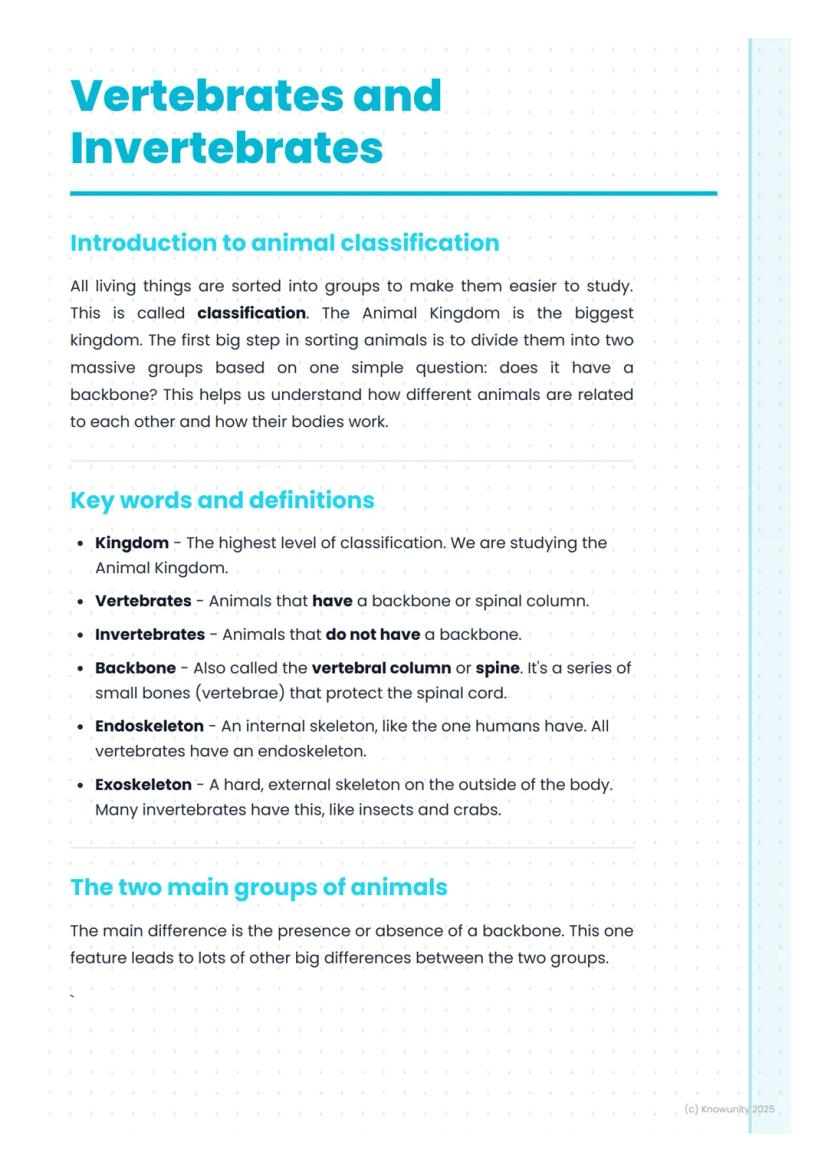
Classification is basically nature's filing system - it helps scientists organise millions of animals into groups that make sense. Think of it like sorting your music playlist, but instead of genres, we're using body structure.
The biggest question in animal classification is dead simple: does it have a backbone or not? This one feature creates two enormous groups that work completely differently. Animals with backbones are called vertebrates, whilst those without are invertebrates.
Your backbone (also called the spine) isn't just one bone - it's actually loads of small bones called vertebrae stacked on top of each other. It's brilliant protection for your spinal cord and gives your body structure. Vertebrates have an endoskeleton (internal skeleton), whilst many invertebrates have an exoskeleton (hard outer shell) or no skeleton at all.
Quick Tip: Don't get fooled by hard shells! A crab's tough exterior is an exoskeleton, not a backbone, so it's still an invertebrate.
2
of 5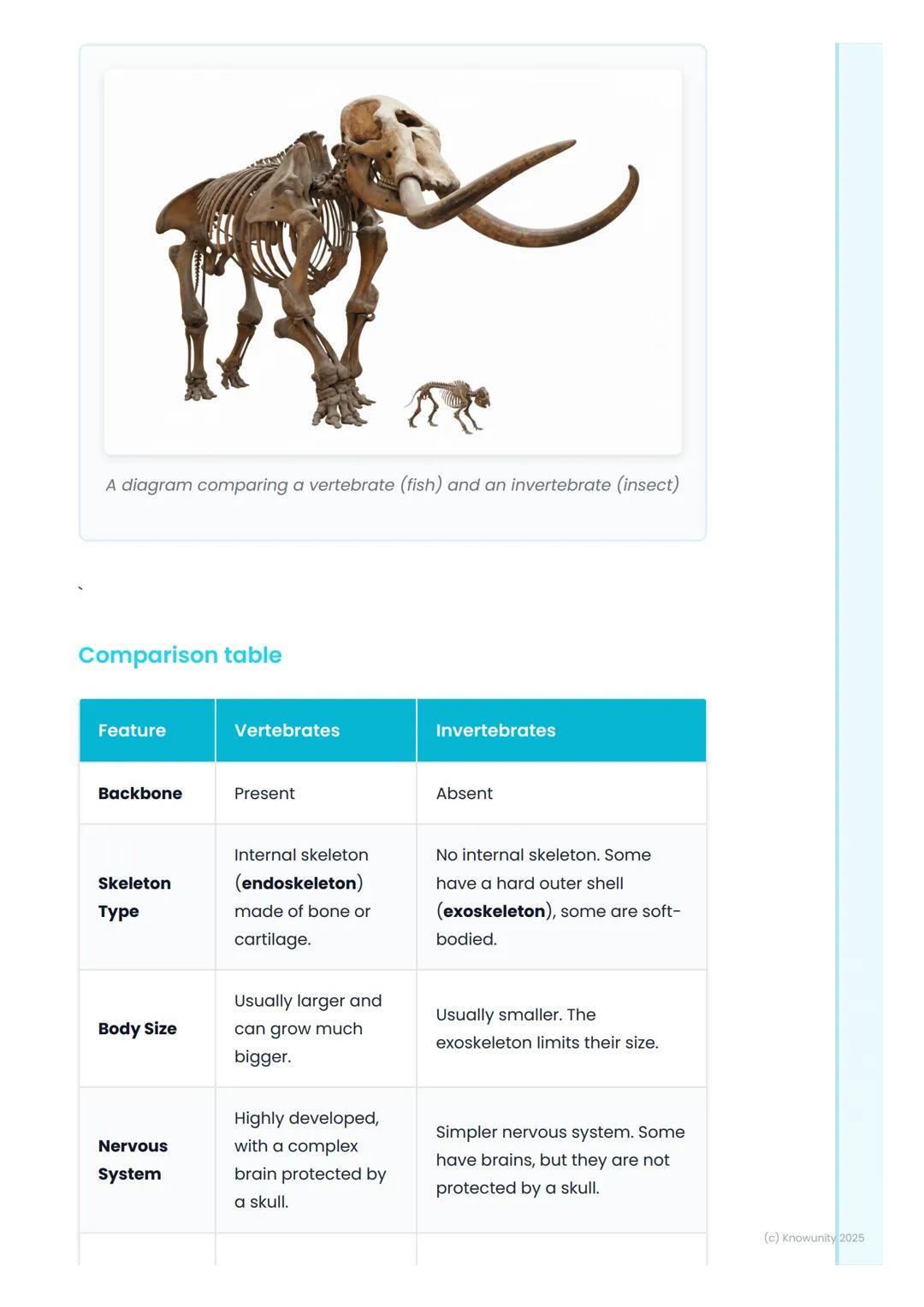
Comparing the Two Groups
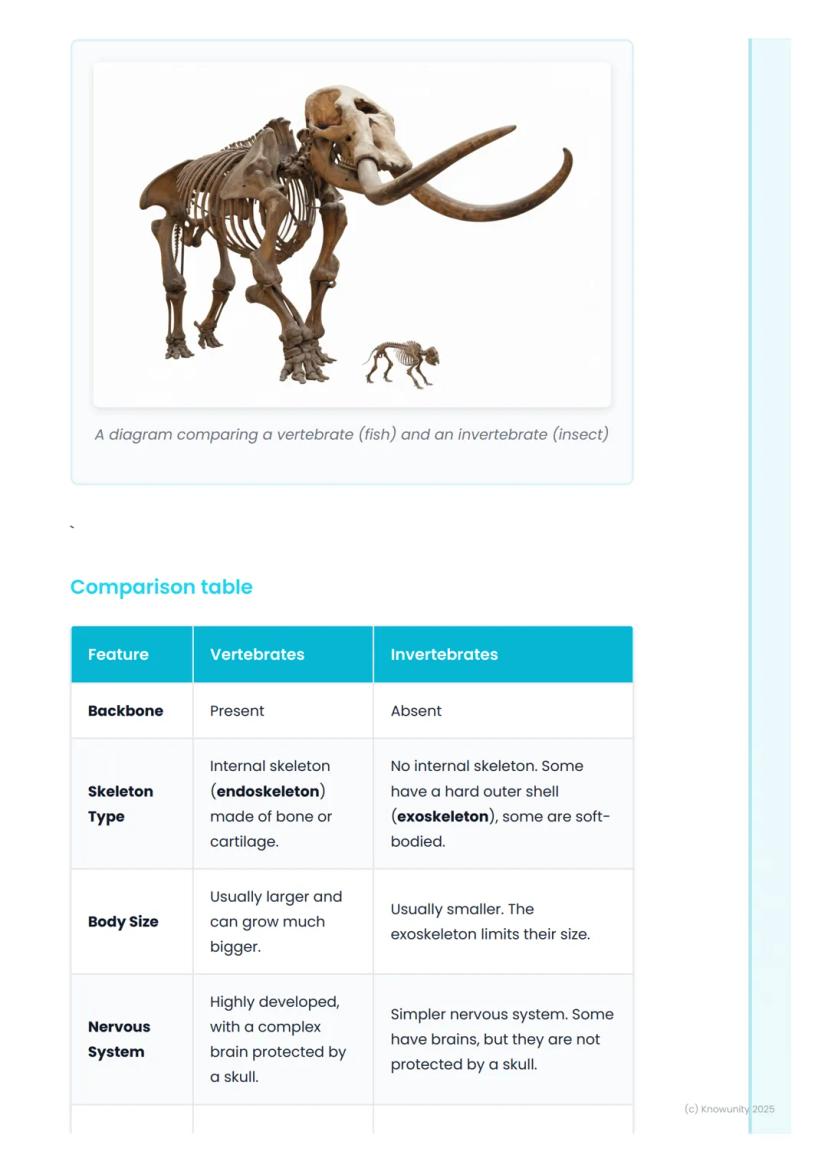
Here's where things get interesting - vertebrates and invertebrates are completely different in how they're built. Vertebrates have internal skeletons made of bone or cartilage, which means they can grow much larger than most invertebrates.
Invertebrates are way more varied - some have exoskeletons (like beetles), some have soft bodies (like worms), and others have shells (like snails). Their nervous systems are simpler too, though some like octopuses are surprisingly clever.
The size difference is huge. Vertebrates can become massive because their internal skeleton grows with them. Invertebrates with exoskeletons are limited because they'd need to shed their "armour" to grow bigger.
Mind-Blowing Fact: Even though we see vertebrates like dogs and birds everywhere, they only make up about 5% of all animal species! Invertebrates dominate at 95%.
3
of 5
Types of Vertebrates and Invertebrates
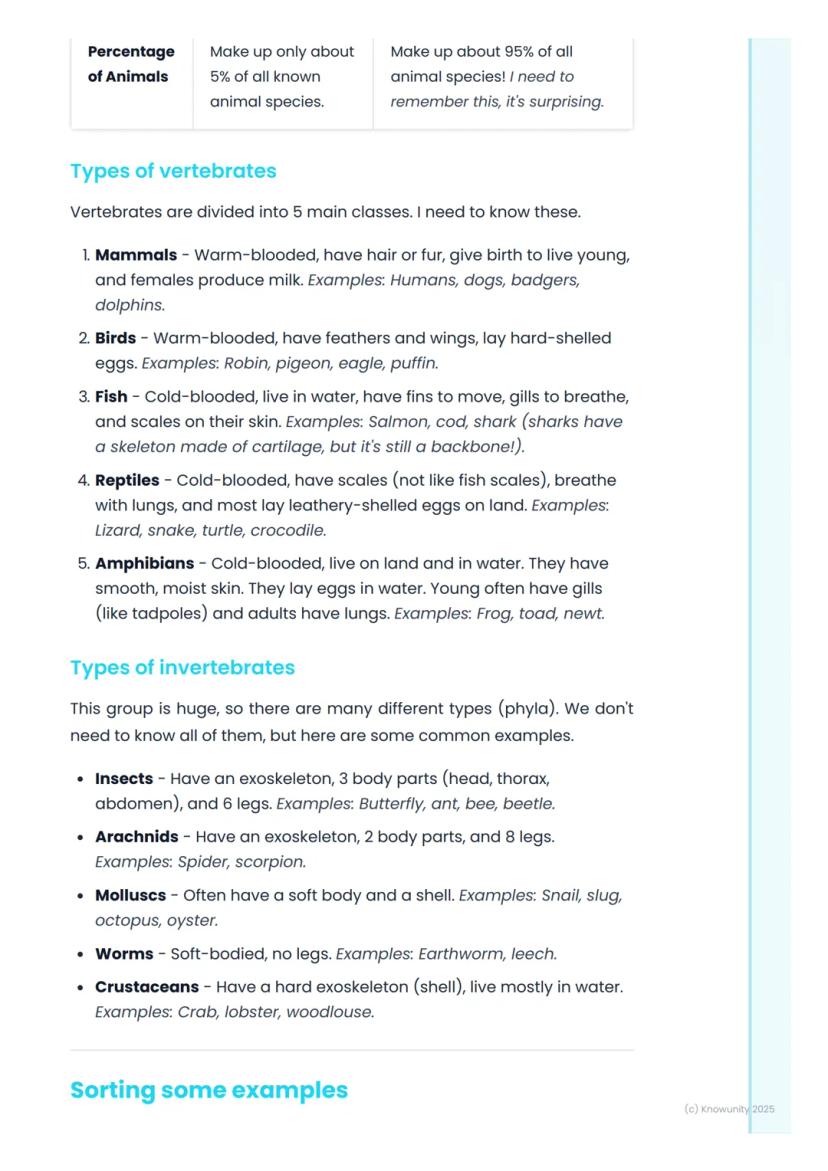
Vertebrates fall into five main classes you need to know. Mammals (like humans and dolphins) are warm-blooded with hair and produce milk. Birds have feathers and lay hard-shelled eggs. Fish live in water with gills and fins - yes, even sharks count because their cartilage skeleton still includes a backbone!
Reptiles are cold-blooded with scales and breathe air, whilst amphibians like frogs live both in water and on land. Each group has adapted brilliantly to their environment.
Invertebrates include insects (6 legs, 3 body parts), arachnids like spiders (8 legs, 2 body parts), molluscs such as snails and octopuses, worms, and crustaceans like crabs. The variety is absolutely mental - from tiny ants to giant squids!
Test Tip: Remember that backbone presence is the ONLY deciding factor. Not legs, wings, or where they live - just that spine!
4
of 5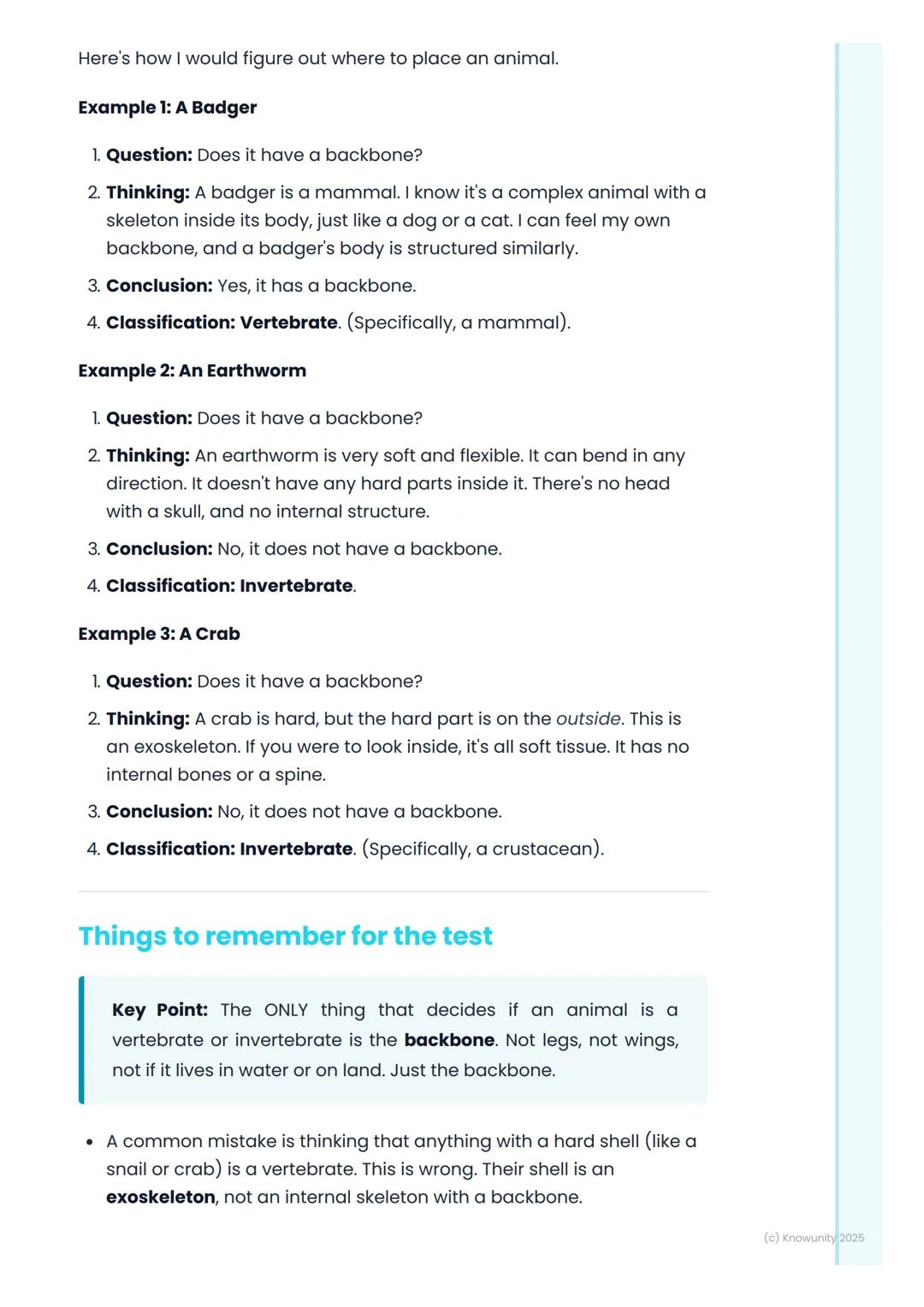
Working Out Classifications
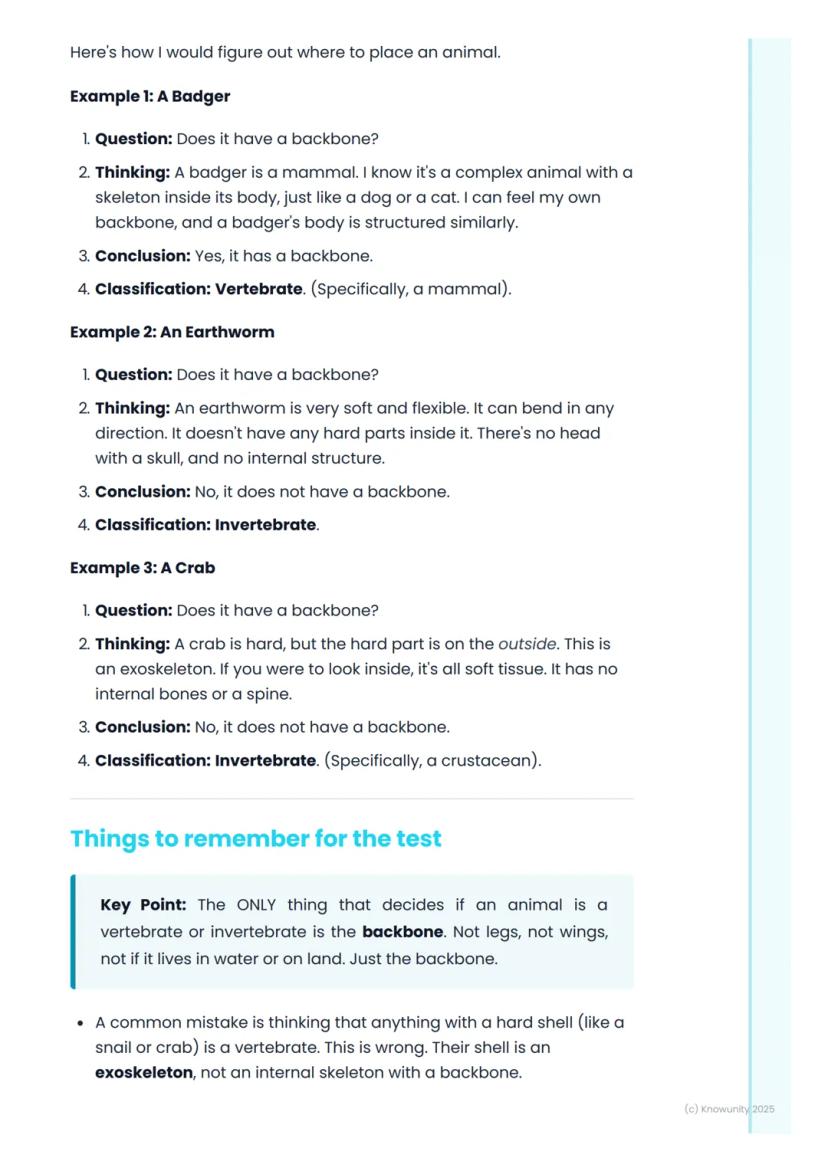
Let's practise with real examples so you'll never get confused in tests. Take a badger - it's furry and walks on land, but most importantly, it has an internal skeleton with a backbone running down its body. Definitely a vertebrate (specifically a mammal).
An earthworm might seem tricky, but think about how bendy and soft it is. No internal hard parts whatsoever, just squishy tissue that can curl in any direction. Clear invertebrate.
Crabs catch loads of people out because they're so hard and tough. But that hardness is all on the outside - crack one open and it's soft inside with no bones. The shell is an exoskeleton, so it's an invertebrate (a crustacean).
Common Mistake Alert: Don't assume anything with a hard exterior is a vertebrate. Shells, exoskeletons, and tough skin don't count as backbones!
5
of 5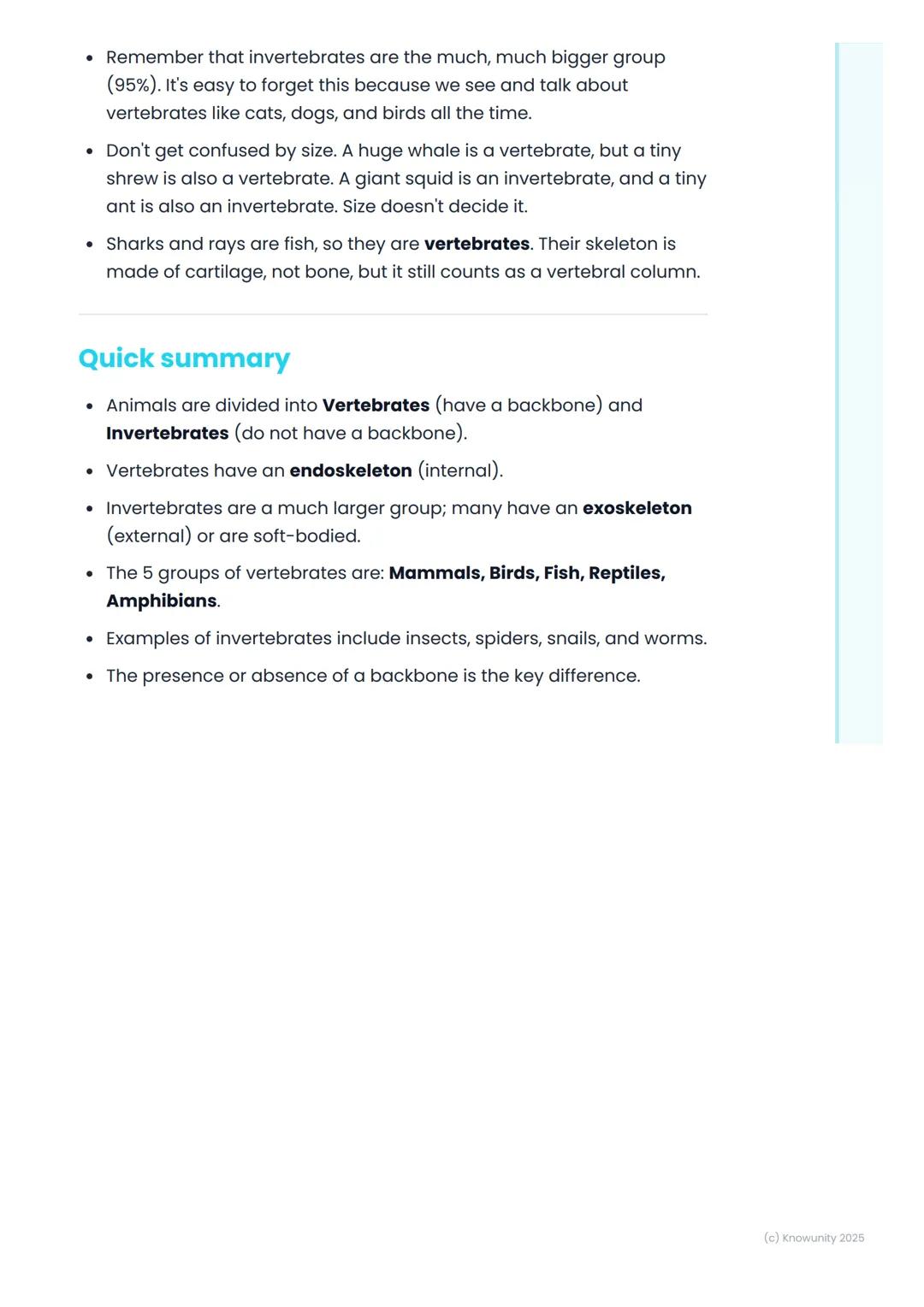
Key Points for Success
Size definitely doesn't matter here - a massive blue whale and a tiny mouse are both vertebrates, whilst a giant squid and a microscopic insect are both invertebrates. The backbone is literally the only thing that counts.
Remember that invertebrates massively outnumber vertebrates in the real world, even though we're more familiar with vertebrates like pets and farm animals. This often surprises people in tests.
Sharks and rays sometimes confuse students because their skeletons are made of cartilage instead of bone. But cartilage still forms a proper backbone structure, so they're definitely vertebrates (fish, specifically).
Final Reminder: When in doubt, imagine the animal's internal structure. Can you picture a spine running through its body? If yes, it's a vertebrate. If it's all soft tissue or has hard parts only on the outside, it's an invertebrate.
Hiç sormayacaksın sanmıştık...
Knowunity yapay zeka arkadaşı nedir?
Yapay zeka arkadaşımız öğrencilerin ihtiyaçlarına göre özel olarak tasarlanmıştır. Platformda bulunan milyonlarca içeriğe dayanarak öğrencilere gerçekten anlamlı ve ilgili yanıtlar verebiliyoruz. Ancak mesele sadece cevaplar değil, refakatçi aynı zamanda kişiselleştirilmiş öğrenme planları, sınavlar veya sohbet içerikleri ve öğrencilerin becerilerine ve gelişimlerine dayalı %100 kişiselleştirme ile öğrencilere günlük öğrenme zorluklarında rehberlik ediyor.
Knowunity uygulamasını nereden indirebilirim?
Uygulamayı Google Play Store ve Apple App Store'dan indirebilirsiniz.
Knowunity ücretsiz mi?
Knowunity uygulaması ücretsiz! Uygulamamız çok yakında indirmeye hazır olacak, bekle bizi. 💙
Biology dersinin en popüler içerikleri
7En popüler içerikler
9Aradığını bulamıyor musun? Diğer derslere göz at.
Kullanıcılarımızdan yorumlar. Onlar her şeyi çok beğendi — sen de beğeneceksin.
4.6/5App Store
4.7/5Google Play
Uygulama çok kolay kullanılıyor ve güzel tasarlanmış. Şu ana kadar aradığım her şeyi buldum ve sunumlardan çok şey öğrendim! Kesinlikle ödevlerim için hep kullanacağım!
A.S.iOS kullanıcısı
Uygulama çok iyi. Çok fazla ders notu ve yardımlaşma var. Örneğin benim problem yaşadığım bir ders Geometriydi ve ANINDA yardım ettiler beraber hem sorularımı çözdük hem konu anlatımı buldum. Herkese tavsiye ederim.
S.L.Android kullanıcısı
BEN ŞOK. Reklamını sık sık gördüğüm için uygulamayı denedim ve gerçekten hayran kaldım. Bu uygulama okul için tam ihtiyacım olan şey. Anında ödev yardımı, konu anlatımı, örnek sınavlar, flaşkartlar hepsi hepsi var, şiddetle tavsiye ederim ✅
A.iOS kullanıcısı
Biology24 görüntüleme·Güncellendi Jun 6, 2026·5 sayfaVertebrates vs. Invertebrates: Understanding Animal Classes
Ever wondered what connects you to a dolphin but not to a spider? It's all about having a backbone! Scientists sort the entire Animal Kingdom into two massive groups based on this one simple feature, and understanding this helps us... Daha fazla göster
1
of 5Ders notlarını görmek için kaydol. Ücretsiz!
- Tüm belgeleri görebilirsin
- Notlarını Yükselt
- Milyonlarca öğrenciye katıl
Vertebrates and Invertebrates
Classification is basically nature's filing system - it helps scientists organise millions of animals into groups that make sense. Think of it like sorting your music playlist, but instead of genres, we're using body structure.
The biggest question in animal classification is dead simple: does it have a backbone or not? This one feature creates two enormous groups that work completely differently. Animals with backbones are called vertebrates, whilst those without are invertebrates.
Your backbone (also called the spine) isn't just one bone - it's actually loads of small bones called vertebrae stacked on top of each other. It's brilliant protection for your spinal cord and gives your body structure. Vertebrates have an endoskeleton (internal skeleton), whilst many invertebrates have an exoskeleton (hard outer shell) or no skeleton at all.
Quick Tip: Don't get fooled by hard shells! A crab's tough exterior is an exoskeleton, not a backbone, so it's still an invertebrate.
2
of 5Ders notlarını görmek için kaydol. Ücretsiz!
- Tüm belgeleri görebilirsin
- Notlarını Yükselt
- Milyonlarca öğrenciye katıl
Comparing the Two Groups
Here's where things get interesting - vertebrates and invertebrates are completely different in how they're built. Vertebrates have internal skeletons made of bone or cartilage, which means they can grow much larger than most invertebrates.
Invertebrates are way more varied - some have exoskeletons (like beetles), some have soft bodies (like worms), and others have shells (like snails). Their nervous systems are simpler too, though some like octopuses are surprisingly clever.
The size difference is huge. Vertebrates can become massive because their internal skeleton grows with them. Invertebrates with exoskeletons are limited because they'd need to shed their "armour" to grow bigger.
Mind-Blowing Fact: Even though we see vertebrates like dogs and birds everywhere, they only make up about 5% of all animal species! Invertebrates dominate at 95%.
3
of 5Ders notlarını görmek için kaydol. Ücretsiz!
- Tüm belgeleri görebilirsin
- Notlarını Yükselt
- Milyonlarca öğrenciye katıl
Types of Vertebrates and Invertebrates
Vertebrates fall into five main classes you need to know. Mammals (like humans and dolphins) are warm-blooded with hair and produce milk. Birds have feathers and lay hard-shelled eggs. Fish live in water with gills and fins - yes, even sharks count because their cartilage skeleton still includes a backbone!
Reptiles are cold-blooded with scales and breathe air, whilst amphibians like frogs live both in water and on land. Each group has adapted brilliantly to their environment.
Invertebrates include insects (6 legs, 3 body parts), arachnids like spiders (8 legs, 2 body parts), molluscs such as snails and octopuses, worms, and crustaceans like crabs. The variety is absolutely mental - from tiny ants to giant squids!
Test Tip: Remember that backbone presence is the ONLY deciding factor. Not legs, wings, or where they live - just that spine!
4
of 5Ders notlarını görmek için kaydol. Ücretsiz!
- Tüm belgeleri görebilirsin
- Notlarını Yükselt
- Milyonlarca öğrenciye katıl
Working Out Classifications
Let's practise with real examples so you'll never get confused in tests. Take a badger - it's furry and walks on land, but most importantly, it has an internal skeleton with a backbone running down its body. Definitely a vertebrate (specifically a mammal).
An earthworm might seem tricky, but think about how bendy and soft it is. No internal hard parts whatsoever, just squishy tissue that can curl in any direction. Clear invertebrate.
Crabs catch loads of people out because they're so hard and tough. But that hardness is all on the outside - crack one open and it's soft inside with no bones. The shell is an exoskeleton, so it's an invertebrate (a crustacean).
Common Mistake Alert: Don't assume anything with a hard exterior is a vertebrate. Shells, exoskeletons, and tough skin don't count as backbones!
5
of 5Ders notlarını görmek için kaydol. Ücretsiz!
- Tüm belgeleri görebilirsin
- Notlarını Yükselt
- Milyonlarca öğrenciye katıl
Key Points for Success
Size definitely doesn't matter here - a massive blue whale and a tiny mouse are both vertebrates, whilst a giant squid and a microscopic insect are both invertebrates. The backbone is literally the only thing that counts.
Remember that invertebrates massively outnumber vertebrates in the real world, even though we're more familiar with vertebrates like pets and farm animals. This often surprises people in tests.
Sharks and rays sometimes confuse students because their skeletons are made of cartilage instead of bone. But cartilage still forms a proper backbone structure, so they're definitely vertebrates (fish, specifically).
Final Reminder: When in doubt, imagine the animal's internal structure. Can you picture a spine running through its body? If yes, it's a vertebrate. If it's all soft tissue or has hard parts only on the outside, it's an invertebrate.
Hiç sormayacaksın sanmıştık...
Knowunity yapay zeka arkadaşı nedir?
Yapay zeka arkadaşımız öğrencilerin ihtiyaçlarına göre özel olarak tasarlanmıştır. Platformda bulunan milyonlarca içeriğe dayanarak öğrencilere gerçekten anlamlı ve ilgili yanıtlar verebiliyoruz. Ancak mesele sadece cevaplar değil, refakatçi aynı zamanda kişiselleştirilmiş öğrenme planları, sınavlar veya sohbet içerikleri ve öğrencilerin becerilerine ve gelişimlerine dayalı %100 kişiselleştirme ile öğrencilere günlük öğrenme zorluklarında rehberlik ediyor.
Knowunity uygulamasını nereden indirebilirim?
Uygulamayı Google Play Store ve Apple App Store'dan indirebilirsiniz.
Knowunity ücretsiz mi?
Knowunity uygulaması ücretsiz! Uygulamamız çok yakında indirmeye hazır olacak, bekle bizi. 💙
Biology dersinin en popüler içerikleri
7En popüler içerikler
9Aradığını bulamıyor musun? Diğer derslere göz at.
Kullanıcılarımızdan yorumlar. Onlar her şeyi çok beğendi — sen de beğeneceksin.
4.6/5App Store
4.7/5Google Play
Uygulama çok kolay kullanılıyor ve güzel tasarlanmış. Şu ana kadar aradığım her şeyi buldum ve sunumlardan çok şey öğrendim! Kesinlikle ödevlerim için hep kullanacağım!
A.S.iOS kullanıcısı
Uygulama çok iyi. Çok fazla ders notu ve yardımlaşma var. Örneğin benim problem yaşadığım bir ders Geometriydi ve ANINDA yardım ettiler beraber hem sorularımı çözdük hem konu anlatımı buldum. Herkese tavsiye ederim.
S.L.Android kullanıcısı
BEN ŞOK. Reklamını sık sık gördüğüm için uygulamayı denedim ve gerçekten hayran kaldım. Bu uygulama okul için tam ihtiyacım olan şey. Anında ödev yardımı, konu anlatımı, örnek sınavlar, flaşkartlar hepsi hepsi var, şiddetle tavsiye ederim ✅
A.iOS kullanıcısı