Advanced Similarity Concepts and Theorems
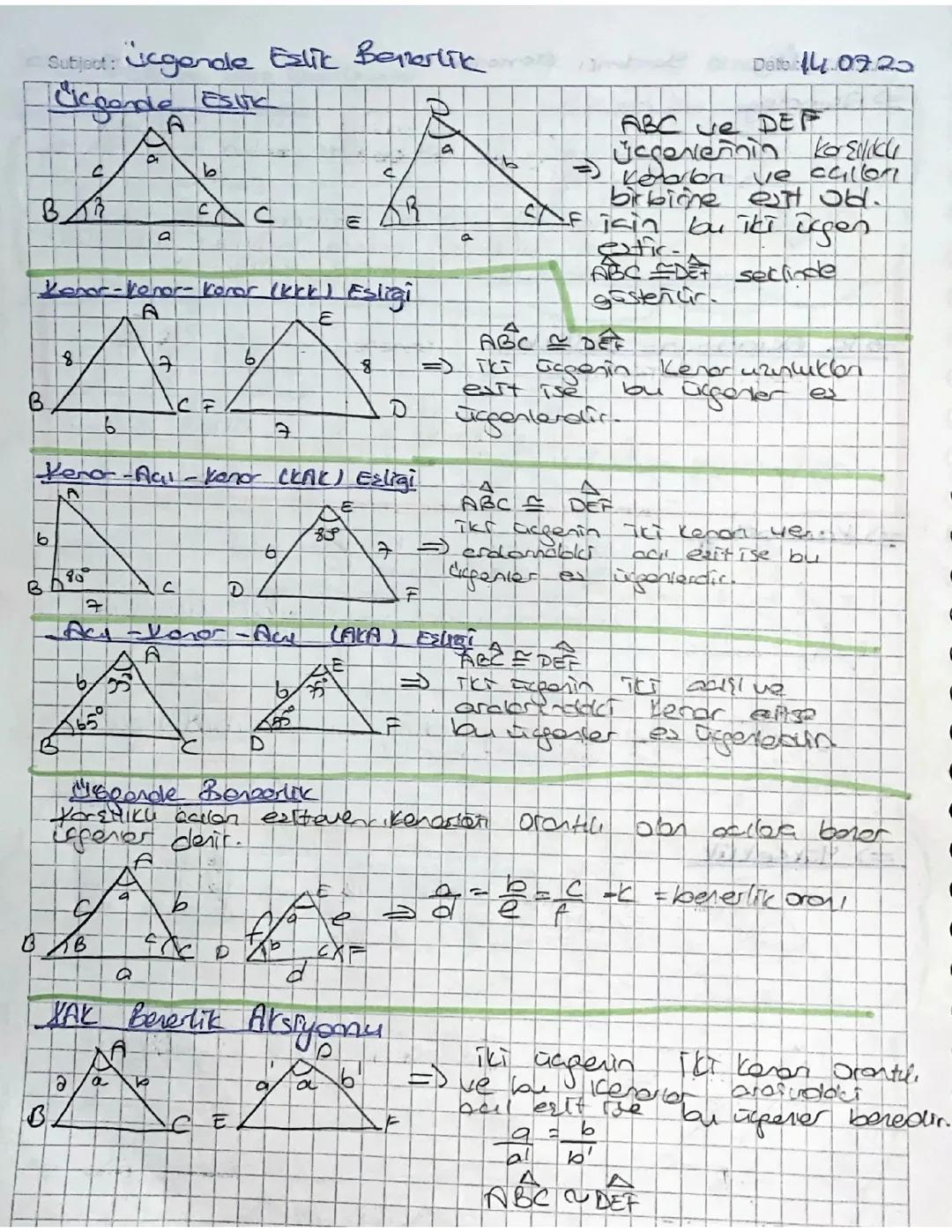
This page delves deeper into triangle similarity, presenting more advanced concepts and theorems crucial for üçgende benzerlik 9. sınıf studies.
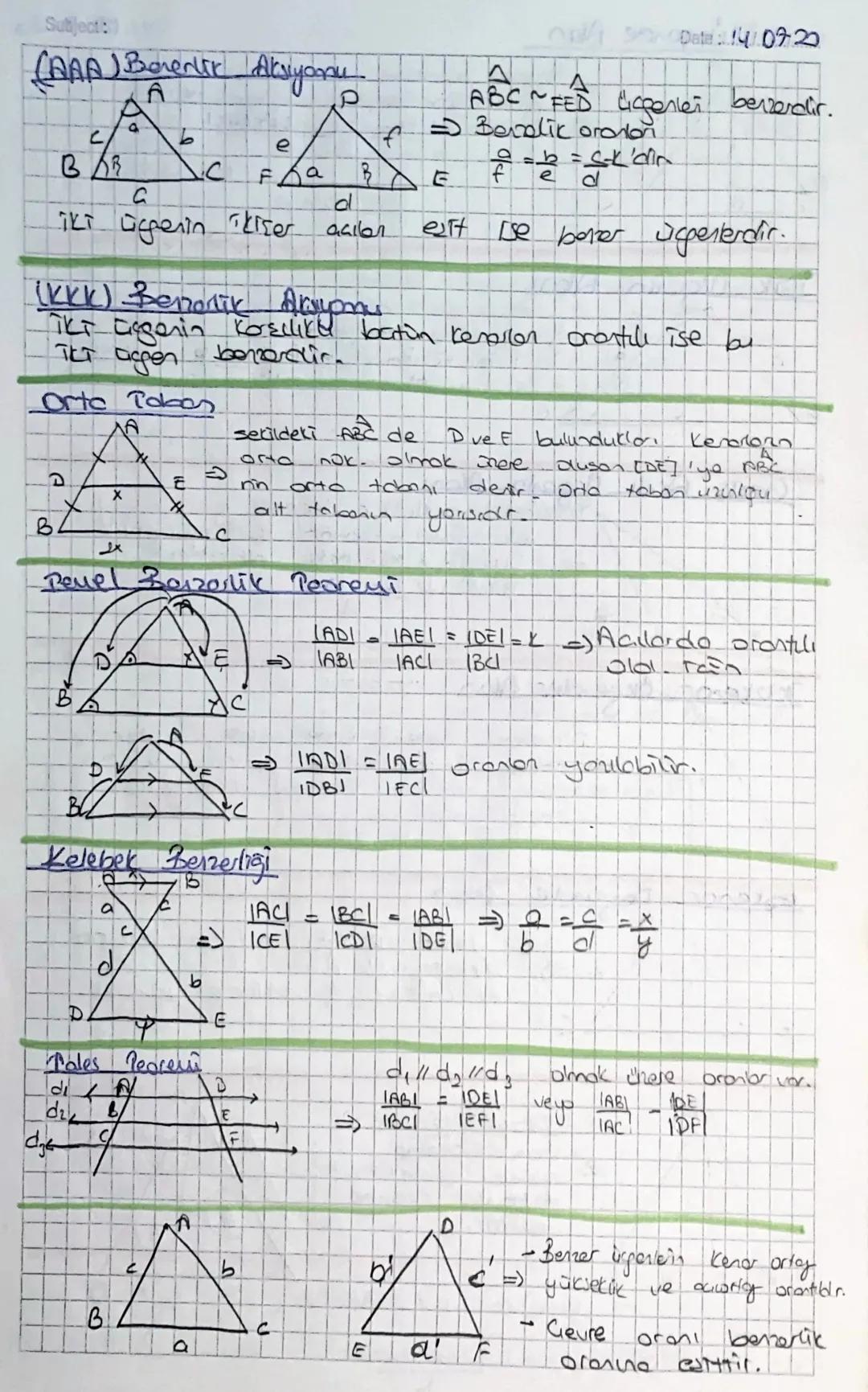
The page starts by elaborating on the Açı-Açı-Açı (AAA) Benzerlik Aksiyomu, reiterating that triangles with three pairs of equal corresponding angles are similar. This is followed by the Kenar-Kenar-Kenar (KKK) Benzerlik Aksiyomu, which states that triangles with proportional corresponding sides are similar.
Vocabulary: Aksiyom (Axiom) - A statement that is taken to be true without proof, serving as a starting point for further reasoning.
The concept of Orta Taban (Midsegment) is introduced, explaining that a line segment connecting the midpoints of two sides of a triangle is parallel to the third side and half its length. This is illustrated with a diagram showing triangle ABC with midpoints D and E.
Definition: Orta Taban (Midsegment) is a line segment that connects the midpoints of two sides of a triangle.
The Temel Benzerlik Teoremi (Basic Similarity Theorem) is presented, stating that a line parallel to one side of a triangle divides the other two sides proportionally. This is demonstrated with a diagram and the proportion AD/DB = AE/EC = DE/BC.
The page also covers Kelebek Benzerliği (Butterfly Similarity), showing how intersecting lines within a triangle create similar smaller triangles. This is illustrated with a diagram and the proportion DB/EC = AB/AC = BC/DE.
Finally, the famous Tales Teoremi (Thales' Theorem) is explained, demonstrating how a line parallel to one side of a triangle divides the other two sides proportionally. The theorem is shown both algebraically and geometrically.
Highlight: Tales Teoremi is a fundamental principle in geometry, with wide-ranging applications in triangle similarity problems.
The page concludes with a note on the properties of similar triangles, emphasizing that corresponding medians, altitudes, and angle bisectors in similar triangles are proportional, with their ratio equal to the similarity ratio.